
Calgary & Alberta Tesla Buying Guide 2026: No PST, Real Costs
Calgary & Alberta Tesla Buying Guide 2026: No PST, Real Costs

In one sentence
Buying a Tesla in Calgary or Alberta in 2026? No provincial sales tax saves ~$4,000, but the $5K federal rebate, $200 EV fee, and winter range all matter.
If you live in Calgary, Edmonton, or anywhere else in Alberta and you’re about to pull the trigger on your first Tesla, let me start with congratulations — you’re probably in the easiest, and cheapest, group of car buyers in all of Canada. The reason is simple: Alberta is the only province in the country with no provincial sales tax (PST), so on any vehicle you pay just the 5% federal GST. The same Model Y that gets hit with 13% HST in Toronto costs only 5% in Calgary, and on that one line item alone you’re looking at three or four thousand dollars saved.
Cheap is great, but actually getting the car home and living with it through an Alberta winter — where −30°C is a normal morning, not a freak event — takes a little more thought than just the tax. Does Tesla even qualify for the federal $5,000 EV rebate? What’s this new $200-a-year EV fee Alberta added? How much range do you lose in the cold, is the Supercharger network good enough, and where in Calgary do you pick up and service the car? Those are the details that actually decide whether you love the thing.
This guide walks through buying and living with a Tesla in Calgary and Alberta the way a local owner would explain it to a friend — start to finish. Every price, tax, and policy below was cross-checked against multiple sources, but rules change often, so always confirm against Tesla’s official site and the Government of Alberta pages before you order.
Disclosure: some links in this article are affiliate/referral links. If you place an order through them, we may earn a small reward at no extra cost to you, and it never affects your price. All analysis is based on public information and real owner experience. This is general information, not tax, legal, or insurance advice. See our disclosure page.
📋 Contents
- In Alberta, the tax savings alone put you ahead
- Which Teslas you can buy in 2026, and what they cost
- The $5,000 federal EV rebate: can a Tesla actually get it?
- Alberta’s $200 EV fee: there’s no getting around it
- In Calgary: where to buy and where to get it serviced
- Charging: Alberta electricity prices and the Supercharger network
- Can a Tesla handle an Alberta winter?
- Insurance and registration: what Alberta owners should know
- From order to delivery: a few money-saving tips
- Road-tripping the Rockies from Calgary without range anxiety
- Frequently Asked Questions
- The bottom line
In Alberta, the tax savings alone put you ahead
Let’s lead with the best part. Vehicle tax varies wildly across Canada, because most provinces charge a provincial tax (PST, or a combined HST) on top of the 5% federal GST. Alberta is the lone exception — there is no provincial sales tax of any kind. Buy a car here, new or used, from a dealer or a private seller, and you pay only the 5% GST. Not a penny of provincial tax.
On a purchase this size, that gap is dramatic. Take a Model Y RWD at a $49,990 sticker and compare the tax across three cities:
| Location | Sales tax rate | Tax on a $49,990 car | Approx. total with tax |
|---|---|---|---|
| Calgary (Alberta) | 5% GST | ~$2,500 | ~$52,490 |
| Toronto (Ontario) | 13% HST | ~$6,499 | ~$56,489 |
| Vancouver (BC) | 12% (GST + PST) | ~$5,999 | ~$55,989 |
Same car: a Calgary buyer saves close to $4,000 versus Toronto and more than $3,000 versus Vancouver. And that’s just the tax on the base price — add FSD or extra options and the gap only widens. Albertans buying a high-priced EV start from a structurally cheaper position, and it’s one thing owners in other provinces simply can’t match.
Which Teslas you can buy in 2026, and what they cost
As of July 2026, the main Tesla models on sale in Canada and their official starting prices (before tax, freight, and other fees) look like this:
- Model 3 RWD — from $39,490. This is the cheapest Model 3 in Canadian history, built at Tesla’s Shanghai Gigafactory, priced below a Toyota Camry. The value play is hard to argue with.
- Model Y RWD — from $49,990. The entry-level Model Y brings the world’s best-selling SUV in under fifty grand — and, as we’ll see below, it’s the one Tesla that qualifies for the federal rebate.
- Model Y Premium AWD — from $64,990, with longer range and more equipment. This is the volume seller.
- Model Y Performance — from $74,990, for buyers who want the acceleration and handling.
A side note on origin: the Canadian-market Model 3 ships from Shanghai and the Model Y from Tesla’s Berlin plant, so neither is caught by Canada’s 25% counter-tariff on US-built vehicles, which remains in force as of this writing.
For most Calgary families the real decision is Model 3 RWD versus Model Y. The short version: if you’re a budget-conscious commuter with a tight parking spot, the Model 3 RWD is a no-brainer. If you’ve got kids and a stroller, or you’re heading into the mountains and camping near Banff in winter, the Model Y’s extra ground clearance, bigger trunk, and optional all-wheel drive will leave you more confident. If you’d like to order through an owner referral, buying through an owner referral link currently gets you 3 months of free FSD (Supervised) — more on that below.
The $5,000 federal EV rebate: can a Tesla actually get it?
This is one of the most common questions from Calgary shoppers, and the answer is better than a lot of the chatter online: yes — but on exactly one configuration.
Canada’s federal EV rebate program (the old iZEV ran out of funding and ended in early 2025 — it’s history now) has been replaced by the new EVAP program, worth up to $5,000 on a battery-electric vehicle. The rules: the transaction price has to be $50,000 or under, the vehicle has to be built in a free-trade-agreement country, and the rebate is applied right at the point of sale.
Run Tesla’s Canadian lineup through those rules and one car comes out the other side: the Model Y RWD at $49,990. It’s Berlin-built (FTA country — check) and it sits $10 under the cap, so it qualifies for the full $5,000, taken off at purchase — an effective price of $44,990. Freight and PDI don’t count toward the $50,000 transaction price, so the roughly $2,500 delivery charge doesn’t break eligibility. What does break it is options: add the $1,300 tow package and the price crosses $50,000 and the entire $5,000 rebate evaporates. If you want the rebate, order the Model Y RWD clean. The $39,490 Model 3, meanwhile, is Shanghai-built — not an FTA origin — so it isn’t on the eligible list at any price, and every other Model Y trim is over the cap.
One more caveat: EVAP funding is first-come, first-served and it’s being drawn down continuously. Nobody can promise the pot will still be open the week you order, so check the Transport Canada EVAP page (and Tesla’s incentives page) right before you place the order, and treat those as the final word.
Alberta’s $200 EV fee: there’s no getting around it
Owning an EV in Alberta comes with one province-specific “little tax” you need to know about: since February 2025, Alberta charges an annual $200 registration tax on battery-electric vehicles.
A few points to keep straight:
- Who pays — every battery-electric vehicle (BEV), Tesla’s whole lineup included. Plug-in hybrids (PHEVs) are currently exempt.
- When — once when the new vehicle is first registered, then every year after when you renew your plate.
- Why — the province’s reasoning is that gas drivers contribute to road maintenance through fuel taxes; since EVs don’t burn fuel, the $200 is meant as a comparable contribution.
- How — it’s added automatically when you renew online through MyAlberta eServices, and it’s the same at a physical registry agent.
Two hundred a year isn’t much — barely sixteen bucks a month — but don’t forget it when you budget. Like your plate renewal and your insurance, it’s one of the fixed annual costs of keeping an EV in Alberta.
In Calgary: where to buy and where to get it serviced
Tesla’s physical footprint in Calgary is concentrated in the south end. The Calgary store and service centre is at 6702 Fairmount Dr SE (near Heritage Drive and Deerfoot Trail, by the Deerfoot Meadows shopping area), and it doubles as showroom, delivery centre, and after-sales service. The store is generally open Monday through Saturday, while the service centre runs weekdays and closes on weekends — book through the Tesla app before you go.
These days you don’t actually have to set foot in a store to buy a Tesla — the whole order goes through the website or app in a few minutes: pick your model and configuration, put down the deposit, and wait for the call to take delivery. The store is more for test drives, seeing the car in person, and pickup day. When you do pick it up, don’t rush — go over the car carefully: paint, wheels, interior panel gaps, the screen, every function. Note any issues on the spot.
If you’re ready to order and don’t already have a referrer, you’re welcome to use my owner referral link. Ordering through an owner referral link currently gets you 3 months of free FSD (Supervised) — at the $99/month subscription price that’s worth roughly $297, which is a nice deal for a new owner who wants to try the driver-assist suite without committing to a long-term subscription (exact rewards depend on Tesla’s current promotion).
Charging: Alberta electricity prices and the Supercharger network
The thing to think through before any EV purchase is “where do I charge, and is it expensive?” Alberta has its own quirks here.
First, electricity prices. Alberta is a deregulated electricity market, so you can choose your own retailer and plan — unlike Ontario or BC. Since 2025, the old Regulated Rate Option (RRO) has been replaced by the new Rate of Last Resort, a fixed rate set every two years. For 2025–2026, Calgary’s rate is roughly 12.06¢/kWh and Edmonton’s about 12.01¢/kWh. If you’re willing to shop around and sign a fixed plan, you can often do better, or at least lock in something more stable.
What does that mean in practice? On a Model Y with roughly a 75 kWh pack at 12¢/kWh, going from near-empty to full costs about nine dollars and gets you three to four hundred kilometres. Versus gas, the fuel savings are substantial — especially for households with long Alberta winters and big commutes, where home charging pays off in a big way. If you have the option, I strongly recommend installing a home charger (Tesla’s own Wall Connector, for instance) and charging overnight on off-peak power, so you roll out fully charged every morning. That’s the way an EV is meant to be lived with.
For longer trips, you lean on Superchargers. Alberta’s network has expanded quickly over the past couple of years:
- Calgary 130 Ave SE: 8 stalls, up to 250 kW, open 24 hours.
- Calgary Macleod Trail SE: 12 stalls, up to 250 kW, open 24 hours.
- Edmonton Southgate Centre: 8 stalls, up to 150 kW, open 24 hours.
- Under construction / planned: satellite towns like Airdrie and Sherwood Park are flagged as future sites to take pressure off the big-city stations.
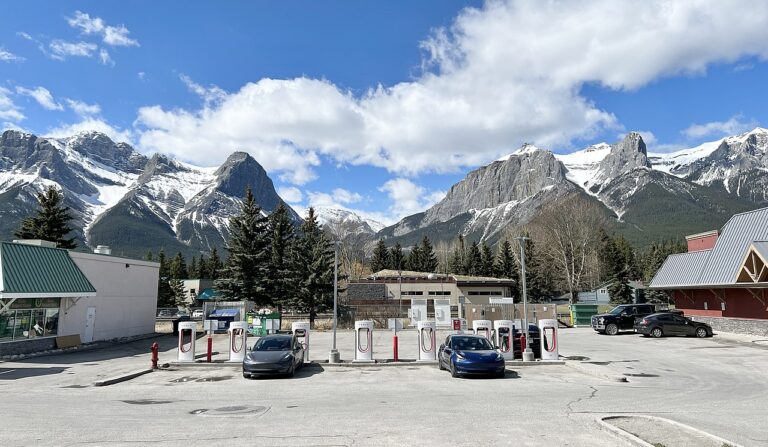
Heading west from Calgary toward Banff and Canmore, there’s Supercharger coverage along the way, so a day trip into the Rockies is no source of anxiety.
Can a Tesla handle an Alberta winter?
This is probably the single biggest question mark for every Alberta shopper. The winters here routinely hit −20 to −30°C — can an EV really cope?
The answer is: absolutely, but you have to know how to use it. Modern Teslas, especially the heat-pump-equipped Model 3 and Model Y, are in the top tier of EVs for cold-weather performance. In third-party testing, the Model Y holds roughly 86% of its range near freezing, and the heat pump cuts energy use significantly versus old resistive heating — at around 20°F (−7°C), the climate system can draw over a third less power.
That said, don’t expect to hit the EPA-rated range in winter. Here’s the realistic picture:
- City commuting: a 10–20% hit, no real impact on daily driving.
- Highway plus deep cold: sustained highway speeds combined with sub-zero temps can knock 30% or more off your range — plan trips with that buffer in mind.
- Slower charging: a cold battery noticeably slows fast charging.
The fix is really one habit, but a crucial one — preconditioning. Before you leave, warm the cabin from the app and the car will heat the battery along the way. Especially before a Supercharger stop, set the station as your destination in the nav so the car preconditions the battery and you charge much faster on arrival. Build that habit and an Alberta winter becomes genuinely pleasant in a Tesla: defrost remotely with one tap, climb into a warm car — far nicer than scraping glass and cold-starting a gas engine.
One more thing: in winter, swap to a proper set of winter tires. That has nothing to do with which car you drive — it’s a safety must on Alberta roads. Keep a snow brush and ice scraper in the car — I keep an AstroAI extendable snow brush in the trunk from October through April — leave some range buffer for cold starts, and you’ll get through winter comfortably. You can round out the kit with −40°C washer fluid and a spare ice scraper on Amazon Canada. And one deep-freeze staple worth its trunk space: a compact NOCO Boost GB40 jump starter. Teslas still have a low-voltage battery, and at −30°C a weak one can leave any car — EV or not — needing a boost; self-rescue beats waiting an hour for roadside assistance.
Insurance and registration: what Alberta owners should know
Alberta’s auto insurance is a private market — companies compete and price independently — unlike the public or semi-public systems in BC and Ontario. That makes shopping around essential, because quotes for the exact same Tesla can vary by a wide margin between companies. Teslas tend to run a little higher than comparably priced gas cars because parts and bodywork cost more, but picking the right company and stacking the right discounts (multi-policy bundling, clean-record, winter-tire discounts, and so on) can bring it down a lot. If you’re weighing how Alberta compares with other provinces, our Canada Tesla insurance guide breaks down how the different provincial systems work.
For registration, Alberta uses the registry agent system: bring your proof of insurance and vehicle information to any registry to get it done, and the $200 EV fee mentioned earlier is collected at this step. The process is straightforward, and the dealer usually helps you sort out temporary plates at delivery.
From order to delivery: a few money-saving tips
To finish, a handful of practical tips to help you buy smarter:
- Check Inventory first. Tesla’s online inventory section often has demo and stock cars at a discount, and they deliver faster. If your budget is tight, start there.
- Don’t rush to buy FSD outright. You can subscribe monthly now — try one month and see whether you actually use it, which is far more rational than buying it outright. Order through an owner referral link and you get a few free months to sample it anyway.
- Go easy on options. White paint is free and interior differences aren’t huge. Alberta’s no-PST advantage already saved you a bundle — no need to spend it back on options you rarely use.
- Install home charging early. If you have a parking spot, put in a home charger. The long-term electricity savings dwarf the cost of the charger itself.
- Watch for year-end deals. At quarter-end and year-end Tesla often runs volume incentives or free Supercharging miles — time it right and you save more.
Road-tripping the Rockies from Calgary without range anxiety
Living in Calgary comes with a perk other cities envy: an hour or so of driving puts you in the Rockies. Banff, Canmore, Lake Louise, Jasper — classic runs nearly every Calgary owner makes. A lot of shoppers worry an EV will leave them stranded on mountain roads or long hauls. In my experience, with a little planning, there’s nothing to be anxious about.
On the mountain roads: climbing does burn power, but the regen on the way down “earns” some of it back, so the round trip is more efficient than you’d guess. Calgary to Banff is just over a hundred kilometres one way, and even with sightseeing around the area, a Model Y with normal range handles the round trip comfortably with no mid-route charging. The trips that need real planning are the longer hauls to Jasper, or running these routes in winter.
For charging on the road, remember three principles:
- Leave home fully charged. If you have a home charger, top up to 100% the night before — it’s the most stress-free way to start a long trip.
- Know your Superchargers along the way. Towns like Canmore have coverage, and the nav plans your charging stops and durations automatically — just follow it. In winter, set the Supercharger as your nav destination so the battery preconditions along the route.
- Leave extra buffer for winter and the mountains. Sub-zero temps plus elevation gain shrink range more than usual. Don’t wait until 10% to look for a charger — top up at 20%. Mountain weather turns on a dime, and buffer is peace of mind.
On home charging, a lot of new Calgary owners agonize over whether to install one and which type. My advice: if you have a fixed parking spot — even a fixed spot in a condo where you can apply to install — put in a Level 2 home charger. Tesla’s own Wall Connector paired with Alberta’s cheap electricity, charging slowly overnight on off-peak power, saves enough over a year to cover the charger and installation. If you rent or can’t install one yet, you can get by on workplace charging, mall destination chargers, and the occasional Supercharger — but long term, the quality-of-life difference with home charging is on another level.
One Alberta-specific detail: it gets brutally cold here, so if your spot is outdoors, choosing charging gear rated for low temperatures — cabling that doesn’t turn to rebar in the deep freeze — makes life much more pleasant. Small touches like that, stacked up, are the difference between a seasoned owner and a beginner.
Frequently Asked Questions
Is buying a Tesla in Calgary really cheaper than in other provinces?
Yes, mainly on tax. Alberta is the only province with no provincial sales tax, so you pay just 5% GST on a vehicle, versus 13% HST in Ontario and 12% in BC. On the same $49,990 Model Y, a Calgary buyer saves close to $4,000 versus a Toronto buyer. The car’s base price is the same across the country — what you save is that tax.
Can I get the $5,000 federal rebate buying a Tesla in Alberta?
Yes — on one configuration. The Model Y RWD at $49,990 is Berlin-built and under the $50,000 cap, so it gets the full $5,000 EVAP rebate at point of sale (effective $44,990). Don’t add the $1,300 tow package, which pushes the price over $50,000 and kills the rebate. The $39,490 Shanghai-built Model 3 isn’t eligible, and other trims are over the cap. Funding is first-come, first-served, so confirm on Transport Canada’s EVAP page and Tesla’s incentives page before you order.
What is Alberta’s $200 EV fee?
It’s a registration tax the province has charged on battery-electric vehicles since February 2025, collected each year at plate renewal. It applies to the entire Tesla lineup; plug-in hybrids are exempt. The province frames it as a fuel-tax equivalent. Remember to fold this $200/year into your ownership budget.
How much range does a Tesla lose in a −30°C Alberta winter?
It depends. City commuting costs about 10–20%; highway driving in deep cold can easily lose 30% or more. The heat-pump Model 3/Y are among the most cold-resistant EVs, and the key is the habit of preconditioning before you leave and using the nav to warm the battery before Supercharging. Done right, winter driving is genuinely comfortable.
Where do I take delivery and get service in Calgary?
Tesla’s Calgary store and service centre is in the south end at 6702 Fairmount Dr SE (near Deerfoot Meadows), combining showroom, delivery, and after-sales service. You can complete the entire order online and just go in for pickup and service — book through the Tesla app in advance.
The bottom line
- Tax advantage: Alberta’s lack of provincial sales tax means you pay only 5% GST — close to $4,000 less than Toronto on a typical Model Y.
- Rebates and fees: the $5,000 federal EVAP rebate applies to exactly one Tesla — the Model Y RWD at $49,990 (skip the $1,300 tow package or you lose it); budget for Alberta’s $200/year EV fee at each plate renewal.
- Running costs: cheap, deregulated electricity (~12¢/kWh) plus a growing Supercharger network make a Tesla inexpensive to run in Alberta — install home charging if you can.
- Winter: heat-pump Teslas handle −30°C well; precondition before driving and before charging, and put winter tires on.
- Buying smart: check inventory cars, subscribe to FSD rather than buy it outright, shop your insurance, and if you’re ordering, an owner referral link gets you 3 months of free FSD (Supervised).
Information currency: prices, taxes, and policy details in this article were compiled from public sources including Tesla’s official site, the Government of Alberta (alberta.ca), and Canadian EV news outlets, current as of July 2026. Electricity prices, vehicle prices, rebate programs, and the EV fee can all change at any time — confirm against Tesla’s official site and the Government of Alberta’s official pages before ordering or registering. This is general information for shopping reference, not tax, legal, or insurance advice; consult a licensed professional or the relevant government agency for your own situation. Some links are affiliate/referral links; using them is entirely optional and never affects your price. See our disclosure page.
Image credit: “Tesla Supercharger in Canmore, Alberta” by Sharon Hahn Darlin, licensed under CC BY 2.0, via Wikimedia Commons.

About the author: Lifei Zhou
Model Y owner since 2022Ontario STO registered apprentice · 310SWorks on Porsche, Mercedes, BMW, Audi weeklyHundreds of readers referred (est.)
Lifei is a Tesla owner based in Canada, writing practical, fact-checked Tesla guides for US and Canadian drivers — buying, ownership, insurance, charging, and TSLA investing, all from first-hand experience.