
Buying a Tesla in Montreal & Quebec 2026: Stack Up to $7,000 in Rebates
Buying a Tesla in Montreal & Quebec 2026: Stack Up to $7,000 in Rebates

In one sentence
A complete 2026 guide to buying a Tesla in Montreal and Quebec: stack up to $7,000 in federal + provincial rebates before they expire, plus taxes and winter range.
If you live in Montreal — or anywhere in Quebec — and you’ve been thinking about trading in that gas-guzzler for a Tesla, 2026 is very likely the best window you’ll get for years. It may also be one of the last. The reason is simple: federal and provincial purchase rebates can still be stacked right now, together worth up to $7,000, but both come with catches. The provincial rebate zeroes out at the end of the year, and the federal pot is first-come, first-served and being drawn down continuously. Miss this window and the math changes completely.
Montreal Tesla owners live in a genuinely unusual spot. They enjoy the cheapest residential electricity in all of North America — a few cents per kilowatt-hour — so home charging costs that make Ontario and BC drivers jealous. But they also face long winters that routinely hit -20°C or colder, where real-world range shrinks meaningfully through the coldest weeks. Layer on Quebec’s French-language rules, the SAAQ’s no-fault insurance system, and a 14.975% sales tax, and newcomers arriving from another province — or another country — can easily trip over the details.
This guide breaks the whole “buying a Tesla in Montreal and Quebec” question down piece by piece: rebates, taxes, electricity rates, winter, where to buy and service and charge, and the French-language and insurance quirks. Every number was checked against the latest figures as of July 2026, but policy moves fast — always confirm on the official pages before you place an order.
Disclosure: some links in this article are affiliate/referral links. If you place an order through them, we may earn a small commission or referral reward at no extra cost to you. All analysis is based on public information, with no paid placement. This is general information, not purchase, tax, insurance, or legal advice. See our disclosure page.
📋 Contents
- How much rebate can you actually get on a Tesla in Quebec in 2026?
- Which Tesla models qualify for the rebates?
- The real total: taxes and registration costs in Quebec
- Montreal’s electricity is almost unbelievably cheap
- Can a Tesla handle Montreal winters?
- Where to buy, service, and charge
- French, insurance, and a few local things to watch
- Quebec vs. Ontario and BC: what’s the difference in buying a Tesla?
- From order to delivery: the full process, start to finish
- Frequently Asked Questions
- The bottom line
How much rebate can you actually get on a Tesla in Quebec in 2026?
Let’s start with the part everyone cares about: the money. In 2026, buying a qualifying battery-electric Tesla in Quebec means you can, in theory, collect two separate government rebates that add up to as much as $7,000:
- Federal EVAP — Canada’s federal Electric Vehicle Affordability Program, which launched on February 16, 2026. Qualifying new battery-electric vehicles get up to $5,000; plug-in hybrids up to $2,500.
- Quebec Roulez vert — the province’s own green-mobility incentive, paying $2,000 on a new BEV with an MSRP under $65,000 for all of 2026 (down sharply from the $7,000 maximum of a few years ago); used BEVs get $1,000.
The good news is that these two can be combined. Ottawa has been explicit that EVAP stacks with provincial incentives like Quebec’s Roulez vert. So a vehicle that appears on both eligibility lists can save you up to $5,000 + $2,000 = $7,000.
Better still, the process is painless. You don’t fill out forms or mail in for a cheque. Both EVAP and Roulez vert are deducted directly from the vehicle price at the dealer or Tesla delivery stage — the quote you see and the contract you sign already reflect the net price after rebates. For the buyer, it works like an instant discount.
But two deadlines are worth memorizing. Roulez vert is a program in wind-down: the $2,000 holds for all of 2026, but you must register the vehicle by December 31, 2026 — the program ends completely on January 1, 2027. (You may have seen claims that the rebate drops in August 2026; that’s misinformation — the official quebec.ca page confirms $2,000 through year-end.) Federal EVAP, meanwhile, has no fixed end date on paper, but its funding pool is first-come, first-served and being drawn down continuously — nobody can guarantee it’s still open the week you order, so check the Transport Canada EVAP page before you commit. In other words, taking delivery and registering within this year is when the rebates are at their richest.
Which Tesla models qualify for the rebates?
Not every Tesla collects both cheques. Two things decide it: price and where the car is built.
Federal EVAP has two hard lines: the transaction price must be $50,000 or less, and the vehicle has to be assembled in a country Canada has a free-trade agreement with. That matters because of where Canadian-market Teslas actually come from: the Model Y ships from Tesla’s Berlin plant (FTA — qualifies on origin) while the Model 3 ships from Shanghai (not an FTA origin — disqualified outright, regardless of price). Those two lines together split Tesla’s lineup right down the middle.
The one model that clears both bars is the Model Y RWD, starting at $49,990 — just $10 under the ceiling. After the $5,000 federal rebate, applied at point of sale, Tesla’s site shows qualifying buyers an effective price of $44,990. One trap to know: freight and PDI don’t count toward the $50,000 transaction price, but options do — add the $1,300 tow package and you cross $50,000 and lose the entire $5,000. Order it clean if you want the rebate. The Model Y Premium AWD ($64,990) and Performance ($74,990) are over the cap and get no federal portion.
On the Model 3 side, the entry Model 3 RWD is on Quebec’s Roulez vert eligibility list and collects the $2,000 provincial rebate. The Canadian Model 3 starts at $39,490, so after the provincial rebate the effective price lands around $37,490. But to be clear: because it’s Shanghai-built, no Model 3 trim qualifies for the federal EVAP at any price — the $2,000 from Quebec is all it gets. Check the current lists on quebec.ca and tc.canada.ca before you order.
A quick summary of the buying decision:
- Want every rebate dollar — the Model Y RWD is the only Tesla that stacks both: $5,000 federal + $2,000 provincial = $7,000 off, for an effective price around $42,990 before tax. Nothing else in the lineup comes close.
- Tightest budget — the entry Model 3 RWD at $39,490 minus the $2,000 Roulez vert is the cheapest way into a Tesla here, even without the federal portion.
- Want long range or performance — the Model Y Premium AWD / Performance miss the federal cap and the Model 3 upper trims miss on origin; build that $5,000 into your cost (they still get Roulez vert if under $65,000 MSRP).
- Eyeing a Model S / Model X — Tesla discontinued both in early 2026 and remaining inventory is essentially gone; they’re not part of the rebate conversation at all.
The real total: taxes and registration costs in Quebec
Rebates make the sticker look good, but Quebec’s taxes will pull the total back up, so factor them in before you buy.
Quebec sales tax is two layers stacked: the federal GST at 5% plus the Quebec QST at 9.975%, for a combined 14.975%. Note that whether this tax is levied on the price before or after the rebate affects the final number — generally the tax base is the transaction price on the invoice. When you sign, have the salesperson itemize the pre-tax price, the rebates, and the tax amount line by line, and double-check it yourself. On a car in the low-$40,000s, the tax alone runs around $6,000 — not a trivial number.
Registration is handled by the SAAQ (Quebec’s automobile insurance board). Regular registration and plate fees are due every year, and EVs currently enjoy one perk: the slice of vehicle value between $40,000 and $75,000 can be partially exempt from the “luxury car” surcharge within 2026. That benefit expires as of 2027, after which the portion above $40,000 gets taxed under the normal rules.
Quebec has also lined up two “future tense” costs for EVs that this year’s buyers should keep in mind:
- $125 annual EV fee — starting January 1, 2027, registering an EV will carry an extra $125 per year (plug-in hybrids pay half, $62.50). The government says this offsets the road-maintenance funding gap created by EVs not paying fuel tax, and expects to raise nearly $380 million by the 2029-30 fiscal year.
- Green-plate toll perk ending — as of April 1, 2027, the EV-exclusive green licence plate will no longer get free or discounted passage on Montreal-area toll bridges and Quebec ferries.
Both take effect only in 2027, so the impact on this year’s buyers is small — but if you plan to keep the car long-term, build that annual $125 into your cost of ownership.
Montreal’s electricity is almost unbelievably cheap
This is the biggest hidden perk for Quebec owners. Hydro-Québec’s residential rates are the lowest in North America, bar none, thanks to the province’s vast hydroelectric resources.
Under the residential Rate D in effect as of April 1, 2026: the first 40 kWh per day costs 6.732 cents/kWh, and anything beyond that 10.406 cents/kWh (both in Canadian dollars). To put that in perspective: home charging in Ontario and BC commonly runs 10-20 cents or more, and California residential power often hits 30-40 US cents. Charging slowly at home in Montreal costs a few cents per kWh — cheap enough to almost ignore.
Let’s run a rough tally. The Model Y RWD has a battery a touch over 60 kWh and goes around 400-500 km on a full charge. Say you drive 1,500 km a month and use about 16 kWh per 100 km — that’s roughly 240 kWh a month. Even charged entirely at the second tier of 10.406 cents, the bill comes to about twenty-some dollars; if most of it falls in the first tier, your monthly electricity might be barely over ten dollars. Over a year, a Montreal owner’s “fuel bill” can come in at less than half of what an out-of-province owner pays.
So in Quebec, if you can install home charging, you absolutely should. A Level 2 charger at home paired with these rates is the combination that pushes an EV’s low running cost to the extreme. Worth noting: Quebec has historically offered rebates on home-charger installation too, with amounts and conditions that change — check quebec.ca for any current funding before you install.
Can a Tesla handle Montreal winters?
Almost every prospective owner asks this, especially newcomers arriving from warmer climates. The answer: absolutely yes — the Teslas all over Montreal’s streets are proof — but you have to accept that winter range will shrink, and learn a few coping techniques.
Cold’s effect on EV range is physics; there’s no way around it. Generally, in the -15°C to -20°C deep cold, with the heat running, real-world range dropping 20-30% below the rated figure is the norm, and extreme cold on short trips drops it more. This isn’t a Tesla flaw — every EV does it. The good news is that current Model Y and Model 3 come standard with a heat pump, far more efficient than the old resistive heating in early EVs, which noticeably protects range.
A few practical tips for easier winter driving in Quebec:
- Preheat before you leave — use the phone app to precondition the cabin and battery ahead of time, especially while still plugged in, so you’re heating with “grid power” rather than “battery power.” More comfortable and easier on range.
- Lean on seat and steering-wheel heaters — they use far less energy than cabin heat and the body feels them more directly.
- Don’t run the battery to empty — in winter, keep your daily charge in a more generous band; batteries also charge more slowly in the cold, so leave yourself a buffer.
- Navigate to a Supercharger to precondition — set the Supercharger as your destination in the car and the system preheats the battery automatically, so it charges much faster on arrival.
Real-world range depends on temperature, speed, tire pressure, whether you’re running winter tires, and more — the above is just a ballpark; go by your own driving data. Quebec law requires winter tires from December 1 to March 15, so don’t forget that; snow tires add a little rolling resistance and cost a bit of range, but safety comes first.
Where to buy, service, and charge
Montreal’s Tesla infrastructure has filled out a lot in recent years — it’s no longer the old “one store for the whole province” situation.
The core downtown hub is on Rue Ferrier: 5350 Rue Ferrier, Montréal, QC H4P 1L9, combining showroom, sales, service centre, and Supercharger in one — the main Tesla facility in Greater Montreal. Beyond that, Laval, Saint-Bruno-de-Montarville, and Quebec City all have service centres, covering the province’s main population areas. Tesla is also building a new service centre of about 80,000 square feet, which will further expand after-sales capacity.
On charging, Quebec’s Supercharger network is already dense along the major highways (such as the Autoroute 20 linking Montreal and Quebec City, and the route toward Ottawa), so intercity long-distance driving is basically worry-free. Day-to-day, charging is mainly home-based with Superchargers as backup — at Montreal’s electricity rates, charge at home whenever you can. For planning a Quebec road trip, you can browse our Canada Tesla coverage for more on driving and charging across the province.
The buying process now happens almost entirely online. You configure on Tesla’s site, pay the deposit, upload documents, and book delivery — no repeated trips to a store. If you know a Tesla owner, ordering through their referral link usually gets you an extra perk (Tesla adjusts the rewards from time to time; a common one is a few months of free FSD (Supervised)). If you don’t know anyone, you’re welcome to use our site owner’s Tesla referral link — the current offer is 3 months of free FSD (Supervised), with the exact reward subject to Tesla’s promotion at the time.
French, insurance, and a few local things to watch
What sets Quebec apart from the rest of Canada most is language and the insurance system — and out-of-province arrivals especially need to adapt.
On language, Quebec’s Charter of the French Language (commonly known as Bill 96) requires commercial contracts and documents to be primarily in French. Tesla provides French-language sales and documentation in Quebec, so the contract and instructions you receive at delivery will most likely be in French. If your French isn’t strong, have the salesperson walk you through every clause before signing, or ask for an English version alongside — don’t sign anything you don’t fully understand. The car’s own system supports Chinese and English display, so there’s no language barrier in daily use.
On insurance, Quebec runs a unique “no-fault” system: the public SAAQ handles bodily-injury compensation, while damage to the vehicle’s property is covered by private insurers. Under this setup, Quebec auto premiums are broadly cheaper than Ontario’s — another hidden perk for local owners. Because Tesla’s parts and labour costs run high, premiums will be a little pricier than for a comparably priced gas car, so it’s worth getting several quotes. For the overall approach to insuring a Tesla in Canada and the factors that drive premiums, read our complete guide to Tesla insurance in Canada — it covers Ontario and BC in more detail, but Quebec owners can borrow most of the thinking.
One often-overlooked point: if you’re moving to Quebec from another province, the vehicle must be re-registered with the SAAQ and re-plated with Quebec plates within the required time after you move in, and meet Quebec’s safety inspection requirements; your driver’s licence also has to be exchanged for a Quebec one. Newcomers handle licence exchange under the SAAQ’s rules. These steps are separate from buying the car itself, but all have to be done — checking the process ahead of time saves a lot of legwork.
Quebec vs. Ontario and BC: what’s the difference in buying a Tesla?
Plenty of people deciding where in Canada to settle — or weighing an out-of-province purchase — ask whether Quebec is really the best-value place to buy a Tesla. Lined up side by side, the differences are real.
Start with rebates. For 2026, Quebec stands alone among the big provinces: Roulez vert pays $2,000 on a new BEV, while Ontario scrapped its provincial purchase rebate years ago and BC’s CleanBC rebate is no longer available either — buyers in both provinces rely on the federal EVAP alone. So on the provincial rebate line, Quebec buyers come out one cheque ahead. Stacked with federal EVAP, a Quebec buyer can save up to $7,000 on a qualifying model, while an Ontario or BC buyer gets at most the federal $5,000.
Now running costs — and this is where Quebec truly pulls away. Hydro-Québec’s residential rates are the lowest in North America; home charging is nearly free. Ontario and BC residential power runs noticeably higher, with time-of-use peak periods pricier still. Over a year of the same mileage, a Montreal owner’s electricity bill can be half or less of what a Toronto or Vancouver owner pays. On insurance, Quebec’s no-fault system keeps premiums broadly lower too.
| Factor | Quebec | Ontario | British Columbia |
|---|---|---|---|
| Provincial rebate (2026) | Roulez vert $2,000 (ends Dec 31, 2026) | None (federal only) | None (CleanBC rebate ended; federal only) |
| Max total rebate | Up to $7,000 | Up to $5,000 | Up to $5,000 |
| Sales tax | 14.975% (GST + QST) | 13% HST | 12% (GST + PST) |
| Home electricity | Lowest in North America (~6.7-10.4 cents/kWh) | Higher, time-of-use | Higher, time-of-use |
| Insurance | No-fault (SAAQ); broadly lower | Private market | Public ICBC + private optional |
| Other notes | French contracts (Bill 96); long, cold winters | Largest population, dense network | Mild coast; winter-tire highway rules |
Of course, Quebec has its “price of admission” too: the 14.975% sales tax is on the high side for Canada (Ontario’s HST is 13%, BC’s GST+PST totals 12%), French contracts are a hurdle for non-French speakers, and the winters are colder and longer than in most provinces. If you’d like to see how tax-free Alberta does the math, contrast this with our Calgary/Alberta coverage — Alberta has no provincial sales tax but also no provincial purchase rebate, which is a whole different equation.
In one line: for the total price “at the moment of purchase,” tax-free Alberta may come out cheaper; but for the all-in cost of “long-term ownership,” Quebec — with its ultra-low electricity and lower premiums — is one of the cheapest provinces in Canada to run a Tesla. If you already live in Quebec, taking advantage of this year’s stacked-rebate window is genuinely attractive.
From order to delivery: the full process, start to finish
Stringing all of the above together, a typical Montreal buyer’s path looks roughly like this:
- 1. Pick the model — combining budget and rebate eligibility, choose the full-rebate Model Y RWD (skip the tow package), the provincial-rebate-only entry Model 3, or pay more for a Premium AWD / Performance trim.
- 2. Check the lists — confirm your exact configuration is currently on quebec.ca’s Roulez vert list and tc.canada.ca’s EVAP list.
- 3. Order online — configure, pay the deposit, and use a referral link at this stage if you have one.
- 4. Prepare documents — have your ID, address, and payment method ready and upload them as Tesla prompts.
- 5. Book delivery — take delivery at Rue Ferrier or your nearest service centre, and inspect the car carefully on the day.
- 6. Register and insure — complete SAAQ registration, buy insurance, fit winter tires, and sort out home charging.
The delivery-day inspection is critical: go over the paint, panel gaps, wheels, and software features item by item, and log and raise any issue on the spot. On the subject of saving money — beyond the rebates, ordering through an owner referral link gets you 3 months of free FSD (Supervised); at the $99/month subscription price that’s worth a few hundred dollars over a few months — a free perk worth grabbing. And while you’re at it, stock up on the winter essentials a Quebec owner needs: an AstroAI extendable snow brush for the daily dig-out, a 12V heated cushion for passengers on -20°C mornings (warming bodies directly costs far less range than blasting cabin heat), plus -40°C washer fluid and a spare ice scraper from Amazon Canada.
Frequently Asked Questions
Can you really collect both the federal and provincial rebates in Quebec?
Yes — but for Tesla, only one model does it. Federal EVAP and Quebec’s Roulez vert are independent programs and the government explicitly allows stacking, but the only Tesla on both lists is the Berlin-built Model Y RWD at $49,990: $5,000 federal + $2,000 provincial = $7,000 within 2026, both deducted directly from the vehicle price at purchase (just don’t add the $1,300 tow package, which pushes it over the $50,000 cap and kills the federal portion). The Shanghai-built Model 3 gets the $2,000 provincial rebate only. Confirm your exact configuration on both official lists before you order.
When does Roulez vert end completely?
Under current policy, the $2,000 holds for all of 2026, but vehicles registered after December 31, 2026 no longer qualify — the program ends completely on January 1, 2027. To get that $2,000, you have to take delivery and register within the year. (Rumours of an August 2026 cut are false; the official page confirms $2,000 through year-end.) Federal EVAP has no fixed end date, but its funding is first-come, first-served and being drawn down — check Transport Canada’s page before you order. That combination is why this year is the richest moment for rebates.
How much range does a Montreal winter cost you?
In -15°C to -20°C cold with the heat running, a 20-30% drop below rated range is common, and extreme cold on short trips costs more. Current models come standard with a heat pump, which is far more efficient than early cars. Techniques like preheating before you leave, leaning on seat heaters, and navigating to a Supercharger to precondition the battery noticeably improve the winter experience. Exact figures vary with temperature, speed, and winter tires — go by your own driving data.
About how much does home charging cost per month in Montreal?
Very little. Hydro-Québec’s residential Rate D for 2026 is 6.732 cents/kWh for the first 40 kWh per day and 10.406 cents/kWh beyond that (in Canadian dollars) — the lowest in North America. Driving around 1,500 km a month, home charging runs roughly ten to twenty-some dollars, far below Ontario, BC, and most of the U.S.
If I move to Quebec from another province, does my existing Tesla need new paperwork?
Yes. The vehicle must be re-registered with the SAAQ, re-plated with Quebec plates, and meet the safety inspection requirements within the required time after you move in, and your driver’s licence has to be exchanged for a Quebec one. These steps are separate from buying a new car, but all have to be done — check the SAAQ’s official site ahead of time for the deadlines and required documents.
Will the French-language contract be a problem if I don’t speak French?
Tesla provides French-language sales and documents in Quebec under Bill 96, so your delivery contract will most likely be in French. If your French isn’t strong, have the salesperson explain each clause before signing or ask for an English version alongside — never sign something you don’t fully understand. The car’s own interface supports English and Chinese, so daily use is no problem.
The bottom line
Add it all up and 2026 is genuinely friendly to Tesla buyers in Quebec:
- Rebates: up to $7,000 stacked (federal EVAP $5,000 + Roulez vert $2,000) on the Model Y RWD, but Roulez vert ends for good after December 31, 2026 and the EVAP funding pool is first-come, first-served.
- Running cost: the lowest electricity in North America makes home charging nearly free, and the no-fault system keeps insurance broadly lower.
- Infrastructure: an increasingly dense Supercharger and service network, anchored by the Rue Ferrier hub in Montreal.
- The trade-offs: long cold winters, French contracts under Bill 96, and — from 2027 — a tightening of rebates plus a new $125 annual EV fee.
- Models: the Model Y RWD (~$42,990 after both rebates) and entry Model 3 (~$37,490 after the provincial rebate) are the best rebate value; Premium AWD/Performance trims price out of the federal rebate, and the Shanghai-built Model 3 never qualifies for it.
Think those few things through, act within this year while the rebates are richest and Roulez vert is still alive, and you’ve got a very favourable window. For more on insurance, check our Tesla insurance guide for Canada, or browse all our Canada Tesla articles.
Information currency: this article draws on public information from Transport Canada (official EVAP page), Québec.ca (Roulez vert), the SAAQ, Hydro-Québec’s official rate documents, Drive Tesla Canada, and Tesla’s own site, with figures current to July 2026. Rebate amounts, model lists, taxes, and electricity rates change frequently — the latest official information from Tesla, quebec.ca, tc.canada.ca, the SAAQ, and Hydro-Québec governs. This is general information, not purchase, tax, insurance, or legal advice; consult Tesla, the relevant government bodies, or a licensed professional for your own situation. Some links are affiliate/referral links; ordering through them does not change your price, and we may receive a referral reward. See our disclosure page.
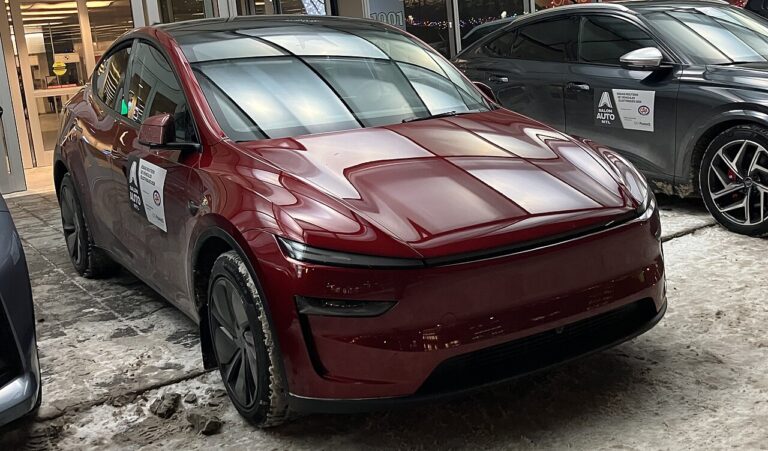
Image credit: “2026 Tesla Model Y at SIAM 2026, Montréal” by Bull-Doser, via Wikimedia Commons.

About the author: Lifei Zhou
Model Y owner since 2022Ontario STO registered apprentice · 310SWorks on Porsche, Mercedes, BMW, Audi weeklyHundreds of readers referred (est.)
Lifei is a Tesla owner based in Canada, writing practical, fact-checked Tesla guides for US and Canadian drivers — buying, ownership, insurance, charging, and TSLA investing, all from first-hand experience.