
Tesla Robotaxi in Austin 2026: How to Ride, Cost & the Real Story
Tesla Robotaxi in Austin 2026: How to Ride, Cost & the Real Story

In one sentence
Tesla's driverless Robotaxi now covers nearly all of Austin in 2026. Here's how to ride, what it costs, how it compares to Waymo, and what it means for owners and TSLA.
On June 3, 2026, Tesla quietly did something big: it opened up its driverless Robotaxi service across nearly all of Austin, Texas, in a single move. The service area jumped to roughly 245 square miles overnight, sweeping in suburbs like Pflugerville and Manor and even reaching stretches of the I-35 corridor and Austin’s airport. Compared with the tiny 20-square-mile pocket the program launched with back in June 2025, that’s a twelvefold expansion — the fifth and by far the largest enlargement since the project began. And it didn’t stop there: by late July 2026, Robotaxi was operating in seven metro areas across three states, with Florida gaining three cities in the space of three weeks.
The news set Tesla owner groups and stock-trading chats buzzing all over again. Some people excitedly asked, “Is there really nobody sitting in the driver’s seat now?” Others coolly pushed back: “I heard there are only about twenty cars running in the whole city — you’ll wait forever for a ride.” The funny thing is, both sides are right. As someone who has driven a Tesla in North America for years and holds a little TSLA, I went back through every official statement and third-party tracking number I could find over the past few days to try to lay this out clearly: what the situation actually is right now, whether an ordinary person can ride, how much it costs, how it stacks up against Waymo, and what it all means for your car and your stock.
Here’s the bottom line up front: Robotaxi has genuinely taken a real step forward. Technically, there is now a fleet of Teslas in Austin running with nobody inside, driving on pure-vision FSD. But “citywide coverage” is more like drawing a bigger box on the map than putting more cars on the road — the number of vehicles actually picking up passengers is still very small. Once you understand the gap between the big promise and what’s actually on the street, you won’t get swept up by the hype from either camp.
Disclosure: this article contains a Tesla owner referral link. If you order a vehicle through a link in this article, the site owner may receive a Tesla referral reward, at no extra cost to your purchase price. This is information sharing, not investment advice. See our disclosure page.
📋 Contents
- What is Tesla Robotaxi (and Cybercab)? It’s not the same as the FSD in your car
- Late July 2026: where Robotaxi actually stands right now
- Can ordinary people ride it now? How to hail one, and what it costs
- No safety driver — is it safe? What are the remote operators doing?
- Tesla vs. Waymo: where Tesla falls short, and where it’s strong
- Cybercab: a two-seater built purely for driverless rides
- What it means for you as a Tesla owner
- What it means for TSLA investors
- When will it come to California, other states, and Canada?
- Frequently Asked Questions
- Summary
What is Tesla Robotaxi (and Cybercab)? It’s not the same as the FSD in your car
A lot of people lump “Robotaxi” together with the FSD they paid for on their own car, but they’re actually two different layers. What you run in your own Model 3 or Model Y is FSD (Supervised) — the car can change lanes, turn, recognize traffic lights, and get on and off the highway by itself, but you must be sitting behind the wheel, ready to take over at any moment, and you bear responsibility if something goes wrong. We dig into what that system is really like to live with in our Tesla Full Self-Driving guide.
Tesla Robotaxi, by contrast, is a ride-hailing service Tesla operates using the same FSD “brain” — but with the driver removed. In Austin’s driverless zone, there is genuinely no one in the front seats. You hail a car with a phone app, a Tesla drives itself to you, and it takes you to your destination with no human driver involved at any point. This is the commercial seedling of Level 4 autonomy: within a defined area, the machine is fully responsible for the driving.
The relationship between the two is simple: FSD is the foundation, and Robotaxi is the business built on top of it. Elon Musk’s long-term script is that once FSD is reliable enough, not only will Tesla’s own cars work as driverless taxis, but the car you buy could one day be plugged into the same network to earn money for you while it sits idle. That vision has been pitched for years, and it finally has a tangible prototype in Austin.
Late July 2026: where Robotaxi actually stands right now
Date-stamp this section — the map has been moving fast. As of the end of July 2026, Tesla Robotaxi operates in seven metro areas:
- Austin, Texas — the flagship: a greater-Austin geofence (roughly 245 square miles including suburbs like Pflugerville and Manor, stretches of I-35, and the airport), no safety monitor in the car, paid rides, open to the general public through the Robotaxi app.
- Houston and Dallas, Texas — live, with smaller service areas than Austin.
- Miami, Florida — launched in early July 2026.
- Orlando and Tampa, Florida — both launched on July 22, 2026, just 18 days after Miami. Three Florida metros in three weeks says a lot about the current expansion tempo.
- San Francisco Bay Area, California — operating, but with a safety monitor on board due to state permitting, so not truly driverless yet.
A few more operating realities worth knowing:
- Fleet size — still the weak spot. The truly driverless fleet in Austin has numbered only in the dozens, though Musk says it is set to double in the coming month. Fleet counts in the newer cities are smaller still.
- Safety drivers — outside California there really is no one inside the car anymore, but Tesla keeps remote operators watching in the background who can intervene at low speed to nudge a stuck car out of the way.
- Operating hours — there are still time-of-day and weather restrictions; service contracts in bad weather, and the app shows what’s available at any given moment.
The most telling thing here is still the scissors gap between “area” and “car count.” The service zones on the map have exploded, but the number of cars on the road has grown far more slowly. The result is that the density of cars per square mile is heavily diluted: wait times can get longer, especially at peak hours. Outlets like Electrek have said it plainly — much of the expansion is about “drawing a bigger box on the map,” with more symbolic value than capacity value.
So if you happen to be in one of these cities and want to try a ride, keep your expectations level: getting one is a treat, and waiting a while shouldn’t surprise you. This is nowhere near the mature, hail-anytime capacity of Waymo in San Francisco or Phoenix right now.
Can ordinary people ride it now? How to hail one, and what it costs
Yes, you can ride — but there’s a threshold, and it’s basically limited to a few Texas cities. The process isn’t much different from Uber or Lyft:
- Download the app. Search “Tesla Robotaxi” in the App Store or Google Play. The iOS version went public in September 2025; Android only caught up in April 2026.
- Sign up and join the queue. If you’re outside an existing service area, you can register in the app and get notified when your city opens up.
- Set your start and end, then hail. Enter a destination within the service zone, the app gives you an estimated fare and confirmation, and a driverless Tesla comes to pick you up.
- Get in and go. Unlock with the app, buckle up, tap “Start Ride” on the screen, and the car drives off on its own.
On passenger age, Tesla lowered the minimum from 13 to 8 in 2026, but minors aged 8 to 17 must be accompanied throughout by a parent, guardian, or authorized adult. That step is clearly aimed at high-frequency family scenarios like ferrying kids around.
As for cities, as of late July 2026 the places where you can actually take a truly driverless ride are Austin, Dallas, and Houston in Texas, plus Miami, Orlando, and Tampa in Florida. The California Bay Area also has Tesla Robotaxis, but because of state regulations a safety monitor still rides along there, so it doesn’t count as truly driverless. Tesla’s stated target is to reach roughly 8-10 metro areas by the end of 2026; Phoenix and Las Vegas have been floated but are not confirmed. Launch dates have a habit of slipping, so treat the official page as the source of truth. If you’re shopping for a Tesla in the Austin area, our Texas Tesla buying guide covers the local angle.
How much does a ride cost? Austin’s pricing has changed several times over the past year. Early on it was a near-flat, token low price (briefly just a few dollars), then it shifted to dynamic per-mile pricing: short trips cheaper, long trips pricier. From recent fares the media has captured, a sub-1-mile hop runs a little over $2, a 5-to-8-mile trip is roughly $8 to $13, and around 11 miles can reach $13–14. Dallas uses a different base-fare-plus-per-mile formula. Side by side, this sits in the same range as local Uber/Lyft fares — it’s not a big discount yet.
Musk’s real pitch is the future: once the fleet is built out, with no driver taking a cut and each car running maximum daily miles, he says operating costs could be pushed below 20 cents a mile, and only then would it become a true “force-multiplier” against ride-hailing. But that’s a story about scale, and we’re nowhere near it yet. The honest advice for anyone heading to Texas to try it: right now you’re paying for the novelty of “experiencing the future” and the bragging rights — don’t expect it to save you money or to show up on demand. Treat it as a product still in beta and your expectations will be calibrated correctly.
No safety driver — is it safe? What are the remote operators doing?
This is the question Tesla owners ask most, and it deserves a careful answer. In Austin’s driverless zone, there really is no one in the front seats — but that doesn’t mean “completely unmonitored.” Tesla staffs remote operators in the background who can watch trips in real time and, when a car gets stuck at an intersection or runs into an edge case like a construction detour, can step in at low speed to move it to a safe spot. So the more accurate description is “nobody in the car, but someone backstopping remotely.”
Over the past year, Austin’s Robotaxi hasn’t been incident-free either. Outlets have reported some low-speed scrapes, hesitant decisions, and cars stopping where they shouldn’t. Tesla’s typical response is to tighten the geofence, tune parameters, and then gradually loosen again. To be fair, Tesla follows a “run small, pull back when problems appear, iterate, then expand” path — cautious, yes, but that caution is exactly why capacity has stayed low.
A few practical tips for riders: for your first ride, go in daytime on a familiar route; if you’re traveling with kids, follow the accompaniment rules strictly; and if the vehicle behaves oddly, the app has options to contact support and pull over — don’t panic and try to grab the controls, because there’s no steering wheel for you to grab anyway.
Tesla vs. Waymo: where Tesla falls short, and where it’s strong
You can’t talk about driverless taxis without Waymo (owned by Google parent Alphabet). Put the two side by side and the gap is plain to see. Waymo already runs around 3,000 driverless cars across more than a dozen US cities, completing well over 500,000 paid rides a week, covering roughly 1,400 square miles, and has raised more than $10 billion as it eyes London and Tokyo. Even in Texas alone, third-party counts put Waymo’s active cars in the hundreds, against Tesla’s few dozen. On the simple question of “who has more driverless cars running stably right now,” Waymo leads by a wide margin — no contest.
But Tesla’s bet isn’t on “now” — it’s on cost and scale. Waymo’s cars are packed with lidar and high-precision sensors, making each unit expensive to build; expansion takes deep pockets, gnawing through one city at a time. Tesla takes the pure-vision route, with hardware that’s just the camera suite already on its mass-production cars. In theory, once the software works, copying it to millions of cars carries almost zero marginal hardware cost. In other words, Waymo is building luxury custom homes one at a time, while Tesla wants to copy-paste a standardized apartment block. Whether that copy-paste succeeds rides entirely on the technical question of whether pure-vision FSD actually works.
So the two can’t be ranked simply in the short term: Waymo wins on today’s capacity and stability, while Tesla is betting on tomorrow’s cost curve and rollout speed. As an observer, the metric to watch isn’t how big a box gets drawn on the map — it’s when Tesla’s driverless fleet count, daily orders per car, and crucially the safety data, start climbing steeply for real.
Cybercab: a two-seater built purely for driverless rides
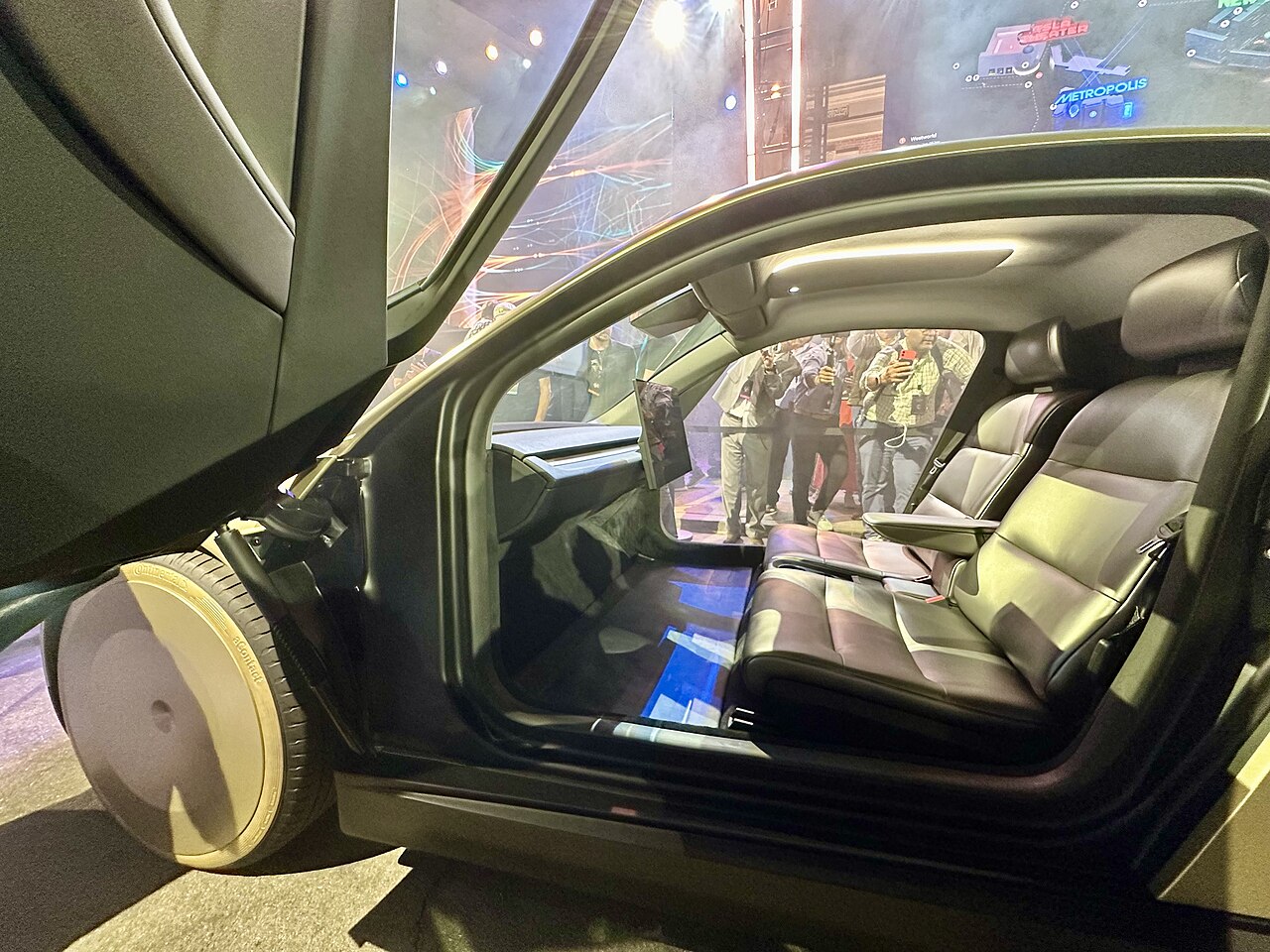
When you talk about scale, you can’t skip the Cybercab, the little hot-hatch-looking car Tesla designed specifically for Robotaxi. Its boldest feature: no steering wheel, no pedals, not even a control interface for a human — purely “the machine drives, the human rides.” Two seats, positioned for point-to-point driverless commuting in the city.
On the production timeline, the first production-version Cybercab rolled off the line at Giga Texas on February 17, 2026, with the company planning to ramp volume within the year. But Musk warned the market on the Q1 earnings call that early output will be slow, because the car uses an entirely new supply chain and manufacturing process — he compared it to the iPhone’s launch (“start small, then climb”) rather than the all-out ramp of the Model 3. His long-term target is huge — around two million units a year across multiple plants — but that’s a vision several years out.
- First unit off the line — February 17, 2026, at Giga Texas.
- Seats and design — two seats, no steering wheel, no pedals, autonomous driving only.
- Production cadence — volume within the year, but a slow early ramp; long-term goal around two million units annually.
For consumers, you can’t buy or drive a Cybercab any time soon — it isn’t sold for individuals to drive at all. Its significance is this: if Tesla can really build this wheel-less car cheaply and run it safely, the per-unit cost of driverless taxis can finally come down, and the whole Robotaxi business starts to close the loop.
What it means for you as a Tesla owner
By now you might be asking: does any of this affect the car I drive? In the short term, not much — but there’s something to keep an eye on.
First, your current car can’t join the Robotaxi network yet. Musk has floated the “your car earns money while idle” idea, but that needs regulatory sign-off, a sorted-out insurance and liability framework, and FSD reliable enough to go hands-off — none of which is here yet. What you can enjoy is still FSD (Supervised), the assist that needs your supervision. If you drive long distances often, it genuinely cuts fatigue a lot.
Second, the enormous real-world data the Robotaxi fleet generates feeds back into the FSD models and eventually flows to your car as an over-the-air update. Put simply, every hesitation and every intervention from those Robotaxis in Austin, Texas, and Florida each day is helping make the FSD in your future car smarter.
Third, if you were already planning to buy and you care about autonomy, FSD is worth focusing on. When you order a new car through an owner referral link, you currently get 3 months of free FSD (Supervised) — at the $99/month subscription price, that’s worth about $297, a real perk for anyone who wants to follow the evolution of autonomy long-term. If you’d like one, feel free to use the site owner’s Tesla referral link. If you’re weighing which model to start with, our US Model 3 guide walks through the trims and ownership costs.
What it means for TSLA investors
Robotaxi is one of the core narratives propping up Tesla’s lofty valuation these past couple of years. The market is willing to hand Tesla a price-to-earnings multiple far above traditional automakers in large part because it’s betting the company can pivot from “selling cars” to “selling autonomous-driving services” — the latter being a software business with completely different margins and upside. So every expansion and every milestone moves the stock.
But as an investor, you have to separate “narrative” from “delivery.” The current reality: the driverless fleet is only a few dozen cars, capacity nowhere near enough to contribute meaningful revenue; Cybercab production has barely started, with very low early output; and on the regulatory front, aside from relatively relaxed Texas, big markets like California are still stuck on the safety-driver requirement. In other words, Robotaxi is at a “burn cash, no income” stage on the financials for now, and the real inflection point depends on when the driverless fleet count and the per-car economics turn positive.
A few hard metrics I personally keep watching: the absolute number of active driverless vehicles and its quarter-over-quarter growth; regulatory approvals in new states (especially California and Arizona); whether per-mile operating cost is really closing in on 20 cents; and whether the safety data holds up to third-party and regulator scrutiny — note that NHTSA has an open investigation into FSD covering roughly 3.2 million vehicles, still ongoing with no conclusion. These are far more reliable than the annual targets Musk shouts from a stage. For a deeper read on Tesla’s place in the US EV landscape, see our US Tesla coverage.
As always, one closing reminder: the above is just information and personal observation — this article is not investment advice. TSLA is extremely volatile, and whether the Robotaxi narrative delivers is full of uncertainty. Manage your position and risk on your own judgment.
When will it come to California, other states, and Canada?
This is probably the biggest question for Bay Area, Los Angeles, and Canadian readers: when does the good stuff reach my door? Honestly, the timeline has to be read on two layers — technical and regulatory. Technically, Tesla can expand wherever it wants; the hard part is regulation. Texas could go driverless first because its autonomous-driving rules are relatively loose, with almost no upfront permitting. California, by contrast, has dual oversight from the DMV and the Public Utilities Commission (CPUC), and getting a “fully driverless paid passenger” permit is a cumbersome process — which is why Bay Area Tesla Robotaxis still need a safety driver, making them essentially a “demo with a driver.”
This explains a slightly counterintuitive phenomenon: California, Tesla’s home base with the highest density of engineers, actually lags Texas on the “truly driverless” front. Regulation-friendly states are indeed where it opened up next: Florida got Miami in early July 2026, then Orlando and Tampa on July 22 — three metros in three weeks. Phoenix and Las Vegas have been talked about but remain unconfirmed, and Tesla’s end-of-2026 target is roughly 8-10 metros. Given Tesla’s habit of slipping deadlines, any promise with a specific month attached still deserves a discount before you believe it.
As for Canadian readers, brace yourselves for “still a while to wait.” Canada is still in a regulatory tug-of-war over even the consumer version of FSD (Supervised); cities like Toronto and Vancouver will see driverless Robotaxi commercial operations on a timeline that only trails the US further. In the short term, what Canadian owners can act on is getting their car bought and keeping up with FSD’s progress. To actually experience “no one in the front seat” right now, the most realistic option is to download the app and take a ride yourself while on a business trip or vacation in Texas — a new kind of bucket-list checkmark.
At the end of the day, the expansion of driverless taxis isn’t a pure engineering problem — it’s a slow variable shaped by the interplay of technology, regulation, insurance, and public opinion. Which city opens first often depends on how tolerant the local government is of autonomous driving, not on where the most Tesla owners live. Once you internalize that logic, you won’t fret over “why isn’t it here yet.”
Frequently Asked Questions
Which cities can you ride Tesla Robotaxi in right now?
As of late July 2026, Robotaxi operates in seven metro areas: Austin (a greater-Austin geofence of about 245 square miles, no safety monitor, open to the public via the app), Dallas, and Houston in Texas; Miami (early July), Orlando, and Tampa (July 22) in Florida; and the San Francisco Bay Area, where a safety monitor still rides along under state regulation. Tesla is targeting roughly 8-10 metros by year-end; Phoenix is not confirmed. Treat the official page as the source for launch dates.
What are the requirements to ride, and how old do you have to be?
You need to download the Tesla Robotaxi app (available on both iOS and Android) and hail a car within the service area. The minimum passenger age has been lowered to 8, but minors aged 8 to 17 must be accompanied throughout by a parent or authorized adult. If you’re outside the service area, you can register in the app and wait for a launch notification.
Is there really nobody in the car? How is safety handled?
In Austin’s driverless zone there genuinely is no driver in the front seats; the car runs on pure-vision FSD. But Tesla has remote operators watching trips in real time who can intervene at low speed when a car gets stuck. It’s not “completely unmonitored” — it’s “nobody in the car, with a remote backstop.”
Is Robotaxi cheaper than Uber?
Not right now. Austin uses dynamic per-mile pricing, and overall fares sit in roughly the same range as local Uber/Lyft. Musk envisions per-mile costs dropping below 20 cents at scale, but that’s a future target — for now you’re paying for the novelty of trying it, not for savings or on-demand availability.
Can my Tesla join the Robotaxi network and earn money for me?
Not yet. This “plug your personal car into a shared network” idea still needs regulation, insurance, a liability framework, and FSD reliability all to be in place, and it isn’t open today. What you can use right now is still FSD (Supervised), which requires your supervision.
Summary
Between the June 2026 citywide launch in Austin and the three Florida cities added in July, Robotaxi has moved from a “demo in the lab” toward a “real multi-city service” — seven metros as of late July 2026, and the symbolism is significant. But peel back the “coverage” wrapper and inside you’ll still find a small fleet, limited operating hours, and a remote-backstop reality. It’s neither the “the driverless era has fully arrived” some people tout, nor the “pure vaporware” others dismiss — it’s a real product that genuinely exists but is still early and needs time to ramp.
For owners, just follow FSD’s evolution; for investors, keep your eyes on the two hard metrics of driverless fleet count and per-car economics, and don’t let the narrative and emotion lead you around. The day the driverless Teslas on these streets go from dozens to thousands — that’s the moment that’s truly worth getting excited about. We’ll keep following it.
Sources and currency: this article draws on public reporting from Electrek, TechTimes, Teslarati, Not a Tesla App, the SF Standard, Tesla’s official support pages, and SEC filings, with data updated as of late July 2026. Robotaxi’s service area, fleet size, pricing, and launch cities change frequently; the actual situation is whatever the Tesla app and the official Robotaxi support page show at the time. For regulatory and safety background, see the NHTSA and the City of Austin.
Image credit: the Cybercab interior photo is by Steve Jurvetson, sourced from Wikimedia Commons, licensed under CC BY 2.0.
Disclaimer: this article is information sharing and does not constitute investment, vehicle-purchase, legal, or tax advice. Prices, policies, and service details may change at any time; rely on the latest information from Tesla and the relevant government agencies before making decisions. Some links are referral links; see our disclosure page. If you’re planning to order, you’re welcome to use the site owner’s Tesla owner referral link, which currently offers 3 months of free FSD (Supervised); ordering through it doesn’t affect your price and helps support this site.
About the author: Lifei Zhou
Model Y owner since 2022Ontario STO registered apprentice · 310SWorks on Porsche, Mercedes, BMW, Audi weeklyHundreds of readers referred (est.)
Lifei is a Tesla owner based in Canada, writing practical, fact-checked Tesla guides for US and Canadian drivers — buying, ownership, insurance, charging, and TSLA investing, all from first-hand experience.