
Tesla FSD in 2026: Full Self-Driving Guide for US & Canada Owners
Tesla FSD in 2026: Full Self-Driving Guide for US & Canada Owners

In one sentence
A 2026 guide to Tesla FSD (Full Self-Driving): the v14 update, $99/month pricing after the buyout ended, HW3 vs HW4, real-world driving, and why it's still Level 2.
“So is Tesla’s Full Self-Driving actually any good — and is it worth the money?” If you’ve spent any time in Tesla owner groups, you’ve heard that question a hundred times, usually with equal parts excitement and skepticism. I’ve driven Teslas across North America for years now, from the early FSD Beta all the way to v14, and most of my friends are on a Model 3 or Model Y too. This guide lays out where Tesla FSD (Full Self-Driving) actually stands as of July 2026 — the latest software, the pricing shake-up, what the hardware situation means for older cars, and what it’s genuinely like to live with day to day. One thing up front, because it matters more than anything else: FSD (Supervised) is a Level 2 driver-assistance system, not autonomous driving, and legal responsibility stays with the human in the driver’s seat at all times.
Disclosure: some links in this article are affiliate/referral links. If you order through them, we may earn a small commission or referral reward at no extra cost to you. All analysis is based on public information and real owner experience, with no paid placement. This is general information, not legal or driving-safety advice — always follow your local laws and Tesla’s official guidance. See our disclosure page.
📋 Contents
- What Tesla FSD actually is: a Level 2 system, not a robot driver
- FSD v14.3.6: where the software stands in mid-2026
- What FSD can and can’t do
- Pricing in 2026: the buyout is gone, subscription only
- HW3 vs HW4: the hardware question for older cars
- How to try FSD for free in North America
- Real-world experience: a long FSD road trip
- Safety and liability: who’s responsible when FSD is on?
- US vs Canada: the key differences
- Robotaxi progress: seven metros and counting
- Is FSD worth subscribing to? My take
- Frequently Asked Questions
- Summary
What Tesla FSD actually is: a Level 2 system, not a robot driver
Let’s clear up the single most important point before anything else, because nearly every misunderstanding about Tesla traces back to it. The product is officially called FSD (Supervised) — and that word “Supervised” is not marketing fluff. Under the SAE driving-automation framework that regulators in both the United States and Canada use, FSD is a Level 2 driver-assistance system. That means the car can steer, accelerate, brake, change lanes, and follow a navigation route, but a licensed, attentive driver must monitor the road continuously and be ready to take over instantly at all times.
This isn’t a technicality buried in the fine print. It’s the legal and practical reality of how the system works today. The car watches you as much as you watch it: cameras track your eyes and hands, and if you look away from the road for too long or take your hands off the wheel, the system warns you and will eventually disengage. So “Full Self-Driving” is the product name, not a description of what’s legally permitted. The right mental model is a very capable co-pilot — one that handles the vast majority of routine driving — not a chauffeur you can hand the car off to.
The reason this matters so much is liability. We’ll come back to it in detail, but keep it front of mind throughout: when FSD is engaged, you are still the driver in the eyes of the law and your insurer.
FSD v14.3.6: where the software stands in mid-2026
The headline software story of 2026 is the v14.3 series, and as of late July the current build is FSD v14.3.6 (firmware 2026.20.6.11), which reached wide release in the last week of July. I pay close attention to every major version because it directly shapes how smooth daily driving feels, and this generation is substantial rather than incremental. Here’s what stands out:
- Roughly 20% faster reaction time. Tesla rewrote the underlying AI compiler and runtime, and the car’s “reflexes” are noticeably quicker. When someone cuts in or a pedestrian steps off the curb, the response is more decisive.
- Upgraded training and vision encoder. Stronger reinforcement learning plus an improved visual encoder make complex intersections smarter — the old hesitation in front of multiple left-turn signals is much reduced.
- More human-like driving. Less lane drift, more sensible following distance, smoother for passengers — fewer phantom brake-pedal stomps from a nervous front passenger.
- Smarter parking. A “P” icon now appears on the map, and the car more proactively finds and maneuvers into spots.
- A new “miles without intervention” counter. This is my favorite addition — it tracks how many consecutive miles you’ve gone without taking over. On a long road trip, watching that number climb is both satisfying and a tangible read on how reliable the system really is.
- Faster Actually Smart Summon. Top speed is up about 33%, now reaching 8 mph (around 13 km/h), so the car comes to pick you up across a parking lot more briskly.
- Improved driver monitoring. Eye tracking and glasses detection were tuned, so sunglasses and prescription-glasses wearers get fewer false “distracted” warnings.
- A dedicated Self-Driving app hub. Subscription management, tutorials, and driving data now live in one place, which makes onboarding far easier for newcomers.
Big picture, the v14 generation has matured into a single stack that handles highway and city driving consistently, without the jarring handoff between two separate behaviors that older versions had. For daily commuting and long hauls alike, it handles most conditions confidently.
A few changes stand out most for longtime owners. The “faster reaction” point sounds vague until you feel it: where an older version would freeze for a beat and then brake hard at an oncoming left-turner, v14.3 starts slowing a fraction earlier and far more gently. Following distance is better calibrated too — no more lurching every time the car ahead taps its brakes. And the intervention counter is, in effect, Tesla letting the data speak for itself; seeing your own uninterrupted mileage is more convincing than any marketing claim.
Updates still arrive the usual way, over the air (OTA). When the prompt appears, park, stay connected, and the install typically finishes in well under an hour — leave it overnight in the garage and it handles itself, no service-center trip required. One caveat: rollouts are staggered by region and hardware batch, so if you haven’t received it yet, be patient and wait a few days. And a note of honesty about v14.3.6 specifically: some owners have reported phantom braking creeping back in on this build. It’s not universal, but if you notice it on your roads, log the events with the in-car feedback tool and stay extra attentive at highway speeds.
What FSD can and can’t do
To set expectations honestly, here’s the practical line between what FSD handles well and where you still have to drive.
What it does well in 2026: highway lane keeping and lane changes, automatic following distance, navigating to and taking highway exits, most city intersections including roundabouts and many unprotected left turns, and increasingly capable parking and Smart Summon in lots. On a clear day, on familiar roads, it can string together long stretches with no intervention at all.
Where you must take over: construction zones with shifted lanes, temporary police hand signals, and heavy rain or snow that blinds the cameras. In those situations the system will usually prompt you to take the wheel — and when it does, you take it, no debate. FSD can handle perhaps 90% or more of routine driving, but the hardest remaining slice — every corner case, with zero human input — is still unsolved. That’s exactly why a Level 2 system keeps a human in the loop.
Pricing in 2026: the buyout is gone, subscription only
Pricing saw a pivotal change in 2026 that every current and prospective owner should understand.
First, the subscription prices:
- United States: US$99/month. If you previously bought Enhanced Autopilot (EAP), you get a discounted rate of US$49/month.
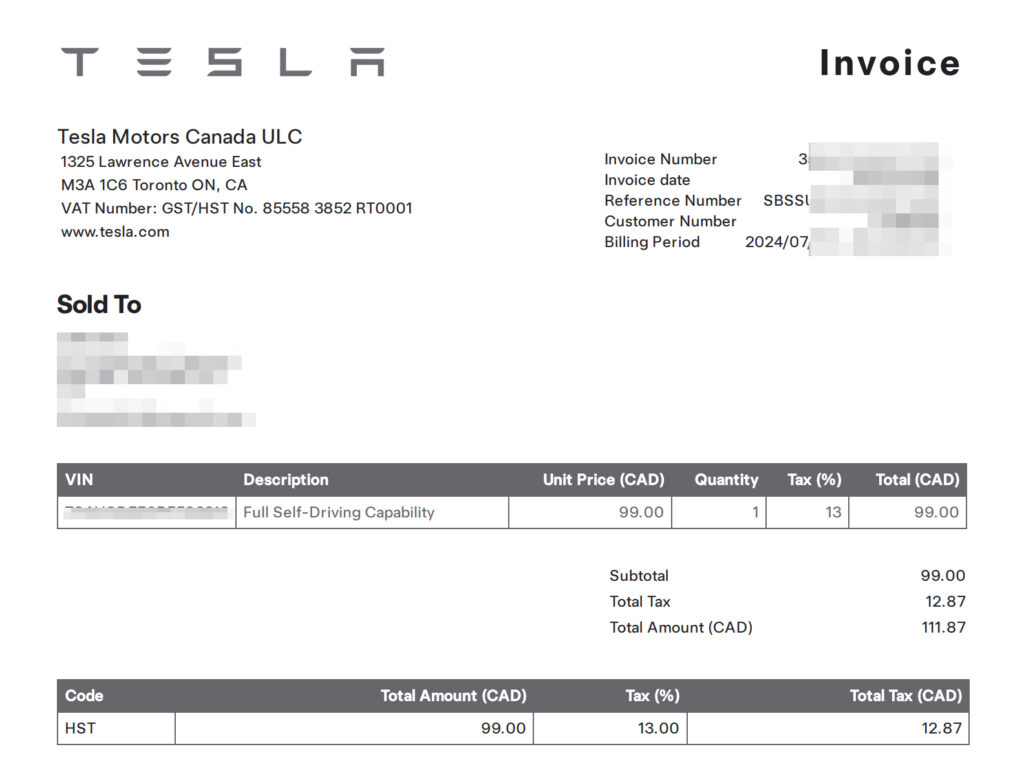
- Canada: C$99/month. You can cancel anytime, but note it is not pro-rated — once you’ve subscribed for the month, you keep it to month’s end, with no partial refund for canceling early.
Now the big news: the one-time purchase was officially discontinued on February 14, 2026. In the US you could once buy FSD outright for $8,000 (and earlier still, as high as $15,000); in Canada it was C$11,000. That option is gone. Tesla has moved fully to a subscription model, so going forward, using FSD essentially means paying monthly.
For most owners, the subscription is actually more flexible — try a month for the price of a tank or two of gas, keep it if you like it, drop it when you don’t. Turn it on for the months you’re road-tripping and off when you’re just commuting. But if you’re the type who plans to keep one car until it dies and use FSD constantly, losing the buyout stings; over the long haul, subscribing isn’t necessarily cheaper.
Run the math: at $99/month, that’s about $1,188 a year, over $3,500 across three years, and close to $6,000 over five. Against the old $8,000 buyout, heavy long-term users genuinely came out ahead buying outright — but that’s no longer on the table. So the calculus has shifted from “should I make a big one-time investment?” to “which months do I actually need it?” My own habit: I cancel during ordinary commuting weeks and subscribe ahead of holidays or long family trips, then re-evaluate. That often works out to three or four paid months a year while still getting the full experience.
One more thing for used-car buyers: the old buyout was tied to the vehicle and could transfer with it (policies flip-flopped over the years), but the FSD transfer windows Tesla used to offer have now closed, and a subscription is tied to your account and does not travel with the car. So don’t assume a used Tesla comes with FSD — you’ll need to start your own subscription. Confirm before you buy.
There’s also a change new buyers need to know about: North American Teslas ordered since January 23, 2026 no longer include basic Autopilot. Out of the box you get Traffic-Aware Cruise Control only — Autosteer (lane centering) now requires an FSD subscription. That makes the subscription decision less optional than it used to be if you’ve grown used to lane-keeping on the highway, so factor it into your monthly math.
If you’re shopping new and want to maximize value at the point of purchase, ordering through an owner referral link is the most direct play. Buying a new Model 3, Model Y, or Cybertruck through a referral link gets you 3 months of free FSD (Supervised) — worth roughly $297 at the $99/month rate. You can use my Tesla owner referral link at checkout; it doesn’t affect your pricing or any other incentives. If you’re not ready to order yet, bookmark it for when you are, and see our Tesla delivery and inspection checklist so the handover goes smoothly.
HW3 vs HW4: the hardware question for older cars
This is far and away the most common question from longtime owners — and our HW3 vs HW4 guide breaks it down in full. Cars delivered in the earlier years run HW3 (Hardware 3), which has meaningfully less compute than the later HW4. As a result, recent major FSD versions have often left HW3 owners watching new features from the sidelines.
The good news: that wait is over. FSD v14 Lite began rolling out wide to all HW3 vehicles on July 21, 2026 — it ships under the same firmware number as the HW4 build, but runs a distilled (compressed) version of the v14 model tuned to fit the older computer. It brings much of the v14 architecture’s benefit to HW3, though capability still trails HW4, and to be clear: HW3 cars have no path to Robotaxi or unsupervised operation.
My advice for HW3 owners: now that v14 Lite is actually on your car, try it on your own roads before drawing conclusions. Everyone’s routes and driving habits differ, so experiences will vary. Only if you genuinely depend on the very latest capabilities should you start weighing a hardware upgrade or a new car. If you’re comparing options, our US Model 3 buying guide walks through current trims and what hardware they ship with.
How to try FSD for free in North America
Plenty of people simply want to sample FSD before committing real money. That’s entirely reasonable. As of 2026, there are two main paths to a free taste:
- 30-day free trial on new cars. New Tesla deliveries in North America come with a 30-day FSD (Supervised) free trial, and Tesla has also pushed trial offers to eligible existing vehicles from time to time. If your car qualifies, watch for the in-car prompt — a free month is well worth taking.
- 3 free months when you buy new via a referral link. This is the most concrete option in my view: order a new Model 3, Model Y, or Cybertruck through an owner referral link and get 3 months of free FSD (Supervised), worth about $297 — though it generally can’t be combined with the 30-day new-car trial, and Tesla confirms the final perk on your order. Use this referral link at order time — it doesn’t change your pricing or eligibility for other incentives.
Three months is more than enough to run FSD through your daily commute, weekend outings, and at least one long trip. By the end you’ll know in your gut whether the monthly fee is worth it — because the only real way to judge FSD is to drive it.
Real-world experience: a long FSD road trip
Specs are dull; here’s what it’s actually like. My friends and I have logged plenty of long FSD trips, and the most representative was a multi-hundred-kilometer highway run heading east across Ontario.
Once on the highway, I engage FSD and the car holds its lane, follows traffic, passes when it should, merges when it should, and changes lanes ahead of the exit the navigation is routing to. The single biggest takeaway is simple: it’s far less tiring. After three or four hours of manual highway driving I used to arrive with sore arms, dry eyes, and a foggy head. With FSD I’m mostly supervising rather than operating — attention still on the road, but body relaxed — and I step out feeling like a different person.
The v14 generation is especially steady on the highway: sensible following gaps, decisive merges, and extra room left around big trucks. That new “miles without intervention” counter is genuinely fun on a long haul — watching the uninterrupted distance tick upward over hundreds of kilometers, with barely a touch of the wheel, does build real confidence in the system.
City driving is dramatically better than the early years too — complex intersections, roundabouts, unprotected left turns are mostly handled with composure. But hit something gnarly — a construction detour, a traffic officer waving cars through, a downpour or snow squall that blinds the cameras — and it will ask you to take over. When it does, you take over.
A few hard-won tips. First, don’t break in FSD downtown amid tight, busy streets — start on a familiar highway or wide arterial to build trust, then work up to harder conditions. Second, FSD lets you tune how assertive it is; new users should start gentler for a smoother ride. Third, when in doubt, take over decisively — a light turn of the wheel or tap of the brake hands control back instantly; never gamble that it’ll figure out a sketchy situation. Fourth, in snow, ice, heavy rain, or thick fog, a camera-only system genuinely struggles, and I’d rather just drive myself than hand it a problem it can’t see.
But I’ll pour some cold water too: FSD is still a Level 2 assistance system, not true autonomy. It can do 90% or more of the daily driving, but that last, hardest bit — every extreme corner case, with no human needed — is still being solved. So there always has to be an alert you behind the wheel. Treat it as a reliable co-pilot, not a hands-off chauffeur, and you’re using it correctly. For a more detailed long-distance log, see our companion piece in the US Tesla section.
Safety and liability: who’s responsible when FSD is on?
This is the part people most often get wrong, so let’s be blunt. Under current law in both the US and Canada, FSD (Supervised) is a Level 2 system, and legal responsibility rests entirely with the driver. If you’re in a collision with FSD engaged, the claim is handled no differently than if you’d been driving manually — fault falls where the facts put it. There is no “the system was driving, so it’s not my fault” defense.
That has direct consequences for insurance. Your premium and your liability don’t change just because FSD was active; you’re the driver, full stop. And a serious warning: using weights, clips, or any device to defeat the steering-wheel hands-on detection can directly jeopardize a claim if it’s discovered after a crash — the vehicle’s own data logs will tell the story. For how a Tesla claim actually plays out, including the FSD-and-fault question, see our detailed Canada Tesla insurance guide.
The system enforces this in real time. Cameras monitor whether you’re distracted; hands off the wheel or eyes off the road for too long triggers escalating alerts and, ultimately, disengagement that can lock you out of FSD for the drive. None of that is Tesla being annoying — it’s the line between a legal Level 2 assist and an unsafe abdication of the controls. For the official framing, read Tesla’s Autopilot and Full Self-Driving support page, and for the regulatory view see NHTSA’s driver-assistance overview and the IIHS guidance on advanced driver assistance. Worth knowing as well: NHTSA has an open investigation into FSD covering roughly 3.2 million vehicles. It’s still ongoing with no conclusion — but it’s one more reason to treat the “Supervised” label seriously.
US vs Canada: the key differences
Both countries are in North America, but using FSD differs in a few ways worth knowing — especially if you drive cross-border or have family on both sides.
| Dimension | United States | Canada |
|---|---|---|
| Subscription price | US$99/month (US$49/month with Enhanced Autopilot) | C$99/month, not pro-rated on cancellation |
| One-time buyout | Discontinued Feb 14, 2026 | Discontinued Feb 14, 2026 |
| Regulatory stance | Allowed as L2 with continuous driver supervision | Allowed as L2 driver assistance; higher levels (L3+) need special authorization in some provinces |
| Feature rollout | Usually first | Follows the US, sometimes by a month or two |
On regulation, both countries treat FSD-type L2 systems the same way in principle: allowed as long as the driver supervises throughout and never lets go of responsibility. Some Canadian provinces (British Columbia, for example) regulate genuine higher-level automation (L3 and up) more strictly and require specific authorization — but because FSD is classified as driver assistance, it isn’t banned across Canadian provinces; you simply must follow ordinary traffic laws and operate it safely. Either side of the border, the core rule is identical: FSD requires driver supervision, so follow your local laws and keep safety first.
Robotaxi progress: seven metros and counting
You can’t talk FSD without touching Tesla’s Robotaxi ambitions. As of late July 2026, here’s where things stand:
- Seven metro areas are live. Robotaxi now operates in Austin (a greater-Austin geofence with no safety monitor on board — a paid service open to the public through the Robotaxi app), plus Houston and Dallas in Texas; Miami (early July), Orlando, and Tampa (July 22) in Florida; and the San Francisco Bay Area, where a safety monitor still rides along in the car.
- Fleet growth. Musk says the Austin fleet is set to double in the coming month, and Tesla’s stated target is to be in roughly 8-10 metro areas by the end of 2026. Phoenix has been rumored but is not confirmed.
- Wider commercialization is reportedly tied to a future FSD v15 (previewed for Q4), pending another step up in capability.
Separately, Musk’s stated goal is to launch unsupervised FSD in the US by the end of 2026. Important caveat: that’s a forward-looking corporate target, and Tesla has repeatedly missed self-driving timelines, so treat it as aspiration and watch official progress rather than the calendar. For us ordinary owners, getting the most out of the v14 we can actually use today beats chasing promises.
Is FSD worth subscribing to? My take
There’s no universal answer — it depends on how you drive. A few ways to think about it:
- Frequent long trips or a long commute: worth it. FSD shows its value most over long stretches of driving; many people find the saved fatigue easily justifies $99/month.
- Mostly short city hops, a few drives a week: use a free trial or the 3 months that come with a new car, then subscribe on demand — on for the months you travel, off otherwise. Cheapest path.
- HW3 owners: v14 Lite is now on your car — try it, then decide based on the real experience.
- Tech enthusiasts who like the latest: a month’s subscription keeps you current with how the system is evolving.
The safest approach is always to try it free first, then decide. If you’re buying new, order through an owner referral link to get those 3 free months of FSD — drive it enough to form your own verdict, and the answer comes naturally.
Frequently Asked Questions
Can I still buy FSD outright in 2026?
No. The one-time buyout ended on February 14, 2026. It’s subscription only now: US$99/month (US$49/month if you have Enhanced Autopilot) in the United States, and C$99/month in Canada.
Can older HW3 cars run the latest FSD v14?
The full v14 build is too demanding for HW3 hardware, but Tesla’s trimmed “v14 Lite” — a distilled version of the v14 model — began rolling out wide to all HW3 vehicles on July 21, 2026. It brings much of the new behavior to older cars, though capability still trails HW4, and HW3 has no path to Robotaxi or unsupervised operation.
Is there a way to try FSD for free?
A couple. First, new cars come with an official 30-day free trial (and Tesla occasionally pushes trials to eligible existing vehicles). Second, buy a new car through an owner referral link to get 3 months of free FSD (Supervised), worth about $297 — one of the most direct free-trial paths available.
Is FSD true self-driving? Can I sleep while it drives?
No, and absolutely not. FSD (Supervised) remains a Level 2 driver-assistance system that requires full driver supervision and instant readiness to take over. Cameras monitor for distraction; hands off the wheel or eyes off the road too long triggers warnings and disengagement. Always follow your local laws.
If I crash while using FSD, who’s liable?
Under current law, FSD (Supervised) is Level 2 and legal responsibility rests entirely with the driver. A claim is handled exactly as if you were driving manually — fault falls where the facts put it, with no “the system was driving” defense. Defeating the hands-on detection can jeopardize a claim, since the vehicle data records what happened. See our Canada Tesla insurance guide for details.
When will Robotaxi reach my city?
As of late July 2026, Robotaxi operates in seven metro areas: Austin (no safety monitor, open to the public via the app), Houston, Dallas, Miami, Orlando, Tampa, and the San Francisco Bay Area (safety monitor on board). Tesla is targeting roughly 8-10 metros by the end of 2026; Phoenix has been rumored but is not confirmed. Larger-scale commercialization is expected to tie to a future FSD v15 — watch Tesla’s official announcements.
Summary
Tesla FSD in 2026 is no longer the novelty toy of its early days. The v14.3 series — currently v14.3.6 — brings faster reactions, smarter parking, a smoother ride, the miles-without-intervention counter, and a dedicated app hub — a clear step up in overall maturity. Pricing has shifted fully to subscription with the buyout gone, which cuts both ways but actually lowers the barrier to trying it. HW3 owners now have v14 Lite on their cars. Robotaxi is live in seven metro areas and expanding, and unsupervised FSD for owners remains an enticing but unproven target. Above all, remember the one rule that never changes: FSD (Supervised) is a Level 2 driver-assistance system, and you, the driver, are responsible at all times.
Whether it’s worth it, you’ll only know by driving it. The smart move is to sample it free — via the official trial, or by ordering a new car through an owner referral link for 3 months of free FSD — then decide whether to keep the subscription.
Information currency: this article was updated in July 2026. Version numbers, prices, Robotaxi coverage, and release timelines all follow Tesla’s latest official announcements and may change at any time. Safety note: FSD (Supervised) is a Level 2 driver-assistance system that requires full driver supervision at all times — never rely on it hands-off or eyes-off, and always follow your local laws. This is general information, not legal, financial, or driving-safety advice. Some links are affiliate/referral links; see our disclosure page. Image credit: Tesla / tslna.com.
About the author: Lifei Zhou
Model Y owner since 2022Ontario STO registered apprentice · 310SWorks on Porsche, Mercedes, BMW, Audi weeklyHundreds of readers referred (est.)
Lifei is a Tesla owner based in Canada, writing practical, fact-checked Tesla guides for US and Canadian drivers — buying, ownership, insurance, charging, and TSLA investing, all from first-hand experience.