
Cost to Charge a Tesla in 2026: Home vs Supercharger, and Canada’s Supercharger Price Changes
Cost to Charge a Tesla in 2026: Home vs Supercharger, and Canada’s Supercharger Price Changes

Charging a Tesla at home costs roughly 4 to 5 cents a mile, or about $9 to $12 for a full battery at average electricity rates. A Supercharger costs two to three times as much, at around 10 to 12 cents a mile. Both are usually cheaper than gasoline.
Cost to charge a Tesla, in short
- Home, United States: about 17 cents per kWh on average, so roughly $9 to $12 for a full charge.
- Home, Canada: about 14 cents per kWh on average, and under 10 cents in Quebec, Manitoba and British Columbia.
- Superchargers, United States: about $0.30 to $0.45 per kWh at most stations.
- Superchargers, Canada: about C$0.25 to C$0.60 per kWh. Tesla changed prices at most Canadian stations twice in September 2026.
- A year of home charging for 12,000 miles: about $450 to $600.
“How much does it actually cost to charge a Tesla?” is one of the first questions any EV-curious driver asks — and the honest answer is “it depends, but almost certainly less than you think.” Where you plug in matters enormously: charging overnight in your own garage can cost a third of what you’d pay at a Supercharger on a road trip, and both are usually cheaper per mile than filling a comparable gas car. The trick is knowing the numbers for each scenario so you can plan around them.
This 2026 guide breaks down the real cost of charging a Tesla in the United States and Canada — home charging versus Supercharging, cost per mile and per kilometre, how it stacks up against gasoline, what makes your bill go up or down, and the concrete steps that bring it as low as possible. All figures reflect prices as of mid-2026 and use ranges rather than false precision, because electricity and energy prices move constantly and vary wildly by region.
Disclosure: some links in this article are affiliate/referral links. If you buy or sign up through them, we may earn a small commission at no extra cost to you. All numbers are based on public data and real owner experience, with no paid placement. This is general information, not financial advice — your local utility rates and Tesla’s live pricing govern. See our disclosure page.
📋 Contents
- Home charging: cost per kWh and what a full charge costs in 2026
- Supercharger cost: price per kWh and the membership question
- Supercharger price changes in Canada (September 2026)
- Cost per mile and cost per kilometre
- Tesla vs gas car: how much you actually save
- What drives your charging cost up or down
- How to get your charging cost as low as possible
- Frequently Asked Questions
Home charging: cost per kWh and what a full charge costs in 2026
Home charging is where most Tesla owners do roughly 80–90% of their charging, and it’s by far the cheapest option. The math is simple: you pay your home electricity rate per kilowatt-hour (kWh), plus a small amount for charging losses (you lose around 8–12% of the energy to heat and overhead, so a “full charge” pulls a bit more from the wall than the battery actually holds).
- Home, overnightabout 80 to 90%
- Superchargers and public chargersabout 10 to 20%
Rough shares for an owner with home charging. Without a home charger the split flips, and so does the cost.
In the United States, the average residential electricity price in 2026 sits in the low-to-mid 17¢ per kWh range nationally, according to the U.S. Energy Information Administration — but the spread is dramatic. Drivers in the cheapest states (parts of the Midwest, the Dakotas) pay around 11–13¢/kWh, while Hawaii tops 40¢/kWh and California often runs in the high 20s to low 30s. In Canada, the national average lands near 14¢/kWh, with Quebec and Manitoba among the cheapest in North America (roughly 8–10¢/kWh) thanks to abundant hydro, British Columbia around 10¢/kWh, Ontario in the 12–15¢/kWh range depending on tier and time of day, and the northern territories far higher.
To put that into a full-charge figure, take a 2026 Model Y Long Range with roughly 75–79 kWh of usable battery, and a Model 3 RWD with about 60 kWh. Charging from near-empty to full at home, the energy cost works out roughly like this:
- Model 3 RWD (~60 kWh usable) — at 14¢/kWh you’re looking at about $9–10 for a full charge; at 30¢/kWh (expensive market), around $19–20.
- Model Y Long Range (~75 kWh usable) — at 14¢/kWh, roughly $11–12 full; at 30¢/kWh, around $24–25.
Most owners almost never charge from 0 to 100% in one go, though — they top up nightly by 20–40%, which means a typical “fill” feels like a couple of dollars rather than a tank of gas. For a deeper dive on the equipment and installation side, see our guide to Tesla home charger installation.
Supercharger cost: price per kWh and the membership question
Superchargers are Tesla’s fast-charging network, built for road trips and quick top-ups, not daily charging — and they cost noticeably more than charging at home because you’re paying for the convenience, the high power, and the real-estate and demand charges Tesla incurs.
In 2026, U.S. Supercharger pricing for most stations falls roughly in the $0.30–$0.45 per kWh band for pay-as-you-go drivers, with off-peak windows at some stations dipping lower and premium California/Hawaii/high-demand sites reaching $0.50–$0.60 or more at peak. Tesla also uses time-of-use pricing, so the same stall can cost more during busy “peak” hours and less overnight. Canadian Supercharger rates run about C$0.25–0.60 per kWh, varying by province, station, and time of day; the next section covers the September 2026 changes.
Then there’s the membership — and a common misconception to clear up. Tesla’s $12.99/month Supercharging Membership is for drivers of non-Tesla EVs, who otherwise pay a higher guest rate (roughly $0.43/kWh typical versus about $0.32/kWh for members). Tesla owners don’t need any membership: your car simply bills the standard owner per-kWh rate through your Tesla account. If you drive a non-Tesla EV and Supercharge more than about 130 kWh a month, the membership usually pays for itself; occasional road-trippers do better on pay-as-you-go. For a full breakdown of network pricing, see our dedicated Tesla Supercharger cost guide.
Translating that to a charge: a Model Y Long Range topped from 10% to 80% at a Supercharger (the typical fast-charge window, about 50 kWh) costs roughly $15–22 at $0.30–$0.45/kWh, and more in expensive markets. Notice that’s two to three times the home cost for the same energy — which is exactly why the golden rule is “home for daily, Superchargers for travel.”
Supercharger price changes in Canada (September 2026)
If you noticed your usual Supercharger costing more this fall, you are not imagining it. Tesla changed prices at most Canadian stations twice in September 2026, according to Drive Tesla Canada, which tracks the rates station by station.
- September 11: prices changed at more than 275 stations. They went up at more than 200 and down at 65. Most increases were small, between 1 and 3 cents per kWh, but a few cities saw bigger jumps.
- September 24: Tesla changed 240 stations again, raising 170 and cutting 70. Calgary and Edmonton, which had jumped to $0.57, came back down to $0.48. Saskatoon went from $0.54 to $0.48. Nova Scotia kept climbing, with Enfield reaching $0.75 at peak.
Each bar runs from the old price to the new one. Prices reported by Drive Tesla Canada.
What to take from this: Supercharger prices in Canada are set station by station and now move often, in both directions. Across the country they run from about $0.25 to $0.60 per kWh, with a few stations above that. Check the price on the car’s screen or in the Tesla app before you plug in, and charge at home when you can. Our Supercharger cost guide covers idle and congestion fees.
Cost per mile and cost per kilometre
The cleanest way to compare charging to gasoline — and to compare home versus Supercharging — is cost per mile (or per km). A Tesla uses roughly 250–300 watt-hours per mile (about 0.25–0.30 kWh/mile, or ~0.16–0.19 kWh/km) in mixed real-world driving, with the Model 3 on the efficient end and the Model Y a touch higher.
- Home charging at ~15¢/kWh: roughly 4–5¢ per mile (about 2.5–3¢ per km). Over 12,000 miles a year, that’s around $450–600 in “fuel.”
- Supercharging at ~$0.38/kWh: roughly 10–12¢ per mile (about 6–7¢ per km) — still competitive with gas, but clearly pricier than home.
Home charging at about 15¢/kWh, Supercharging at about $0.38/kWh, gasoline at about $3.95 a gallon.
The takeaway: a Tesla owner who charges mostly at home spends single-digit cents per mile to drive, while even worst-case Supercharger-only driving tends to stay at or below the per-mile fuel cost of an efficient gas sedan.
Tesla vs gas car: how much you actually save
Here’s where electricity’s advantage shows up. As of mid-2026, the U.S. national average for regular gasoline is roughly $3.90–$4.00 per gallon (it has swung between about $3.60 and $4.50 across the year). A reasonably efficient gas car at 28 mpg costs about 14¢ per mile in fuel; a thirstier SUV at 22 mpg pushes toward 18¢/mile. You can model any vehicle on the official fueleconomy.gov calculator.
Stack that against a Tesla:
- Versus home charging (4–5¢/mile), the Tesla driver saves roughly 9–13¢ per mile. Over 12,000 miles, that’s about $1,100–1,500 a year in fuel alone.
- Even versus Supercharger-only charging (10–12¢/mile), there’s still a modest per-mile saving over an average gas car — plus you skip oil changes, spark plugs, and most engine maintenance.
Canadian drivers see a similar pattern: with gas typically in the C$1.50–1.80/litre range and cheap hydro electricity in several provinces, home-charged EVs often beat gas by an even wider margin per kilometre. For a fuller savings picture including incentives and maintenance, read our Tesla savings guide for the USA.
What drives your charging cost up or down
Two identical Teslas in two driveways can have very different charging bills. The main factors:
- Time-of-use rates. Many utilities in California, Ontario, and elsewhere charge far less overnight (off-peak) than during the day. Ontario’s Ultra-Low Overnight plan, for example, prices overnight power at just 3.9¢/kWh (per the OEB — check current rates). Scheduling charging for off-peak hours — easy to set in the Tesla app — can cut your home rate by 30–50% or more.
- Temperature. Cold weather is the biggest swing factor. In deep winter, range can drop 15–30% because the battery and cabin need heating, and preconditioning draws extra energy. That raises your effective cost per mile in January versus July.
- Battery health and chemistry. LFP batteries (in some RWD models) are happy charging to 100% daily; NMC packs prefer an 80–90% daily ceiling. Over years, gradual battery degradation slightly raises kWh-per-mile, though it’s usually minor.
- Driving style and speed. Highway speeds above 70 mph, hard acceleration, and roof racks all spike consumption. Efficiency falls off fast at high speed.
- Charging losses. Slow Level 1 (120V) charging is less efficient than a proper Level 2 wall connector, so a 240V home setup is both faster and slightly cheaper per added mile.
How to get your charging cost as low as possible
A few habits and small purchases compound into real savings:
- Charge at home, on a schedule, off-peak. This single move is responsible for most of the savings. Set a charge limit (80–90% for daily NMC, 100% for LFP) and a start time after off-peak rates kick in.
- Install Level 2 charging. A 240V circuit and a wall connector charge several times faster than a standard outlet and waste less energy. If you’re hardwiring or want a flexible plug-in option, owners commonly add a robust NEMA 14-50 outlet (Amazon US) or the equivalent in Canada for their garage.
- Carry a portable charger for flexibility. A good portable mobile connector (Amazon US) lets you top up at any standard or 240V outlet — handy at relatives’ homes or rentals where Superchargers aren’t around.
- Use free and cheap chargers when you can. Workplaces, malls, hotels, and some municipal lots offer free or low-cost Level 2 charging. A CCS-to-Tesla adapter (Amazon US) also opens up many third-party DC fast chargers, which sometimes undercut Supercharger pricing.
- Supercharge strategically. On road trips, charge to about 80% (charging slows sharply above that), favour off-peak Supercharger pricing where dynamic rates apply, and precondition the battery on the way so you charge faster and waste less.
- Consider solar. If you have rooftop solar, charging during sunny hours can drop your effective fuel cost close to zero.
If you don’t own a Tesla yet and are about to order, ordering a Model 3, Model Y, or Cybertruck through a Tesla referral link currently gets you three months of free FSD (Supervised) — worth about $297 at the subscription price — and Tesla’s referral perks have occasionally included Supercharging credits in past rounds.
| Scenario (2026) | Model 3 RWD (~60 kWh) | Model Y LR (~75 kWh) | Cost per mile |
|---|---|---|---|
| Home @ 14¢/kWh | ~$9–10 full | ~$11–12 full | ~4¢ |
| Home @ 30¢/kWh (pricey) | ~$19–20 full | ~$24–25 full | ~8–9¢ |
| Supercharger @ $0.38/kWh | ~$23 full (10–80%: ~$15) | ~$29 full (10–80%: ~$19) | ~10–12¢ |
| Gas car @ 28 mpg, $3.95/gal | — | — | ~14¢ |
Figures are illustrative 2026 estimates including typical charging losses; your actual cost depends on local rates, time of day, weather, and driving style.
Frequently Asked Questions
Is it cheaper to charge a Tesla at home or at a Supercharger?
Home charging is almost always cheaper — typically two to three times less per kWh than a Supercharger. Use home charging for daily driving and reserve Superchargers for road trips and quick top-ups.
How much does it cost to fully charge a Tesla in 2026?
At a typical home rate around 14¢/kWh, a full charge runs roughly $9–12 for a Model 3 RWD or Model Y Long Range. At a Supercharger, a comparable charge is roughly $20–30 depending on local pricing and time of day.
Is charging a Tesla cheaper than buying gas?
Yes, in nearly all cases. Home charging costs about 4–5¢ per mile versus roughly 14¢ per mile for a 28-mpg gas car — a saving of around $1,100–1,500 a year over 12,000 miles, before maintenance savings.
Is the Tesla Supercharger membership worth it?
The $12.99/month membership only applies to non-Tesla EV drivers — Tesla owners pay the standard owner rate automatically and don’t need it. For non-Tesla drivers, it drops the guest rate (about $0.43/kWh) to roughly the owner rate (about $0.32/kWh), so it pays off once you Supercharge more than about 130 kWh a month. Total up your monthly Supercharger kWh and compare.
Does cold weather make charging more expensive?
Effectively, yes. Cold weather can cut range 15–30% because the battery and cabin draw extra energy for heating, raising your cost per mile in winter. Preconditioning while plugged in and parking in a garage both help.
How much does charging cost in Canada versus the US?
Canada is often cheaper for home charging thanks to low-cost hydroelectricity in provinces like Quebec, Manitoba, and BC (roughly 8–10¢/kWh), while US home rates average in the high teens. Supercharger pricing is broadly comparable in local-currency terms.
Summary: charging a Tesla in 2026 is cheap when you do it right. Home charging at typical rates costs a few dollars to add a day’s range and works out to single-digit cents per mile — a big saving over gasoline — while Superchargers cost more but remain reasonable for travel. Charge at home off-peak, set up Level 2, use cheap or free chargers when available, and reserve Supercharging for road trips, and your real-world cost stays near the bottom of every range above.
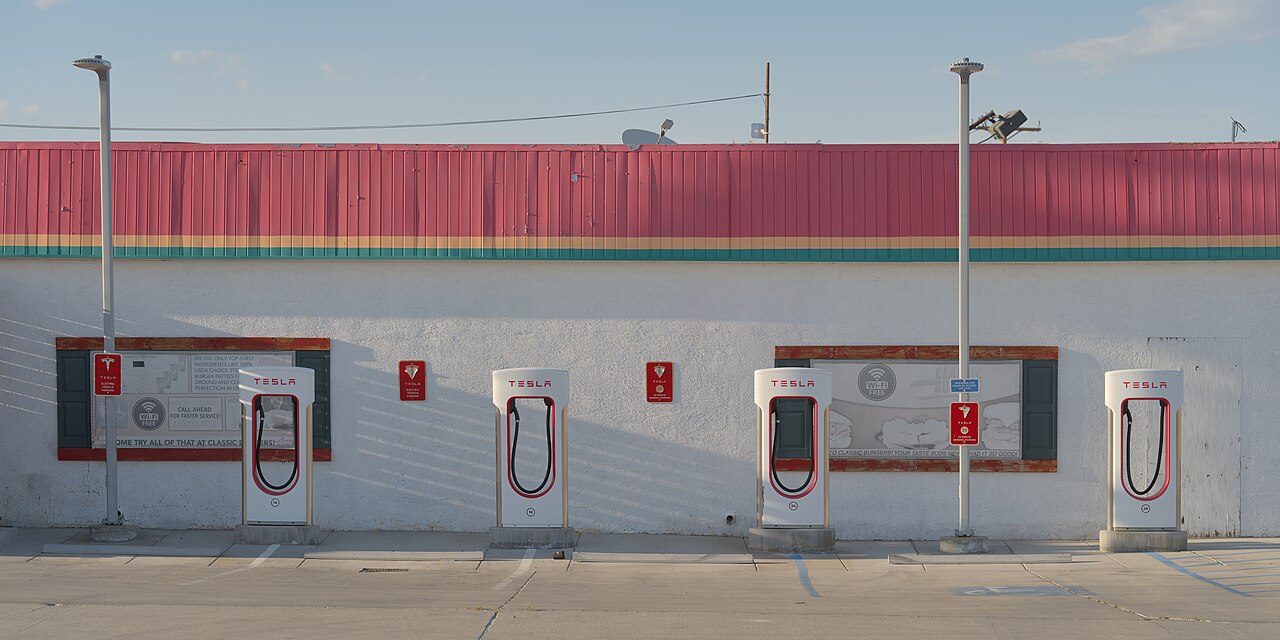
This article is general information based on mid-2026 public data and is not financial advice; electricity, gas, and Supercharger prices change frequently and vary by region, so confirm current rates with your utility and Tesla’s live pricing before budgeting. Some links are affiliate/referral links — see our disclosure page. Image credit: via Wikimedia Commons (Creative Commons).

About the author: Lifei Zhou
Model Y owner since 2022Ontario STO registered apprentice · 310SWorks on Porsche, Mercedes, BMW, Audi weeklyHundreds of readers referred (est.)
Lifei is a Tesla owner based in Canada, writing practical, fact-checked Tesla guides for US and Canadian drivers — buying, ownership, insurance, charging, and TSLA investing, all from first-hand experience.