
Tesla Camp Mode Guide 2026: Battery Use, Where to Sleep & Gear
Tesla Camp Mode Guide 2026: Battery Use, Where to Sleep & Gear

In one sentence
How Tesla Camp Mode works, how much battery a night really uses, where it's legal to sleep in North America, plus the mattress, sunshade, and gear you need (2026).
The moment summer arrives, the same question floods my inbox: can you really just sleep inside your Tesla on a camping trip, under the stars, or by the beach? Will you wake up to a dead battery, a stuffy cabin, or a security guard tapping on the glass at 2 a.m.? Over the past few years I’ve slept more than a dozen nights in my Model Y — in California, Nevada, and the lake country of Ontario — going from a fumbling first attempt to setting up the bed with my eyes closed. Every mistake I made and every hotel night I saved, I’ll lay out for you here in one place.
The good news is that a Tesla is fundamentally better suited to car sleeping than any gas car. It has a dedicated Camp Mode that keeps the climate control, screen, audio, and charging ports running all night long — and because it’s fully electric, running the A/C overnight produces zero carbon monoxide. That’s something gas-car owners simply cannot match. The catch is that a lot of people misunderstand the power draw, the legal places to park, and the comfort side of things, and only find out the hard way once they’re out on the road.
This guide walks through everything a North American owner needs to know about sleeping in the car, in order: what Camp Mode is, how to turn it on, how much battery a night really uses, where it’s legal to sleep, what gear makes it comfortable, and how to plan your charging. Whether you drive a Model 3, a refreshed Model Y, or a Model S/X, it all applies — and everything below reflects the situation as of 2026.
Disclosure: some links in this article are affiliate/referral links. If you place an order or get a quote through them, we may earn a small commission at no extra cost to you, and it never affects our independent recommendations. This is general information, not legal advice — always follow local laws and posted signs. See our disclosure page.
📋 Contents
- What Camp Mode actually is — and how it differs from Keep and Dog Mode
- How to turn on Camp Mode — three steps
- How much battery does a full night really use?
- Which Teslas can you sleep in? Interior space, measured
- Where is it legal to sleep overnight in North America?
- Sleep more comfortably: the essential gear list
- Safety first: do these things before you sleep
- A few practical tricks from experience
- Summer vs. winter: two different approaches
- Frequently Asked Questions
- Summary
What Camp Mode actually is — and how it differs from Keep and Dog Mode
Tesla has three “keep the climate running” modes with confusingly similar names but completely different jobs. Mix them up and you’ll get caught out. In short:
- Keep — for when you’ve parked and stepped away but want the A/C to keep running (because there’s still a person or something temperature-sensitive in the car). It only maintains the cabin temperature; the screen dims and the doors auto-lock. It is not designed for overnight stays.
- Dog Mode — built specifically for pets left in the car. It keeps the cabin cool and displays a large message on the touchscreen telling passersby “My owner will be back soon, it’s 22°C inside,” so no well-meaning stranger smashes a window to rescue the dog.
- Camp Mode — this is the one built for people staying in the car for a long time, or overnight. It maintains the climate and keeps the touchscreen, audio, USB, and 12V outlets powered the whole time, while disabling auto-lock so you don’t accidentally lock yourself out when you step out for a midnight bathroom break.
In other words, Camp Mode turns your car into a tiny air-conditioned bedroom. Once it’s on, you can fold the seats flat, lie down under a blanket, stream shows, listen to music, and charge your phone, all while the temperature holds steady through the night. It has been standard on every Tesla since 2019 — no extra option to buy, no subscription, completely free to use.
How to turn on Camp Mode — three steps
It’s very simple. Once you’ve parked and shifted into Park:
- Tap the temperature (fan) icon at the bottom of the touchscreen to bring up the climate control panel.
- Find the Camp option in that panel and tap it. The screen switches to the camp interface, showing the current cabin temperature and the estimated time remaining.
- Set your target temperature (I usually go 22–24°C in summer, 18–20°C in winter) and let the car hold it from there.
Once it’s on, you can stay in the car or step away briefly — the climate won’t cut out. To turn it off, shift back into Drive or simply exit Camp Mode on the screen. One handy detail: while Camp Mode is running, the Tesla phone app shows you the cabin temperature and battery level remotely, so if you want to check whether you have enough charge in the middle of the night, you just reach for your phone instead of getting up.
There’s one easily overlooked safeguard: Camp Mode only runs while the battery is above 20%. The moment your charge drops to 20%, the system automatically exits, reserving the remaining range to get you to the nearest charger. So range anxiety while camping is, in fact, backstopped by the car itself — it won’t let you actually strand yourself in the wild.
How much battery does a full night really use?
This is the most-asked and most-misunderstood question of all. Many people assume one night of A/C drains half the battery, but the reality is nowhere near that dramatic. Pooling real owner tests and media measurements, Camp Mode in mild weather draws roughly the following:
| Scenario | Draw per hour | Over 8 hours of sleep |
|---|---|---|
| Mild summer night (15–25°C) | about 1% / hour | about 8–10% |
| Hot summer night (above 30°C, A/C running hard) | about 1.5–2% / hour | about 12–16% |
| Cold winter night (near 0°C / 30°F) | about 2–3% / hour | about 15–20% |
In plain terms: on most summer nights, a full night’s sleep costs only around 10% of your battery — about the same as driving a few dozen kilometres of highway. Even on a near-freezing winter night, you’ll lose at most a fifth. So as long as you start the night above 50%, you’ll not only wake up comfortable enough to leave but still have plenty of range to reach a Supercharger.
A few variables are worth remembering: the outside temperature (the more extreme, the more power), the cabin temperature you set (the bigger the gap from outside, the more power), whether you keep the big screen running movies all night (the display and audio draw power too), and the model itself. Cars with a heat pump (Model Y, and Model 3 from 2021 on) are noticeably more efficient in the cold, which is one reason they’re especially well suited to camping. For more on how overnight cycling affects long-term battery health, see our deep dive on Tesla battery degradation.
One practical tip: if the campsite or a friend’s place has an outlet, even an ordinary 120V household plug (using Tesla’s included Mobile Connector) will roughly offset Camp Mode’s draw while you sleep — the battery essentially stays put. Plug into a 240V Level 2 charger and you’ll actually gain charge overnight.
Which Teslas can you sleep in? Interior space, measured
Every Tesla can run Camp Mode, but how comfortably you can stretch out depends on interior space. The best car for sleeping is the Model Y — with the rear seats folded, it’s nearly flat from the trunk all the way to the front seats, giving you a natural double-bed footprint. Here’s roughly how each model measures up with the seats down:
| Model | Length when flat | Good for two? |
|---|---|---|
| Model Y | about 76–83 in. (longer with front seats slid forward) | Best in class — two adults fit comfortably |
| Model 3 | Rear seats don’t fold fully flat; a bit short | Comfortable for one; tight for two |
| Model X | Roomy, but a step between the second and third rows | Needs leveling; can sleep two |
| Model S | Sedan shape, limited length | One person barely; not recommended for two |
Take the Model Y: with the rear seats folded you get about 76 inches, and by sliding the front seats as far forward as possible you can stretch that to 83 inches (about 2.1 m), enough for anyone up to roughly 6’2″ to lie out. Two things to watch: first, even folded flat the rear seatbacks still have a gentle 7–10 degree incline, plus a small step of a few centimetres up to the trunk floor; second, the narrowest point between the wheel wells is about 41 inches, so size your mattress to that width and don’t buy one too wide to fit. A proper inflatable mattress flattens all of this out easily — more on gear below.
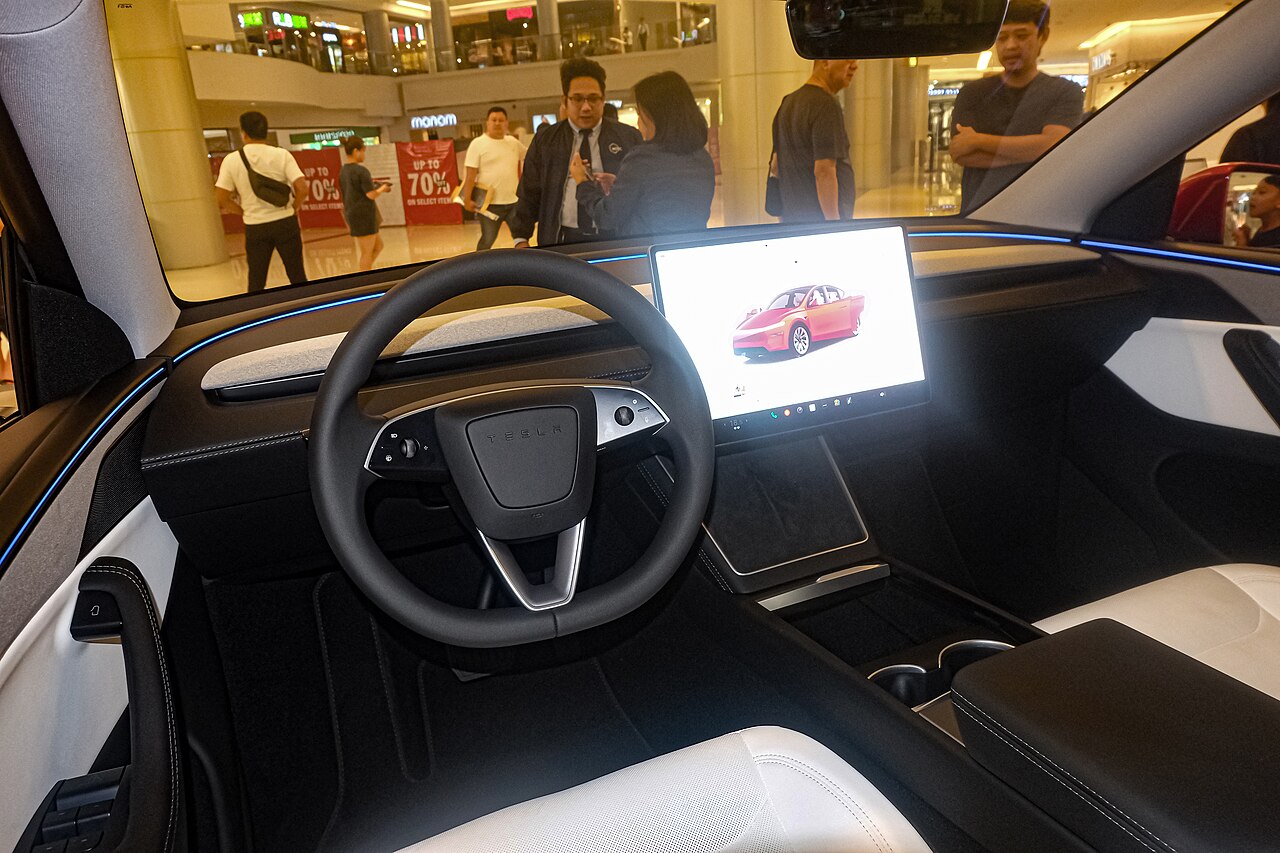
If you’re still deciding which Tesla to buy and which version suits long road trips and camping, it’s worth noting that placing your order through an owner referral link currently gets you 3 months of free FSD (Supervised) — worth about $297 at the $99/month subscription price, a genuine perk for anyone who drives a lot of long distances.
Where is it legal to sleep overnight in North America?
Your bed is set up and your battery is topped off — now the last and most easily botched question: where can you actually park to sleep? Sleeping in your car is not itself illegal in the vast majority of US states, but whether a specific patch of ground allows it, and for how long, is decided by local rules and the property owner. By common type:
Walmart and other big-box lots
Many Walmart locations have traditionally been friendly to RVs and overnight parking — but this is a store-by-store thing. Some welcome it; others are barred by local ordinance. The safest move is to go in and ask a manager whether overnight stays are allowed and which corner to use. Even where it’s permitted, you have to stay inside the car — no pitching a tent or setting up chairs and tables to “camp” outside. The same goes for Cracker Barrel restaurants and some Cabela’s / Bass Pro stores, which RV travelers often use as overnight stops. Walmart spells out its case-by-case policy on its own corporate site, and it’s always store discretion.
Highway rest areas
Many states’ highway rest areas allow short-term overnight parking, so long-haul drivers can nap and avoid fatigued driving — but rules differ by state and by rest area, and some cap how long you can stay (a few hours, say). Read the posted signs before you settle in, so you’re not woken up mid-sleep.
National forests, BLM land, and dispersed camping
For a wilder, quieter experience, head to land managed by the Bureau of Land Management (BLM) or to national forests — many allow free dispersed camping, where you simply drive in, find an open spot, and stay the night (the RV crowd calls this boondocking). Inside national parks, by contrast, you usually have to reserve a campsite in advance and pay a modest fee; you can’t just park anywhere. The BLM publishes where dispersed camping is permitted on blm.gov.
Established campgrounds and a note on Canada
The most hassle-free option is still an established campground or a KOA — many have electrical hookups so you can charge while you sleep. Canada follows similar logic: some Walmarts allow overnight stays, provincial and national parks require a reserved site, and cities often have “no overnight parking” ordinances — watch the signs especially in big cities like Vancouver and Toronto. The whole thing boils down to one rule: on private land, ask the owner; in public areas, read the signs; when in doubt, move on rather than gamble.
Sleep more comfortably: the essential gear list
About seventy percent of how comfortable a night in the car feels comes down to gear. These are the items I’ve found most worth it, ranked by importance, with links to the specific products I’d buy — clicking through never affects your price:
- An SUV inflatable mattress. This is the single most important piece — it flattens out the seatback incline and the trunk step and transforms how you sleep. The Ciremiv SUV air mattress fits the Model Y and Model 3 with the rear seats folded and inflates in minutes (Canadian readers: Amazon Canada).
- A full sunshade / blackout set. The glass roof is a Tesla signature, but when camping it lets the morning sun wake you at dawn, and during the day it cuts heat and gives you privacy. The BASENOR folding sunshade set solves all of this and folds away compactly.
- A small USB or rechargeable cabin fan. Even with the A/C holding temperature, a little airflow keeps the cabin from feeling stuffy and helps with condensation on the glass. A compact clip-on fan runs off the USB port and barely sips power.
- A portable air compressor. Camping often means unpaved roads where tire pressure shifts, and a compact inflator like the AstroAI tire inflator can both top up your tires and pump up the mattress — one tool, many jobs.
Beyond that, a sleeping bag or a thin duvet, a couple of pillows, and a small wedge cushion to fill the gap between the front seats and the cargo area pretty much complete the kit. For a more systematic accessories rundown, our Tesla summer road trip guide covers what to pack before you head out.
Safety first: do these things before you sleep
The biggest safety advantage of overnighting in an EV is that running the A/C burns no fuel and emits no exhaust, so the cabin never accumulates carbon monoxide — something a gas car idling overnight absolutely cannot guarantee, and people die from it every year. But “EVs are safer” doesn’t mean you can sleep without precautions. Run through this checklist before you turn in:
- Lock the doors manually. Camp Mode disables auto-lock so you can come and go freely, but that also means the doors may be unlocked once you’re asleep. Lock up via the phone app or the in-car screen before bed — both for security and for warmth.
- Sentry Mode turns off automatically. Under Camp Mode, Sentry and the vehicle alarm are disabled, since they’d keep recording and waking you and would drain extra power. So park somewhere safe and well-lit.
- Leave a window cracked for ventilation. There’s no CO risk, but two people breathing in a sealed cabin all night will fog the glass and make the air stuffy. Crack a window a centimetre or two, or occasionally run the climate on fresh-air mode.
- Don’t let the battery run too low. As noted, Camp Mode exits below 20%; start every night above 50% to leave margin for the morning drive and for finding a charger.
- Be extra careful with pets or kids. Set a comfortable steady temperature and keep the phone app’s remote monitoring on, so even a midnight bathroom trip lets you glance at the cabin conditions.
One more reassurance: running Camp Mode all night is normal use and won’t harm the battery — Tesla designed it that way, so don’t worry. What you genuinely want to avoid is parking in blazing sun for long stretches and overheating the pack, which is unrelated to Camp Mode itself.
A few practical tricks from experience
Finally, a handful of details I’ve worked out myself that tutorials rarely mention, each of which can lift the car-sleeping experience another notch.
First, pre-cool or pre-heat the cabin to your target before switching on Camp Mode. If you arrive at a sweltering campsite on a summer evening, blast the regular A/C for ten or fifteen minutes to bring the temperature down, then switch to Camp Mode to hold it — that’s both more comfortable and more efficient than letting Camp Mode crawl down from a hot start. The phone app can also pre-condition remotely so the car is already cool when you get back.
Second, lean on seat heating rather than cranking up the cabin temperature. On a winter night, instead of heating the whole cabin high, set the climate a little lower and let the seat heaters deliver warmth straight to your body — lower overall draw, and a cozier you. Many Model Y and Model 3 versions have rear seat heating, so don’t waste it.
Third, stash valuables in the frunk. With Sentry off in Camp Mode, when you’re parked in a public spot, items like cameras and laptops are safer locked in the front trunk than left in the cabin. The same applies when you step out to shop or use the restroom.
Fourth, download your entertainment in advance. Backcountry sites often have no signal, so Tesla Theater streaming may stutter — cache the shows and music you want before you leave, or load up a USB drive with movies. That drive doubles as your Sentry recording stick, killing two birds with one stone. If you’re planning a longer haul, our Supercharger cost guide helps you budget the charging stops along the way.
Fifth, watch out for areas with big day-to-night temperature swings. In the American Southwest deserts or the Canadian mountains, it can be over 30°C in the day and drop to single digits in the small hours. Don’t set the temperature only to how it feels when you doze off — bring an extra blanket and pick a camp temperature that handles the overnight drop, so you’re not jolted awake by the cold at 3 a.m.
Summer vs. winter: two different approaches
Even though it’s the same act of sleeping in the car, summer and winter call for completely different priorities.
In summer, the focus is heat management and blackout. Daytime sun heats the cabin fast, so park in tree shade or a garage where you can; pre-cool with the regular A/C for a few minutes before lying down; and absolutely install the sunshades, or you’ll be wide awake the moment the sky lightens at 4 or 5 a.m. The upside is that on mild summer nights Camp Mode is very efficient, making it the best season of the year for car sleeping.
In winter, the focus is warmth and range. In the cold, Camp Mode draws up to 2–3% per hour, and the battery’s range is already reduced by low temperatures, so winter camping especially demands starting from a high charge and, ideally, plugging in. Heat-pump models shine here. Dressing warmly and packing a heavier sleeping bag saves power and keeps you more comfortable than relying on the A/C alone.
Frequently Asked Questions
Will sleeping a whole night with Camp Mode on damage the battery?
No. Running Camp Mode overnight is normal, officially supported use and won’t harm the battery or shorten its life. It even has a 20% auto-exit safeguard so you always have enough range to reach a charger. What you actually want to avoid is overheating the pack through long stretches of direct sun, which has nothing to do with Camp Mode itself.
Can you get carbon monoxide poisoning running the A/C overnight in summer?
No. A Tesla is fully electric — running the A/C burns no fuel and emits no exhaust, so no carbon monoxide builds up in the cabin. That’s exactly where an EV is safer overnight than a gas car. Still, crack a window for ventilation to keep the air fresh and reduce fogging.
Can you sleep in a Model 3, or do you really need a Model Y?
The Model 3 runs Camp Mode too, but as a sedan its rear seats don’t fold completely flat and the length is shorter — fine for one person, tight for two. For comfortable overnighting the Model Y is the top pick, with a near-double-bed footprint when the seats are down, making it the most camp-friendly Tesla.
Will I get kicked out of a Walmart parking lot?
It depends on the store. Plenty of Walmarts allow overnight parking, but some are barred by local ordinance. The safest approach is to ask a manager whether overnight stays are allowed and where to park, and to stay inside the car without pitching a tent or setting up furniture outside. When in doubt, switch to an established campground or rest area.
Does Sentry Mode stay on during Camp Mode?
No. Camp Mode automatically disables Sentry and the vehicle alarm so they don’t keep recording and wake you, and to save power. So park somewhere safe and well-lit, and remember to lock the doors manually before you sleep.
Summary
Ultimately, Tesla’s Camp Mode turns sleeping in the car from a compromise into a genuinely comfortable way to travel: steady temperature, quiet, no exhaust, and a battery that the system itself backstops. Just remember three things — start from a high charge, park somewhere both legal and safe, and round out the comfort with a mattress and a sunshade set — and you can spend nights by the mountains, lakes, and shores of North America, trading a string of hotel bills for mornings where the view is right outside your door. This summer, pick a weekend, take the car out, and try a night. If you haven’t bought yet, ordering through a Tesla owner referral link gets you that free FSD trial to enjoy on the way there. For more US-focused Tesla guides, browse our US Tesla section.
Information currency: the power-draw figures, operating steps, and parking rules in this article were compiled from Tesla’s official documentation, owner communities, and independent media tests, current as of July 2026. Tesla software updates may change Camp Mode’s interface and behaviour, and local parking and camping regulations vary and change over time — always defer to the latest in-car prompts and official local information.
Image credit: Model Y photo by Ethan Llamas via Wikimedia Commons (exterior), licensed under CC BY-SA 4.0.
Disclaimer: this article is for information only and does not constitute purchase, modification, or legal advice. When sleeping in your car, follow all local laws and property-owner rules, and watch your personal and property safety. This article contains Tesla and Amazon referral links; if you buy through them, we may earn a commission at no extra cost to you, and all recommendations reflect independent editorial judgment. See our disclosure page.
About the author: Lifei Zhou
Model Y owner since 2022Ontario STO registered apprentice · 310SWorks on Porsche, Mercedes, BMW, Audi weeklyHundreds of readers referred (est.)
Lifei is a Tesla owner based in Canada, writing practical, fact-checked Tesla guides for US and Canadian drivers — buying, ownership, insurance, charging, and TSLA investing, all from first-hand experience.