
How to Own a Tesla Without a Home Charger (2026): Apartment & Condo Charging
How to Own a Tesla Without a Home Charger (2026): Apartment & Condo Charging

Here’s the question that stops a lot of people from buying a Tesla: “I live in an apartment with no garage and no plug near my parking spot — can I even own one?” The short answer is yes, and hundreds of thousands of North Americans already do it. You don’t need a driveway or a hardwired charger to live happily with a Tesla. What you need is a charging plan that fits where you actually park, plus a couple of cheap accessories and a realistic sense of how often you’ll top up.
This guide walks through every practical way to charge a Tesla when you don’t have a home charger — from a regular wall outlet in a shared garage, to your workplace, to Superchargers you fold into errands you already run. It’s written for renters, condo owners, and anyone in the US or Canada who parks on the street or in a lot. We’ll cover real 2026 costs, the gear that’s worth buying, and your legal right to get a charger installed even when your building resists.
Disclosure: some links are affiliate/referral links. If you buy or order through them, we may earn a commission or referral credit at no extra cost to you. See our disclosure page.
📋 Contents
- First, do the math: how much charging do you actually need?
- Option 1: Charge from any regular wall outlet (Level 1)
- Option 2: Get a 240V outlet or Level 2 charger where you park
- Option 3: Lean on workplace and public Level 2 charging
- Option 4: Use Superchargers as your “gas station”
- Know your legal right to charge (US and Canada)
- A realistic weekly charging routine without a home charger
- Thinking of buying? A few ownership tips
- Frequently Asked Questions
- Summary: your no-home-charger game plan
First, do the math: how much charging do you actually need?
Before you panic about not having a fast charger, look at how far you really drive. The average American drives about 37 miles a day and the average Canadian a bit less, according to national travel data. A Tesla only needs to replace what you use — not fill from empty every night.
That reframes the whole problem. If you drive 40 miles a day, you need to add roughly 40 miles of range in a 24-hour window. Even the slowest charging method — a standard household outlet — can usually do that. You don’t need Level 2 speed to survive; you need it to be convenient. Big difference.
Here’s a rough ladder of charging speeds so you can see where each option lands:
| Method | Power | Range added per hour | Best for |
|---|---|---|---|
| Standard outlet (Level 1, 120V) | ~1.4 kW | 3–5 miles | Overnight, low-mileage drivers |
| 240V outlet / Level 2 (NEMA 14-50) | ~9–11 kW | 20–30 miles | Shared garages, workplace |
| Public Level 2 (ChargePoint, etc.) | ~7–19 kW | 15–40 miles | Work, gym, grocery runs |
| Tesla Supercharger (DC fast) | up to 250 kW | ~200 miles in 15 min | Weekly top-ups, road trips |
Option 1: Charge from any regular wall outlet (Level 1)
This is the most underrated option. Every Tesla can charge from an ordinary 120V household outlet (240V in a normal Canadian context works too, but the classic North American wall socket is 120V) using the Tesla Mobile Connector. Plug into the outlet in your shared garage, a carport, or an exterior receptacle, and the car quietly sips power all night.
The catch: since 2022 Tesla no longer includes the Mobile Connector with new cars. You buy it separately for around $230 USD (about $300 CAD) from the Tesla Shop. It ships with a NEMA 5-15 adapter for standard outlets and you can add a NEMA 14-50 adapter for 240V. If you’d rather have a spare or a longer third-party cable, search Tesla mobile connectors on Amazon US or on Amazon CA.
Level 1 adds only 3–5 miles of range per hour, but plugged in for 12 hours overnight that’s 40–60 miles — enough for the average commuter to never think about charging. The math only breaks down if you drive far every single day. For everyone else, “trickle charging” from a normal outlet is a genuinely viable primary method, and it’s the cheapest electricity you’ll find.
Option 2: Get a 240V outlet or Level 2 charger where you park
If your parking spot is near an electrical panel — even a shared garage wall — a licensed electrician can sometimes add a NEMA 14-50 outlet for a few hundred to a couple thousand dollars. Then you plug in your Mobile Connector (with the 14-50 adapter) or a dedicated Wall Connector and get true overnight Level 2 speed: 20–30 miles per hour, a full charge every night.
In a building you don’t own, this requires landlord or HOA cooperation — which is where “right to charge” laws come in (see below). Some buildings will install shared, networked EV chargers that bill you per session; others let you pay for a dedicated line to your spot. It’s worth asking, because Level 2 at home turns charging from a chore into a non-event. For the full breakdown of installation costs and the rebates still available (the US federal 30C charger credit expired June 30, 2026 — state and utility programs remain), see our Tesla home charger installation guide.
Option 3: Lean on workplace and public Level 2 charging
Regular access to a Level 2 charger at work is almost as good as charging at home — you arrive in the morning near empty and leave with a full battery, on someone else’s electricity. Ask your employer whether they have (or will add) EV chargers; many offer them free or at a low flat rate as a perk.
No workplace charging? Public Level 2 is everywhere: grocery stores, gyms, malls, libraries, municipal lots. Use Tesla’s charging map, plus apps like PlugShare and ChargePoint, to find stations near places you already go. Your Tesla comes with a J1772 adapter in the box, so it plugs into virtually any non-Tesla Level 2 station in North America. If yours has gone missing — or you want a spare that lives in the door pocket — a Lectron J1772-to-NACS adapter runs about $50–$70 and does the same job. Charge while you shop, and the “wasted” time disappears into errands you’d run anyway.
A cheap, sturdy charging accessory kit — a J1772 adapter case, a cable organizer, and a set of gloves for winter plugging — makes public charging far less annoying. Browse Tesla charging accessories on Amazon US or the Canadian selection on Amazon CA.
Option 4: Use Superchargers as your “gas station”
Many apartment-dwelling owners skip home charging entirely and treat Tesla Superchargers like a weekly fill-up. Superchargers are fast (up to ~200 miles in 15 minutes) and reliable, and Tesla keeps adding more urban locations. The trade-off is cost and time: you’re paying premium per-kWh rates and spending 15–30 minutes at the station.
In 2026, US Supercharger prices typically run $0.30–$0.45 per kWh, with high-demand regions hitting $0.50–$0.60+ at peak. Charging during off-peak hours can cut 30–40% off the bill. (As a Tesla owner you pay the standard per-kWh rate automatically — no subscription needed; the $12.99/month Supercharging Membership is only for non-Tesla EV drivers, who otherwise pay a higher guest rate.) Watch for idle fees — $0.50–$1.00 per minute once your car is done and the station is busy — so move your car promptly. For a full cost breakdown, see our guides on Supercharger costs and how much it costs to charge a Tesla.
Realistically, a Supercharger-only strategy costs more per mile than home Level 1 — but it’s still usually cheaper than gasoline, and for a low-mileage city driver it can mean one 20-minute stop a week. That’s a very livable routine.
Know your legal right to charge (US and Canada)
If your building or HOA flat-out refuses to allow a charger, you may have the law on your side. A growing number of US states have “right to charge” statutes that stop HOAs and landlords from banning EV charging equipment in a resident’s parking space, provided the resident pays the costs.
The strongest protections are in California, Colorado, Connecticut, DC, Illinois, Maryland, Massachusetts, New York, Oregon, Virginia, and Washington. California’s Civil Code §4745 is the gold standard — HOAs cannot prohibit a charger in your assigned space, and starting in 2026 new residential units with parking must be “EV Ready.” Florida and several other states protect condo owners’ installations in their limited-common-element spaces. Note the important gap: most of these laws protect owners, and only a handful (Colorado, Connecticut, Illinois, Oregon, DC) meaningfully protect renters. Check the Plug In America right-to-charge tracker for your state.
In Canada, rules are set provincially and by strata/condo boards. British Columbia has led the way — its Strata Property Act was amended to make it easier for owners to get charger approvals, and utilities like BC Hydro and provincial programs offer rebates for multi-unit charging installs. Ontario and Quebec condo owners have similar (if less sweeping) pathways. Bring a written proposal to your board — a licensed install, owner-paid, on a sub-metered line is hard to refuse.
A realistic weekly charging routine without a home charger
Here’s how thousands of apartment owners actually do it — mix and match:
- The trickle-charger: Plug into a 120V outlet in the shared garage every night. Wake up with 40–50 more miles. Supercharge once a month for a buffer.
- The workplace commuter: Charge free at the office 2–3 days a week; that alone covers most driving. Public Level 2 during weekend errands fills the gaps.
- The Supercharger regular: No home or work charging at all — one 20-minute Supercharger stop per week, timed for off-peak and paired with grocery shopping.
Most people blend two of these. The key mindset shift: you’re not replicating a gas-station “empty-to-full” ritual. You’re keeping the battery topped up in the background of life you’re already living.
Thinking of buying? A few ownership tips
If the charging plan checks out and you’re ready to order, note that ordering a new Tesla through a referral link currently gets you 3 months of free Full Self-Driving (Supervised) — a real perk worth a few hundred dollars if you’d try FSD anyway. You can use our link when you order your Tesla through the referral program; it costs you nothing extra.
Before you commit, price out your first year of charging honestly using the mix above, budget ~$230 for a Mobile Connector, and if you’re a renter, confirm your legal options in writing. For accessories, our Tesla accessories guides cover what’s actually worth buying for a new owner. And if you do end up with the option to install at home later, the NACS adapter guide explains how the connector landscape is consolidating in North America.
Frequently Asked Questions
Can I really own a Tesla with no home charger?
Yes. Many owners rely entirely on a standard wall outlet, workplace charging, public Level 2, and occasional Superchargers. As long as you can add roughly as many miles per day as you drive — and the average driver covers under 40 miles — you’ll be fine. The main downside is convenience, not feasibility.
How long does it take to charge a Tesla from a normal wall outlet?
A standard 120V outlet adds about 3–5 miles of range per hour, so a full charge from near-empty can take a day or more. But you rarely charge from empty. Plugged in overnight (12 hours), you’ll gain 40–60 miles — enough to cover a typical daily commute without ever visiting a fast charger.
Do I still need to buy the Tesla Mobile Connector?
Yes, unless yours came with the car (Teslas built before mid-2022 often included it). New vehicles don’t ship with one; it costs around $230 USD / $300 CAD from Tesla and lets you charge from any 120V or 240V outlet. It’s the single most useful accessory for an owner without a dedicated charger.
Is Supercharging-only more expensive than charging at home?
Per mile, yes. Superchargers run about $0.30–$0.45/kWh in 2026 versus roughly $0.10–$0.20/kWh at home, so relying only on Superchargers costs more. But it’s still typically cheaper than gasoline, and for a low-mileage city driver the convenience can be worth the premium.
Can my landlord or HOA stop me from installing a charger?
It depends where you live. Many US states (California, Colorado, New York, Illinois and others) have “right to charge” laws that bar HOAs and landlords from prohibiting an owner-paid charger in your parking space, though renter protections are narrower. In Canada, BC and other provinces have made strata/condo approvals easier. Always propose a licensed, owner-funded, sub-metered install in writing.
What’s the cheapest way to charge without a home charger?
A standard 120V outlet you already have access to — in a shared garage or via an exterior receptacle — is the cheapest, using ordinary residential electricity rates. Free workplace charging is effectively $0. Superchargers are the most expensive routine option, so use them to fill gaps rather than as your daily source.
Summary: your no-home-charger game plan
- Do the math first — most drivers need under 40 miles a day, which even a slow outlet can replace overnight.
- Buy the Mobile Connector (~$230) and charge from any 120V or 240V outlet you can reach.
- Stack your sources: workplace + public Level 2 + occasional Superchargers cover almost any lifestyle.
- Superchargers are your gas station — fast and reliable, just watch per-kWh rates and idle fees.
- Know your rights: right-to-charge laws (US) and easier strata rules (Canada) may let you install a charger even in a rental or condo.
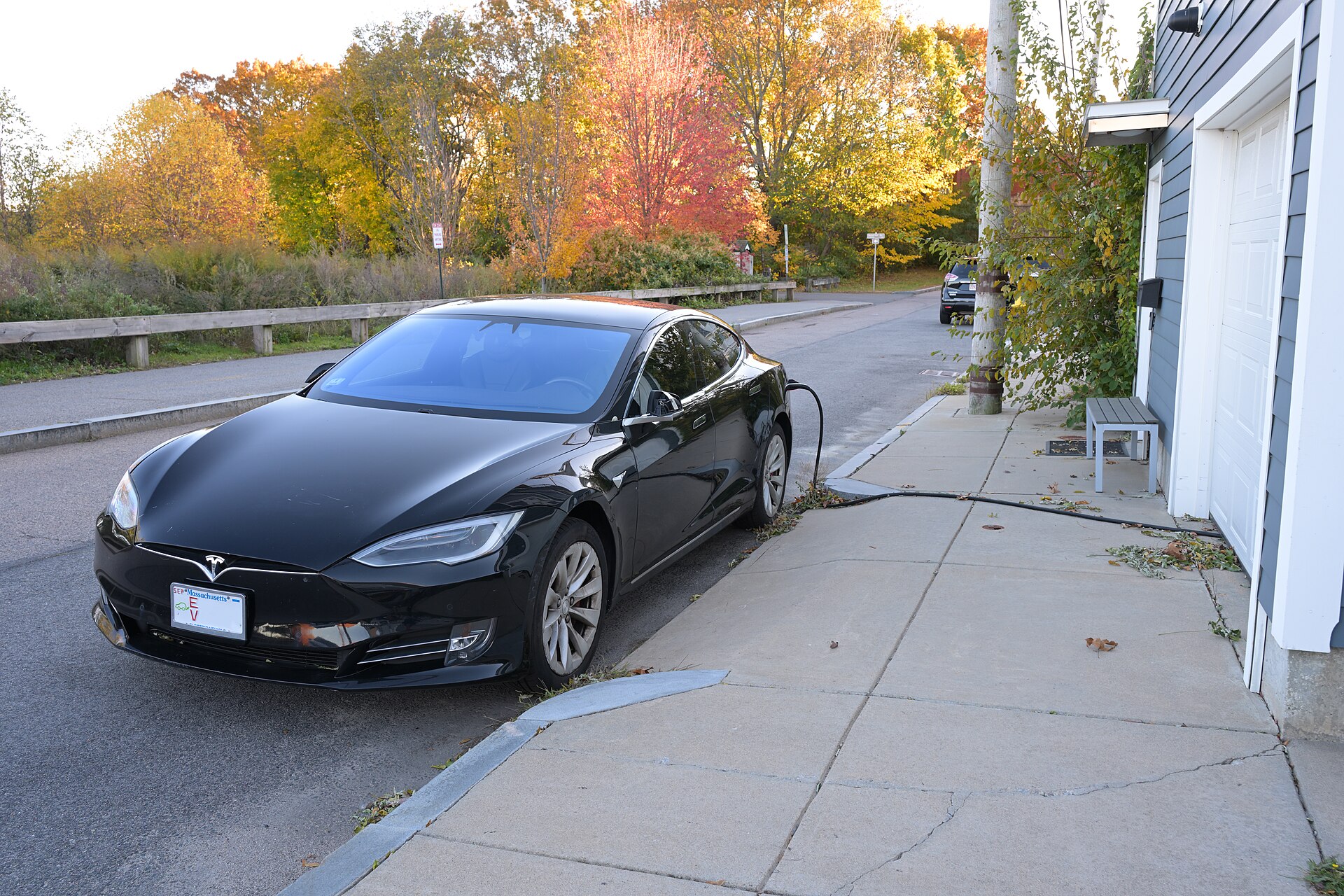
Information current as of July 2026. Prices, Supercharger rates, and right-to-charge laws change and vary by location and utility — confirm current figures with Tesla and your local authorities before purchasing. This article is general information, not legal or financial advice. Some links are affiliate/referral links; see our disclosure page. Image credit: Tesla Model S home charging in Dorchester, Boston, by 4300streetcar, licensed under CC BY 4.0, via Wikimedia Commons.

About the author: Lifei Zhou
Lifei is a Tesla owner based in Canada, writing practical, fact-checked Tesla guides for US and Canadian drivers — buying, ownership, insurance, charging, and TSLA investing, all from first-hand experience.
