
Used Tesla Buying Guide 2026: Where to Buy, Inspect, Warranty & Prices
Used Tesla Buying Guide 2026: Where to Buy, Inspect, Warranty & Prices

In one sentence
A complete 2026 guide to buying a used Tesla in the US and Canada — where to buy, how to inspect, how the battery warranty transfers, and real price ranges.
For the past couple of years, nine out of ten friends who asked me about buying a Tesla opened with the same two questions: how much is a new one, and is there a rebate? But heading into 2026, the wind has shifted. The federal $7,500 clean-vehicle tax credit for new EVs closed for good on September 30, 2025, and the used-EV credit of up to $4,000 disappeared on the very same day. New cars suddenly got noticeably “pricier” — and at the same time, the wave of Teslas leased and financed back in 2022–2023 is flooding back into the used market, a phenomenon the industry calls the off-lease wave. More supply, steadier prices, and the value math on a used Tesla suddenly looks very good.
I’ve driven Teslas for several years and have helped friends and family vet plenty of used listings. This article lays out the whole picture in one place: whether a used Tesla is worth it, where to buy, how to inspect, how the warranty math works, and how to pick between models. It covers both the United States and Canada — so whether you’re a budget-conscious student, a newcomer who just landed, or a family that simply wants to drive electric for less, you should come away knowing what to do.
Here’s the bottom line up front: a used Tesla in 2026 is one of the best buying windows in years — provided you know how to choose, how to inspect, and how to read that warranty ledger. Let’s break it down section by section.
Disclosure: some links in this article are affiliate/referral links. If you order or shop through them, we may earn a small commission at no extra cost to you. All analysis is based on public information and real owner experience, with no paid placement. This is general information, not financial, tax, or legal advice. See our disclosure page.
📋 Contents
- Why used Teslas suddenly make sense in 2026
- Where to buy: the real differences between three channels
- What’s actually “official” about Tesla’s used cars: a 102-point inspection and warranty extension
- The battery is the key: an 8-year warranty that travels with the car, and gentler degradation than you’d fear
- How to pick each model used, with US and Canada price ranges
- Delivery and viewing day: check every one of these
- Taxes and savings: with the rebates gone, what can a used buyer still save?
- Buying a used Tesla in Canada: a few local notes
- New vs. used: how to actually weigh it
- Frequently Asked Questions
- The bottom line
Why used Teslas suddenly make sense in 2026
Three things have landed at the same time, leaving the used market both deep and affordable this year.
First, the rebates are gone. After September 30, 2025, the federal $7,500 clean-vehicle credit for new cars and the up-to-$4,000 credit for used cars both ended. In plain terms, whether you buy new or used in 2026, don’t count on either of those federal dollars anymore. New cars losing that $7,500 “discount” pushed their out-the-door prices up meaningfully — which, ironically, nudged a lot of budget-sensitive buyers toward used.
Second, the off-lease return. 2022 and 2023 were peak delivery years for Tesla in North America, with a lot of buyers leasing or financing. Those three-year terms are maturing right around 2025–2026. Add to that Tesla’s policy whiplash — it scrapped lease-end buyouts in 2022, then reopened buyouts across the lineup on November 27, 2024 — and a large volume of off-lease cars has poured into used channels. More supply naturally drives prices down.
Third, prices have already ground down to relatively low levels. Tesla’s repeated new-car price cuts over the last two years have dragged the entire used-price curve down with them. The pain of early buyers who depreciated fast is, in effect, a bargain for today’s used shoppers.
There’s a “got pricier” side worth flagging too: the new auto-loan interest deduction (up to $10,000 a year, tax years 2025–2028) applies only to brand-new vehicles assembled in the United States — used cars are entirely excluded. We’ll get into the tax details in a later section. So the new-vs-used decision has to fold that math in as well.
Where to buy: the real differences between three channels
In North America, there are basically three roads to a used Tesla, and each has its own personality.
- Tesla Used Inventory (the official channel) — you order directly on Tesla’s website. The car has been through an official inspection and comes with extra warranty coverage. It’s the most hassle-free path, but prices usually run a chunk higher than the private market, and you can’t see or test-drive the car beforehand.
- Third-party dealers and used platforms — CarMax, Carvana, AutoTrader, CarGurus and the like. Lots of inventory, you can see and drive the car, and you can negotiate. But the warranty and condition are on you to verify, and you’ll want to watch out for shady dealers reselling new inventory cars as “used” at inflated prices.
- Private sellers — the lowest prices and the most flexibility, but zero warranty backstop. Inspection, title transfer, and financing are all your job. Best suited to people who know cars and don’t mind rolling up their sleeves.
The table below lines up the key differences across all three channels:
| Factor | Tesla Used Inventory | Third-party dealer | Private seller |
|---|---|---|---|
| Price | Higher (roughly $5,000 more for the same condition) | Mid-range; some room to negotiate | Lowest |
| Extra warranty | Yes (remaining factory warranty + 1 yr / 10,000 mi) | Varies by dealer; usually a limited third-party warranty | None — only the remaining factory battery/drivetrain warranty |
| Test drive? | No | Usually yes | Yes |
| Return policy | No returns after delivery | Some offer a 7-day return | None |
| Peace of mind | Highest | Medium | Lowest |
My advice: if it’s your first EV and you’d rather avoid headaches, lead with Tesla Used Inventory — the premium buys you peace of mind and that extra warranty. If you’re on a tight budget and willing to put in the time to inspect, the third-party and private channels can save you several thousand dollars of real money.
What’s actually “official” about Tesla’s used cars: a 102-point inspection and warranty extension
A lot of people assume Tesla runs a proper “Certified Pre-Owned” program. Strictly speaking, it doesn’t have a traditional CPO brand the way legacy automakers do — but every used car Tesla sells goes through a genuine, substantive process, and the value is real.
Each car that comes into a service center gets a 102-point inspection covering the mechanicals, electrical, exterior, and interior, item by item. Cars that fall short are reconditioned first or simply kept off the lot. Once it passes, the car keeps the remaining portion of the original 4-year / 50,000-mile basic vehicle warranty; if that basic warranty has already expired, Tesla adds a 1-year / 10,000-mile used-vehicle limited warranty on top. Net it out and a used Tesla, counted from new, is typically covered to roughly 5 years / 60,000 miles on the vehicle — not bad for a used car.
But the official channel has two counterintuitive catches you need to settle before you order:
- No test drive — official used cars are an online, buy-from-photos transaction. You can’t touch the actual car before pickup, let alone drive it. You’re relying on the condition description and that inspection backing.
- No returns after delivery — Tesla has no return policy on used cars. Once you accept delivery, you can’t back out the way you sometimes can on a new car. That makes delivery-day inspection all the more critical.
Precisely because you’re buying online sight-unseen, delivery day is your one and only chance to find fault. Whatever the channel, walk the car methodically before you sign — there’s a full delivery checklist later in this article.
The battery is the key: an 8-year warranty that travels with the car, and gentler degradation than you’d fear
When buying a used EV, the thing everyone worries about most is the battery — what if it’s degraded, and isn’t a replacement tens of thousands of dollars? Here’s what I’d say: the battery is actually the most reassuring part of a used Tesla, for two reasons.
First, the high-voltage battery and drive unit warranty travels with the car, calculated from the vehicle’s in-service date, no matter how many owners it has had. The specific terms are:
- Model 3 / Model Y rear-wheel-drive — 8 years or 100,000 miles, whichever comes first.
- Model 3 Long Range/Performance and all Model Y variants — 8 years or 120,000 miles.
- Model S / Model X — 8 years or 150,000 miles.
The warranty also spells out that battery capacity won’t fall below 70% retention during the warranty period; below that line, Tesla repairs or replaces it. So if you buy a 2022 car, the battery warranty most likely has several years left — that backstop is essentially thrown in for free.
Second, real-world degradation is gentler than people imagine. Large-sample third-party data shows Model 3 and Model Y batteries lose under 10% of capacity by 100,000 miles — still holding 90%+ — and around 15% by 200,000 miles, leaving roughly 85%. The curve isn’t a straight line: the first 60,000–80,000 miles usually drop a bit faster (the first 5–8%), then settle into a very gradual plateau of only about 1–2% a year.
How do you roughly gauge a used car’s battery health yourself? When you pick it up or look it over, charge to 100% and read the full-charge range shown on the dash, then compare it to that car’s original new-car rated range — the gap tells you how much it’s lost. Also watch for charging speed limits, frequent fault codes, or other anomalies. If you want to go deeper on range and charging, our US Tesla guides cover range and charging details across the different trims.
How to pick each model used, with US and Canada price ranges
Tesla’s core lineup is four cars, and the priorities shift a bit when shopping used. The prices below are broad ranges only — actual numbers swing with year, mileage, configuration, and region, so always defer to live listings and official pages.
Model 3 — the largest used population and the easiest entry point to find. A 2022–2023 Long Range runs roughly $22,000–$30,000 in the US; in Canada, that batch of Long Range cars originally around CA$69,990 now goes for roughly CA$45,000–$52,000 used. Great for commuting, tight budgets, and first-time EV buyers. Favor the Long Range — its mileage and range hold up better over time.
Model Y — North America’s most popular family SUV, with space and practicality as its killer features, and a relatively steadier used premium. The Canadian batch of Long Range Model Ys originally around CA$76,990 now sits roughly CA$52,000–$60,000 used; in the US, the same model year runs a few thousand more than a Model 3. Families with kids, cargo needs, or road trips should look here first, no hesitation.
Model S — the older flagship sedan that depreciates the hardest, which paradoxically makes it a chance to drive a luxury car at a bargain-bin price. A 5-to-7-year-old Model S runs roughly $30,000–$60,000 in the US, a wide spread depending on year, mileage, battery, and options. And here’s a 2026 twist: Tesla discontinued the Model S and Model X in March 2026, and by July the remaining new inventory was essentially gone — so used (including Tesla’s official used inventory) is now the only realistic way into one, while the final wave of trade-ins is quietly deepening supply. Just remember it’s a pricier car to buy and a pricier car to repair — leave room in both your budget and your expectations. Tesla has said existing S/X owners will keep getting service, parts, and OTA support for years to come.
Model X — the falcon-wing, seven-seat SUV with serious presence, but those falcon-wing doors and the complex suspension are the prime suspects for later repairs. On a used X, make a point of checking the door operation and the air suspension. Best for buyers with a genuine need for that much space who also know to budget for the complexity.
My overall pick order: Model Y first for families, Model 3 Long Range first on a tight budget, a used Model S as a gamble if you want luxury and can stomach repair costs, and the Model X only after you’ve done your homework.
Delivery and viewing day: check every one of these
Whatever the channel, don’t begrudge the effort on pickup or viewing day. Walk through every item below and you’ll dodge the vast majority of pitfalls.
- Paint and bodywork — circle the car and check that the panel gaps are even, look for mismatched touch-up paint and signs of collision or body repair, paying special attention to the front and rear bumpers and the fenders.
- Glass and roof — inspect the panoramic glass roof and the front and rear windshields for cracks and chips. Tesla glass isn’t cheap to replace.
- Tires and brakes — check that all four tires wear evenly and aren’t too old by date code. EVs eat tires, and a fresh set runs hundreds to over a thousand dollars. A cheap digital tire pressure gauge in your pocket also lets you spot a slow leak the seller “forgot” to mention.
- Interior and powered parts — open and close the seats, doors, windows, trunk/frunk, and charge-port door one by one; check the steering wheel and screen for scratches or burn-in.
- Screen and software — power up and look for any center-display errors, confirm all cameras are present, and check whether paid features like FSD or Enhanced Autopilot carry over with the car (this is crucial — more below).
- Battery range — charge to full and compare against the official rated range to estimate degradation, and watch for any charging-speed-limited warnings.
- Vehicle history — run a Carfax or equivalent report by VIN to confirm accidents, title status, and mileage all line up.
One special note on FSD: don’t pay a premium for a used car just because the seller says it “has FSD.” As of 2026 the picture has hardened — Tesla’s FSD-transfer program for owners has ended, the one-time buyout was permanently discontinued in February 2026, and on private resales paid software has often been removed from the car when ownership changes. What shows on the seller’s screen today is no promise of what your account will show next month. My rule: treat FSD as not included unless Tesla’s own listing explicitly says otherwise, and plan on the $99/month subscription if you want it — which, on the bright side, means any used Tesla can run FSD without an $8,000 sunk cost. And a genuine plus for older cars: in July 2026 Tesla pushed FSD v14 “Lite” to HW3 vehicles in wide release — a distilled build, less capable than HW4’s, but it means those cheaper 2018–2022 cars are no longer frozen out of current software.
A few small accessories make taking over a used car smoother. Picking up a fresh set of key cards and a high-endurance USB drive for the dashcam and Sentry footage is worth doing on day one — high-endurance grade matters because ordinary drives can’t take the constant 24/7 writes; the SanDisk Ultra Fit 256GB is the plug-and-forget pick. An OBD reader and a set of 3W all-weather floor mats round out the handover kit — used-car carpets have lived a life, and fresh mats reset the cabin instantly.
Taxes and savings: with the rebates gone, what can a used buyer still save?
The two federal credits ended at the end of September 2025, so for any 2026 purchase — new or used — leave them out of your math. But there are still several ways to save, and used buyers especially need to sort out which ones apply and which don’t.
First, a commonly confused point: the new auto-loan interest deduction added for tax years 2025–2028 (up to $10,000 of interest a year) applies only to brand-new cars, requires final assembly in the United States, requires the loan to originate after the end of 2024, and must be personal (non-commercial) use, with the benefit phasing out above $100,000 income for singles / $200,000 for couples. Crucially — used cars don’t qualify. So if you’re chasing this interest deduction, it only matters on a new car, and that’s another line in the new-vs-used ledger.
So what can a used buyer still save?
- State/provincial rebates or perks — some states and provinces still have their own EV incentives or charger subsidies. Check the latest rules for your location before you buy.
- Shop your insurance around — Tesla premiums aren’t low, and quotes vary widely between companies, so get several. For a deep dive on how to insure and where to save, see our Tesla insurance guide for Canada.
- Used loan rates — used-car loan rates are typically higher than new. Shop several banks and credit unions; don’t just take the dealer’s default lender.
- Charging costs — home charging is meaningfully cheaper than Supercharging, and over time the gap is large.
Disclaimer: the tax information above is general background only and isn’t tax or legal advice. For your own situation, consult a licensed tax professional or rely on the official IRS/CRA pages.
Buying a used Tesla in Canada: a few local notes
For readers in Canada, buying a used Tesla differs from the US in a few spots worth pulling out separately.
First, price and exchange rate. Canadian new-car pricing is higher to begin with, so used prices rise accordingly. If you’re considering importing a car from the US, fold the exchange rate, duties, compliance modifications (daytime running lights, metric units), and transport into your total cost — it’s often less of a deal than it looks.
Second, provincial rebates vary widely. EV incentives in provinces like BC and Quebec have changed frequently in recent years, while Ontario has long had no provincial purchase rebate. Always check the latest rules for your province before buying.
Third, buying across provincial lines means watching for inspection (safety / out-of-province inspection) and tax differences — sales-tax rates and transfer processes vary by province.
Fourth, the winter factor. Canadian winters are cold, and EV range takes a bigger hit in the cold; if you can test real-world range on a cold day during a used inspection, that’s far more telling.
New vs. used: how to actually weigh it
By the end of all this, a lot of people are still torn: should I buy new or used right now? Here’s a simple decision framework.
These situations lean used: a limited budget and a desire to drive electric for less; being fine without the latest styling and features; a willingness to spend time inspecting and a basic ability to judge condition; and not caring about the auto-loan interest deduction that only applies to new cars.
These situations lean new: you value the newest driver-assist hardware and a warranty that starts from zero; you want a US-assembled model to claim up to $10,000 a year in auto-loan interest deduction; you want a brand-new battery and full factory warranty for total peace of mind; or you simply want the first-owner experience.
One perk worth mentioning that only exists on new cars: if you do decide to buy new, ordering through an existing owner’s referral link usually gets you 3 months of free FSD (Supervised). At the $99/month subscription price, that’s worth roughly $297 — essentially a free quarter of driver assistance. If you’d like it, you can use my Tesla owner referral link; the perk attaches automatically when you order through it, at no extra cost to you.
In the end, there’s no absolute right or wrong between used and new — only what fits your budget and your needs. Square away the warranty math, the range math, and the tax math in this article, and your choice will get clear on its own.
Frequently Asked Questions
How much battery warranty is left on a used Tesla, and does it transfer to me?
It transfers. Tesla’s high-voltage battery and drive-unit warranty travels with the car, calculated from the vehicle’s in-service date regardless of how many owners it’s had. Model 3/Y RWD is 8 years or 100,000 miles, Long Range and Performance are 8 years or 120,000 miles, and Model S/X is 8 years or 150,000 miles, with capacity retention guaranteed not to fall below 70% during the period. So on a car from around 2022, the battery warranty most likely still has several years left.
Are there still federal tax credits on a used Tesla in 2026?
No. The federal $7,500 credit for new cars and the up-to-$4,000 credit for used cars both ended on September 30, 2025, so 2026 purchases don’t qualify. The new auto-loan interest deduction applies only to brand-new cars and not to used ones. There may still be state or provincial incentives — verify the latest local rules.
Can I test-drive or return a used Tesla bought from the official channel?
Neither. Tesla Used Inventory is an online, buy-from-photos transaction with no test drive before pickup, and Tesla has no return policy on used cars — once you accept the vehicle, you can’t back out. That’s why delivery-day inspection is so critical; go through the checklist item by item before you sign.
If a used Tesla has well over 100,000 miles, is the battery about to die?
Not nearly. Real large-sample data shows Model 3/Y batteries lose under 10% of capacity by 100,000 miles and only around 15% by 200,000 miles. The first several tens of thousands of miles drop a bit faster, after which it’s roughly 1–2% a year — the battery typically outlasts other parts of the car.
Is the official channel’s extra ~$5,000 worth it?
Depends what you’re after. The extra money buys the 102-point inspection backing, the additional 1-year / 10,000-mile warranty, and a hassle-free process start to finish. Worth it for the hassle-averse and first-time EV buyers; people willing to inspect a car themselves and judge condition can save that money through third-party or private channels.
The bottom line
A used Tesla in 2026 catches a good moment — ample off-lease supply and steadier prices — making it a relatively smart buying window compared with recent years. Remember just three things: trust the battery warranty that travels with the car, inspect the car item by item on delivery day, and get the tax and savings math straight. Nail those, and driving home a well-warrantied EV for tens of thousands less really isn’t hard. Here’s to landing the right car soon.
Information currency: this article cross-checks Tesla’s official warranty and used-car pages, the IRS guidance on the clean-vehicle credits and the auto-loan interest deduction, and public reporting from outlets such as InsideEVs, Recharged, CarsDirect, Cars.com, and CarGurus, with data current as of July 2026. Policies, prices, and warranty terms can change at any time — before buying, defer to the latest information on Tesla’s site and the official IRS/CRA pages. This is general information, not tax, legal, or financial advice; consult a licensed professional for your own situation. Some links are affiliate/referral links; see our disclosure page.
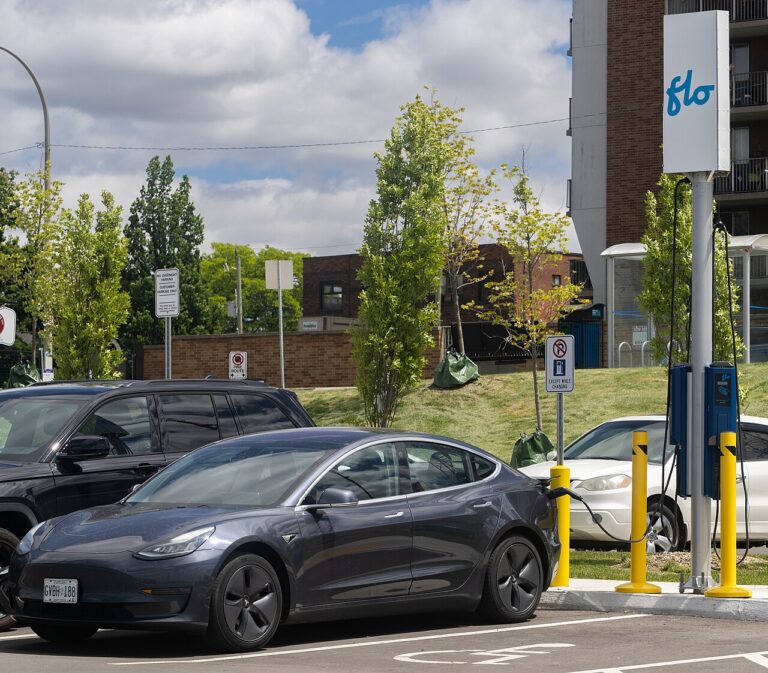
Image credit: “Tesla Model 3 charging, Windsor, Ontario” by Crisco 1492, licensed under CC BY-SA 4.0, via Wikimedia Commons.

About the author: Lifei Zhou
Model Y owner since 2022Ontario STO registered apprentice · 310SWorks on Porsche, Mercedes, BMW, Audi weeklyHundreds of readers referred (est.)
Lifei is a Tesla owner based in Canada, writing practical, fact-checked Tesla guides for US and Canadian drivers — buying, ownership, insurance, charging, and TSLA investing, all from first-hand experience.