
2026 Tesla Model 3 USA Guide: Trims, Price, Range, FSD & Warranty Explained
2026 Tesla Model 3 USA Guide: Trims, Price, Range, FSD & Warranty Explained

In one sentence
A 2026 USA Tesla Model 3 buyer's guide: four trims compared, pricing, range, charging, FSD subscription, warranty, insurance, and how to buy for less.
If you’ve been shopping for a Tesla in North America but the SUV silhouette of the Model Y just isn’t your thing, the Model 3 is almost certainly the car you keep circling back to. It’s Tesla’s longest-running, highest-volume sedan, it got a major redesign in early 2024 (codename “Highland”), and from late 2025 into 2026 the whole lineup was reshuffled again — new trim names, a starting price cut to $36,990, and a stripped-down Standard model that didn’t exist before. Plenty of long-time owners look at the current configurator and feel a little lost.
This 2026 guide walks through the four U.S. Model 3 trims, their pricing, range, charging, FSD, warranty, and insurance in one place, from the perspective of someone who has actually lived with a Tesla for a few years. It also tackles the question everyone is asking after the federal $7,500 tax credit disappeared: is the Model 3 still worth it, and how do you buy one without overpaying? It’s a long read, so bookmark it and jump around by section.
Disclosure: this article contains Tesla owner-referral and affiliate links. If you order or buy through them, we may earn a small commission or referral benefit at no extra cost to you, and it never affects your price or our editorial judgment. See our disclosure page.
📋 Contents
- The four 2026 Model 3 trims and prices at a glance
- What exactly did the entry-level Standard trim lose?
- Premium versus Performance: how to choose
- Range, efficiency, and what to expect from Supercharging
- After the $7,500 credit ended, how do you buy for the least money?
- FSD, Autopilot, and the software subscription math
- Warranty, insurance, and ownership costs
- Model 3 or Model Y? The one-line answer
- From order to delivery: how the process works
- Colors, wheels, and options: how to spec it smartly
- The monthly math: what a Model 3 really costs per month
- Versus rival EVs, is the Model 3 still compelling?
- Frequently Asked Questions
- Final thoughts
The four 2026 Model 3 trims and prices at a glance
For 2026 there are four U.S. Model 3 configurations, each offered as either rear-wheel drive (RWD) or all-wheel drive (AWD). Tesla dropped the old “RWD / Long Range / Performance” naming: the middle long-range trim is now called Premium, and a new entry-level Standard slots in below it. The table below shows official starting prices, which exclude the $1,640 order and delivery fee and any taxes.
| Trim | Starting price (USD) | Drivetrain | EPA range | 0–60 mph |
|---|---|---|---|---|
| Standard RWD | $36,990 | Rear-wheel drive | ~321 miles | ~5.8 sec |
| Premium RWD | $42,490 | Rear-wheel drive | ~363 miles | ~4.9 sec |
| Premium AWD | $47,490 | Dual-motor AWD | ~346 miles | ~4.2 sec |
| Performance | $54,990 | Dual-motor AWD | ~298 miles | ~2.9 sec |
A few things to keep in mind. Every trim adds the unavoidable $1,640 order and delivery fee on top of the listed price, and those prices are the bare vehicle cost — your out-the-door figure still includes state sales tax, registration, and documentation fees. The range numbers are EPA estimates; real-world range depends on your driving style, speed, climate control, tires, and temperature, so mentally knock about 20% off for sustained highway cruising. The Performance trim actually has the lowest range not because of a smaller battery, but because of its wider high-performance tires and more aggressive tuning — that’s normal for a performance car.
For comparison with the Model Y everyone knows: trim-for-trim, the Model 3 is typically five to six thousand dollars cheaper, has slightly longer range, and drives lower and more like a “car” than an SUV. If you’re cross-shopping the two, the official Tesla Model 3 page lists the live configuration, and reading this alongside a Model Y breakdown usually settles the sedan-versus-SUV question fast.
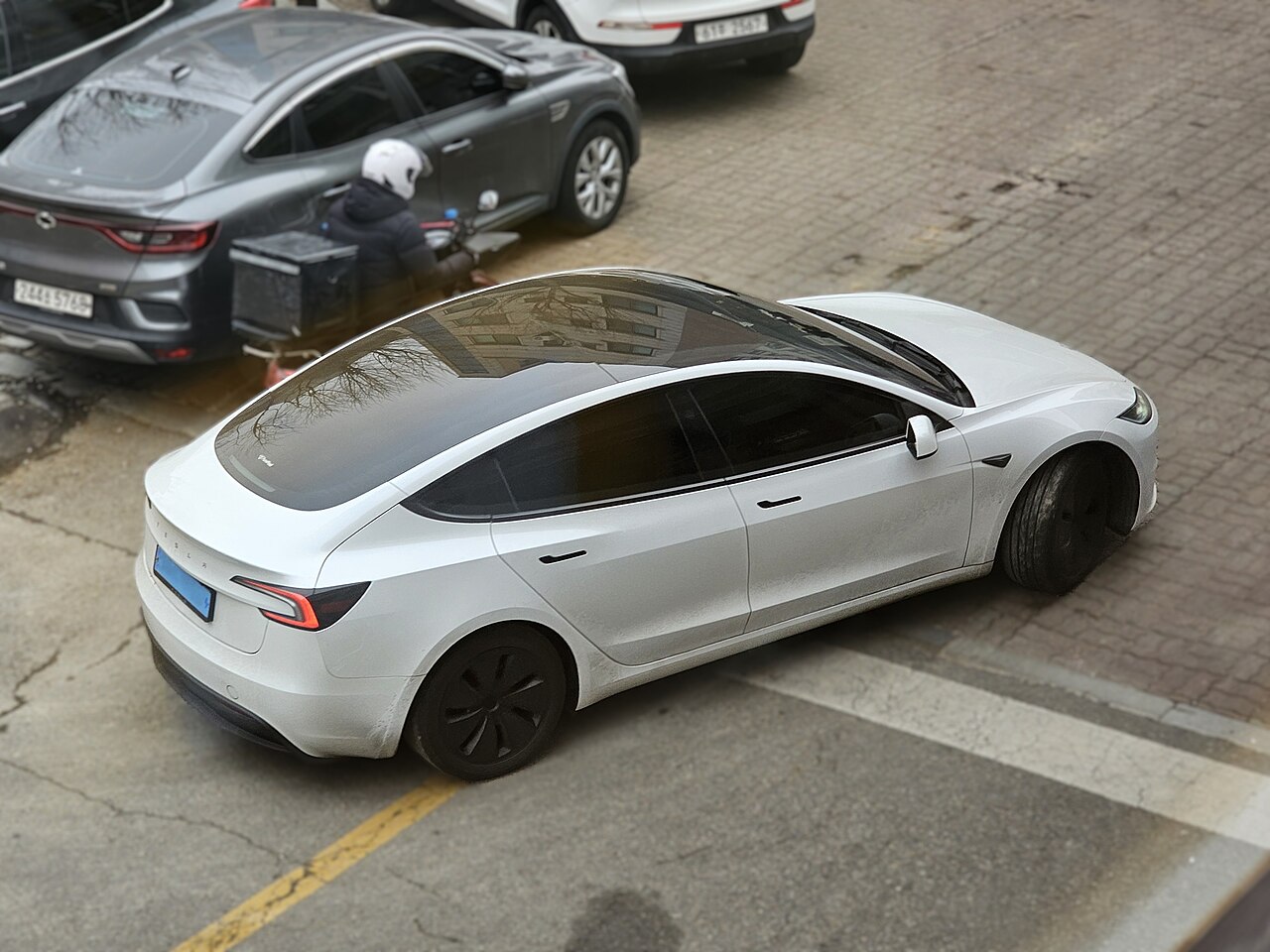
What exactly did the entry-level Standard trim lose?
The $36,990 Standard is the “stripped” trim Tesla introduced in late 2025 with one goal: pull the entry price down. It shares the same shell, the same HW4 self-driving hardware, and the same glass roof as the Premium above it, but the interior and feature set were trimmed considerably. If you’re drawn in by the price, make sure you can live with the cuts first.
The main things that were removed or changed:
- Seat material — the full faux-leather upholstery is replaced by a fabric-and-faux-leather mix that feels more economy-grade but wears and cleans easily.
- Audio — the 15-speaker system with subwoofer drops to 7 speakers, no subwoofer, and no AM/FM radio (streaming still works as usual).
- Rear screen — the 8-inch rear entertainment display is gone.
- Seat features — heating only, no ventilation; some power adjustments move into the touchscreen, and the second-row seats fold manually.
- Ambient lighting and headlights — the wraparound ambient light strip is gone (only footwell and door lights remain), and the matrix LED headlights are dropped.
- Small details — no HEPA cabin filter, manually folding mirrors, blacked-out badging, and slightly different front and rear fascias.
The good news is that the Model 3 Standard keeps the panoramic glass roof (the contemporary Model Y Standard actually lost its glass roof), which is a welcome mercy in a sedan where headroom is already tight. The heated steering wheel survives too. Overall, the Standard suits budget-conscious city commuters who don’t care much about audio or rear entertainment; but if you regularly carry passengers in back or you’re an audiophile, spending the extra five-plus thousand on Premium is far more comfortable.
Premium versus Performance: how to choose
Setting the Standard aside, the real volume sellers are the two Premium trims plus the top Performance. Here’s how they break down by use case.
Premium RWD ($42,490) is my personal pick — the “sweet spot” configuration. Its 363-mile range is the longest in the lineup, the single rear motor is efficient, and tires and maintenance are cheaper. For city commuting plus the occasional road trip, it’s more than enough. For most families who don’t live somewhere with year-round snow and ice, this is simply the smartest buy.
Premium AWD ($47,490) costs five thousand more than RWD and buys you dual-motor all-wheel drive, a 4.2-second 0–60, and steadier grip in snow and rain. If you live in a snowy northern state — upstate New York, Minnesota, the Colorado mountains — or regularly drive rough roads, that five thousand is well spent; pure city drivers won’t really use it.
Performance ($54,990) is for people who genuinely want driving fun: a 2.9-second 0–60, sport-tuned suspension, sport seats, larger wheels, and bigger brakes. The price is range dropping to 298 miles, pricier tires, more road noise, and a stiffer ride. It’s more of a “performance toy you can daily” than a rational commuter.
The one-line decision logic:
- Budget-first, city commuting — Standard or Premium RWD.
- Want the longest, most balanced range — Premium RWD, buy it without overthinking.
- Year-round rain and snow, want AWD peace of mind — Premium AWD.
- You just want speed and fun — Performance.
Range, efficiency, and what to expect from Supercharging
EPA range is an ideal figure that the real world discounts. Take the longest-range Premium RWD: rated at 363 miles, gentle low-speed city driving can get close to that or even beat it, but cruising the highway at 75 mph with the climate running typically lands you in the 270–300 mile range. Winter is harsher still — losing 30–40% in sub-freezing temperatures is normal, and northern owners should be mentally prepared for it. The U.S. EPA’s fueleconomy.gov is a good neutral reference for comparing official efficiency numbers across EVs.
On charging, the Model 3 peaks at around 250 kW on a V3 Supercharger, taking roughly 25–30 minutes from 10% to 80% — about the length of a coffee stop on a road trip. With a Level 2 home charger (240V) installed, charging from low to full overnight is effortless, and daily commuting becomes “full at home, never worry on the road.” If you haven’t set up home charging yet, our guide to Tesla home charger installation walks through the wiring, permits, and gear.
One more thing worth noting: all new cars in North America now ship with a native NACS port, and the Supercharger network is gradually opening to other brands — but as a Tesla owner you’re still the group with the smoothest charging experience. Plug-and-charge with automatic billing, no card or app to fish out, is an edge nobody else can match in the near term.
After the $7,500 credit ended, how do you buy for the least money?
First, the most important fact: the federal $7,500 Clean Vehicle Tax Credit for new cars officially ended on September 30, 2025, so buying a Model 3 in 2026 gets you exactly zero federal incentive. Any listing online still touting “twenty-something thousand out the door” is running on expired information. Here’s how you can still save in the post-credit era.
First, watch inventory cars. Tesla’s website inventory and demo vehicles often carry direct discounts of a few hundred to a couple thousand dollars, and some are nearly-new cars with very low mileage — if you’re not picky about configuration, you can save real money. Second, watch for periodic financing offers — as of late July 2026, Tesla is running 0.99% APR over 72 months on the Model 3 Premium and Performance trims (the Standard has no promotional rate, and June’s free-Supercharging promotion has ended); these change month to month, so check the official site before ordering. Third, make good use of the owner referral link.
Speaking of referral links, this is one of the few perks you can still get for free in the post-credit era: order through a Tesla owner’s referral link and new owners typically get 3 months of free FSD (Supervised). At the current $99/month subscription price, that’s worth around $297. You’re ordering anyway, so there’s no downside to using one. Tesla adjusts the exact benefit from time to time, so the order page is the final word.
Fourth, don’t overlook state and local incentives. The federal credit is gone, but some states and utilities still keep their own EV rebates or charger subsidies (parts of California, Colorado, New Jersey, and others, with frequently changing terms). Check your state’s energy or motor-vehicle site before you buy and grab whatever you can.
FSD, Autopilot, and the software subscription math
Tesla’s driver-assistance policy saw a big shift for 2026: starting in February 2026, FSD (Supervised) is no longer available as a one-time purchase for new buyers and moved to subscription only, at $99/month, cancel anytime. For people who hold a car short-term or just want to sample it occasionally, the subscription is actually more flexible — no eight-thousand-dollar upfront hit.
Another change that catches many buyers off guard: since January 23, 2026, new Teslas delivered in North America no longer include basic Autopilot on any trim — the standard equipment is Traffic-Aware Cruise Control only, and lane-centering Autosteer now requires the FSD subscription. That applies to Standard, Premium, and Performance alike. Tesla changes this frequently, so the feature list shown in your car at delivery is what governs.
Whether FSD is good enough and worth the money is a matter of taste. My advice: use the referral link above to get the 3 months free first, run it on your daily commute for a while, then decide whether to keep subscribing. Like it, keep paying; don’t, cancel immediately — zero-cost trial and error.
Warranty, insurance, and ownership costs
You can’t judge a car on its sticker price alone; the ownership math matters too. Starting with the warranty, the 2026 Model 3 official coverage looks like this:
- Basic vehicle warranty — 4 years or 50,000 miles, whichever comes first.
- Battery and drive unit warranty — 8 years or 100,000 miles on the Standard RWD; 8 years or 120,000 miles on the longer-range Premium and Performance trims, with battery capacity guaranteed not to fall below 70% of original during the term.
The battery warranty follows the car, not the owner, which matters a lot to used Model 3 buyers — as long as it hasn’t expired, it stays valid through a change of hands. For the precise terms and claim details, rely on Tesla’s official warranty page. If you’re shopping used, our used Tesla buying guide covers what to verify on warranty and battery health.
On insurance, Tesla premiums aren’t cheap in the U.S., especially for new or young drivers — three to five thousand dollars a year is common in places like New York and California. Before ordering, take the VIN to a few insurers to compare quotes, and don’t just look at Tesla’s own Tesla Insurance (offered in only some states). Canadian buyers can see our detailed breakdown in the Tesla insurance in Canada guide, much of which applies in principle anywhere. Ownership itself is low-stress with an EV — no oil, spark plugs, or transmission — so day to day it’s just tires, wipers, cabin filters, and washer fluid, adding up to real savings over a gas car across a few years.
Model 3 or Model Y? The one-line answer
This is the question I get asked most. The two cars share a platform, the same electric powertrain, and a near-identical software experience; the difference is body shape.
Reasons to pick the Model 3 — cheaper (five to six thousand less trim-for-trim), slightly longer range, lower and sportier stance, easier to park, looks more like a “car.” Best for singles, couples, mainly-city commuters with the occasional road trip.
Reasons to pick the Model Y — far bigger cargo area, roomier rear seat and headroom, higher seating position with better visibility, room for a stroller and camping gear. Best for families with kids, frequent big-item haulers, and anyone who needs cargo capacity.
In a sentence: no kids and want to save money and enjoy handling, go Model 3 without hesitation; have kids and need space and cargo, step up to the Model Y.
From order to delivery: how the process works
Buying a Model 3 in the U.S. happens almost entirely online — far simpler than a traditional dealership:
- Configure trim, color, wheels, and interior on the website, then place the order with an order fee (refund conditions per the official site).
- Choose your delivery method (pickup at a nearby delivery center, or home delivery in some areas), and upload your licence, insurance, and payment method.
- Wait for production and a delivery window — Tesla pushes the VIN and delivery time through the app, and inventory cars often arrive in a few days to a week or two.
- Inspect the car on delivery day — do not treat this step as a formality.
Inspection is where buyers most often get short-changed. Paint, panel gaps, tire production dates, interior flaws, the touchscreen, charge port, and the auto door handles — check every one. Our Tesla delivery inspection checklist walks through exactly what to look at before you take the keys; log any issue with your delivery advisor on the spot, which is far easier than arguing after you’ve driven it home. For more U.S.-specific buying content, browse our U.S. Tesla section.
Colors, wheels, and options: how to spec it smartly
Those modest-looking options in the configurator can add several thousand dollars when stacked, so here’s some practical advice.
On paint, Pearl White is usually the only no-cost color, it’s timeless and hides dirt well, and it holds resale value steadily. The solid black, silver-grey, and deep blue typically add a thousand-plus, and the priciest is the color-shifting multi-coat red (around two thousand-plus). My take: unless you genuinely love a particular color, white is plenty, and the saved money is better spent on paint protection film or insurance. Northern owners get a hidden bonus too — light paint means a less scorching interior after summer sun.
On wheels, the Premium comes standard with 18-inch Photon wheels, with optional 19-inch Nova wheels. The 18s give more range, less road noise, and cheaper tire repairs and replacement; the 19s are purely for looks, at the cost of a dozen-plus miles of range, more road noise, and pricier future tires. For daily driving I strongly suggest keeping the 18s and saving that thousand-plus. The interior comes in black or white only — white looks upscale but needs diligent care, so black is the lower-stress choice for families with kids or pets. One cheap upgrade I’d do on day one either way: a Spigen matte screen protector for the center display — everything in this car runs through that touchscreen, and the matte finish kills fingerprints and glare.
FSD, as covered above, is now a $99/month subscription. You don’t need to check it at order — just activate it in the car after delivery if you want, and the safest move is to test the waters with the 3 free months from a referral link.
The monthly math: what a Model 3 really costs per month
Many people fixate on the sticker price without working out what they’ll actually pay each month. Here’s a rough calculation using the Premium RWD ($42,490) so you have a feel for it; your real numbers depend on your state and your actual quote.
Say the vehicle is $42,490, plus the $1,640 order and delivery fee, and estimate sales tax at around 8% (it varies enormously — Oregon and a few states have none, California is higher). Out the door lands around the high forties. With 20% down and a 60-month loan at current rates, the monthly payment roughly falls in the six-to-seven-hundred-dollar range; catch one of Tesla’s promotional rates — the Premium trims are at 0.99% APR over 72 months as of July 2026 — and that number can drop meaningfully, so always check the current financing offers before ordering.
On running costs: if home electricity runs about $0.15/kWh and you drive 12,000 miles a year, your electricity bill is roughly three to four hundred dollars a year, averaging twenty to thirty dollars a month — far less than a comparable gas car. Insurance ranges from one or two hundred to three or four hundred a month by region; maintenance is nearly negligible. Add it up and the true monthly cost of owning a Model 3 is dominated by the loan payment and insurance, while electricity and maintenance are where you genuinely save.
Versus rival EVs, is the Model 3 still compelling?
In the $30,000-to-$50,000 electric sedan space in 2026, the Model 3 doesn’t actually have many serious rivals. The Hyundai Ioniq 6 offers long range, fast charging, and a generously finished interior, but its software ecosystem and charging network can’t match Tesla’s; mainstream EVs from Honda and Chevrolet have decent space but trail in smarts and efficiency. The Model 3’s biggest moat is still the Supercharger network and its mature software — plug-and-charge, frequently refreshed OTA updates — the kind of thing you can’t go back from once you’ve used it.
Of course the Model 3 isn’t flawless: rear headroom is tight, the suspension is firm, the all-touchscreen controls take getting used to, and the service network is still thin in some smaller cities. But scoring it across price, range, charging, smarts, and resale together, it remains the benchmark in this price bracket. If you’re genuinely torn, book a test drive at your nearest Tesla store, sit in the back seat yourself, and run a stretch of highway — that’s worth more than a hundred articles. If you decide to buy afterward, remember to grab a free FSD trial with a referral link.
Frequently Asked Questions
What’s the 2026 Model 3 starting price, and can I still get the federal tax credit?
In the U.S., the Standard RWD starts at $36,990 (excluding the $1,640 order and delivery fee and state taxes). The federal $7,500 new-car tax credit ended on September 30, 2025, so 2026 purchases no longer qualify — that’s the single biggest policy change.
Is the entry-level Standard trim worth buying?
It depends on your needs. It drops the premium audio, rear screen, ambient lighting, ventilated seats, and matrix headlights, but keeps the glass roof, heated steering wheel, and HW4 hardware. It suits budget-conscious city commuters who don’t care about audio or rear entertainment; if you value comfort and finish, spend about five thousand more on the Premium RWD.
What’s the real-world range of a Model 3?
Using the longest-range Premium RWD (EPA 363 miles): gentle city driving approaches the rated figure, highway cruising at 75 mph with climate control runs around 270–300 miles, and severe winter cold can cut another 30–40%. Just leave enough buffer for your commute distance before buying.
How is FSD priced now, and is there a free trial?
From 2026, FSD (Supervised) is subscription-only at $99/month, cancel anytime. New owners who order through a Tesla owner referral link typically get 3 months of free FSD (worth about $297, per the order page) — try it free before committing to a long-term subscription.
Is the price gap between the Model 3 and Model Y worth it?
Trim-for-trim, the Model Y costs about five to six thousand dollars more than the Model 3, mainly buying a bigger cargo area, a roomier rear seat, and a higher seating position. Have kids or need cargo, go Y; want to save money, enjoy handling, and mostly drive in the city, the Model 3 is the better value.
Final thoughts
The 2026 Model 3 is, in essence, a “cheaper, more mature, but no-longer-subsidized” electric sedan. The good news is that the redesigned car is noticeably better than early versions on range, build quality, quietness, and software, and the $36,990 starting price is still competitive among EVs in its class; the bad news is that with the federal credit gone, the out-the-door cost has genuinely risen, which makes it all the more worth clawing back savings through inventory cars, financing offers, and referral links.
If this guide helped you think it through and you’re ready to order, you’re welcome to use my owner referral link — you get a free FSD trial, it’s a small bit of support for me, and your price doesn’t change at all. As for the small stuff, a set of 3W all-weather floor mats (also on Amazon Canada) is worth grabbing before delivery — the factory carpets are the first thing winter slush ruins. Here’s hoping you pick up the Model 3 you’ve been waiting for.
Information currency: prices, configurations, range, and warranty figures in this article are compiled from Tesla’s official site and public sources such as Edmunds, KBB, US News, and the IRS, current as of July 2026. Tesla changes pricing, trims, configurations, and software policy very frequently — the current tesla.com page governs before you order. This is general buying information, not purchase, financial, or legal advice; for tax, insurance, and incentive matters, rely on the latest official rules and professional advice. Some links are affiliate/referral links; see our disclosure page.
Image credit: cover image Tesla Model 3 ‘Highland’ by OWS Photography, Wikimedia Commons, CC BY 4.0; white car image by Damian B Oh, Wikimedia Commons, CC BY-SA 4.0.

About the author: Lifei Zhou
Model Y owner since 2022Ontario STO registered apprentice · 310SWorks on Porsche, Mercedes, BMW, Audi weeklyHundreds of readers referred (est.)
Lifei is a Tesla owner based in Canada, writing practical, fact-checked Tesla guides for US and Canadian drivers — buying, ownership, insurance, charging, and TSLA investing, all from first-hand experience.