
Texas Tesla Buying Guide 2026: Taxes, Charging & Austin/Dallas/Houston
Texas Tesla Buying Guide 2026: Taxes, Charging & Austin/Dallas/Houston

In one sentence
How to buy a Tesla in Texas in 2026: the franchise-law quirk, sales tax and the $200 EV fee, near-free overnight home charging, plus Austin, Dallas and Houston tips.
Here’s something that catches a lot of newcomers off guard: Tesla’s global headquarters sits in Austin, Texas, one of its largest plants — Giga Texas, out in Del Valle just east of the city — builds the Model Y, the Cybertruck, and the Cybercab, and yet, in Texas, you cannot walk into a Tesla store, haggle on price, sign, and drive off the way you would at a normal dealership. That single quirk is the most confusing part of buying a Tesla in the Lone Star State.
Weighing another warm, no-state-income-tax market? Our Florida Tesla buying guide walks through a similar setup — no state income tax, but higher insurance and hurricane-season trade-offs.
I’ve walked through this process with friends and fellow owners across Austin, Plano, and Katy, so this guide lays out the whole thing in plain numbers: what it actually costs to buy a Tesla in Texas in 2026 — from ordering and paying tax to titling and taking delivery — what’s left to save now that the federal $7,500 credit is gone, and the two big Texas-only perks that make ownership genuinely cheap: a deregulated electricity market that can make home charging nearly free, plus Robotaxi and the Gigafactory right in your backyard. Whether you’re in Austin, the Dallas–Fort Worth metroplex (Plano, Frisco, Richardson, Allen), or the Houston suburbs (Katy, Sugar Land, Bellaire), this one’s for you.
Disclosure: some links in this article are affiliate/referral links. If you place an order or sign up through them, we may earn a small commission at no extra cost to you, and it never changes what I tell you straight. Prices here are rough ranges only — confirm exact figures on Tesla’s official site and the relevant Texas government pages. See our disclosure page.
📋 Contents
- Headquartered in Austin, yet “can’t” sell cars in Texas: clearing up the weird part first
- What a Tesla actually costs to buy in Texas: the taxes and fees, line by line
- With the federal $7,500 gone, what’s left to save in Texas?
- How to order and take delivery: the Texas process and pitfalls
- Texas’s biggest hidden perk: a deregulated power market that makes home charging nearly free
- Charging network and road trips: Superchargers, Buc-ee’s, and the interstates
- The Texas heat: running an EV at 100°F-plus
- Which Tesla should a Texas owner pick? Three needs, three answers
- Registration, inspection, and insurance: the localized loose ends
- A Texas bonus: Robotaxi and the Gigafactory right next door
- Frequently Asked Questions
- The bottom line
Headquartered in Austin, yet “can’t” sell cars in Texas: clearing up the weird part first
Texas franchise law says automakers can’t sell directly to consumers in the state — they have to go through a licensed independent dealer. Tesla has no traditional dealer network, so for years it’s been stuck behind that line. Even after moving its headquarters to Austin, Tesla still couldn’t get the legislature to crack the door open in the 2025 session, leaving Texas one of the least direct-sale-friendly states in the country for the company.
So how does it actually work in practice? Like this:
- You order online. Every configuration choice, payment, and loan or lease is completed on tesla.com or in the Tesla app. Legally, the order counts as an out-of-state transaction.
- Showrooms are look-only — no price talk, no in-store closing. Austin and Houston have Tesla “galleries” where you can see and sit in the cars, but staff are legally barred from discussing price or placing an order for you in the store. It’s not attitude; the law forbids it.
- Delivery still happens locally in Texas. Once your order is placed, the car is routed to a delivery center in Austin, Dallas, Houston, San Antonio, or elsewhere, and you pick it up in person. You don’t actually have to drive out of state.
Bottom line: “can’t sell in Texas” is mostly a paperwork technicality. The only practical effect on you is that there’s no walking in to haggle — and Tesla has fixed nationwide pricing with no negotiation anyway. Just treat it as buying a car entirely online. Before your first time, it helps to read through our USA Model Y guide or USA Model 3 guide so you know how to spec the car, which makes ordering fast.
What a Tesla actually costs to buy in Texas: the taxes and fees, line by line
Texas has no state personal income tax — one of the big reasons so many Californians and New Yorkers have moved here — which means your take-home pay stretches further at the car lot too. But Texas still collects its share when you buy a car. The main pieces are below.
1. Motor vehicle sales tax: a flat 6.25% statewide
Texas charges 6.25% sales/use tax on motor vehicles, and unlike ordinary retail goods, this 6.25% is uniform across the entire state — there’s no stacked city or county add-on. So the rate is the same whether you buy in Austin or Houston. On a Model Y with an out-the-door price around $45,000, that tax alone is roughly $2,800. It’s calculated on the vehicle price, so the more options you add, the more tax you pay.
2. Title, registration, and assorted fees
Beyond sales tax, there’s the license plate registration fee, the title transfer fee, county add-ons, and so on — together these typically land in the low hundreds of dollars, varying a bit by county. Tesla generally handles the title and registration paperwork as part of delivery, folding the cost into your order or delivery documents, so you don’t have to stand in line at the county tax office yourself.
3. The EV-specific annual fee: $200 a year
This is the one every Texas EV owner needs to know. To make up for the highway-maintenance shortfall from EVs not paying gas tax, Texas has charged a $200 annual registration surcharge on fully electric vehicles since September 2023. The catch: when you first register a new car, you prepay two years up front — $400. Plug-in and conventional hybrids don’t pay it. This recurs every year, so build it into your cost of ownership.
Stack it all up, and on a $45,000 Model Y, beyond the car price you should plan for roughly: about $2,800 sales tax + about $400–$600 for first-year registration including the EV prepay + miscellaneous fees. Compared with a state like California, where sales tax routinely runs 9%–10% plus various emissions-related charges, Texas is actually on the friendlier side for “tax” — the big win being that the 6.25% doesn’t stack local rates.
A lot of people moving to Texas are coming from California or New York, so a side-by-side makes it more tangible (the table below is conceptual — confirm exact figures with each jurisdiction’s official source):
| Comparison item | Texas (TX) | California (CA) | New York (NY) |
|---|---|---|---|
| State income tax | None | Up to about 13.3% | Up to about 10.9% |
| Vehicle sales tax | Flat 6.25% statewide | ~7.25%–10%+ (stacks local tax) | ~4% + local tax, often around 8% |
| EV annual fee | $200/year (new cars prepay two years) | Road-improvement and similar surcharges | Relatively low |
| Electricity flexibility | Mostly deregulated — choose plans, free overnight power available | Regulated, high tiered rates | Regulated, generally high |
The takeaway is blunt: at the moment of purchase, Texas isn’t the cheapest (that sales tax is real), but once you’ve moved in and hold the car long term, no state income tax plus the ability to pick your own electricity plan save you far more over a few years than that purchase-time tax costs. That’s exactly why so many California and New York transplants brought the car along with the move.
With the federal $7,500 gone, what’s left to save in Texas?
First, the unavoidable bad news: the federal new-EV tax credit of up to $7,500 officially ended on September 30, 2025, so a Tesla newly ordered in 2026 no longer comes with it. That’s the same everywhere in the US — Texas can’t dodge it. For a full picture of how to save now that the credit is gone, see Tesla’s official incentives page for the latest on what remains.
So what about at the Texas level? A few points:
- The state’s $2,500 EV rebate is basically off the table. The Texas Commission on Environmental Quality (TCEQ) light-duty purchase/lease incentive (LDPLIP) really did offer up to $2,500 for fully electric vehicles, but the state hands out only about 2,000 slots a year, first-come first-served, and this fiscal year’s window closed back in early 2026 with the funds exhausted. To take a shot at the next round, watch the TCEQ site.
- Local utilities occasionally offer charging-related rebates. Municipal utilities like Austin Energy and CPS Energy in San Antonio periodically run rebate programs for home chargers or Level 2 equipment. Amounts and terms change often, so before installing a home charger, search your utility’s site for “EV charger rebate.”
- The home-charging tax credit (30C) has now expired. The federal credit for home charging equipment ended on June 30, 2026. If you completed a qualifying install before that date you can still claim it when you file, but a new install today gets nothing — budget the charger at full cost.
- The auto-loan interest deduction is the live federal break. Under the OBBBA, interest on a loan for a new U.S.-assembled vehicle is deductible — up to $10,000 a year for tax years 2025–2028, phasing out above $100k income (single) / $200k (joint), claimed on Schedule 1-A with your VIN. Every current Tesla qualifies, and since Tesla has been running promo financing (as of late July 2026, 0% APR on Model Y RWD over 72 months with at least 5% down, 0.99% on most other Y and Model 3 trims — check tesla.com for current terms), financing can genuinely beat paying cash for some buyers.
In short: don’t count on Texas-level purchase incentives. Shift your savings focus to the ownership phase — especially the electricity rates covered below, which are where Texas truly shines.
How to order and take delivery: the Texas process and pitfalls
The Texas buying process is much like other states’, but a few local details are worth pulling out:
Ordering: inventory cars vs. custom orders
If you’re price-sensitive, browse Tesla’s inventory cars first. These are already in transit or sitting at a delivery center — fixed configurations, but they often carry a few thousand dollars in savings and much faster pickup, which suits anyone who needs a car soon or wants to save. A built-to-order custom configuration takes anywhere from a few weeks to a couple of months.
There’s also an easily overlooked perk at order time: ordering through an existing owner’s referral link usually gets a new car 3 months of free FSD (Supervised). At the $99/month subscription price, that’s about $297 in value — handy if you want to try out the driver-assistance suite for free before deciding whether to buy it outright. You’re welcome to use our site owner’s Tesla referral link to order; it takes a couple of minutes and the savings are real.
Delivery: in Austin, you can even pick up at the Gigafactory
Austin owners get an option you won’t find elsewhere — taking delivery at Giga Texas itself. This plant is a primary source of the Model Y for the eastern US market and the home base of the Cybertruck, and driving your new car off from the very place it’s built is hard to beat for sheer occasion. Of course, Dallas, Houston, and San Antonio all have proper delivery centers too — just go to whichever location the system assigns you.
Inspect the car on delivery day, every time
Wherever you pick up, don’t skip the delivery-day inspection. Texas sun is harsh, so focus on the paint for color mismatch and orange peel, check that panel gaps are even, look for scratches on glass and interior trim, and confirm the charge port and every function work. Spotting a problem and photographing it on the spot, then writing it into the delivery paperwork, is a hundred times easier than fighting about it after you’ve driven home. For the full checklist, see our Tesla delivery inspection guide and just work down it item by item.
Texas’s biggest hidden perk: a deregulated power market that makes home charging nearly free
If Texas is merely “fine” on taxes, the electricity market is its trump card over other states. Most of Texas (Dallas, Houston, Fort Worth, and other deregulated areas under ERCOT) runs a competitive retail electricity market, letting you freely choose your provider and plan. It sounds minor, but for an EV owner charging every day, it adds up to serious year-round savings.
The core play comes down to two plan types:
- Free Nights plans. Plenty of providers offer plans where electricity is free during a set overnight window — typically roughly 9 p.m. to 6 a.m. Set your car to charge in the small hours and that power is, in theory, near zero, with only a sliver of transmission/distribution (TDU) delivery charge left — working out to about 3–4 cents per kWh. A year of charging a Tesla becomes almost a giveaway.
- Time-of-Use plans. TXU, Gexa, Rhythm, and others all offer TOU plans that push off-peak rates very low to reward shifting your usage to night. Pair that with Tesla’s in-car scheduled/off-peak charging, set your departure time and off-peak window, and the system charges automatically at the right hour.
To make it concrete: a common effective rate in the Dallas area is around 14 cents per kWh, so driving 100 miles costs roughly $3.50–$6; but once you’re on a Free Nights plan and shift all charging to the small hours, that 100 miles can drop to nearly negligible. It’s a perk California and New York owners can only envy.
If you’ve installed a Tesla Powerwall, deregulated areas of Texas also let you use Tesla Electric — Tesla’s own retail electricity plan — to manage car, rooftop solar, storage, and rates together. No Powerwall? No problem; pick a solid Free Nights or TOU plan and the effect is already excellent. For install costs, charger selection, and wiring details, see our home charger installation guide.
Charging network and road trips: Superchargers, Buc-ee’s, and the interstates
Texas is big, with cities often two or three hundred miles apart, but the Tesla Supercharger network is dense here. Along the main arteries — I-35 (San Antonio–Austin–Dallas), I-10 (Houston–San Antonio–El Paso), and I-45 (Houston–Dallas) — Supercharger stops come one after another, so planning a long trip rarely causes range anxiety.
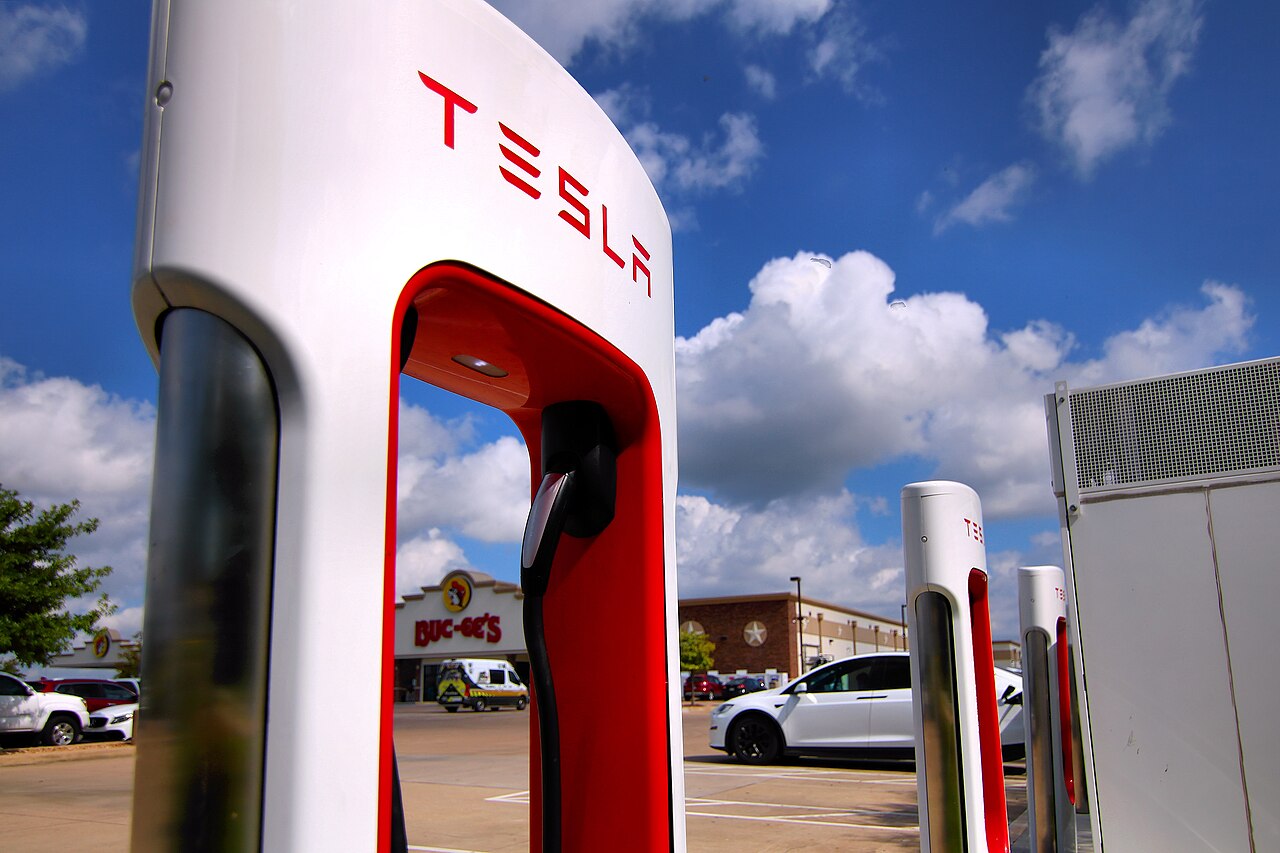
Texas also has a charging experience all its own — many Superchargers are built right next to a Buc-ee’s. The giant gas-station-convenience-store chain Texans are famously proud of is spotless, well-stocked, and known for its restrooms, so ducking in during the 20–30 minutes you’re charging to grab snacks and use the facilities times out perfectly. It’s a standard ritual of the Texas road trip.
On Supercharger pricing, Texas per-kWh rates are on the lower-to-middle end nationally, with off-peak and non-peak windows cheaper still. For daily commuting, if you can charge at home, Superchargers are mostly for long-haul top-ups, so they don’t make up much of your cost.
The Texas heat: running an EV at 100°F-plus
Texas summers are genuinely brutal — July and August routinely push past 100°F (about 38°C) in Dallas and Houston, and a car parked in open sun easily hits 130–140°F inside. High heat has a few real effects on an EV; knowing them in advance keeps you calm:
- Range shrinks, but more gently than in winter. In extreme heat the battery uses extra power to cool itself, and the A/C runs hard, so real-world range typically drops about 10% — nowhere near as steep as the winter hit.
- Use remote pre-cooling. Turn on the A/C from the app before you leave, so the cabin is cool when you get in — more comfortable and it reduces the big instantaneous load right after you set off.
- Watch Cabin Overheat Protection. Tesla’s Cabin Overheat Protection caps the interior temperature during sun exposure; confirm it’s on before you park.
- Mind Sentry Mode’s drain. Running Sentry for long stretches in strong sun keeps drawing power for cooling and recording, so for long parking (an airport run, say) consider turning it off or limiting it.
Two cheap pieces of gear earn their keep fast in a Texas summer. A windshield sunshade keeps the wheel and screen touchable and slows interior aging — I use the BASENOR folding sunshade, which folds flat into the frunk. And because triple-digit heat swings tire pressure around (and a Tesla carries no spare), an AstroAI tire inflator in the trunk means a two-minute top-off before any long haul down I-10 instead of hunting for a working gas-station air pump.
Which Tesla should a Texas owner pick? Three needs, three answers
The configuration details could fill a whole article on their own; here I’ll just point you in a direction based on how Texans actually use their cars:
- Commuting on a budget — Model 3 or Model Y Standard/RWD. Texas cities sprawl and commutes are long, so a rear-wheel-drive trim (Standard or Premium RWD) is both stable and efficient on the highway, making it the most common pick for Austin and Plano commuters. To save money, watch the inventory listings.
- Whole family, hauling and packing — Model Y. Texas families tend to have big houses, more kids, and a habit of heading to state parks and the lake, so the Model Y’s space and cargo room are more practical, and the refreshed version’s quieter cabin and suspension suit long drives.
- Pickup loyalist who wants to tow — Cybertruck. Texas is the heartland of pickup culture, and the Cybertruck is accepted here far more readily than elsewhere — towing a boat, hauling building materials, working a ranch. It’s also built at Giga Texas, so local visibility is high and the accessory scene is active.
Not sure which version to pick? Don’t go by gut — read through the range, price, and FSD differences for each trim in our USA Model Y guide, then decide based on your daily mileage and budget, and you’ll rarely buy wrong.
Registration, inspection, and insurance: the localized loose ends
Once you’ve taken delivery, the rest is fully “registering” the car as a Texan. A few key points:
Starting in 2025, Texas eliminated the annual safety inspection for non-commercial vehicles, replacing it with a nominal program replacement fee collected at registration. However, in air-quality-controlled counties like Dallas–Fort Worth, Houston, Austin, and El Paso, some vehicles still need an emissions inspection — the good news is that fully electric cars have no tailpipe emissions and are generally exempt from the emissions test. Confirm specifics with your county and the official Texas pages.
On insurance, Texas car-insurance rates run on the higher side nationally, and Teslas tend to cost more than comparably priced gas cars because of parts and labor for repairs. Get several quotes before you take delivery. Tesla’s own Tesla Insurance is available in Texas and prices based on actual driving behavior, so steady drivers may come out ahead — worth pitting against Geico, Progressive, and State Farm. Chinese-heavy suburbs like Plano, Katy, and Sugar Land tend to have better safety and claims records, which sometimes yields friendlier quotes. For a deeper look at how EV repair costs drive premiums, our broader Tesla insurance coverage and the US Tesla category have more.
A Texas bonus: Robotaxi and the Gigafactory right next door
When it comes to owning a Tesla, Texas owners have a bit of a “front-row seat.” As of July 2026, Robotaxi is live in Austin, Houston, and Dallas — three of the seven metros where the service operates anywhere in the country, and the Austin geofence keeps growing (Musk says the fleet there is set to double again). If you live in any of these cities, you can open the Robotaxi app and hail a driverless ride today — something few US states can claim even one city for, let alone three. And Giga Texas isn’t just a major Austin employer (its workforce numbers in the tens of thousands); it also means many eastern-US Model Ys are built locally, with shorter logistics and sometimes faster delivery, plus the occasional factory event to wander through. For a Tesla owner, living in the city where the cars are made is pretty cool in itself.
Frequently Asked Questions
Can you actually walk into a store and buy a Tesla in Texas?
Not complete the purchase in-store. Texas franchise law doesn’t let Tesla sell directly, so you can only order online at tesla.com or in the app. The Austin and Houston galleries let you see and experience the cars, but staff legally can’t discuss price or close a sale for you. Delivery happens at a local Texas delivery center, so you don’t actually travel out of state.
How much do the taxes and fees add up to when buying a Tesla in Texas?
Mainly the 6.25% statewide motor vehicle sales tax (no local stacking), low-hundreds-of-dollars title and registration fees, and the $200 annual EV registration surcharge (new cars prepay two years, $400). On a $45,000 vehicle, total out-the-door taxes and fees land roughly in the $3,200–$3,500 range. Texas has no state income tax, so the overall tax burden is on the friendlier side nationally.
Are there any Tesla buying incentives left in Texas?
The federal $7,500 new-car credit ended on September 30, 2025 — gone nationwide. Texas’s state-level $2,500 LDPLIP rebate has very few slots and this fiscal year’s allotment is exhausted, so don’t count on it. More practical: watch your local utility (such as Austin Energy or CPS Energy) for home-charging rebates, and — if you finance — the OBBBA auto-loan interest deduction, which is the main federal break still standing. (The federal home-charger credit expired June 30, 2026.)
Is home charging in Texas really almost free?
In deregulated areas it really can be very cheap. Many providers offer “Free Nights” or very low off-peak time-of-use plans; set the car to charge in the small hours and the cost can drop to nearly negligible. The key is picking the right plan and making good use of the car’s scheduled charging. Remote areas without these plans pay normal rates.
Can Austin buyers pick up at the Gigafactory?
Yes — Austin owners have the chance to take delivery at Giga Texas, which is a real occasion. Dallas, Houston, and San Antonio have their own delivery centers; just go wherever the system schedules you. Wherever you pick up, remember to inspect the car carefully on the day and document any flaws on the spot.
The bottom line
Buying a Tesla in Texas starts with the awkward “headquartered here but can’t sell direct” setup, but once you’ve got the process down, you’ll find it’s actually a very EV-friendly state: no state income tax, sales tax that doesn’t stack local rates, a deregulated power market that makes home charging nearly free, plus a dense Supercharger network, Robotaxi, and the Gigafactory all close at hand. Shifting your “savings” focus from purchase incentives to electricity rates and cost of ownership is how a Texas owner really wins.
One last note, as always: if this helped you sort things out, consider ordering through the site owner’s Tesla referral link — a new car generally gets 3 months of free FSD (Supervised), at no extra cost to you, and it’s a small way to support the site. Here’s to a smooth ride in Texas.
Sources and currency: this article draws on Tesla’s official site, the Texas Comptroller, the Texas DMV (TxDMV) for titling and registration, TCEQ, and public reporting from multiple outlets, last updated late July 2026. For independent EV running-cost comparisons, see fueleconomy.gov. Taxes, incentives, electricity plans, and policy can change at any time — confirm the latest on Tesla’s official site and the relevant Texas government pages before ordering or filing.
Image credit: the Buc-ee’s Supercharger photo was taken by Larry D. Moore (Tesla Superchargers at the Buc-ee’s in Bastrop, Texas), licensed under CC BY 4.0 via Wikimedia Commons (file page).
Disclaimer: this article is for information sharing only and does not constitute purchase, tax, or legal advice. For your specific situation regarding taxes, registration, insurance, and incentives, consult Tesla directly, a qualified tax professional, or the relevant government agencies.

About the author: Lifei Zhou
Model Y owner since 2022Ontario STO registered apprentice · 310SWorks on Porsche, Mercedes, BMW, Audi weeklyHundreds of readers referred (est.)
Lifei is a Tesla owner based in Canada, writing practical, fact-checked Tesla guides for US and Canadian drivers — buying, ownership, insurance, charging, and TSLA investing, all from first-hand experience.