
Driving a Tesla Across Canada on the Trans-Canada Highway (2026): Supercharger Route, Winter Range & Newfoundland
Driving a Tesla Across Canada on the Trans-Canada Highway (2026): Supercharger Route, Winter Range & Newfoundland

In one sentence
Can you drive a Tesla coast to coast in Canada? The 2026 Trans-Canada Supercharger route, Northern Ontario tips, winter range, costs and Newfoundland CCS charging.
Can you actually drive a Tesla coast to coast on the Trans-Canada Highway? Yes, and the hardest parts are no longer the ones most people worry about. Since Tesla filled the Northern Ontario gap in December 2019, the Supercharger corridor from Victoria to the Maritimes has been continuous. The only real planning puzzles left are Lake Superior in winter, a few long, quiet stretches with no cell service, and Newfoundland, where you’ll be using third-party CCS fast chargers instead of Superchargers. This guide walks through the full 7,800 km route province by province, with realistic winter range numbers, what charging costs, and a short gear list that’s actually worth packing.
Disclosure: some links are affiliate/referral links (Tesla referral, JOWUA, Amazon, Starlink). If you use them we may earn a commission or credit at no extra cost to you. See our disclosure page.
📋 Contents
- The Short Answer: Is a Cross-Canada Tesla Trip Realistic in 2026?
- Route Overview: Province by Province
- Northern Ontario: The Leg That Decides the Trip
- Winter vs Summer: How Much Range to Actually Plan For
- Newfoundland: Ferry, CCS Adapter and the NL Hydro Network
- What a Cross-Canada Tesla Trip Costs to “Fuel”
- Staying Connected Where Cell Service Disappears
- A Short Packing List That Earns Its Space
- Buying a Tesla for the Trip? Timing and the Referral Perk
- Frequently Asked Questions
- Summary
The Short Answer: Is a Cross-Canada Tesla Trip Realistic in 2026?
The Trans-Canada Highway runs about 7,821 km from Victoria, BC to St. John’s, NL, through all ten provinces. For a Tesla, here’s how it breaks down:
- Victoria to the Nova Scotia ferry terminal is on the Supercharger network all the way. That includes Highway 17 across Northern Ontario, where Tesla opened a chain of sites (Kenora, Dryden, Ignace, Upsala, Thunder Bay, Nipigon, Terrace Bay, White River, Wawa and Sault Ste. Marie) in late 2019. CBC covered that rollout at the time.
- Newfoundland is the exception. At the time of writing, we couldn’t confirm an open Tesla Supercharger on the island. St. John’s has been on Tesla’s planned list since it won a Supercharger vote in 2023. For now you’ll rely on NL Hydro’s ChargePoint-run fast chargers, which are CCS/CHAdeMO only.
- Drive Tesla Canada’s live tracker counts roughly 288 open Canadian Supercharger sites as of late September 2026, with more under construction. Check Tesla’s official Find Us map before each day’s drive, because sites open and expand constantly.
Planning to buy a Tesla before a trip like this? Ordering a new Model 3, Model Y or Cybertruck through our Tesla referral link gets you 3 months of free FSD (Supervised) for the long highway days. More on that at the end.
A comfortable pace is 10–14 driving days end to end, with a couple of rest days. Record-chasers have done it in about five days, but that isn’t a vacation. If you only want part of the route, our Toronto–Ottawa–Montreal FSD road trip covers the busiest stretch in detail.
Route Overview: Province by Province
The table below is a planning skeleton, not turn-by-turn directions. Let the car’s trip planner pick the exact stops. It routes around busy sites and preconditions the battery automatically when a Supercharger is set as the destination.
| Segment | Approx. distance | Charging | What to watch |
|---|---|---|---|
| Victoria → Vancouver (BC Ferries) → Calgary | ~1,100 km + ferry | Superchargers (Hope, Kamloops, Revelstoke, Golden, Banff area) | Mountain passes eat range going up; Rogers Pass closures in winter |
| Calgary → Regina → Winnipeg | ~1,330 km | Superchargers (Swift Current, Moose Jaw, Regina, Whitewood, Brandon, Portage la Prairie) | Prairie headwinds can cost more range than hills do |
| Winnipeg → Thunder Bay → Sault Ste. Marie | ~1,420 km | Superchargers along Hwy 17 (Kenora through Wawa) | Hardest leg: cold, moose, small sites, patchy cell service |
| Sault Ste. Marie → Sudbury → Ottawa / Toronto | ~800–900 km | Dense Supercharger coverage | Busy summer weekends; plan off-peak stops |
| Ottawa → Montreal → Québec City → New Brunswick | ~1,000 km | Superchargers | French-only road signs in Québec; winter tires legally required Dec 1–Mar 15 |
| New Brunswick → Nova Scotia → North Sydney | ~550 km | Superchargers (Aulac NB and onward) | Arrive at the ferry with a healthy state of charge |
| Port aux Basques → St. John’s (Marine Atlantic ferry first) | ~900 km | NL Hydro CCS fast chargers roughly every 70 km | Needs a CCS1 adapter and CCS support enabled on the car |
Distances are rounded highway estimates. Your route changes them, for example going via Toronto instead of Ottawa, or taking the Confederation Bridge detour to PEI.
Northern Ontario: The Leg That Decides the Trip
Highway 17 around the top of Lake Superior is spectacular, and it’s the only section where a sloppy plan will actually bite. Here’s why, and what to do about it.
Why it’s harder than it looks on the map
- Few alternatives. Between Thunder Bay and Sault Ste. Marie, if a Supercharger site is busy or has a stall down, the next option can be a long way off. Third-party chargers are sparse.
- Smaller sites. Some of the 2019-era Highway 17 locations have far fewer stalls than city sites. On a summer Saturday you may wait.
- Weather and wildlife. Lake-effect snow, long dark evenings from November on, and moose on the road after dusk. Our Tesla winter driving guide covers tires, preconditioning and cabin-heat strategy in more depth.
- Dead zones. There are real cell gaps along Superior’s north shore. Tesla’s live charger availability and streaming need a connection. Navigation keeps working with cached maps, but live traffic and stall counts may not update.
What we’d do
- Arrive at every Highway 17 Supercharger with at least 15–20% instead of the 5–10% the trip planner is happy with. In winter, aim higher.
- Charge a bit past what the planner suggests when the next leg runs along the lakeshore or into a headwind. The extra ten minutes buys you slack.
- Drive the Wawa–Thunder Bay section in daylight whenever you can. It’s safer with moose around, and the scenery is the reason you came.
- Screenshot the next day’s charger list the night before, in case you lose signal.
Winter vs Summer: How Much Range to Actually Plan For
The U.S. Department of Energy’s fueleconomy.gov cold-weather testing found EV range can drop by about 41% at 20°F (−7°C) when the cabin heater runs, but only about 12% when it doesn’t. Roughly two-thirds of the extra energy goes to heating the cabin. Teslas with heat pumps do better than that worst case, but the lesson holds: in winter, heating the cabin costs you more range than the cold battery does.
| Condition | Planning factor vs rated range | Model Y RWD (463 km rated) ≈ |
|---|---|---|
| Summer, 100–110 km/h, mild wind | ~80–85% | 370–390 km |
| Shoulder season (0–10°C), light rain | ~70–75% | 325–345 km |
| Deep cold (−15°C and below), heat on, snow | ~55–65% | 255–300 km |
These are our conservative planning numbers, not test results. And remember you’ll only use the 80%→10% window on most legs, which cuts the usable distance further. Practical winter tips:
- Use seat and steering-wheel heat and keep the cabin at 19–20°C instead of 22°C.
- Precondition while plugged in overnight so the battery and cabin are warm on grid power, not battery power.
- Drive at 100 km/h instead of 115 km/h on the long Ontario stretches. Aero drag grows fast with speed.
- If you stay somewhere with a Level 2 plug, even a few hours of destination charging takes pressure off the next morning.
Newfoundland: Ferry, CCS Adapter and the NL Hydro Network
This is the section most cross-Canada Tesla guides skip. Here’s how it works.
1. The Marine Atlantic ferry
You cross from North Sydney, NS to Port aux Basques, NL. According to Marine Atlantic’s EV page, each terminal has two Level 2 chargers you can use while waiting to board, if one is free. EVs get an “EV” card for the dashboard and are directed to designated lanes. Don’t count on charging onboard. Top up at the last Nova Scotia Supercharger and roll on with plenty of charge, because you’ll want to drive off and reach the first fast charger without stress. Book well ahead in summer.
2. Check that your Tesla can use CCS
On the touchscreen, go to Controls → Software → Additional Vehicle Information and look for “CCS and 3-Party NACS DC Charging Support”. If it says Enabled, you only need an adapter. Most recent Model 3/Y and Cybertruck builds show Enabled. Some early cars need a retrofit, which the Tesla app will offer if you qualify.
The adapter we’d pack is JOWUA’s CCS1 to NACS DC & AC charging adapter. It works on DC fast chargers and on CCS1 AC units, and it’s listed for Model 3, Model Y, Model S/X and Cybertruck. Use code TSLNA for 5% off. Tesla also sells its own CCS1 adapter. For the Level 2 chargers at hotels and the ferry terminals, a compact J1772 to NACS adapter (also code TSLNA) is worth having. Our NACS adapter guide explains which plug fits where.
3. Charging across the island
NL Hydro runs fast chargers roughly every 70 km along the Trans-Canada from Port aux Basques to St. John’s, part of 33 fast-charging stations province-wide. The network runs on ChargePoint, so set up a free ChargePoint account and app before you sail. Pricing is time-based: $15/hour for Level 3 and $1.50/hour for Level 2 at the time of writing. Time-based billing penalizes slow charging, so plug in with a low state of charge and a warm battery (navigate to the charger in the car’s nav so it preconditions), and unplug once charging slows down. NL Hydro says ultra-fast units are being added in 2026.
What a Cross-Canada Tesla Trip Costs to “Fuel”
Canadian Superchargers generally run about C$0.30–0.60/kWh depending on the site and time of day. Your car shows the exact price before you plug in. Here’s a rough estimate for the full ~7,800 km:
| Vehicle | Assumed consumption | Energy / fuel for 7,800 km | Estimated cost |
|---|---|---|---|
| Tesla Model Y (summer) | ~17 kWh/100 km | ~1,330 kWh | ~C$450–700 |
| Tesla Model Y (winter) | ~24 kWh/100 km | ~1,870 kWh | ~C$650–1,000 |
| Compact hybrid SUV | ~6.5 L/100 km | ~510 L | ~C$770 at $1.50/L |
| Gas mid-size SUV | ~10 L/100 km | ~780 L | ~C$1,170 at $1.50/L |
These figures are illustrative. Gas prices vary a lot by province, and Newfoundland’s time-based pricing works out differently from per-kWh. On a pure road trip, a Tesla beats a gas SUV comfortably but doesn’t beat a good hybrid by much. The big savings come from cheap overnight charging at home the rest of the year.
Staying Connected Where Cell Service Disappears
Long stretches of Highway 17, parts of the Rockies, and a lot of central Newfoundland have weak or no cell coverage. Tesla’s Premium Connectivity (C$13.99/month in Canada) uses the same cellular networks, so it can’t help where there’s no tower.
That’s why a lot of Canadian Tesla road-trippers now bring a Starlink Mini. It runs off the car’s 12V or USB-C power, sets up in a couple of minutes at a campsite or rest area, and gives your phone and laptop real internet on the north shore of Superior or in Gros Morne. We tested power draw in our Starlink Mini on Model Y 12V guide. If you’re in Canada, ordering through a Starlink referral link gets you the current referral perk. This link works for Canadian orders only. It isn’t essential for the trip, but it’s a nice extra if you plan to camp or work from the road.
A Short Packing List That Earns Its Space
You don’t need a trunk full of gadgets. These are the items that solve real problems on this route:
- CCS1 adapter. Required for Newfoundland, and useful anywhere a Supercharger is down (see above).
- Tire inflator. Teslas don’t carry a spare, and cold nights drop tire pressure. JOWUA’s portable air compressor + charging kit is USB-C rechargeable (code TSLNA). Pair it with a Slime tire sealant kit (about C$30–50) for punctures far from a tire shop.
- Foldable seat-back tray. Supercharger stops are lunch breaks. JOWUA’s foldable car tray fits Model 3/Y/S/X and Cybertruck front seats and stows in the frunk.
- Snow brush for fall and winter crossings. The AstroAI extendable snow brush reaches across a Model Y roof and windshield.
- Camping mattress if you’ll use Camp Mode. Sleeping in the car at a campground is common along this route. A rear-cargo air mattress covers it.
Buying a Tesla for the Trip? Timing and the Referral Perk
If this trip is part of why you’re shopping, a few Canada-specific points:
- The Model Y RWD at C$49,990 is the only Model Y trim that qualifies for the federal Electric Vehicle Affordability Program (EVAP) C$5,000 rebate. Adding the tow package pushes it over the C$50,000 cap. Check Transport Canada’s page for remaining funding before you order.
- Recent reports put new Canadian Model Y deliveries in December 2026 to January 2027. For a summer 2027 trip you’re fine. For this fall, you’d be looking at inventory cars.
- FSD (Supervised) is a subscription at C$99/month. On long, boring stretches like the Prairies it cuts driver fatigue noticeably, but you must stay attentive and hands-ready.
New Tesla owners who order a Model 3, Model Y or Cybertruck through a Tesla referral link get 3 months of free FSD (Supervised), which is a good way to try it on a big trip. It generally can’t be combined with the new-car FSD trial or other offers. Tesla confirms the final perk on your order. Buyers who already own or previously owned a Tesla are offered a loyalty discount instead.
Frequently Asked Questions
How long does it take to drive across Canada in a Tesla?
Driving time for the roughly 7,800 km Trans-Canada route is about 80–90 hours, plus charging. Most people who enjoy the trip take 10–14 days. Charging stops add surprisingly little, since they overlap with meals and bathroom breaks.
Are there Tesla Superchargers across Northern Ontario?
Yes. Since December 2019, Highway 17 has had Superchargers at Kenora, Dryden, Ignace, Upsala, Thunder Bay, Nipigon, Terrace Bay, White River, Wawa and Sault Ste. Marie. Some sites are small, so leave a buffer and check stall availability before committing to a leg.
Can I charge my Tesla in Newfoundland?
Yes, with a CCS1 adapter. NL Hydro’s ChargePoint network puts fast chargers roughly every 70 km along the Trans-Canada from Port aux Basques to St. John’s. Confirm your car shows “CCS and 3-Party NACS DC Charging Support: Enabled” and set up the ChargePoint app before the ferry.
Can I charge on the Marine Atlantic ferry?
Not onboard. Each Marine Atlantic terminal has two Level 2 chargers you can use while waiting to board, subject to availability. Arrive at the ferry with plenty of charge.
Is a winter cross-Canada Tesla trip a bad idea?
It’s doable but demanding. Expect to plan on roughly 55–65% of rated range in deep cold, shorter daylight, and occasional highway closures in the Rockies and Northern Ontario. Winter tires are mandatory in Québec from December 1 to March 15 and a very good idea everywhere else.
Does FSD (Supervised) work on the Trans-Canada Highway?
FSD (Supervised) is available in Canada and works on the Trans-Canada Highway. You must supervise at all times. It handles long divided stretches well. Two-lane sections with passing zones, construction and wildlife still need your full attention. New owners who order through a Tesla referral link get 3 months of FSD (Supervised). It generally can’t be combined with the new-car trial or other offers, and Tesla confirms the final perk on your order.
Summary
- A Tesla can cover the entire Trans-Canada Highway. Superchargers run continuously from Victoria to Nova Scotia, and Newfoundland uses NL Hydro CCS chargers roughly every 70 km.
- Northern Ontario is the leg to plan carefully. Keep larger buffers, drive in daylight, and screenshot charger info in case you lose signal.
- In deep winter, plan on 55–65% of rated range. Cabin heat is the biggest drain.
- Pack a CCS1 adapter, a tire inflator and sealant, and a snow brush in season. Starlink Mini is a nice-to-have for camping in dead zones.
- Charging for the full trip costs roughly C$450–1,000 depending on season. That’s cheaper than a gas SUV and close to a hybrid.
JOWUA offer for tslna readers: Tesla-specific charging adapters, organizers, phone mounts and road-trip gear. Use code TSLNA for 5% off at JOWUA’s Tesla accessories store. Free worldwide shipping on orders over US$130 · DHL Express in 5–7 days · Duties & taxes included (DDP) for Canada and the US.
More Canadian Tesla guides: Canada Tesla.
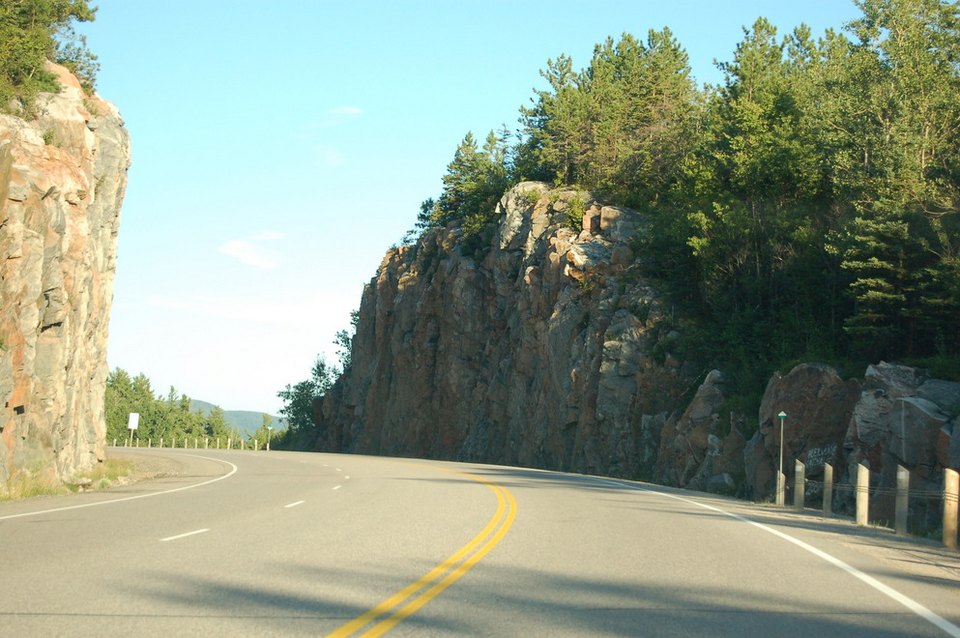
Image credit: “Highway 17 Lake Superior” by Graham M Fawcett (gr_h_m), CC BY-SA 2.0, via Wikimedia Commons (converted to JPEG).
About the author: Lifei Zhou
Model Y owner since 2022Ontario STO registered apprentice · 310SWorks on Porsche, Mercedes, BMW, Audi weeklyHundreds of readers referred (est.)
Lifei is a Tesla owner based in Canada, writing practical, fact-checked Tesla guides for US and Canadian drivers — buying, ownership, insurance, charging, and TSLA investing, all from first-hand experience.