
Tesla Model 3 vs Model Y (2026): Price, Size, Range & Which to Buy in the US and Canada
Tesla Model 3 vs Model Y (2026): Price, Size, Range & Which to Buy in the US and Canada

It’s the question nearly every Tesla shopper in the US and Canada ends up wrestling with: Model Y or Model 3? They share the same software, the same Supercharger network, much of the same interior, and even a lot of the same parts — yet one is a compact crossover and the other a sport sedan, and the gap between them comes down to a few thousand dollars, a few inches of headroom, and how you actually live with a car. Pick wrong and you’ll spend years either hauling a car seat in and out of a low-slung sedan or paying an SUV premium for cargo space you never fill.
This is a head-to-head guide for 2026 buyers in North America: real pricing, the dimensions that matter day to day, range and charging, how each one drives, and — most importantly — clear recommendations for families, commuters, and single drivers. Prices, financing and delivery times below were checked on September 22, 2026; where Tesla moves quickly we’ve used ranges rather than inventing precise numbers.
Model 3 vs Model Y in one minute (September 2026)
- Price: in the US the Model 3 starts at $36,990 and the Model Y at $39,990. Trim for trim, the Y costs about $3,000–3,500 more.
- Canada flips the math: the Shanghai-built Model 3 starts at C$39,490 with no rebate, while the Berlin-built Model Y RWD is C$49,990 before the $5,000 EVAP rebate, or C$44,990 after it.
- Space: the Y has about 9 cu ft more cargo room behind the rear seats and 6.6 inches more height. Buy it for kids, car seats, dogs or bulky gear.
- Range and handling: the Model 3 goes farther (up to 363 mi EPA) and drives sharper. Buy it for commuting and solo or two-person driving.
- Either one ordered through an owner referral link comes with 3 months of free FSD (Supervised).
Disclosure: some links in this article are affiliate/referral links. If you order or buy through them, we may earn a small commission at no extra cost to you. All analysis is based on publicly available specs and real owner experience, with no paid placement by Tesla. See our disclosure page.
📋 Contents
- Price: where the two actually land in 2026
- Size, space, and everyday practicality
- Range and charging
- Performance and handling
- Interior and tech
- Who should buy which: families, commuters, and single drivers
- Resale value and depreciation
- Side-by-side: the core comparison
- Frequently Asked Questions
- The bottom line
Price: where the two actually land in 2026
Start with the wallet, because this is where most decisions are really made. In the United States as of September 2026 (unchanged since May), the Model 3 lineup runs $36,990 for the Standard RWD, $42,490 for the Premium RWD, $47,490 for the Premium AWD, and $54,990 for the Performance. The Model Y starts higher across the board: $39,990 for the Standard RWD, $41,990 for the Standard AWD, $45,990 for the Premium RWD, $49,990 for the Premium AWD, and $57,990 for the Model Y Performance. (All of these are before the $1,390 destination fee and $250 order fee — about $1,640 on top at checkout.)
The practical takeaway: for any matched pair of trims, the Model Y costs roughly $3,000–$3,500 more than the equivalent Model 3. That’s the SUV tax, and it’s the single biggest input into your decision.
US price and financing, trim by trim (September 2026)
| Trim | Model 3 | Model Y | Gap |
|---|---|---|---|
| Standard RWD | $36,990 · 321 mi · no promo rate | $39,990 · 321 mi · 1.49% APR | +$3,000 |
| Standard AWD | — | $41,990 · 294 mi · 1.49% | — |
| Premium RWD | $42,490 · 1.99% | $45,990 · 357 mi · 1.49% | +$3,500 |
| Premium AWD | $47,490 · 363 mi · 1.99% | $49,990 · 327 mi · 1.49% | +$2,500 |
| Performance | $54,990 · 1.99% | $57,990 · 306 mi · 3.99% | +$3,000 |
Prices exclude the $1,390 destination and $250 order fees. APRs are Tesla’s 72-month promotional rates for September 2026 and end September 30; the Model 3 Standard has no promotional rate. Check Tesla’s site for the current month.
One wrinkle the sticker gap hides: because the Model Y currently gets a lower promo rate (1.49% vs 1.99%), the monthly payment gap on a financed car is a little smaller than the price gap suggests. On the flip side, the cheapest Model 3 has no promo rate at all, so if you finance, compare the Model 3 Standard at your bank’s rate against the Model Y Standard at 1.49%.
In Canada the picture shifted in May 2026 when Tesla moved Model 3 sourcing to Giga Shanghai, dropping the entry Model 3 Premium RWD to a record-low C$39,490 (463 km), with the Premium AWD at C$49,990 (570 km) and the Performance at C$74,990. The Berlin-built Model Y runs C$49,990 (RWD) / C$64,990 (Premium AWD) / C$74,990 (Performance). One big wrinkle: only the Model Y RWD qualifies for the federal $5,000 EVAP incentive (effective price C$44,990), while the Shanghai-built Model 3 gets nothing because it isn’t made in a free-trade-agreement country — so at the entry level the real gap between the two is only about C$5,500. As always, incentives are first-come-first-served; check Transport Canada and your province before ordering. Quebec buyers can add the provincial $2,000 Roulez vert rebate on either car in 2026.
Timing matters in Canada too. New Model Y orders are being quoted delivery in December 2026 to January 2027 because Berlin’s 2026 allocation for Canada is largely sold out. If you need a car before winter, check existing Model Y inventory or look at the Model 3.
Model 3 Premium vs Model Y Standard: the cross-shop
A lot of buyers end up comparing these two because they sit close in price. In the US the Model 3 Premium RWD ($42,490) and Model Y Standard AWD ($41,990) are within $500 of each other, and the Model 3 Premium AWD ($47,490) is only $2,500 more than the Model Y Standard RWD. Here’s the trade:
- The Model 3 Premium gives you the nicer cabin (upgraded audio, ambient lighting, ventilated front seats, the rear screen), more range, and quicker acceleration.
- The Model Y Standard gives you the body: higher seating, a bigger hatch and about 9 cu ft more cargo space behind the rear seats, but with a simplified interior (textile seats, fewer speakers, no rear screen, a fabric-covered roof instead of the glass one).
Rule of thumb: if you’d use the cargo space every week, the Model Y Standard. If you’re buying for the drive and the cabin, the Model 3 Premium is more car for the money. In Canada the same cross-shop is simpler: the Model 3 Premium RWD at C$39,490 costs C$5,500 less than an EVAP-eligible Model Y RWD (C$44,990 after the rebate).
If you want the full trim-by-trim breakdowns for your country, see our dedicated guides for the Model Y in the USA, the Model 3 in the USA, and for Canadians the Model Y and Model 3 Canada pages.
Size, space, and everyday practicality
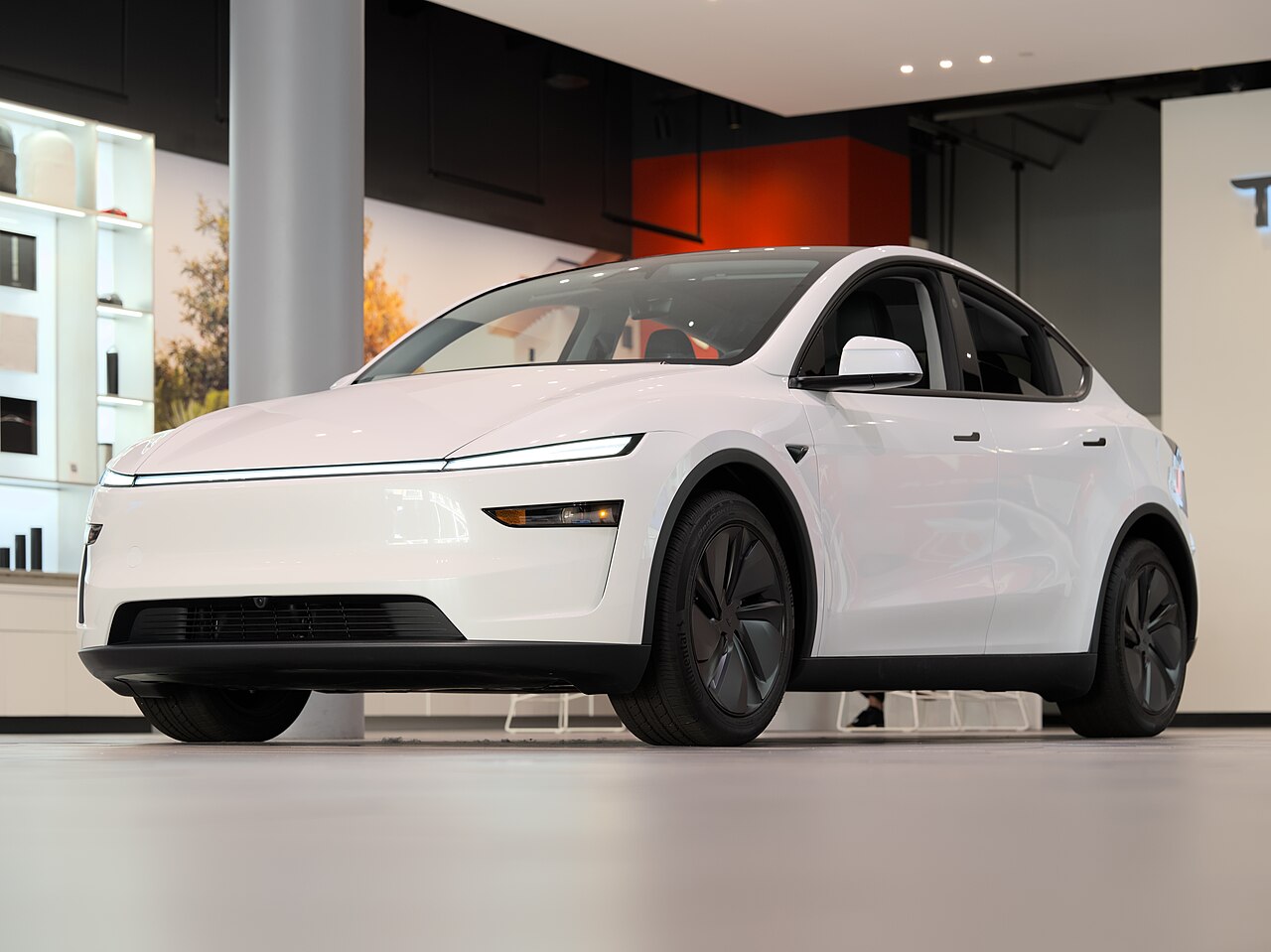
On paper the two cars are almost the same length — the Model 3 is actually a touch longer at 189.8 inches versus the Model Y’s 188.8 inches. The differences that matter are vertical. The Model Y stands 63.4 inches tall against the Model 3’s 56.8 inches, and it’s wider too (78.0 vs 76.1 inches). That extra height does three things: it raises the seating position to a crossover-friendly hip point, opens up real rear-seat headroom, and — combined with the SUV body — transforms the cargo hold.
Behind the rear seats the Model Y swallows about 33.1 cubic feet versus the Model 3’s 24.1, and with the second row folded Tesla quotes roughly 76 cubic feet of total cargo volume in the Y. In plain terms: the Model Y eats strollers, golf bags, flat-pack furniture, and a Costco run without drama; the Model 3’s trunk is generous for a sedan but its trunk opening is narrower and the load floor is lower, so bulky items are a wrestling match.
Both cars have a useful front trunk (frunk) and the Model 3’s lower roofline actually makes it the easier car to slide into for some drivers — you sit down into it like a sports sedan. The Model Y’s taller doors and upright entry are friendlier for kids, car seats, older passengers, and anyone loading a dog. If you regularly fit three across the back or haul gear, the Y’s advantage is decisive; if it’s mostly two people and the occasional suitcase, the Model 3 never feels cramped.
Range and charging
Range is close enough that it rarely decides the matchup, but the Model 3 has a slight edge thanks to its lower, slipperier body. The Model 3 tops out at an EPA-rated 363 miles (Premium AWD), the best in either lineup, while the Model Y’s champ is the Premium RWD at 357 miles, with the Premium AWD at 327 and the Performance at 306. The Standard RWD trims of both sit at 321 miles (the Model Y Standard AWD dips to 294).
Charging is identical in every way that counts. Both use Tesla’s NACS port and tap the same Supercharger network — the single biggest real-world advantage of buying a Tesla in North America — and both peak around 250 kW on V3/V4 Superchargers, adding roughly 175–200 miles in about 15 minutes under good conditions. For home charging, both pair with the same Wall Connector, and the experience is interchangeable. If you do a lot of highway miles, the Model 3’s extra efficiency means marginally fewer or shorter stops, but you won’t reorganize your life around it.
One accessory note for either car: US Teslas haven’t shipped with a Mobile Connector since 2022, so check what’s in the box for your market. If you’ll charge at friends’ houses or hotels without chargers, budget for Tesla’s Mobile Connector, and for a Wall Connector at home.
Performance and handling
This is where the Model 3 quietly wins the enthusiast vote. Lower, lighter, and with a lower center of gravity, the Model 3 turns in sharper and feels more planted in corners — it drives like the sport sedan it’s shaped to be. The Model Y is far from soft, but the taller body and higher mass mean a hair more body roll and a slightly less connected feel.
In a straight line both are quick to absurd. The Model 3 Standard RWD does 0–60 mph in about 5.8 seconds; the Premium AWD in roughly 4.2 seconds; and the Model 3 Performance is the headliner at about 2.9 seconds with around 510 hp — genuinely supercar-quick. The Model Y answers with 4.6 seconds for the Standard and Premium AWD trims and 3.3 seconds for the Model Y Performance (around 460 hp). For 99% of buyers, even the base trims are faster than anything they’ve owned; the Performance trims are a treat, but they cost more to buy and more to insure, so quote both before you commit.
Ride comfort is a wash with a slight tilt toward the Model Y, whose longer-travel suspension and taller sidewalls soak up broken pavement a bit better — relevant if your commute involves potholes or rough winter roads.
Interior and tech
Step inside and the two are near-twins. Same minimalist dashboard, same central touchscreen running the same software, same over-the-air updates, same app, same Sentry Mode and dashcam. The Model Y typically adds a small rear touchscreen for back-seat climate and media, and its taller cabin simply feels airier. Both offer the panoramic glass roof that makes the interior feel larger than its footprint.
Because the software is shared, every Tesla party trick — phone-as-key, summon, navigation that auto-routes through Superchargers, gaming, streaming — works identically on both. If you order through an owner referral link, you currently get 3 months of free Full Self-Driving (Supervised) thrown in, which is the cheapest way to try the system before deciding whether it’s worth subscribing. Whichever you choose, plan to budget for a few essentials on day one: all-weather floor liners, a matte screen protector (the shared touchscreen is the one part of either car you touch constantly), and a center-console organizer. JOWUA makes all three for both the current Model 3 and Model Y; code TSLNA takes 5% off, and orders over US$130 ship free by DHL (5–7 days) with duties prepaid to the US and Canada.
Who should buy which: families, commuters, and single drivers
Here’s the part that actually answers the question. Match the car to your life, not the spec sheet.
Families (kids, car seats, a dog, weekend gear): buy the Model Y. The taller entry makes wrangling car seats and toddlers far less painful, the cargo hold handles strollers and Costco hauls, and the back seat is genuinely comfortable for three across. The roughly $3,000 premium over the Model 3 buys real, daily-use practicality you’ll feel every single trip. The Premium AWD is the family sweet spot — enough range, all-weather traction, and no need for the pricey Performance trim. And if two rows genuinely aren’t enough, there’s now a bigger option: the long-wheelbase, six-seat Model Y L opened for US orders on July 2, 2026 at $61,990 (2+2+2 seating, 325 miles EPA, deliveries October–November; US-only, with no Canadian launch date).
Commuters (mostly solo or two-up, lots of highway miles): the Model 3 is the smarter buy. You get the best range in the lineup, the lowest price of entry, the sharpest handling for a fun daily drive, and the best efficiency for long stretches. Unless you regularly carry bulky cargo, the sedan’s trunk is plenty, and you pocket thousands at purchase plus a bit at the pump… so to speak.
Single drivers and enthusiasts: Model 3, almost every time. It’s cheaper, faster-feeling, better-handling, and more efficient. If your budget stretches and you crave acceleration, the Model 3 Performance at sub-3 seconds is the most car-for-the-money in the entire Tesla range. Only step up to the Y if you genuinely use the cargo space or want the higher seating position.
Whichever you pick, don’t skip the handover walkaround — panel gaps and paint flaws are far cheaper to flag on delivery day than to chase later. Our delivery inspection checklist walks you through exactly what to check before you sign.
Resale value and depreciation
Both cars depreciate like normal EVs now — the wild swings of a few years ago have largely settled. In 2026 data the two land close together over five years, with retention roughly in the mid-40s to low-50s percent depending on trim and condition; clean, well-kept Premium (formerly Long Range) examples of either sit at the top of that band. Encouragingly, the Model Y’s three-year depreciation now runs in the same ballpark as a Honda CR-V or Toyota RAV4 — strong company for any EV.
Two practical notes. First, Performance trims depreciate a touch faster in absolute dollars simply because they cost more up front. Second, color, condition, and FSD don’t move resale as much as buyers expect — high mileage and accident history matter far more. If long-term value is a priority, a clean Premium-trim example of either — historically the volume configuration — is one of the safer bets in the EV market; one exception worth hunting for is a used car with bought-out FSD, since the buyout was discontinued in February 2026 and can’t be added to a new car at any price.
So which has better resale value? Close to a tie. The Model Y has a slightly deeper used-buyer pool in North America because crossovers sell faster, which helps it hold value in dollar terms; the Model 3 loses fewer total dollars because it costs less to begin with. In Canada, the Shanghai-built Model 3’s big 2026 price cut pulls down values of older Model 3s, which is worth knowing if you’re buying used.
Side-by-side: the core comparison
| Dimension (2026) | Model 3 (sedan) | Model Y (crossover) |
|---|---|---|
| US starting price | ~$36,990 (Standard) | ~$39,990 (RWD) |
| Canada starting price | ~C$39,490 | ~C$49,990 (C$44,990 after EVAP) |
| Max EPA range | Up to ~363 mi | Up to ~357 mi |
| Cargo behind rear seats | ~24.1 cu ft | ~33.1 cu ft (up to ~76 folded) |
| Height | 56.8 in (lower, sportier) | 63.4 in (higher seating) |
| 0–60 mph (base → Performance) | ~5.8s → ~2.9s | ~6.8s → ~3.3s |
| Handling feel | Sharper, sportier | Composed, slight body roll |
| Charging | NACS, Supercharger, ~250 kW | NACS, Supercharger, ~250 kW |
| 5-yr value retention | ~mid-40s–low-50s % | ~mid-40s–low-50s % |
| Best for | Commuters, singles, enthusiasts | Families, cargo, taller drivers |
For the official specs and live pricing, check Tesla’s own Model Y and Model 3 pages, and verify range and efficiency on fueleconomy.gov.
Frequently Asked Questions
Is the Model Y or Model 3 better for a family with two kids?
The Model Y, clearly. The taller body makes installing car seats and loading kids far easier, the cargo area handles strollers and weekend gear, and the back seat is roomier for three across. The roughly $3,000 premium over the Model 3 buys daily-use practicality a family will appreciate on every trip. A Model 3 works for a small family, but you’ll feel the lower roof and smaller trunk opening sooner than you’d like.
Which one is cheaper to own overall?
The Model 3 is cheaper at every comparable trim, uses slightly less energy, and tends to insure a bit lower because it’s worth a little less and weighs less. The Model Y costs more up front but its strong resale and family-friendly versatility can justify the difference if you actually use the space. Run both trims you’re considering through an insurance quote before ordering — the premium gap, especially on Performance trims, can be meaningful.
Do they charge at the same speed?
Effectively yes. Both use the NACS port, access the Supercharger network, and peak around 250 kW, adding roughly 175–200 miles in about 15 minutes in good conditions. The Model 3 is marginally more efficient, so on a long road trip it may need slightly shorter or fewer stops, but the difference is small.
Is the Model 3 Performance or Model Y Performance the better buy?
For pure thrills and value, the Model 3 Performance — it’s quicker (around 2.9 seconds 0–60), handles sharper, and costs less. Choose the Model Y Performance only if you need the SUV’s cargo and seating and still want maximum speed. Both Performance trims cost more to insure, so factor that in.
Will I regret buying the Model 3 instead of the Model Y?
Only if your needs grow — a new baby, a dog, a move to a place with rough roads, or a habit of hauling bulky gear. If you’re mostly commuting or driving solo and two-up, the Model 3 delivers more range, sharper driving, and thousands in savings, and most owners never miss the extra space. When in doubt about future cargo needs, the Model Y is the safer hedge.
Is the Model 3 or Model Y cheaper in Canada?
The Model 3. The Shanghai-built Model 3 Premium RWD is C$39,490 and doesn’t qualify for EVAP; the Model Y RWD is C$49,990 and does, so it drops to C$44,990 after the $5,000 rebate. The real entry-level gap is about C$5,500. Above the entry trims, the Model 3 Premium AWD (C$49,990) undercuts the Model Y Premium AWD (C$64,990) by C$15,000.
Should I get a Model 3 Premium or a Model Y Standard?
If you need cargo space and a higher seat, the Model Y Standard. If you want the nicer interior, more range and quicker acceleration for about the same money, the Model 3 Premium. In the US the Model 3 Premium RWD and Model Y Standard AWD are within $500 of each other.
Do both come with the same Full Self-Driving and software?
Yes — identical software, identical FSD (Supervised) hardware and options, identical over-the-air updates. There’s no software advantage to either model. Ordering through an owner referral link currently includes 3 months of free FSD (Supervised) so you can try it before subscribing.
The bottom line
- Choose the Model Y if: you have kids or a dog, regularly haul cargo, want a higher seating position, or value all-weather versatility over saving a few thousand dollars.
- Choose the Model 3 if: you’re a commuter, a single driver, or an enthusiast — you’ll get the best range, the sharpest handling, the lowest price, and slightly better resale.
- Both share: the same software, Supercharger access, NACS charging, build quality, and ownership experience — so you genuinely can’t make a bad choice, only the wrong fit.
- Before you order: quote insurance on the exact trim you want, inspect carefully at delivery, and consider an owner referral link for 3 months of free FSD (Supervised).
Pricing, financing, range, and specifications in this article were checked on September 22, 2026 and reflect publicly available Tesla configurations for the US and Canada. Tesla changes prices, trims, and incentives frequently — always confirm current figures on Tesla’s official site before ordering. This is general buying information, not financial advice. Some links are affiliate/referral links; see our disclosure page. Image credit: via Wikimedia Commons (Creative Commons).

About the author: Lifei Zhou
Model Y owner since 2022Ontario STO registered apprentice · 310SWorks on Porsche, Mercedes, BMW, Audi weeklyHundreds of readers referred (est.)
Lifei is a Tesla owner based in Canada, writing practical, fact-checked Tesla guides for US and Canadian drivers — buying, ownership, insurance, charging, and TSLA investing, all from first-hand experience.