
Tesla Model Y vs Mustang Mach-E vs Ioniq 5 (2026): Which Electric SUV Wins?
Tesla Model Y vs Mustang Mach-E vs Ioniq 5 (2026): Which Electric SUV Wins?

If you are shopping for an electric SUV in North America right now, three names end up on almost every short list: the Tesla Model Y, the Ford Mustang Mach-E, and the Hyundai Ioniq 5. They cover roughly the same price band, seat a family of five, and promise 300-ish miles of range — yet they feel like very different cars once you live with them. This guide breaks down how the 2026 versions actually compare on price, range, charging, software, and total cost, and tells you which one fits which kind of buyer.
Disclosure: some links are affiliate/referral links, meaning we may earn a commission at no extra cost to you if you buy through them. See our disclosure page.
📋 Contents
Why these three electric SUVs
The Model Y has been the best-selling EV in the U.S. and Canada for years, so it sets the baseline everyone else is judged against. The Mustang Mach-E is Ford’s mainstream answer — a stylish, familiar-feeling crossover with real infotainment flexibility. The Ioniq 5 is the value and fast-charging champion, with a retro-futuristic design that keeps winning awards.
All three are compact-to-midsize five-seat SUVs (the Model Y offers an optional third row in the U.S.), all three lost access to the U.S. federal $7,500 tax credit when it expired on September 30, 2025, and all three can now charge at Tesla Superchargers. Those shared facts make this a genuine three-way fight rather than a lopsided comparison. The differences are in the details — and the details matter a lot when you drive 12,000 miles a year.
Price and range compared (2026)
Pricing below is manufacturer’s suggested retail before destination/freight, order fees, and any regional adjustments — always confirm the live number on each brand’s configurator, because EV pricing has moved several times in the past year. Ranges are EPA estimates for the U.S. market; Canadian NRCan figures are quoted in kilometres and differ slightly.
| Spec (2026) | Tesla Model Y | Ford Mustang Mach-E | Hyundai Ioniq 5 |
|---|---|---|---|
| Starting MSRP (US) | ~$39,990 (Standard RWD) | ~$37,800 (Select) | ~$35,000 (SE Standard Range) |
| Top trim (US) | ~$57,990 (Performance) | ~$57,690 (Rally) | ~$49,000 (Limited); ~$55k+ (N) |
| EPA range (best trim) | Up to ~357 mi | Up to ~320 mi | Up to ~318 mi |
| Horsepower range | ~295–510 hp | ~264–480 hp | ~168–320 hp (641 hp N) |
| Charge port | Native NACS | CCS1 (NACS adapter needed) | Native NACS (800V) |
| Supercharger peak | ~250 kW | ~150 kW (via adapter) | ~95–125 kW (400V-limited) |
| EV/battery warranty | 8 yr / 100k–120k mi | 8 yr / 100k mi | 10 yr / 100k mi |
| Apple CarPlay | No | Yes (wireless) | Yes (wireless) |
| US federal credit (2026) | None | None | None |
The headline read: the Ioniq 5 is the cheapest way in and has the best warranty, the Mach-E splits the difference and is the only one with Apple CarPlay and a base price under $38,000 in RWD form, and the Model Y still posts the longest range and the fastest, most seamless Supercharging. For a deeper trim-by-trim breakdown on the Tesla side, see our full 2026 Model Y USA guide and the Model Y Canada guide.
Charging: where the Model Y still wins
On paper, charging looks like a tie now that everyone can use Tesla Superchargers. In practice it is the biggest real-world separator of the three.
The Model Y was built for the Supercharger network. Plug in, and the car authenticates, bills your account, and pulls up to about 250 kW with zero extra steps. There is no adapter to carry, lose, or fumble with in the rain, and the in-car trip planner preconditions the battery and routes you stall-to-stall automatically.
The Ioniq 5 has a clever twist. Its 800V architecture is the fastest-charging system in this group — at a 350 kW CCS station (Electrify America’s best), it can go from 10% to 80% in around 20 minutes, quicker than either rival. But most Tesla Superchargers run at 400V, which forces the Ioniq 5 to step down to roughly 95–125 kW, so a Supercharger session takes closer to 30 minutes. The takeaway: the Ioniq 5 is brilliant on 350 kW networks and merely okay on Superchargers.
The Mach-E is the odd one out. Through 2026 it still uses a CCS1 port, so charging at a Supercharger requires Ford’s NACS adapter (about $200), and it peaks near 150 kW. It works, but it is one more piece of hardware and one more thing that can go wrong. If you’re weighing an adapter-based EV, our NACS adapter guide explains exactly what to buy and how it behaves at a Tesla stall, and our Supercharger cost breakdown covers what a session actually costs.
Software, interior, and living with each one
This is where personal taste takes over. The Model Y runs Tesla’s own operating system: one crisp 15.6-inch center screen, over-the-air updates that genuinely add features, the best-in-class navigation and route planner, and gaming/streaming when parked. What it does not have is Apple CarPlay or Android Auto — a dealbreaker for some, a non-issue for others who live inside the Tesla app.
The Mach-E leans the opposite way. Ford’s 15.5-inch vertical screen runs a Sync-based system with wireless CarPlay and Android Auto standard, so your phone’s maps and music mirror straight to the dash. The cabin feels the most conventional and car-like of the three, with a small driver display and physical touches Tesla dropped years ago.
The Ioniq 5 splits the difference beautifully: dual 12.3-inch displays, wireless CarPlay/Android Auto, physical climate buttons, a flat floor with a sliding console, and vehicle-to-load (V2L) power that can run a coffee maker or charge an e-bike from the car’s battery. Its 800V system and lounge-like interior make it the tech enthusiast’s pick.
On cargo, all three swallow a family’s gear; the Model Y adds a usable front trunk and the optional U.S. third row, the Mach-E offers up to ~59.7 cubic feet with seats folded, and the Ioniq 5’s flat floor makes loading easiest.
What each one costs to own in 2026
Since the U.S. federal $7,500 new-EV credit ended on September 30, 2025, none of these three qualifies for it anymore — so sticker price and financing matter more than they did a year ago. Tesla routinely posts low promotional APRs on the Model Y (recently as low as 0%–0.99% on some trims for well-qualified buyers), while Ford and Hyundai counter with cash incentives and lease deals that change monthly. Always price all three the same week.
Two ownership costs favor the Ioniq 5 and Mach-E: dealer service networks are everywhere, and Hyundai’s 10-year/100,000-mile powertrain warranty is the longest here. The Model Y counters with the lowest scheduled maintenance (no oil changes, minimal service intervals) and the strongest resale value of the trio — worth real money at trade-in time. Insurance varies wildly by state and province, so get quotes before you commit.
If the Model Y is your pick, ordering through a Tesla referral link currently adds 3 months of free Full Self-Driving (Supervised) on a new Model 3, Model Y, or Cybertruck — a genuine perk that costs you nothing extra. In Canada, remember the Model Y RWD is the only trim that slips under the $50,000 cap for the federal iZEV rebate when it’s funded, so check current 2026 incentive status before you order.
Which electric SUV should you buy?
There is no single winner — there’s a best fit for you.
Buy the Tesla Model Y if you road-trip often, want the longest range and the smoothest Supercharging, care about resale value, and don’t mind skipping CarPlay. It’s the safest all-rounder and the reason the other two exist.
Buy the Ford Mustang Mach-E if you want wireless CarPlay, a more traditional cabin, sharp styling, and a lower entry price — and you mostly charge at home so the adapter and slower peak rarely bite.
Buy the Hyundai Ioniq 5 if you want the best value and warranty, the fastest charging on 350 kW networks, V2L power, and a genuinely lovely interior — and you can live with modest Supercharger speeds.
Still deciding between two Teslas instead? Our Model Y vs Model 3 comparison and the full US Tesla guides go deeper on trims and options.
Gear worth buying whichever SUV wins
A new EV is a big purchase, and the first few weeks are when little annoyances show up. A handful of inexpensive accessories solve most of them — and these work whether you land on the Model Y, the Mach-E, or the Ioniq 5.
Start with all-weather floor liners. Factory carpet mats are the first thing to look tired after a wet winter or muddy hikes, so a set of laser-fit rubber liners like these 3W all-weather floor mats (sold in model-specific fits) is the single best first purchase for any EV owner — expect to spend in the $80–130 range for a full set.
Two more that pay for themselves quickly: a folding windshield sunshade (roughly $30–50) keeps the cabin dramatically cooler in summer and cuts how hard the AC has to work, and if your SUV has a built-in dashcam or sentry-style recorder, a fast, high-endurance 256GB high-endurance USB drive (about $25–35) records reliably without dropping frames. Tesla owners specifically will also want a matte center-screen protector to kill glare and fingerprints on that big display. For the full checklist, see our new-owner accessories guide and browse more Tesla accessory picks.
Frequently Asked Questions
Is the Tesla Model Y better than the Mustang Mach-E and Ioniq 5?
Overall, the Model Y is the strongest all-rounder thanks to its range, seamless Supercharging, and resale value. But the Mach-E wins on CarPlay and a conventional cabin, and the Ioniq 5 wins on price, warranty, and 350 kW fast-charging. The “best” depends on how and where you charge.
Can the Mach-E and Ioniq 5 use Tesla Superchargers?
Yes. The Ioniq 5 (2025 model year onward) has a native NACS port and plugs in directly, though most Superchargers cap it near 95–125 kW because they run at 400V. The Mach-E still uses a CCS1 port through 2026 and needs Ford’s ~$200 NACS adapter, peaking around 150 kW.
Do any of these EVs still get the $7,500 tax credit in 2026?
No. The U.S. federal clean-vehicle tax credit expired on September 30, 2025, so none of the three qualifies in 2026. In Canada, only the Model Y RWD sneaks under the $50,000 cap for the federal iZEV rebate when funding is available — verify the current balance before ordering.
Which of the three charges the fastest?
On a 350 kW CCS charger the Ioniq 5 is quickest (about 20 minutes from 10% to 80%). But on Tesla’s Supercharger network the Model Y is fastest and simplest, pulling up to ~250 kW with no adapter. The Mach-E sits in the middle at roughly 150 kW.
Which has the best warranty and resale value?
Hyundai offers the longest coverage — 10 years / 100,000 miles on the powertrain. The Model Y holds its value best at resale and has the lowest routine maintenance, which offsets its shorter 8-year battery warranty for many buyers.
Does the Model Y have Apple CarPlay?
No. Tesla uses its own operating system and does not support Apple CarPlay or Android Auto on any model. The Mach-E and Ioniq 5 both include wireless CarPlay and Android Auto, which is a deciding factor for phone-centric drivers.
The bottom line
- Model Y — best range, best Supercharging, best resale; no CarPlay. The default choice for road-trippers.
- Mustang Mach-E — CarPlay, familiar cabin, low RWD entry price; needs an adapter for Superchargers.
- Ioniq 5 — best value and warranty, fastest on 350 kW chargers, V2L power; modest Supercharger speeds.
- None qualifies for the U.S. $7,500 credit in 2026 — compare out-the-door prices and financing the same week.
- Ordering a Tesla through a referral link adds 3 months of free FSD (Supervised) at no extra cost.
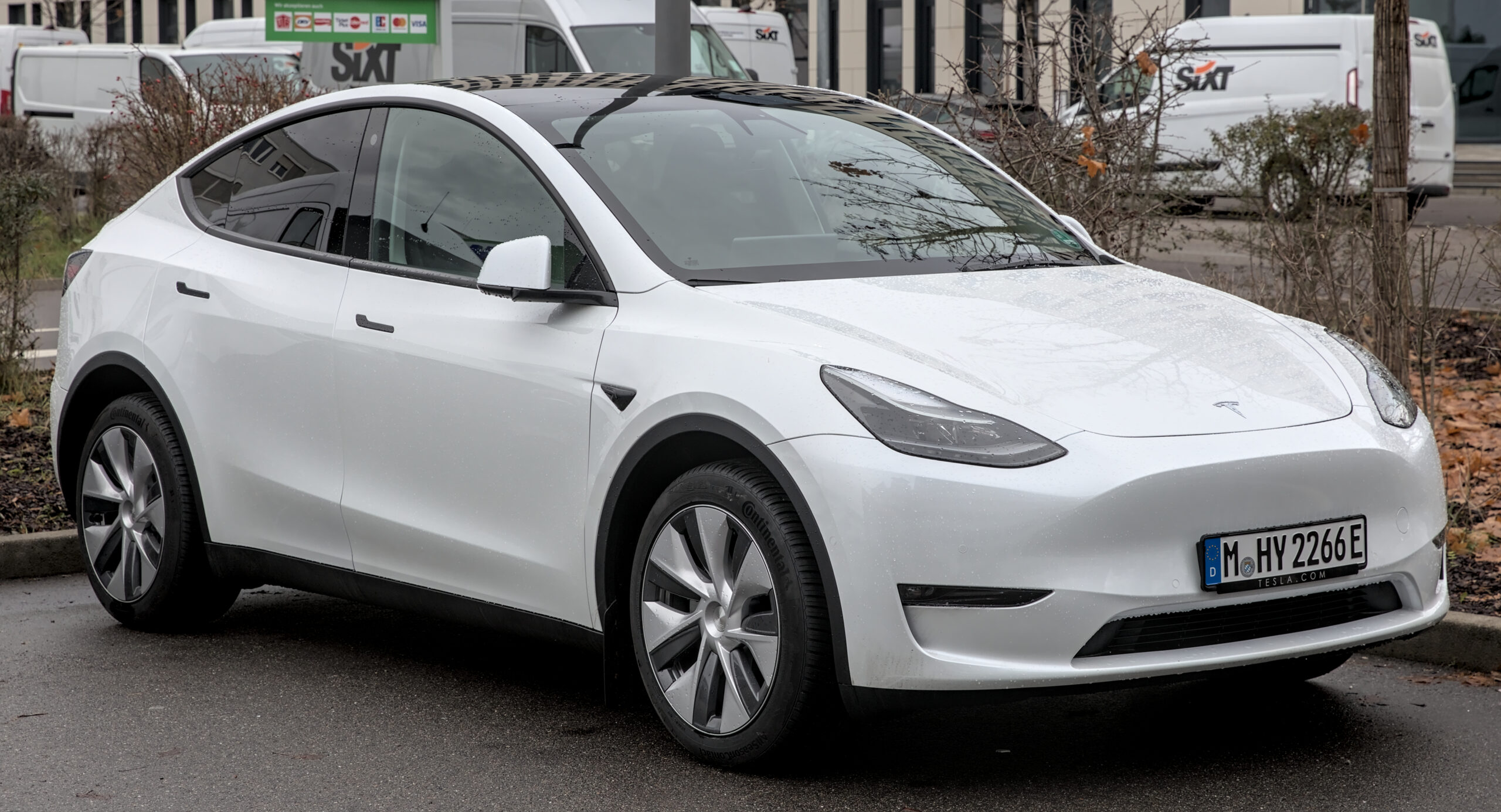
Information is current as of 2026 and reflects U.S. pricing and EPA figures unless noted; Canadian prices and NRCan range figures differ. Specifications, pricing, and incentives change frequently — always confirm on the manufacturer’s official site before purchasing. This article is for general information only and is not financial or purchasing advice. Some links are affiliate/referral links; see our disclosure page. Image credit: Tesla Model Y by Alexander Migl, CC BY-SA 4.0, via Wikimedia Commons.
Sources for verification: Tesla Model Y (official), Ford Mustang Mach-E (official), Hyundai Ioniq 5 (official), and fueleconomy.gov for EPA range and efficiency data.

About the author: Lifei
Lifei is a Tesla owner based in Canada, writing practical, fact-checked Tesla guides for US and Canadian drivers — buying, ownership, insurance, charging, and TSLA investing, all from first-hand experience.
