
Driving a Tesla From Toronto to Florida for the Winter (2026): Snowbird Route, Charging Cost and Border Rules
Driving a Tesla From Toronto to Florida for the Winter (2026): Snowbird Route, Charging Cost and Border Rules

Yes, you can drive a Tesla from Toronto to Florida for the winter, and the Supercharger network makes it easy. Plan on roughly 2,100 to 2,250 km, two or three driving days, and a charging bill that is usually a couple of hundred US dollars, depending on your car and the prices at each stop. The parts that catch snowbirds out are not the charging: they are the US 30-day registration rule, your provincial health coverage and the day counts for tax.
Disclosure: some links are affiliate/referral links. If you buy through them, this site may earn a commission or referral credit at no extra cost to you. See our disclosure page.
Key facts (checked October 29, 2026)
- Toronto to Orlando is about 2,130 km via Niagara and the I-95 side, or about 2,240 km via Detroit and I-75, both around 21.5 hours of driving.
- Canadians who stay in the US 30 days or longer must be registered. Drivers who cross by land often get no I-94, so they usually need to file Form G-325R online.
- Canadian visitors who file G-325R do not need a biometrics appointment, according to USCIS.
- OHIP pays at most $50 a day for emergency outpatient care outside Canada and $400 a day for intensive inpatient care, so private travel medical insurance is essential.
- Spending fewer than 183 days in the US in a calendar year lets most snowbirds claim the closer connection exception on IRS Form 8840.
- A 2026 Model Y Long Range AWD is rated at 27 kWh per 100 miles, which works out to roughly 360 to 410 kWh for the trip.
Every fall, thousands of Ontario and Quebec snowbirds load up the car and head south on the QEW or the 401. More of them now do it in a Tesla. I’m in the Toronto area too, and I’ve put about 1,400 km on Full Self-Driving (Supervised) in a single trip from Oakville to Ottawa and Montreal, so I know how relaxed a long Tesla drive can be. The drive to Florida is longer, but it is mostly the same routine: navigate to the destination, let the car pick the stops, and take a 20 to 30 minute break every few hours. This guide covers the route, what the charging really costs, and the paperwork that matters far more than range.
📋 Contents
- Which route to take from Toronto to Florida
- How charging works on the drive
- What the charging costs, roughly
- Paperwork before you cross: the 30-day registration rule
- Health coverage and insurance while you are away
- Taxes: stay under 183 days and file Form 8840
- Charging in Florida for the winter
- If you fly home mid-winter and leave the car
- Thinking about a Tesla for next winter’s drive?
- Frequently Asked Questions
- Summary
Which route to take from Toronto to Florida
There are two classic snowbird routes, and a Tesla handles both. The trip planner in the car does not care which border you cross. It simply plans Supercharger stops along whatever route you pick.
East: Niagara, then I-95 side
- Drive time
- About 21.5 h
West: Windsor-Detroit and I-75
- Drive time
- About 21.5 h
Source: LazyTrips route guide. Exact distance depends on where in Florida you are going.
The LazyTrips route guide puts the eastern route at 2,130 km and the inland I-75 route at 2,240 km, with almost identical driving time. Rome2Rio lands in the same range. For the Gulf Coast (Naples, Sarasota, Fort Myers), the I-75 route usually makes more sense. For the Atlantic side (Palm Beach, Fort Lauderdale), the eastern route does.
Two practical points for a November or December departure:
- The first day is the winter day. Western New York, Pennsylvania, Ohio and the mountains of West Virginia can all see snow and freezing rain. Leave on a clear forecast if you can.
- Many snowbirds split the drive into three days of about 7 hours each. Two long days are possible, but charging stops add time, so three is more comfortable.
How charging works on the drive
You don’t need to plan stops yourself. Enter your Florida address in the car’s navigation and the trip planner adds Supercharger stops, shows your arrival percentage at each one, and tells you how long to charge. On a highway trip, the fastest pattern is usually to arrive at around 10 to 20% and leave once the car says you have enough to reach the next stop, instead of charging to 100% every time.
- Start full. Charge to 100% at home the night before. Home electricity in Ontario is far cheaper than any Supercharger, and a full battery covers most of the first leg to the border and beyond.
- Let the car precondition. When a Supercharger is set as the destination, the car warms the battery on the way, which matters a lot on a cold first day. Our guide to preconditioning in winter explains how it works.
- Check prices in the car. US Supercharger prices vary by site and time of day, and the car shows the current rate for each stop before you arrive. Off-peak hours are usually cheaper.
- Payment is automatic. Charging is billed to the card on your Tesla account, so there is nothing to set up at the border. US stops are priced in US dollars.
Tesla’s Supercharging support page covers idle fees and how pricing is displayed. For a deeper look at rates, see our Supercharger cost guide.
What the charging costs, roughly
The EPA rates a 2026 Model Y Long Range AWD at 27 kWh per 100 miles, and a Long Range RWD at 25. The Toronto to Orlando trip is about 1,325 miles, so the EPA figure works out to about 360 kWh. Highway speeds and a cold start usually push real use higher, so a sensible estimate is around 410 kWh.
Supercharger prices change too often to quote one number, so here is the trip at three prices. Plug in what you see in the car.
Estimate: 1,325 miles at the EPA 27 kWh/100 mi rating for a 2026 Model Y Long Range AWD, plus about 15% for highway speed and winter. A full charge at home before you leave lowers the total. Scale: US$0 to US$250.
Leaving with a full battery from home takes a real bite out of that number, since a big share of the first leg is already paid for at home rates. Driving a little slower helps too, because consumption climbs quickly at high interstate speeds.
Paperwork before you cross: the 30-day registration rule
This is the step most snowbirds now ask about, and it applies no matter what you drive. According to USCIS, visitors aged 14 and over who stay in the United States for 30 days or longer must be registered. The Government of Canada’s US travel advice page repeats the warning and says non-compliance can lead to penalties, fines and misdemeanour prosecution.
- If you fly, you are usually registered already. Air travellers get an electronic I-94, which counts as registration.
- If you drive, you often are not. USCIS says Canadian visitors who entered at a land port and were not issued an I-94 are not registered unless they registered another way.
- How to register: file Form G-325R online through a USCIS account before your 30th day in the country. It cannot be filed by mail. Each person files their own.
- No fingerprints for Canadians: USCIS says Canadian visitors who file G-325R are not scheduled for a biometrics appointment and receive their proof of registration directly.
- NEXUS: USCIS lists people last admitted through NEXUS, SENTRI, FAST or Global Entry as already registered. Keep proof with you either way.
You can look up whether you have an I-94 on the CBP I-94 website. Rules in this area have shifted several times since 2025, so check the USCIS page again the week you leave. For the border crossing itself, including what to declare and Supercharging on both sides, see our guide to driving a Tesla across the US–Canada border.
- Day 30 in the USYou must be registered. Land travellers without an I-94 file Form G-325R online before this day.
- 153 days in OntarioOntario says you need at least 153 days in the province in each of the two 12-month periods before a longer absence, if you plan to be away more than seven months.
- 183 days in the USAt 183 days or more in a calendar year, you can no longer use the closer connection exception on Form 8840.
- June 15 the next yearThe usual Form 8840 deadline for snowbirds with no US wages.
Sources: USCIS, Ontario Ministry of Health, IRS. Other provinces have their own limits.
Health coverage and insurance while you are away
Your provincial plan is not travel insurance. Ontario’s OHIP coverage while outside Canada page says emergency outpatient care abroad is paid at up to $50 a day, and emergency inpatient care at up to $400 a day for intensive levels of care and $200 a day for other levels. A single night in a Florida hospital can cost many times that, so a private travel medical policy that covers your full stay is essential. Quebec, BC and other provinces have their own absence limits, so check your province’s rules before you book a five-month rental.
For the car itself, Ontario auto policies generally cover driving in the United States, but a multi-month stay is worth a phone call. Tell your insurer how long you will be gone, where the car will be parked, and whether anyone else will drive it. Note that Tesla Insurance is not sold in Canada, so you will be dealing with your regular Canadian insurer.
Taxes: stay under 183 days and file Form 8840
The US uses a “substantial presence test” that counts days over three years, so even a snowbird who spends well under six months a year can trip it. The fix for most Canadians is the closer connection exception. You claim it on IRS Form 8840, which is only available if you were in the US for fewer than 183 days in the calendar year and keep your tax home and closer ties in Canada. Each spouse files their own form, and for snowbirds with no US wages it is usually due June 15 of the following year.
Note that registering with USCIS under the 30-day rule does nothing for your tax status. They are separate systems. If your situation is unusual (a US rental property, US income, or more than about four months a year in the US), talk to a cross-border tax professional.
Charging in Florida for the winter
Once you arrive, daily driving is easy. Florida has dense Supercharger coverage, and short trips around town use little energy in warm weather. The question is whether you can charge where you are staying.
- RV parks and many winter rentals have a NEMA 14-50 outlet. A 50-amp RV pedestal is the same outlet many Tesla owners use at home, and it can add most of a day’s driving in a few hours.
- Condos vary. Some Florida condos have shared Level 2 chargers, and some allow nothing. Ask before you sign the lease.
- A regular 120V outlet works for light driving. It is slow, but it can cover a few short errands a day.
If you will rely on a 14-50 outlet, a portable Level 2 charger is the one piece of gear worth bringing. The Lectron 40A portable Level 2 charger plugs into a NEMA 14-50 and charges at up to 40 amps. Check that the version you pick has the Tesla (NACS) plug, or pair it with an adapter. It is worth it if you’ll be at an RV park or a rental with a 240V outlet, and it doubles as a backup at home. The budget alternative is the Tesla Mobile Connector. It plugs into a standard 120V outlet out of the box and needs Tesla’s separate NEMA 14-50 adapter for 240V.
Tire pressure is the other thing to watch. Tires lose pressure in the cold and gain it in the heat, so pressures set in a Toronto driveway in November will read high after a week in Florida. Check them once you settle in with a simple gauge like the AstroAI digital tire gauge, and set them to the pressure on the door-jamb sticker.
If you fly home mid-winter and leave the car
Some snowbirds drive down, fly home for the holidays, and fly back. A parked Tesla loses some charge every day, mostly from the car waking up and from Sentry Mode. When I left my Model Y parked for about two months on a trip to China, it went from 75% to 52%. That was without Sentry Mode running, so turn Sentry off if the car is in a secure spot, set the charge limit to a moderate level, and leave it plugged in if you have a plug. The app lets you check the battery from anywhere.
If you end up staying longer than a season, our Florida Tesla guide covers local costs, insurance and summer heat.
Thinking about a Tesla for next winter’s drive?
If you are still driving a gas car south each year, the charging savings add up quickly, and the trip planner removes most of the range worry. I ordered my Model Y straight from tesla.com in January 2022 without a test drive, and it has handled four Toronto winters. If you order a new Tesla through our referral link, you get 3 months of FSD (Supervised). It generally can’t be combined with the new-car FSD trial or other offers; Tesla confirms the final perk on your order.
Frequently Asked Questions
How long does it take to drive a Tesla from Toronto to Florida?
The driving alone is about 21 to 22 hours to Orlando, plus charging stops of about 20 to 30 minutes every few hours. Most snowbirds split it into two or three days. Three days of about 7 hours each is the comfortable option.
Are there enough Superchargers between Ontario and Florida?
Yes. Both the I-75 corridor and the I-77/I-95 side have Superchargers at regular intervals. The car’s trip planner picks the stops and shows the charge you will arrive with, so you don’t need to plan them yourself.
Do Canadian snowbirds driving to Florida need to register with the US government?
If you stay 30 days or longer, yes, you must be registered. Travellers who fly in get an I-94 that counts as registration. Drivers often don’t get one, so they usually file Form G-325R online through a USCIS account before day 30. USCIS says Canadian visitors don’t need a biometrics appointment.
Does my Canadian Tesla work at US Superchargers?
Yes. Charging is billed to the payment method on your Tesla account, and US stops are priced in US dollars. There is nothing to activate at the border.
How much does it cost to Supercharge from Toronto to Orlando?
For a Model Y Long Range, our estimate is about 410 kWh for the whole trip, which is about US$164 at US$0.40/kWh and US$246 at US$0.60/kWh. Leaving with a full charge from home lowers the total. Check the prices shown in the car for your actual stops.
Can I charge at a Florida RV park?
Usually, if the site has a 50-amp NEMA 14-50 outlet. You need a charger or adapter that fits that outlet, such as a portable Level 2 charger or a Tesla Mobile Connector with the 14-50 adapter. Ask the park first, since some charge extra for EV use.
Order a Tesla with 3 months of FSD (Supervised) →
Summary
- Toronto to Orlando is about 2,130 km via Niagara or 2,240 km via Detroit and I-75, around 21.5 hours of driving either way.
- The car’s trip planner handles Supercharger stops. Leave home at 100% and let the car precondition on the cold first day.
- Expect very roughly US$160 to US$250 in Supercharging for a Model Y Long Range, depending on the prices you hit.
- Staying 30 days or longer means you must be registered. Land travellers without an I-94 usually file Form G-325R online.
- Buy travel medical insurance. OHIP pays only up to $50 a day for outpatient and $400 a day for intensive inpatient care abroad.
- Stay under 183 days in the US and file Form 8840, usually by June 15 the following year.
- In Florida, a NEMA 14-50 outlet at an RV park or rental plus a portable Level 2 charger makes daily charging simple.
This article is general information, not legal, tax or immigration advice. Registration, health coverage and tax rules depend on your situation and can change, so check the official pages linked above or talk to a professional before you rely on them.
More Canadian ownership guides: Canada Tesla.
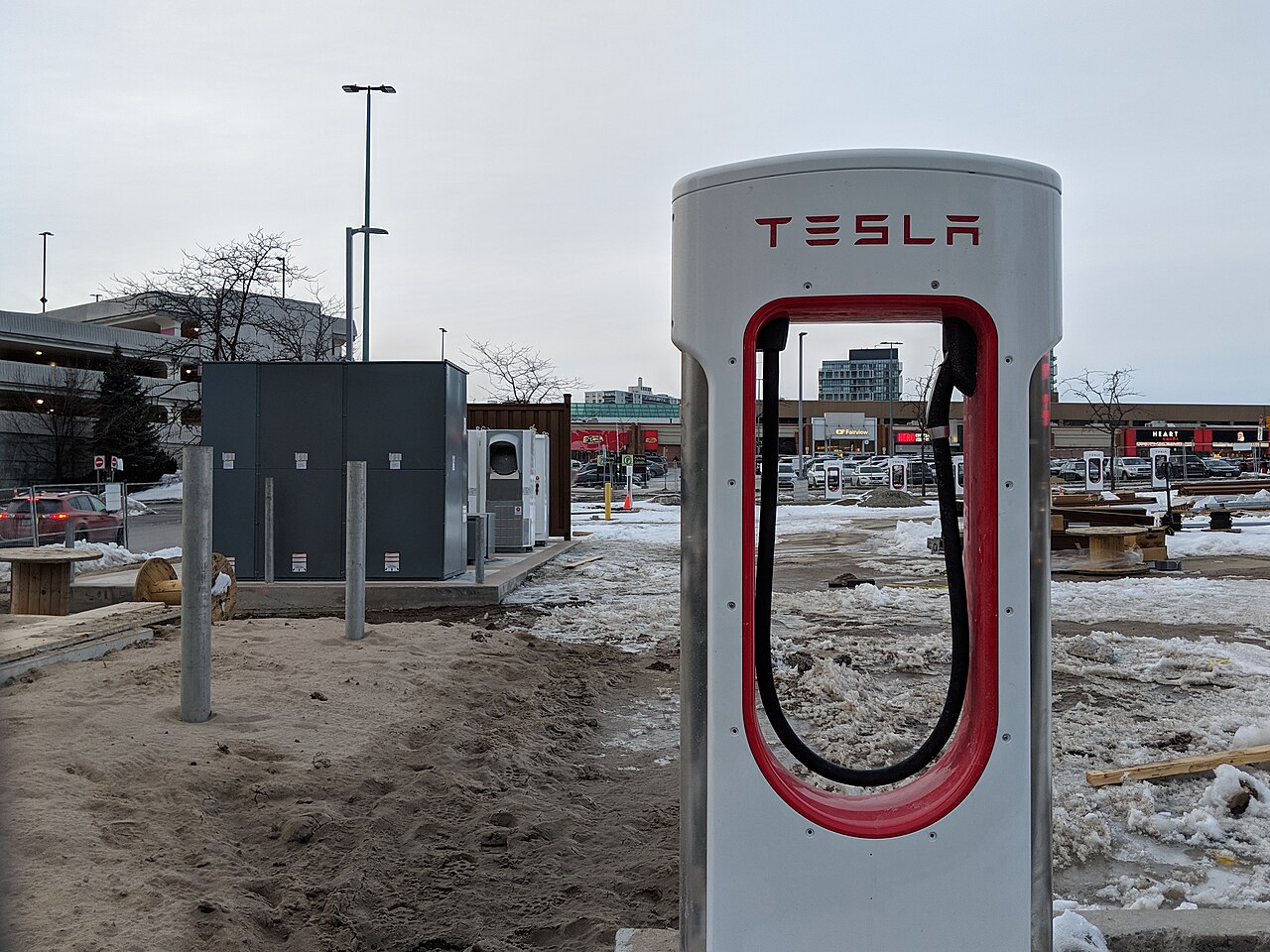
Image credit: TESLA chargers at Fairview Mall in Toronto by Sikander Iqbal, CC BY-SA 4.0, via Wikimedia Commons.

About the author: Lifei Zhou
Model Y owner since 2022Ontario STO registered apprentice · 310SWorks on Porsche, Mercedes, BMW, Audi weeklyHundreds of readers referred (est.)
Lifei is a Tesla owner based in Canada, writing practical, fact-checked Tesla guides for US and Canadian drivers — buying, ownership, insurance, charging, and TSLA investing, all from first-hand experience.