
Taking a Tesla on a Ski Trip (2026): Where the Skis Go, Winter Range and Charging Near the Hill
Taking a Tesla on a Ski Trip (2026): Where the Skis Go, Winter Range and Charging Near the Hill

Yes, a Tesla makes a good ski car, as long as you plan for three things: where the skis go, how much range the cold and the gear will cost you, and where you will charge near the hill. In a Model Y, the easiest answer is to fold the middle rear seat and carry skis inside, which costs no range at all. If you need a roof or hitch carrier, expect the roof option to hurt highway efficiency the most, and arrive with a charging plan for the chalet or the closest Supercharger.
Disclosure: some links are affiliate/referral links (Tesla referral, Starlink referral and Amazon). If you buy through them, we may earn a reward or commission at no extra cost to you. See our disclosure page.
Key facts (checked October 20, 2026)
- The Model Y rear seat splits 40/20/40, so you can fold only the middle section for skis and still seat two people in the back.
- Tesla rates its Model Y roof rack at 165 lb (75 kg), and that total includes the ski carrier and the skis.
- In a controlled highway test, a loaded roof carrier forced a speed cut from 130 to 97 km/h to match the no-load consumption. A rear carrier needed only 7 km/h.
- Quebec requires winter tires on Quebec-registered vehicles from December 1 to March 15. B.C. requires winter tires or chains on designated routes from October 1.
- Mont-Tremblant got a new 24-stall Supercharger in late September 2026, and Whistler and Collingwood (Blue Mountain) also have Superchargers nearby.
📋 Contents
- Where the skis go: inside, on the roof or on the hitch
- How much range a ski trip really costs
- Charging near the hill: Superchargers and the chalet outlet
- Winter tires and chains: the rules by province
- Driving the mountain road: Autopilot, regen and the climb
- At the resort: parking all day and the overnight stay
- Which Tesla is the best ski car?
- Frequently Asked Questions
- Summary
Where the skis go: inside, on the roof or on the hitch
There are three ways to carry skis or boards in a Tesla, and each one trades space, cost and range differently.
Inside the car. The Model Y has a 40/20/40 split rear seat. Fold only the narrow middle section and skis slide from the cargo area between the two rear passengers, toward the front console. Two adults ride in back, two in front, and nothing sits outside the car to catch the wind. It is the cheapest option and the most efficient one. Wrap the edges in a ski bag or an old blanket so they don’t scuff the trim or the seatback. The Model 3 has a 60/40 split instead, so carrying skis inside means losing one side of the rear bench.
On the roof. Tesla sells its own Model Y roof rack with a rated load of 165 lb (75 kg). That rating covers everything on top: the ski carrier, the skis and any snow stuck to them. A roof carrier makes sense for a family of four with four pairs of skis, or when boots, bags and groceries fill the cargo area. The downside is drag, which we cover in the next section.
On a hitch. A hitch-mounted ski carrier keeps the load behind the car, where it adds much less drag than a roof carrier. It needs a tow hitch, though. In Canada that has a cost beyond the hitch itself: the Model Y Rear-Wheel Drive at $49,990 is the only Model Y that qualifies for the federal $5,000 EVAP rebate, and the rebate has a $50,000 transaction price cap. Adding the $1,300 factory tow hitch pushes the car over the cap. If you are buying a Model Y RWD in Canada and want the rebate, plan on carrying skis inside or on the roof.
Inside (Model Y)
- Range cost
- None
- Seats left
- 4
Roof rack
- Range cost
- Highest
- Seats left
- 5
Hitch carrier
- Range cost
- Small
- Seats left
- 5
Rack rating from Tesla Shop. Hitch price and EVAP cap from Tesla Canada’s configurator, checked October 5, 2026.
How much range a ski trip really costs
Two things eat range on the way to the hill: the cold and the load on the car.
Cold is the bigger one. The U.S. Department of Energy’s cold-weather page on fueleconomy.gov, citing a AAA study, says EV range can drop by about 41% at 20°F (about −7°C) in mixed driving when the cabin heater is on. Without cabin heat, the drop was about 12%. Roughly two-thirds of the extra energy goes to heating the cabin. That was the worst case in that test. Heat pumps, preconditioning and seat heaters all help, but plan a ski day as if you have well under the rated range.
Here is a rough example. A Canadian Model Y Rear-Wheel Drive is rated at 463 km. Take 41% off and you get roughly 273 km. That is a pessimistic estimate, not a measurement. On most trips you will do better, especially if you leave warm. I’ve driven my Model Y through four Toronto-area winters, and the pattern is consistent: a short trip from a cold start costs far more per km than a long highway run with a warm battery.
The load on the car comes next. The best controlled data I found comes from AVILOO, an Austrian battery-diagnostics company. In an April 2025 test, it drove a VW ID.4 on a highway near Vienna with no carrier, a loaded roof carrier and a loaded rear carrier, using cruise control at night. To match the energy use of the unloaded car at 130 km/h, the driver with the roof carrier had to slow to 97 km/h. With the rear carrier, the cut was only 7 km/h.
AVILOO test, VW ID.4 with three bikes, April 2025. Skis sit lower than bikes, so a ski carrier likely costs less, but the pattern holds. Scale: 0 to 40 km/h.
That test used bikes, not skis. Skis lie flat and present a smaller face to the wind, so a ski carrier should cost less than a bike rack. Either way, anything on the roof costs most at highway speed, because drag rises with the square of speed. If you do use a roof carrier, slowing from 120 to 105 km/h on the highway gets back much of the loss. Take the carrier off between trips.
Charging near the hill: Superchargers and the chalet outlet
Most popular Canadian ski areas now have a Supercharger within a short drive. A few worth knowing:
| Ski area | Nearest Supercharger | What to know |
|---|---|---|
| Mont-Tremblant, QC | 235 Montée Ryan (new, 24 stalls) and 420 Route 117 (8 stalls) | The Montée Ryan site opened in late September 2026 as Canada’s 3,000th stall. Non-Tesla EVs can use it with a NACS adapter. |
| Whistler Blackcomb, BC | Whistler Marketplace, 4370 Lorimer Road (12 stalls) | Newer, faster stalls in the village. The older Fairmont Château Whistler site has 10 stalls at up to 72 kW in a paid garage. |
| Blue Mountain, ON | Collingwood, 10 Keith Avenue | About a 10-minute drive from the resort. Top up on the way in, not on the way home. |
Sources for the table: Drive Tesla Canada’s reports on the Mont-Tremblant opening and on the Whistler and Collingwood sites. Prices vary by site and time of day. Across Canada, Supercharger rates run roughly $0.25 to $0.60 per kWh, and Tesla changed many of them in September 2026. Check the price in the car or the app before you plug in.
Two habits make Supercharging in the cold much faster. First, set the Supercharger as your navigation destination so the car warms the battery on the way. A cold pack charges slowly. Our winter preconditioning guide covers how this works. Second, charge on the way to the hill, not on the way home. You want a full-enough battery when the car sits in a cold parking lot all day.
The chalet outlet is the other half of the plan. A regular 120 V outlet only adds a few kilometres per hour, which is enough to replace what a day of sitting in the cold used but not much more. Many rental chalets and condos have a 240 V dryer or range outlet, often a NEMA 14-50 or 14-30 in the garage. Ask the host before you book.
If you have that outlet, a portable Level 2 charger is the most useful thing to bring. The Lectron 40A portable Level 2 charger plugs into a NEMA 14-50 and can deliver up to 40 A at 240 V, or about 9.6 kW, which refills a Model 3 or Model Y overnight. Check that the plug type on the listing matches your car. It is worth it if you visit chalets or cottages often. If you only travel once or twice a winter, Tesla’s own Mobile Connector is the cheaper alternative. It charges slower than a 40 A unit, but it covers the basics.
Never plug a car charger into an extension cord, and only use an outlet the host has approved.
Winter tires and chains: the rules by province
The rules differ by province, and the all-season tires many Teslas come with don’t meet them.
In Quebec, winter tires are mandatory from December 1 to March 15 inclusive on Quebec-registered passenger vehicles, including rental cars. The tires must carry the three-peak mountain snowflake symbol. The fine is $200 to $300. Vehicles registered outside Quebec are exempt, so an Ontario plate won’t be ticketed for all-seasons on the way to Tremblant. That exemption covers the law, not the road. If you drive in snow, use winter tires.
In B.C., designated routes require winter tires or chains from October 1. On most routes the requirement runs to April 30. On some highways that aren’t through mountain passes or high-snowfall areas, it ends March 31. The Sea-to-Sky Highway (Highway 99) to Whistler is covered. A legal winter tire needs at least 3.5 mm of tread and an M+S or mountain snowflake mark. Chains on summer tires don’t count. Ski hill access roads are often private and can set their own rules, so check the resort’s road page.
- October 1B.C. designated routes, including the Sea-to-Sky Highway, require winter tires or chains.
- December 1Quebec-registered vehicles must have winter tires with the mountain snowflake symbol.
- March 15Quebec’s requirement ends (inclusive).
- March 31B.C. requirement ends on select highways outside mountain passes and high-snowfall areas.
- April 30B.C. requirement ends on most designated routes.
Ontario has no winter tire law, but Ontario insurers must offer a discount for winter tires, and the roads to Blue Mountain and Mont Tremblant get plenty of snow. See our Tesla winter tires guide for sizes and picks. Tesla only allows approved low-profile chains, on the rear wheels. Read our snow chains guide before you buy a set.
Driving the mountain road: Autopilot, regen and the climb
A climb to a ski resort uses a lot of energy, and the descent gives some back through regenerative braking. On a cold morning, though, regen may be limited until the battery warms. You’ll see a dotted line on the power meter or a blue snowflake on the screen. Brake earlier than you normally would on the way down until regen returns.
Snow can cover cameras and sensors. Before you leave the parking lot, brush off the front camera area on the windshield, the side repeater cameras and the rear camera. Autopilot and FSD (Supervised) may refuse to engage or may hand control back if the cameras can’t see. On snowy mountain roads, it is usually better to drive yourself. Our mountain driving guide covers the climb and range planning in more detail.
A good snow brush is worth the trunk space. The AstroAI extendable snow brush extends far enough to reach the middle of a Model Y windshield and roof. It works on any Tesla.
At the resort: parking all day and the overnight stay
A Tesla parked in a ski lot all day loses a bit of charge, and more if Sentry Mode is on. If the lot is busy and you want Sentry for peace of mind, keep it on, but start the day with some extra charge. If you trust the lot, turn Sentry off to save energy.
About 30 to 45 minutes before you head back to the car, turn on climate from the app. The cabin warms, the windows defrost and the battery starts to warm up for the drive. If you set the car to defrost, it also helps free frozen door handles and the charge port.
At a chalet without power, plug in as soon as you arrive and set a departure time for the morning. If the chalet has nothing, start the next day with a Supercharger stop on the way home rather than squeezing the last kilometres out on the way in.
Some rural chalets have weak cell coverage, which makes the Tesla app slow and streaming impossible. In Canada, a Starlink Mini is one way around it. I bought one and measured 131 Mbps on my Toronto balcony, and it also works on the Model Y dashboard through the windshield. If you’re in Canada, you can order through our Starlink referral link. It works for Canadian customers only.
Which Tesla is the best ski car?
For most skiers, the Model Y is the easier choice. The 40/20/40 seat, the taller cargo area and the higher ground clearance make it a better fit than the Model 3. All-wheel drive helps on unplowed parking lots and chalet driveways, but winter tires matter more than the number of motors.
In Canada, the Model Y Rear-Wheel Drive is $49,990 with 463 km of rated range, and it is the only Model Y that qualifies for the $5,000 EVAP rebate. The Premium AWD is $64,990 with 542 km and dual motors. If you ski often, live where the roads aren’t plowed early, or drive to hills more than a few hours away, the Premium AWD’s extra range and traction are worth considering. If you ski a few weekends a year, the RWD with good winter tires does the job and leaves room in the budget for a portable charger. I ordered my own Model Y straight from tesla.com without a test drive, and you can do the same through a Tesla referral link, which gives new buyers 3 months of FSD (Supervised). It generally can’t be combined with the new-car FSD trial or other offers. Tesla confirms the final perk on your order.
In the U.S., the Model Y AWD starts at $41,990 and the Premium AWD at $49,990, before any current financing offers.
Frequently Asked Questions
Can you fit skis inside a Tesla Model Y?
Yes. Fold the middle 20% section of the rear seat and skis slide in from the cargo area between the two rear seats. Four people can still ride. Wrap the edges so they don’t scratch the trim.
Can you fit skis inside a Tesla Model 3?
The Model 3’s rear seat folds 60/40, so carrying skis inside means folding one side of the bench. Two adults fit in front and one in back. For four people with skis, you need a roof carrier.
How much weight can the Tesla Model Y roof rack hold?
Tesla rates its Model Y roof rack at 165 lb (75 kg). That includes the carrier and everything in it, so weigh the skis and carrier together.
Does a roof ski rack reduce Tesla range?
Yes, mainly at highway speed. In a controlled test with a loaded roof carrier, the driver had to slow from 130 to 97 km/h to match the car’s no-load energy use. A rear carrier needed only a 7 km/h cut. Skis inside the car cost nothing.
Do I need winter tires to drive to Mont Tremblant from Ontario?
Not by law. Quebec’s December 1 to March 15 requirement applies to Quebec-registered vehicles. Winter tires are still the safest choice on that road in winter.
Do I need winter tires to drive to Whistler?
Yes. The Sea-to-Sky Highway is a designated route, so winter tires (M+S or mountain snowflake, at least 3.5 mm of tread) or chains are required from October 1.
Is it OK to leave my Tesla in a ski hill parking lot all day?
Yes. It will lose a little charge, more with Sentry Mode on. Start the day with extra charge and warm the car from the app before you walk back.
Summary
- In a Model Y, fold the middle rear seat and carry skis inside. It costs no range and keeps four seats.
- Tesla’s roof rack is rated at 165 lb (75 kg), carrier included. Roof loads cost the most at highway speed.
- A hitch carrier is more efficient, but in Canada the $1,300 hitch puts a Model Y RWD over the EVAP cap.
- Plan for cold-weather range loss. Fueleconomy.gov cites up to about 41% at −7°C with the heater on.
- Know the tire rules: Quebec December 1 to March 15, B.C. designated routes from October 1.
- Navigate to the Supercharger so the battery warms, and ask chalet hosts about a 240 V outlet.
Order with a referral link for 3 months of FSD (Supervised) →
More guides: Canada Tesla and US Tesla.
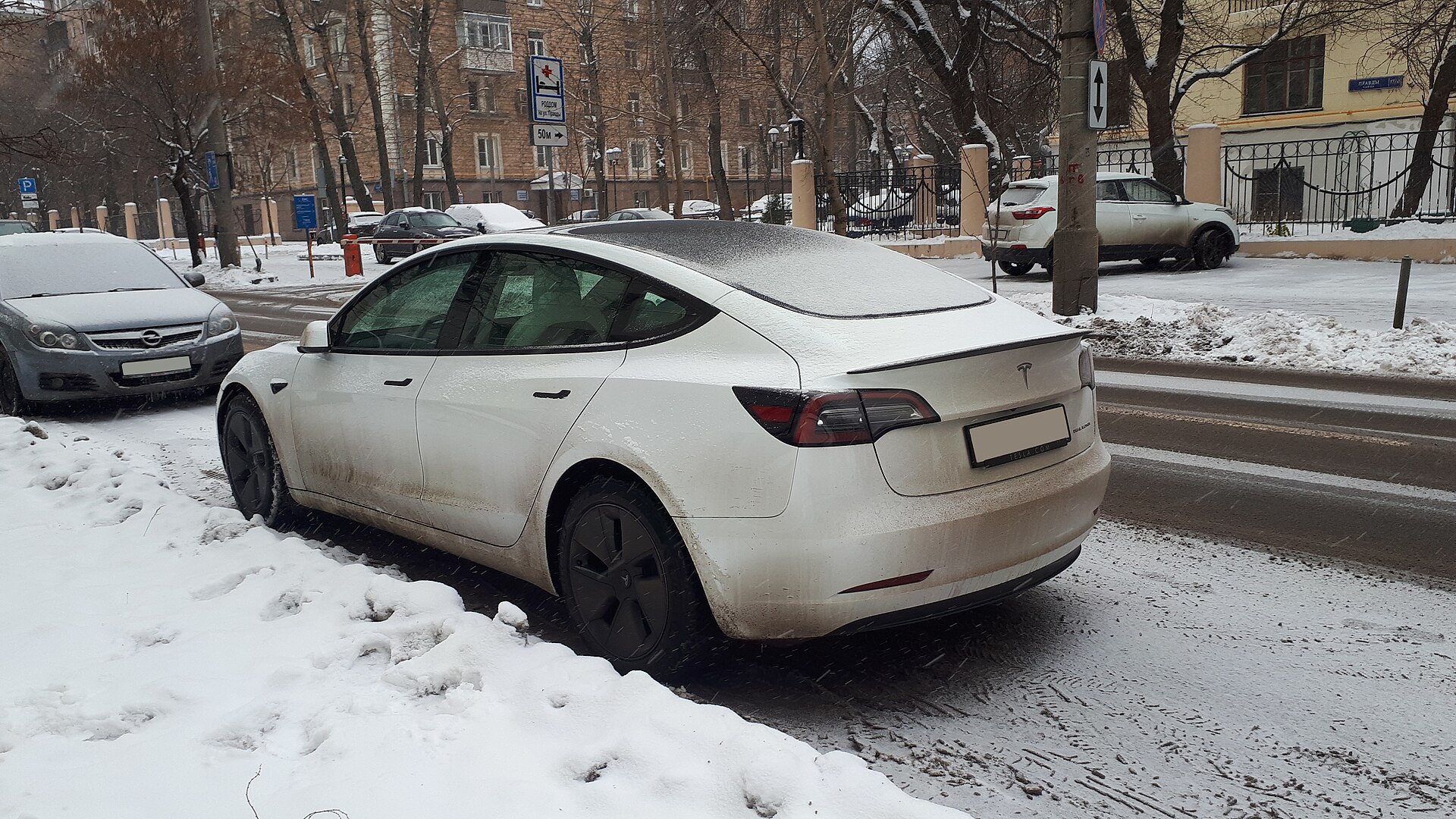
Image credit: “Tesla Model S in snow (rear view)” by Kirill Borisenko, CC BY-SA 4.0, via Wikimedia Commons.
About the author: Lifei Zhou
Model Y owner since 2022Ontario STO registered apprentice · 310SWorks on Porsche, Mercedes, BMW, Audi weeklyHundreds of readers referred (est.)
Lifei is a Tesla owner based in Canada, writing practical, fact-checked Tesla guides for US and Canadian drivers — buying, ownership, insurance, charging, and TSLA investing, all from first-hand experience.