
Florida Tesla Buying Guide 2026: Taxes, High Premiums & Hurricane Tips
Florida Tesla Buying Guide 2026: Taxes, High Premiums & Hurricane Tips

In one sentence
No state income tax doesn't mean cheap. A 2026 Florida Tesla buying guide: sales tax and EV fees, sky-high insurance, hurricane-season flood protection, and charging.
A lot of people who just moved to Florida — or who are about to buy their first Tesla here — start with one assumption: Florida has no state income tax, so owning a car must be cheap too, right? The honest answer is “half right, half wrong.” Buying the car does save you a few of the hidden costs you’d pay elsewhere, but Florida quietly stacks the deck against EV owners in three places: insurance, hurricane season, and brutal summer heat. Add it all up and Florida isn’t necessarily the bargain that “no income tax” makes it sound.
I’ve driven a Tesla in South Florida for a few years, and plenty of owners I know in Miami, Orlando, Tampa, and Jacksonville have lived the same realities. This guide lays out what it actually costs to buy and own a Tesla in the Sunshine State in 2026: how the taxes and fees really work, what you can still save now that the federal credit is gone, what charging looks like, why Florida insurance is so eye-wateringly expensive, how to protect your car during hurricane season and salt-water flooding, how the heat affects the car, and finally the big news everyone in Miami is talking about — Robotaxi is now live in Florida.
Disclosure: some links in this article are affiliate/referral links. If you order or buy through them, we may earn a small commission at no extra cost to you. All analysis is based on public information and real owner experience, with no paid placement. This is general information, not purchase, insurance, tax, or legal advice. See our disclosure page.
📋 Contents
- Buying a Tesla in Florida: get the tax math straight first
- The federal credit is gone — but these still save you money
- Charging: what Florida’s electricity prices and Supercharger network are really like
- Insurance: the biggest trap of owning a Tesla in Florida
- Hurricane season: how to guard against rain, flooding, and salt-water immersion
- Heat and sun: what Florida summers really do to your car
- Robotaxi is now live in Florida
- Where to buy in Florida and how delivery works
- Frequently Asked Questions
- Final thoughts
Buying a Tesla in Florida: get the tax math straight first
Florida has no state income tax — that part is genuinely enviable. But buying a car means paying sales tax, which is a completely different thing from income tax, and Florida’s vehicle sales tax is anything but low.
The base is a 6% state sales tax on the vehicle, applied to both new and used cars — there’s no used-car exemption here. On top of that 6%, most counties add a discretionary surtax of roughly 0.5% to 1.5%. The good news: that county surtax only applies to the first $5,000 of the purchase price, so even on an expensive car, the county portion caps out at about $50 to $75. In other words, the real money is in that 6% state tax.
Take a $45,000 Model Y as an example. The state tax alone is $2,700, plus no more than about $75 in county surtax, for a total of close to $2,800. You pay this in one lump sum at delivery, and there’s no way around it.
Here’s a pleasant surprise — and a spot where a lot of articles floating around (including an earlier version of this one) get it wrong: Florida currently has no annual EV registration fee. The bill that would have added a $200-a-year fee on battery-electric vehicles (SB 804, which would have climbed to $250 later) died in the legislature in March 2026 and never became law. As of July 2026, you register a Tesla in Florida just like any other car — no EV surcharge at renewal. If you’ve seen “$200 a year” quoted somewhere, that number came from the failed bill, not from anything you’ll actually pay.
The table below lays out the main taxes and fees you’ll run into buying a battery-electric Tesla in Florida, so you go in knowing the numbers:
| Item | Amount / Notes |
|---|---|
| State sales tax | 6% of the purchase price; charged on both new and used cars |
| County surtax | 0.5%–1.5%, but only on the first $5,000 — caps at roughly $75 |
| Annual EV fee | None — the proposed $200 fee (SB 804) died in March 2026; EVs register like any other car |
| State EV purchase rebate | None — Florida offers no state cash-back or tax credit |
| Registration / plate fees | Based on vehicle weight and first-time registration; tens to a hundred-plus dollars |
For comparison: states like New York and New Jersey often hand you a state rebate at purchase, while Florida offers exactly zero state incentive. So don’t let “no income tax” throw off your math — at the moment you buy, Florida isn’t actually cheap. For how to pick a trim and configuration, see our 2026 USA Model Y complete guide and run the numbers alongside Florida’s tax picture. Cross-shopping the sedan? Our USA Model 3 guide covers that too.
The federal credit is gone — but these still save you money
First, the thing everyone asks about: the federal $7,500 EV tax credit has been fully eliminated for cars purchased after September 30, 2025. That’s a nationwide change — it applies in every state, Florida included. The era of counting on that credit to save money is over.
That said, a few avenues still work for Florida owners:
- Auto-loan interest deduction: if you finance the car, the OBBBA lets you deduct up to $10,000 a year in interest on a new U.S.-assembled vehicle for tax years 2025–2028 — every current Tesla qualifies. It phases out above $100k income (single) / $200k (joint), and you claim it on Schedule 1-A with your VIN. Depending on your loan and bracket, that’s real money back each year. Pair it with Tesla’s current promo financing — as of late July 2026 the Model Y RWD was advertised at 0% APR over 72 months (with at least 5% down) and most other Model Y and Model 3 trims at 0.99% — though rates change monthly, so go by tesla.com at order time.
- Home charger credit — now expired: the federal 30C credit for home-charging equipment ended on June 30, 2026. If you completed a qualifying install before that date you can still claim it when you file, but a new install today no longer qualifies — budget the charger at full cost.
- FPL’s EVolution Home program: Florida Power & Light, the state’s largest utility, has offered a “subscription” home-charging plan — you pay a fixed monthly fee (roughly $27 to $36 a month), FPL installs a Level 2 home charger for you, and it defaults to charging during nights and weekends during off-peak hours. Over a few years, the electricity savings plus the avoided upfront install cost often add up to several hundred dollars. Availability and terms are set on FPL’s site.
- Free FSD through an owner referral link: ordering through an existing owner’s referral link often gets you a free trial of FSD (Supervised). As it stands now, a new car ordered through an owner referral link gets 3 months of free FSD (Supervised) — worth about $297 at the $99/month subscription price. It’s a small perk, but it’s a single tap at checkout, so there’s no reason to skip it.
One more angle: Florida’s abundant sunshine makes solar plus a Powerwall a natural add-on. Fair warning on the money side, though: the federal 25D residential clean-energy credit ended on December 31, 2025, so a system you buy outright in 2026 gets no federal credit — the main workaround is a third-party lease or PPA, where the installer claims a commercial credit and (ideally) passes some savings through. Even at full price, it powers your EV while hedging against hurricane-season outages — more on that below.
Charging: what Florida’s electricity prices and Supercharger network are really like
Florida’s residential electricity prices sit in the middle-to-upper range nationally. As of mid-2026, the state’s average residential rate is around 15.5 cents per kWh; FPL is on the cheaper end at roughly 14.5 cents all-in. That’s well below California, but a bit higher than Texas and several Midwestern states.
Charging at home is easy to estimate. A Model Y’s battery is about 75 kWh, and going from 20% to 80% adds roughly 45 kWh — at 15 cents that’s about $6 to $7 for around 250 km of range, far cheaper than gasoline. If you get into FPL’s off-peak hours or the EVolution Home program, your per-kWh cost drops even further.
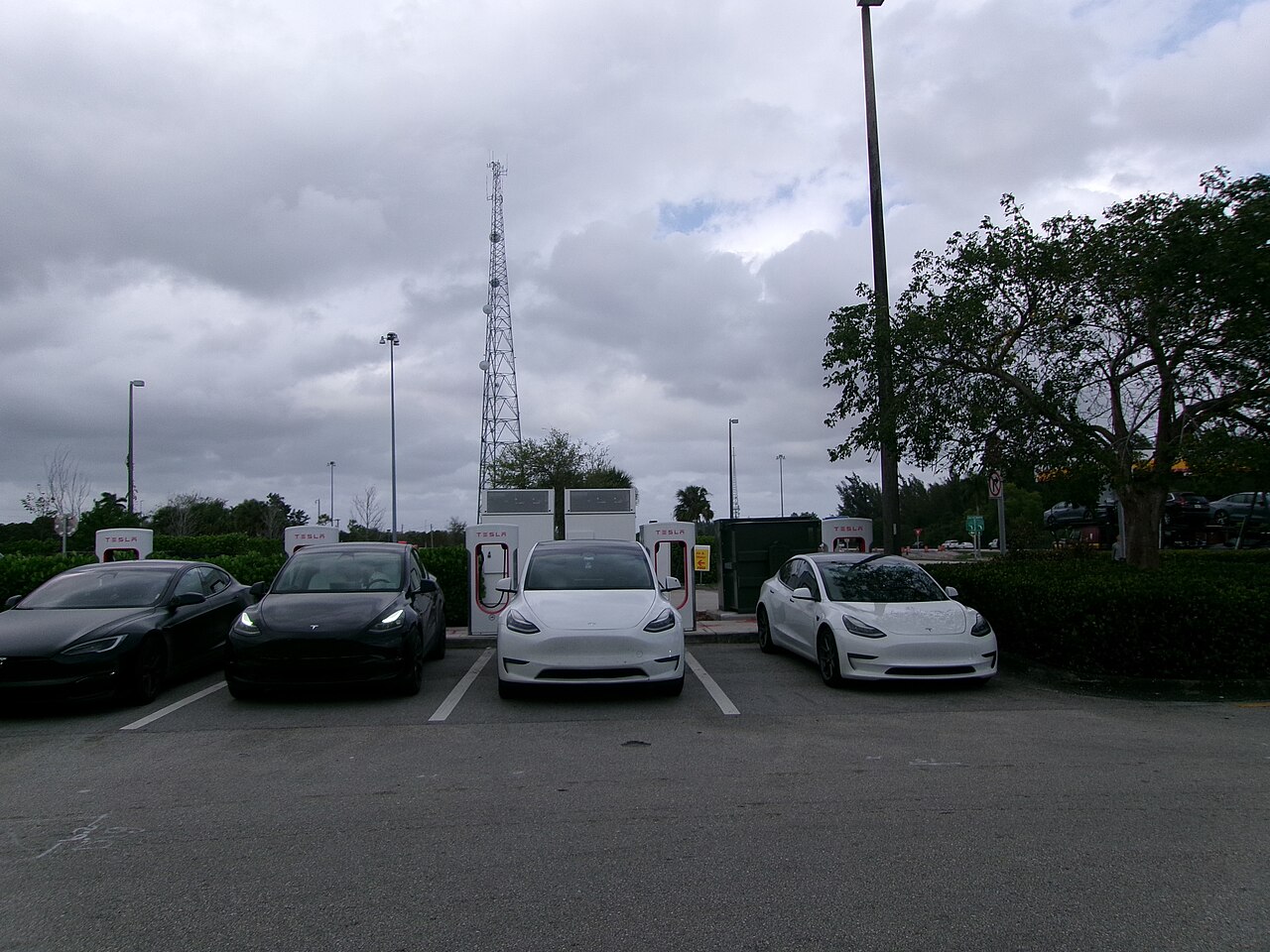
Florida’s Supercharger network is one of its real strengths. As a tourism and retirement state, Florida has dense Tesla Supercharger coverage: 200-plus Supercharger stations and 2,600-plus stalls statewide, running from Miami all the way north to Jacksonville. Along I-95, I-75, and Florida’s Turnpike, long-distance trips are basically charge-anxiety-free. The bank of Superchargers at the West Palm Beach service plaza, pictured below, is a typical Turnpike-corridor layout.
Keep in mind that Superchargers are priced per use, cost more than home charging, and add congestion fees during peak periods. During Florida’s tourist high season (winter through spring break) and on holidays, queues at popular stations are common. The cheapest play is to charge at home for daily driving and save Superchargers for road trips and emergencies.
Insurance: the biggest trap of owning a Tesla in Florida
If any single cost is going to blindside a new Florida owner, it’s car insurance. Florida’s auto premiums are perennially among the highest in the country, and Teslas are already pricier to insure than comparably priced gas cars — expensive parts, few specialized repair shops, costly ADAS sensor calibration. Stack those two factors and the result stings.
Per 2026 public data, the average annual Tesla premium in Florida runs about $4,743. The Model 3 is relatively cheaper at around $4,041, while the Model S is the most expensive at about $5,838. For context, the nationwide Tesla average is roughly $4,149, and the all-vehicle U.S. average is only about $2,513. In other words, insuring a Tesla in Florida costs hundreds to over a thousand dollars more per year than the national average.
Florida premiums are high for structural reasons: it’s a no-fault state with special PIP (Personal Injury Protection) requirements, it has a high share of uninsured drivers, and hurricane- and flood-related vehicle claims pile up — insurers spread all of that cost across every policyholder. You can’t change those forces single-handedly, but a few moves genuinely shave the premium:
- Shop multiple companies: Tesla quotes in Florida can differ by 2x between insurers. Some data shows certain companies pricing Florida Tesla coverage down around $2,600 — far below the $4,700-plus average. Never sign after asking just one.
- Be cautious with Tesla’s own insurance: Tesla Insurance is available in Florida and prices off your Safety Score, so steady drivers may come out ahead — but the claims experience gets polarized reviews, so compare it against the traditional majors before committing.
- Raise your deductible: bumping your collision and comprehensive deductible from $500 to $1,000 usually lowers the annual premium, provided you keep that emergency cash on hand.
- Garage / enclosed parking: in hurricane- and flood-prone areas, being able to park in a garage or on higher ground can help your comprehensive rate.
For how the insurance math compares across borders, our Canada Tesla insurance guide breaks down why Tesla premiums run high and how to structure coverage — much of the “why” applies to Florida owners too.
Hurricane season: how to guard against rain, flooding, and salt-water immersion
Florida’s Atlantic hurricane season runs from June 1 to November 30 — more than half the year. For Tesla owners, the worry isn’t whether the car will drive; it’s flooding, and specifically salt-water flooding.
Let’s be precise about a risk that gets exaggerated by some media but is genuinely real: when an EV is submerged in salty storm-surge seawater, the salt conducts electricity and can seep into the battery pack, causing short circuits, heat buildup, and — in extreme cases — fire. During major past hurricanes like Ian and Helene, Florida did see cases of saltwater-soaked EVs catching fire. The key qualifier: this is the risk after salt-water immersion, not from a bit of rain or driving through a shallow puddle. For everyday driving through shallow standing water in the rain, a Tesla’s protection is plenty.
The real principle is simple: don’t let your car sit in salt water. If you live in a coastal low-lying area or a storm-surge warning zone, do these things before a hurricane arrives:
- Move the car to high ground in advance: upper levels of a parking garage, elevated terrain, away from the coast and known flood spots — this is the single most effective step.
- Charge up before the storm: charging stations and Superchargers see long queues in the days before a storm, and once the power’s out you can’t charge at all. Top off early so you can ride out an outage and evacuate at a moment’s notice.
- If it does get soaked in salt water: Tesla officially advises parking a flooded car at least 15 meters (about 50 feet) from any building until a professional can inspect it — don’t park it in the garage or against the house, in case it ignites.
- Check your comprehensive coverage: flood and storm-surge damage normally goes through comprehensive, not collision. Florida owners absolutely must confirm they carry comprehensive, not just third-party liability.
The other side of hurricane season is power outages. Losing power for days after a big storm is routine in Florida, which is exactly why more and more Florida households install a Powerwall: paired with solar, your home keeps running during an outage and your car keeps charging, and it can ride out a degree of salt-water flooding (Tesla states the Powerwall 3 tolerates a certain depth of water — check the official spec). It’s a worthwhile pairing given how much of the year hurricane season covers. A few low-cost items belong in every Florida owner’s trunk before the season too — an emergency kit, a jump pack like the NOCO Boost Plus GB40 (a dead 12V battery is exactly the kind of thing that strikes after a week of outage), and basic supplies are easy to grab in one go on Amazon.
Heat and sun: what Florida summers really do to your car
Beyond hurricanes, the daily reality for Florida owners is heat and relentless sun. South Florida summers routinely top 95°F (35°C), and a car baking in the sun can hit 140°F (60°C) inside — which affects a Tesla in several ways.
On range: heat actually hurts range less than winter cold does, but running the A/C full blast noticeably increases consumption. In stop-and-go city driving with the A/C cranked, dropping to 80–90% of rated range is normal. The truly unpleasant part is the “oven experience” the moment you get in, plus the slow, long-term wear that constant sun puts on the interior and battery.
A few habits every veteran Florida owner relies on: use the phone app to pre-cool the cabin remotely before you drive, so getting in isn’t like stepping into a sauna; park in shade or a garage whenever possible, and put a sunshade across the windshield so the steering wheel and screen don’t scorch and the interior ages more slowly; if the car will sit unused for a while, don’t leave it near full or near empty for long, and park it in the shade to be kinder to the battery. Sentry Mode draws power continuously under a blazing sun, so turn it off when you don’t need it. A windshield sunshade pays for itself fast in Florida — I use the BASENOR folding sunshade, which folds flat into the trunk when you’re not using it — and if you run Sentry while parked, grab a high-endurance USB drive sized for 24/7 recording at the same time. One more heat note: Florida’s big day-night temperature swings move tire pressure around more than you’d think, so I also keep an AstroAI tire inflator in the trunk — a Tesla has no spare, and topping off before a highway run takes two minutes. For a full summer-driving and long-distance checklist, our Tesla summer road trip guide is well suited to Florida owners.
Robotaxi is now live in Florida
This used to be the question friends in Miami, Orlando, and Tampa asked most — and as of July 2026, the answer flipped from “someday” to “now.” Tesla’s Robotaxi service is officially operating in Miami, Orlando, and Tampa. Miami launched in early July, and Orlando and Tampa followed within weeks — Tampa went live on July 22, just 18 days after Miami. That’s three Florida metros in a single month.
Florida now sits alongside Texas (Austin, Houston, Dallas) and the California Bay Area (where cars still carry a safety monitor) among the seven metro areas where the service runs. Each city is geofenced — you hail a ride through the Robotaxi app inside the service area, and coverage zones have been expanding quickly. If you’re in one of the three Florida metros, it’s worth downloading the app and checking whether your neighborhood is inside the fence yet.
For buyers, though, keep the practical takeaway grounded: Robotaxi is a service Tesla operates with its own fleet. If you’re ordering a car because you imagine it will go out and earn money for you on its own, that program still doesn’t exist — don’t build it into your purchase math. What you can count on today in your own car is FSD (Supervised) driver assistance, at $99 a month.
Where to buy in Florida and how delivery works
Florida is one of Tesla’s biggest sales states, with showrooms and delivery centers in Miami, Orlando, Tampa, Jacksonville, West Palm Beach, and elsewhere — picking up a car is easy. The buying process is the same as nationwide: order entirely online, then take delivery at a center or via home delivery.
A few Florida-specific reminders: first, when you order, figure out which county that 6% sales tax lands in — county surtax rates vary slightly. Second, Florida inventory (in-stock) cars turn over fast, and you’ll often find inventory discounts around the start and end of tourist high season, so if you’re in a hurry, refresh the inventory page often. Third, get your insurance quotes before you order — don’t wait until delivery day to discover just how high Florida premiums are.
If you don’t already have a referrer at checkout, ordering through an owner referral link gets you those months of free FSD — a handy perk for a new owner. And on delivery day, walk through an inspection checklist and verify the details on the spot, so you avoid disputes later. For more Florida content, browse our US Tesla section.
Frequently Asked Questions
Florida has no state income tax — does that make buying a Tesla cheaper than in other states?
Not at the purchase step. Income tax and a car’s sales tax are two different things — Florida still charges 6% vehicle sales tax, and there’s no state EV purchase rebate of any kind. On the plus side, there’s no annual EV registration fee either (the proposed $200 fee died in the legislature in March 2026). But with some of the highest auto premiums in the nation, overall ownership cost in Florida isn’t low. What you actually save is not paying state income tax on your earnings, not the cost of buying the car.
How much does it cost to insure a Tesla in Florida per year?
Per 2026 data, the average annual Tesla premium in Florida is about $4,743 — Model 3 is cheaper (around $4,041) and Model S is the most expensive (around $5,838). That’s well above the national average. Shopping multiple companies, raising your deductible, and parking in a garage can all help — some companies quote Florida Tesla coverage as low as around $2,600, so absolutely shop around.
If my Tesla gets flooded during hurricane season, will it catch fire?
It depends on whether it’s salt water. EVs submerged in salty storm-surge seawater do carry a real risk of battery short circuit and fire — Florida saw such cases during several major hurricanes. There’s no need to panic about driving through shallow water in ordinary rain. If it does get soaked in salt water, Tesla advises parking it at least about 15 meters from any building and getting a professional inspection promptly; flood damage is generally handled under comprehensive coverage.
Can you ride a Robotaxi in Miami or Orlando yet?
Yes — as of July 2026, Tesla’s Robotaxi operates in Miami, Orlando, and Tampa. Miami launched in early July 2026 and Tampa followed on July 22. Service is geofenced to defined zones in each metro and hailed through the Robotaxi app, with coverage areas expanding — check the app for whether your part of town is inside the current service area.
Is home charging worth it in Florida? Is electricity expensive?
Yes, it’s worth it. Florida residential electricity averages around 15.5 cents per kWh, and FPL is lower still — home charging costs far less than gasoline, and less than Supercharging. Charging a Model Y from 20% to 80% at home runs only about $6 to $7. Layer on FPL’s off-peak hours or the EVolution Home program and it gets even cheaper. Charge at home daily and use Superchargers for road trips — that’s the most economical combo in Florida.
Final thoughts
Florida isn’t exactly “paradise” for Tesla owners, but it’s no reason to walk away either. The logic runs like this: you pay normal 6% sales tax to buy, there’s no state rebate, insurance is pricey, summers bake the car, and hurricane season means guarding against flooding — but in exchange you get no state income tax, a dense Supercharger network, moderate electricity prices, and abundant sun that’s ideal for pairing solar with a Powerwall. Put all of that on one ledger, then factor in whether you live on the coast or inland and whether you have a garage, and only then can you judge how expensive this car really is to own in Florida.
If you’re going to order, remember three things: get insurance quotes first, calculate the sales tax for your specific county, and use an owner referral link at checkout to claim the free FSD. Get those steps right and driving a Tesla in Florida is, honestly, a pretty pleasant experience.
Information currency: the taxes, electricity prices, premiums, incentives, and Robotaxi progress in this article were compiled from the Florida Department of Revenue, the EIA, FPL announcements, and industry-media sources publicly available as of late July 2026, cross-checked against at least three independent sources. Policies and prices can change at any time — before ordering, insuring, or filing taxes, rely on Tesla’s official site, official Florida pages (such as the Florida FLHSMV), and the actual quotes you receive. For hurricane timing and tracking, see the National Hurricane Center. The referral link in this article is the author’s personal Tesla referral link; ordering through it may earn both of us a Tesla perk (such as a period of free FSD) but does not affect your purchase price, and using it is entirely voluntary. This is general information only, not purchase, insurance, tax, or legal advice; consult licensed professionals for tax, insurance, and claims matters. Some links are affiliate/referral links; see our disclosure page. Image credit: Tesla Chargers @ West Palm Beach Service Plaza by DanTD (Wikimedia Commons, CC BY 4.0).

About the author: Lifei Zhou
Model Y owner since 2022Ontario STO registered apprentice · 310SWorks on Porsche, Mercedes, BMW, Audi weeklyHundreds of readers referred (est.)
Lifei is a Tesla owner based in Canada, writing practical, fact-checked Tesla guides for US and Canadian drivers — buying, ownership, insurance, charging, and TSLA investing, all from first-hand experience.