
Tesla Cybertruck vs F-150 Lightning vs Rivian R1T vs Silverado EV: 2026 Electric Truck Showdown
Tesla Cybertruck vs F-150 Lightning vs Rivian R1T vs Silverado EV: 2026 Electric Truck Showdown

The full-size electric pickup used to be a one-truck show. In 2026 it’s a genuine segment: the Tesla Cybertruck now shares showroom-floor mindshare with the Ford F-150 Lightning, the Rivian R1T, and the Chevrolet Silverado EV. Each takes a very different swing at what an electric truck should be — stainless-steel spaceship, familiar work truck, adventure rig, or range king. If you’re cross-shopping them this year, the spec sheets can blur together fast, so this guide lines them up head-to-head on the numbers that actually change your ownership experience: price, range, towing, charging, and daily livability.
Disclosure: some links are affiliate/referral links. If you buy or order through them, we may earn a commission at no extra cost to you. See our disclosure page.
📋 Contents
- The 2026 Electric Pickup Landscape at a Glance
- Price and Value: What You Actually Pay in 2026
- Range and Real-World Efficiency
- Towing and Payload: The Numbers That Matter for Work
- Charging: The Tesla Supercharger Advantage
- Design, Interior, and Daily Driving
- Living With an Electric Truck: Gear Worth Keeping Aboard
- Which Electric Truck Should You Buy?
- Frequently Asked Questions
- The Bottom Line
The 2026 Electric Pickup Landscape at a Glance
Before we dig into each category, here’s how the four major electric pickups stack up on paper. Prices are starting MSRP for the 2026 model year and exclude destination fees; range figures are the best EPA or manufacturer estimate available for each lineup.
| Truck | Starting MSRP (2026) | Best Range | Peak Power | Max Towing |
|---|---|---|---|---|
| Tesla Cybertruck | $69,990 (AWD) | 325 mi | ~845 hp (Cyberbeast) | 11,000 lb |
| Ford F-150 Lightning | $63,345 (STX retail) | 320 mi | 580 hp | 8,600 lb |
| Rivian R1T | ~$72,000 (Dual Standard) | 420 mi (Max pack) | 1,025 hp (Quad) | 11,000 lb |
| Chevrolet Silverado EV | $54,895 (WT fleet) | 493 mi (WT Max Range) | 725 hp (Trail Boss) | 12,500 lb |
No single truck wins every column, which is exactly why the segment is interesting. The Silverado EV posts the biggest range and towing figures, the Rivian brings supercar power, the Lightning is the most conventional and affordable to get into, and the Cybertruck leans on Tesla’s charging network and software. Let’s break down what those differences mean in practice.
Price and Value: What You Actually Pay in 2026
Sticker prices need a caveat this year. The federal $7,500 EV tax credit for new vehicles ended on September 30, 2025 and has not been revived, so none of these trucks qualify for that incentive anymore. The number you see on the configurator is much closer to the number you’ll finance.
A few things to read past the headline MSRPs:
- Chevrolet Silverado EV starts lowest on paper at $54,895, but that’s the fleet-focused Work Truck (WT). The consumer-oriented LT trim realistically starts around $62,995, and a loaded RST Stars & Steel edition climbs past $100,000.
- Ford F-150 Lightning is the easiest mainstream entry point at $63,345 for the retail STX (the cheaper Pro is fleet-only), with a top Platinum near $87,000. Ford standardized the larger Extended Range battery on lower trims for 2026, which improves the value story (see Ford’s official Lightning page).
- Tesla Cybertruck opens at $69,990 for the dual-motor AWD after Tesla dropped the entry-level RWD version; the tri-motor Cyberbeast tops out at $99,990.
- Rivian R1T starts in the low-$70,000s for the Dual Standard and can approach $122,000 for a Quad-Motor with the Max battery.
If your priority is the lowest cost of entry to a capable consumer EV truck, the Lightning and Silverado EV LT are your value plays. If you order a Tesla, note that placing your order through a Tesla referral link currently adds three months of Full Self-Driving (Supervised) at no charge — a perk worth roughly $300 that the other brands can’t match. For a deeper build-and-price walkthrough, see our Tesla Cybertruck buying guide.
Range and Real-World Efficiency
On paper the Chevrolet Silverado EV dominates: its Max Range battery is rated up to 493 miles, a figure no other pickup — electric or otherwise — comes close to matching. The Rivian R1T’s optional 140-kWh Max pack delivers up to 420 miles, while the Cybertruck (325 miles) and Lightning (up to 320 miles) sit in a similar, more conventional bracket.
Two caveats keep those numbers honest:
- Big range costs big money. The Silverado’s 493-mile and Rivian’s 420-mile figures require the most expensive battery options. In their base configurations, both trucks land much closer to the Cybertruck and Lightning.
- Towing and weather erase range fast. Every EV pickup loses a substantial chunk of range when towing a heavy trailer or driving in deep cold — often 40-50%. If you tow regularly, treat the EPA number as a best-case ceiling, not a plan. Our Tesla towing range guide explains how quickly the miles disappear under load.
You can compare official efficiency and range side by side for any of these trucks on the government’s fueleconomy.gov database, which is the most neutral source available.
Towing and Payload: The Numbers That Matter for Work
If you bought a full-size truck to actually work it, this is the section that counts. All four are legitimately capable, but they separate at the top:
| Truck | Max Towing | Notable Utility Feature |
|---|---|---|
| Chevrolet Silverado EV | Up to 12,500 lb | Multi-Flex Midgate for long-item hauling |
| Tesla Cybertruck | Up to 11,000 lb | Lockable powered tonneau, 120V/240V outlets |
| Rivian R1T | Up to 11,000 lb | Gear Tunnel and lockable front trunk |
| Ford F-150 Lightning | Up to 8,600 lb (Platinum) | Pro Power Onboard, huge mega power frunk |
The Silverado EV’s 12,500-pound ceiling and its clever Multi-Flex Midgate (which opens the bulkhead between cab and bed to carry very long items) make it the most truck-like of the group for heavy work. The Cybertruck and R1T match at 11,000 pounds. The Lightning trails on maximum towing but counters with the segment’s best mobile-power story: its Pro Power Onboard can run tools, a job site, or even back-feed a house during an outage. Every one of these trucks can also power your campsite or tailgate — the Cybertruck and Lightning both offer standard household-style outlets in the bed.
Charging: The Tesla Supercharger Advantage
Charging is where the Cybertruck still has a structural edge. It ships with a native North American Charging Standard (NACS) port, per Tesla’s official specs, which means it plugs directly into the Tesla Supercharger network — the largest, most reliable fast-charging network on the continent — with no adapter and tight in-car integration for trip planning and battery preconditioning.
The good news for everyone else: the industry has standardized on NACS. The Lightning, R1T, and Silverado EV can all use Tesla Superchargers today, either through a NACS adapter or, on newer builds, a native NACS port that’s rolling out across the non-Tesla lineup. In practice that means the “Tesla-only charging” advantage has narrowed a lot — but adapter-based charging can still be slightly slower to initiate and occasionally fussier than the Cybertruck’s plug-and-charge simplicity. All four also charge on CCS and standard Level 2 home equipment. If you’re new to EV charging, our overview of Cybertruck accessories and charging gear is a useful primer, and the same principles apply to any electric truck.
Design, Interior, and Daily Driving
These four trucks could not look more different, and that matters more than usual because a truck is a statement as much as a tool.
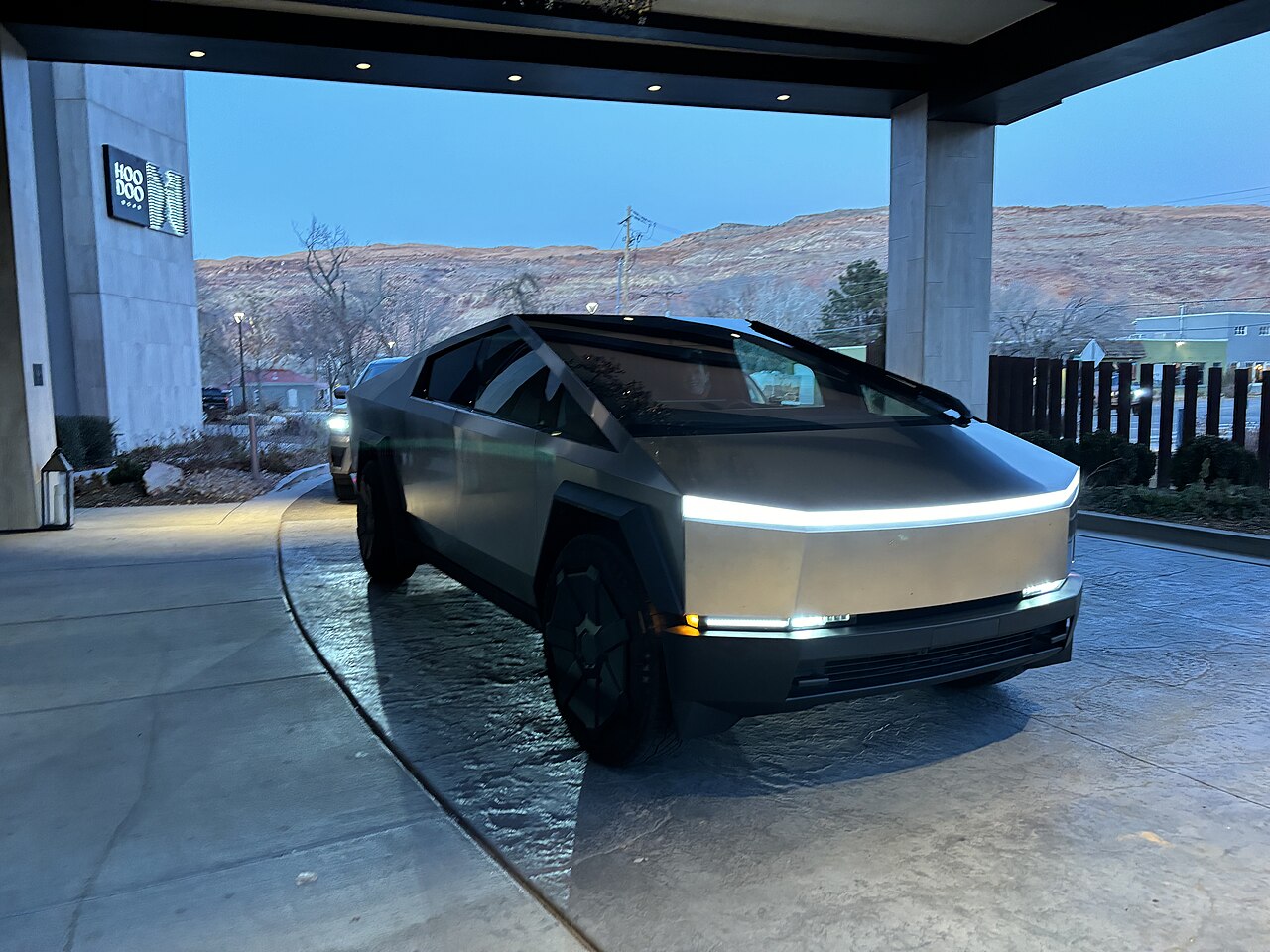
- Tesla Cybertruck is the outlier — angular stainless-steel bodywork, a steer-by-wire yoke, and a minimalist cabin built around one large screen. It draws crowds and comments everywhere it goes. Love it or hate it, nothing else looks remotely like it.
- Ford F-150 Lightning is deliberately normal. It looks and drives like the best-selling truck in America because it basically is one, just electrified. For buyers who want an EV without reinventing their driveway, that familiarity is the whole point.
- Rivian R1T splits the difference with a friendly, adventure-focused design, premium materials, and genuine off-road hardware. It’s the enthusiast’s pick and arguably the nicest interior of the bunch.
- Chevrolet Silverado EV is the big, planted highway cruiser — it’s the largest of the four and leans into range and towing over personality.
On the road, all four deliver the instant, silent torque that makes EV trucks so satisfying to drive. The Cybertruck and R1T Quad are the drag-strip stars; the Lightning and Silverado prioritize a smooth, familiar ride.
Living With an Electric Truck: Gear Worth Keeping Aboard
One quirk unites all of these trucks: none of them comes with a full-size spare tire from the factory. Combine that with the fact that EV trucks are heavy and hard on tires, and a small kit in the frunk pays for itself the first time you catch a slow leak on a back road.
The single most useful item is a compact portable 12V air compressor (expect to pay in the $30-50 range). It tops off a low tire in minutes and lets you run the correct pressures for towing versus daily driving — a real efficiency lever on a heavy truck. Pair it with a tire plug and sealant kit so a puncture becomes a 15-minute roadside fix instead of a flatbed call, and a simple digital tire-pressure gauge to check pressures cold.
It’s also worth carrying a portable lithium jump starter — not for the drive battery, but for the 12V accessory battery every EV still relies on to wake up its computers and unlock the doors. A dead 12V is one of the more common ways an EV owner gets stranded in a parking lot, and a pocket jump pack (roughly $60-80) gets you moving again. None of this is Tesla-specific; it’s smart gear for any electric pickup.
Which Electric Truck Should You Buy?
There’s no universal winner, but there is a right answer for each type of buyer:
- Buy the Chevrolet Silverado EV if maximum range and towing are non-negotiable and you want the most traditional big-truck feel.
- Buy the Ford F-150 Lightning if you want the lowest-drama entry to an EV truck, class-leading exportable power, and a shape your job site already trusts.
- Buy the Rivian R1T if you value the nicest cabin, real off-road ability, and standout design without going full Cybertruck.
- Buy the Tesla Cybertruck if you want the deepest software integration, the smoothest Supercharger experience, and a truck that turns every trip into a conversation.
For many North American buyers the deciding factor comes down to charging habits and brand comfort. If you already live in the Tesla ecosystem — or you want that seamless Supercharger road-trip experience — the Cybertruck makes the most sense, and ordering through a Tesla referral link tacks on three months of free Full Self-Driving (Supervised) to sweeten the deal. Whichever way you lean, take a look at the rest of our US Tesla guides before you sign — and if a Model Y or Model 3 might actually fit your life better than a full-size truck, our Model Y USA guide is a good reality check.
Frequently Asked Questions
Which electric truck has the longest range in 2026?
The Chevrolet Silverado EV leads with a GM-estimated 493 miles on the Work Truck Max Range configuration. The Rivian R1T with the Max battery pack is next at up to 420 miles, while the Tesla Cybertruck (325 miles) and Ford F-150 Lightning (up to 320 miles) are closely matched. Remember these are best-case EPA-style figures; towing and cold weather reduce real-world range significantly.
Do these trucks still qualify for the $7,500 federal tax credit?
No. The federal EV tax credit for new vehicles ended on September 30, 2025, so none of these trucks qualify for it in 2026. Some states and Canadian provinces still offer their own incentives, so check local programs before you buy.
Can the Ford, Rivian, and Chevy trucks charge at Tesla Superchargers?
Yes. The Tesla Cybertruck has a native NACS port and plugs in directly. The F-150 Lightning, R1T, and Silverado EV can use Superchargers with a NACS adapter, and newer builds increasingly ship with a native NACS port. All four also charge on CCS fast chargers and standard Level 2 home equipment.
Which electric truck tows the most?
The Chevrolet Silverado EV has the highest maximum tow rating at up to 12,500 pounds. The Tesla Cybertruck and Rivian R1T both top out at 11,000 pounds, and the Ford F-150 Lightning maxes out at 8,600 pounds on the Platinum trim. Every EV truck loses substantial range while towing, regardless of brand.
Is the Tesla Cybertruck available in Canada?
As of 2026 the Cybertruck is sold in the United States (and Puerto Rico) but has not opened for order in Canada. Canadian truck shoppers looking at electric options currently have easier access to the F-150 Lightning, Silverado EV, and Rivian R1T. Always confirm current availability on each automaker’s site.
Does ordering a Tesla through a referral link really give free FSD?
Yes. As of this writing, placing a new Cybertruck, Model 3, or Model Y order through a valid Tesla referral link adds three months of Full Self-Driving (Supervised) at no cost, and it stacks with the standard 30-day trial. Tesla changes referral perks periodically, so confirm the current offer on Tesla’s site when you order.
The Bottom Line
- Longest range and towing: Chevrolet Silverado EV (up to 493 mi / 12,500 lb).
- Best value entry point: Ford F-150 Lightning STX and Silverado EV LT.
- Most power and nicest cabin: Rivian R1T.
- Best charging experience and software: Tesla Cybertruck, with a referral bonus of three months free FSD (Supervised).
- Universal advice: the $7,500 federal credit is gone, none of these trucks include a spare, and towing slashes range — plan and pack accordingly.
Information current as of August 2026. Prices, range ratings, and incentives change frequently and vary by trim, region, and configuration — always confirm current figures with the automaker before ordering. This article is for general information only and is not financial or purchasing advice. Some links are affiliate or referral links; see our disclosure page. Image credit: Tesla Cybertruck by A1C6, released under CC0 (public domain), via Wikimedia Commons.

About the author: Lifei
Lifei is a Tesla owner based in Canada, writing practical, fact-checked Tesla guides for US and Canadian drivers — buying, ownership, insurance, charging, and TSLA investing, all from first-hand experience.
