
Driving a Tesla Across the US–Canada Border in 2026: Supercharging, Insurance, Customs & Snowbird Rules
Driving a Tesla Across the US–Canada Border in 2026: Supercharging, Insurance, Customs & Snowbird Rules

In one sentence
How Supercharger billing, Premium Connectivity, warranty, insurance, customs limits, winter-tire laws and the USCIS 30-day rule work when you drive a Tesla between the U.S. and Canada.
Every fall, tens of thousands of Canadians point their cars south toward Florida and Arizona, and every summer Americans stream north to Banff, Whistler, Toronto and Quebec City. More and more of those cars are Teslas — and the question we get most often is some version of “will my car just work over there?” The short answer is yes: the Supercharger network, Premium Connectivity, FSD (Supervised) and even your warranty all treat the United States and Canada as one region. But there are real differences in Supercharger billing, Level 2 charging networks, insurance, customs limits, winter-tire laws and — new for 2026 — a U.S. registration rule that catches Canadian snowbirds off guard. This guide walks through all of it, in both directions, so your border crossing is the least eventful part of the trip.
Disclosure: some links are affiliate/referral links, which means we may earn a small commission at no extra cost to you. It never changes the price you pay or our recommendations. See our disclosure page.
📋 Contents
- The Short Version: Your Tesla Treats the U.S. and Canada as One Region
- Supercharging Across the Border: Billing, Prices and Card Fees
- Beyond Superchargers: Level 2 Networks, Adapters and Hotel Charging
- Paperwork at the Border: Documents, Insurance and Customs Limits
- For Canadian Snowbirds: The 30-Day U.S. Registration Rule and the Drive South
- For Americans Heading North: km/h, Winter Tires, Tolls and Northern Ontario
- Tires, Flats and the No-Spare Problem on Both Sides
- Staying Connected on Both Sides: Premium Connectivity and Starlink
- Pre-Trip Checklist for a Cross-Border Tesla Drive
- Frequently Asked Questions
- The Bottom Line
The Short Version: Your Tesla Treats the U.S. and Canada as One Region
Tesla designed its North American vehicles, software and network around a single U.S.–Canada region, which is why a Canadian-registered Model Y can plug into a Supercharger in Georgia and a Michigan-registered Model 3 can navigate to a Supercharger in Sudbury without any setup. Here is what carries over automatically and what needs a little attention before you leave:
| Feature | Works across the border? | What to know |
|---|---|---|
| Supercharging | Yes, automatically | Billed in the local currency (USD or CAD) to the card on your Tesla account; foreign-transaction fees may apply. |
| Trip Planner / navigation | Yes | One continuous North American map; routes through Superchargers on both sides. |
| Premium Connectivity | Yes | Covers the U.S., Canada, Mexico and Puerto Rico with no roaming surcharge; brief reconnect at the border. |
| FSD (Supervised) subscription | Yes | $99/month in either country; the same supervision rules apply on both sides. |
| Warranty and service | Yes | Tesla’s warranty region is the U.S. and Canada together; any Tesla Service Center in either country can do warranty work. |
| Speed units (mph / km/h) | No — manual | Switch units under Controls > Display; the car does not flip them at the border. |
| Level 2 public charging | Yes, with adapter | Both countries use J1772 for Level 2; the adapter comes with the car. Non-Tesla DC fast chargers are CCS1. |
Tesla’s own travel tips page covers the basics; the rest of this article fills in the details that page leaves out.
Supercharging Across the Border: Billing, Prices and Card Fees
Nothing changes about how you charge — pull in, plug in, walk away. What changes is the bill. Canadian Superchargers bill in Canadian dollars and U.S. Superchargers bill in U.S. dollars, and both charge the payment card attached to your Tesla account. That has two consequences:
- If your card charges a foreign-transaction fee (typically 2.5–3%), every session on the other side of the border costs a little extra. A no-foreign-fee credit card, added to your Tesla account before the trip, avoids this entirely.
- Prices look very different on paper. A Canadian looking at “$0.45/kWh” in Ohio is seeing U.S. dollars; an American looking at “$0.58/kWh” in Alberta is seeing Canadian dollars. Do the conversion before you decide a site is expensive.
| Supercharging in 2026 | United States | Canada |
|---|---|---|
| Typical price range | US$0.30–0.45/kWh; peak or high-cost areas US$0.50–0.60+ | C$0.30–0.60/kWh depending on province, site and time of day |
| Billing basis | Per kWh everywhere, with time-of-use pricing at many sites | Per kWh in most provinces; a few Atlantic provinces still use tiered per-minute billing |
| Currency billed | USD | CAD |
| Idle and congestion fees | Yes, at busy sites | Yes, at busy sites |
| Membership needed? | No — Tesla owners pay per session | No |
Time-of-use pricing is now the norm at busy sites on both sides. If your schedule is flexible, charging outside the late-afternoon peak often saves 20–30% — a meaningful amount over a 2,400 km (1,500-mile) snowbird run. For a deeper look at what a session actually costs, see our Supercharger cost guide.
One tip from long-time snowbirds: you do not need a second Tesla account or a U.S. address to charge in the U.S. for months. Keep your Canadian account, add a card that works in both currencies, and let the network bill you in whatever currency the site uses.
Beyond Superchargers: Level 2 Networks, Adapters and Hotel Charging
Superchargers get you between cities; Level 2 charging is what makes a two-week stay at a lakeside cottage or a four-month stay in a Florida condo painless. The good news is that both countries standardized on the same Level 2 connector, J1772, and Tesla includes a J1772 adapter with every new car sold in North America. Check that it is actually in your car before you leave — it usually lives in the trunk cubby or frunk with the charging gear, and it walks away more often than you’d think. If yours is missing, a spare such as the Lectron J1772-to-Tesla adapter (roughly $40–60) covers every FLO, ChargePoint, Circuit électrique, BC Hydro, Ivy or Blink Level 2 station you will meet on the road.
Americans heading into Quebec will notice how dense the provincially run Circuit électrique network is — it is worth installing the app and adding a card before you cross, because many of its stations don’t accept tap-to-pay. Canadians heading south will lean on ChargePoint and Blink for hotel and shopping-center Level 2, plus the destination chargers that Tesla lists in the car’s navigation.
For DC fast charging outside the Supercharger network (Electrify America and Electrify Canada, EVgo, Petro-Canada, Ivy), you need Tesla’s CCS1 adapter, which is a different part from the J1772 adapter. Our NACS and adapter guide explains which adapter does what and which cars can even use CCS.
The single most useful item for cross-border Tesla travel, though, is the one Tesla stopped putting in the trunk: a Tesla Mobile Connector (typically $200–300). With the standard 120 V plug it turns any outdoor outlet at a cottage, Airbnb or condo parking spot into an overnight trickle charger — slow, but 5–7 km (3–5 miles) of range per hour adds up to a full day’s local driving by morning. With the NEMA 14-50 plug it becomes a proper Level 2 charger at RV parks and campgrounds on both sides of the border. Snowbirds who spend the winter in a rented condo without a charger tell us the Mobile Connector plus a 120 V outlet is enough for grocery runs and beach days, with a Supercharger visit every week or two for anything more.
Paperwork at the Border: Documents, Insurance and Customs Limits
An EV clears customs exactly like any other car, but a few documents deserve a spot in the glovebox (or, since Teslas have a glovebox that opens from the screen, in the center console):
- A valid passport (or NEXUS card at NEXUS lanes) for every person in the car. Enhanced driver’s licences work at land crossings for residents of the states and provinces that issue them.
- Your vehicle registration. If you are driving a car registered to someone else — or a leased car — bring a letter of permission from the owner or lessor; leased-vehicle drivers should confirm the lease allows cross-border travel.
- Proof of insurance. U.S. and Canadian auto policies generally cover both countries thanks to reciprocal arrangements, but Americans should ask their insurer for a Canadian Non-Resident Inter-Province insurance card (most issue one free), and Canadians should tell their insurer if they will be in the U.S. for more than about four weeks, since some policies need a note on file or a small premium adjustment. Tesla Insurance policyholders should read the policy documents for territory language rather than assume.
Customs allowances catch people with a trunk full of cross-border shopping. As of 2026, Canadian residents returning after 48 hours or more can bring back C$800 in goods duty- and tax-free (C$200 for 24–48 hours; nothing for trips under 24 hours), per the CBSA’s “I Declare” guide. U.S. residents get US$800 after 48 hours abroad and US$200 for shorter trips, per U.S. Customs and Border Protection. Two EV-specific notes: a charging adapter or accessory you bought on the other side counts toward that limit, and cannabis — legal in Canada and in many U.S. states — is illegal to carry across the border in either direction, even between two places where it is legal. Leave it at home.
For Canadian Snowbirds: The 30-Day U.S. Registration Rule and the Drive South
This is the section most Canadian Tesla owners need to read twice. Since April 2025, Canadian citizens who enter the U.S. at a land border and stay 30 days or longer must register with U.S. Citizenship and Immigration Services by filing Form G-325R through a free online USCIS account. Canadians who fly in are automatically issued an electronic I-94 and are already registered; drivers usually are not issued one, so the obligation falls on them. Failing to register or to carry proof of registration is a misdemeanor with fines that can reach several thousand dollars. The rule is still in force in 2026, so build it into your trip: file G-325R within the first month, keep a printout of the confirmation in the car, and check the USCIS registration page for current instructions before you leave. As before, Canadian visitors are generally admitted for up to six months, and you must also watch the tax “substantial presence” thresholds if you spend more than roughly four months a year in the U.S.
The drive itself is easy in a Tesla. The two classic snowbird corridors — I-75 from the Detroit–Windsor or Sarnia crossings down through Ohio, Kentucky and Georgia, and I-95 from Buffalo or the Quebec crossings down the Eastern Seaboard — are among the most densely Supercharged highways in North America, with sites every 100–160 km (60–100 miles) and plenty of 250 kW V3 and V4 stalls. Trip Planner will route you without any manual help. Expect the trip to take one extra charging stop per day compared with a gas car, and plan the first day for cold-weather range loss if you leave in November or December; our winter driving guide has the numbers.
Once you arrive, a few things are different from home. Florida and Arizona have no state EV incentives but also no shortage of Superchargers; Florida in particular has dense coverage along both coasts and I-4. If you are thinking of buying a car while you are there, remember that a U.S.-purchased Tesla still has to be imported and registered in Canada when you come home — read our Florida buying guide and Transport Canada’s import rules first. And if you are shopping in Canada before you go, ordering a Model 3, Model Y or Cybertruck through a Tesla referral link currently includes 3 months of free FSD (Supervised) — which happens to be exactly the feature you will appreciate most on a 25-hour drive down I-75.
For Americans Heading North: km/h, Winter Tires, Tolls and Northern Ontario
Going the other way is just as smooth, with a few Canadian-specific wrinkles:
- Units. Your Tesla will not switch to km/h on its own. Change it under Controls > Display before you cross, or you will be staring at a “100” sign while the car shows 62. Speed-limit sign recognition does read Canadian signs correctly, so the limit the car displays will be right once units match.
- Winter tires. British Columbia requires winter tires (M+S or three-peak mountain snowflake, at least 3.5 mm tread) on most highways from October 1 to April 30, and the rule applies to out-of-province visitors — if you are driving to Whistler or through the Coquihalla on all-season summer tires in January, you can be turned around. Quebec’s December 1 – March 15 mandate technically applies only to Quebec-registered vehicles, but Quebec winters do not care about registration; see our winter tires guide.
- Tolls. Ontario’s Highway 407 ETR has no toll booths; cameras read your plate and mail a bill (with a video-toll surcharge) to the registered address, including U.S. addresses. Either skip the 407 or budget for it. Bridge and tunnel crossings at Detroit, Buffalo and Niagara take cards.
- Northern Ontario. Superchargers now run the full Trans-Canada from coast to coast, but on Highway 17 between Sault Ste. Marie and Thunder Bay there are still stretches of 200+ km between fast chargers. Arrive at those sites with margin, and don’t skip a charge because the next one “looks close” on the map.
- Weather gear. If you are visiting between November and April, a compact tool like the AstroAI extendable snow brush and ice scraper (around $15–25) earns its space — a Tesla’s glass roof and flush handles ice over quickly, and Canadian hotel parking lots are not always plowed by checkout.
Cold-weather charging speeds also deserve a mention: a battery that has sat overnight at −20 °C charges slowly until it warms up. Navigate to the Supercharger in the car (rather than just driving there) so preconditioning starts automatically, and you will cut 10–15 minutes off the first stop of the morning.
Tires, Flats and the No-Spare Problem on Both Sides
Teslas don’t carry a spare, and a flat in rural Saskatchewan or on a Georgia interstate at night is a very different experience from a flat near home. Both countries have roadside assistance through the Tesla app, and Tesla’s roadside coverage works in either country while the car is under warranty, but response times outside cities can be long. A 12 V inflator such as the AstroAI portable tire inflator (around $30–45) plugs into the car’s 12 V socket and gets you to the nearest tire shop after a slow leak; it also lets you correct pressures when the TPMS warning lights up after a cold snap or a mountain pass. Pair it with a plug-style repair kit and you have handled 90% of tire emergencies without a tow.
Two Tesla-specific reminders for long trips: check tire pressure at every second Supercharger stop (cold Canadian mornings and hot Florida afternoons swing pressure by several psi), and remember that Canadian tire shops are used to Teslas — every major chain stocks the common 18- and 19-inch Model 3 and Model Y sizes, and most know to use the correct jack pads.
Staying Connected on Both Sides: Premium Connectivity and Starlink
Premium Connectivity — US$9.99/month or US$99/year in the U.S., C$13.99/month or C$140/year in Canada — covers the U.S., Canada, Mexico and Puerto Rico under one subscription, so streaming, live traffic and satellite maps keep working across the line with no roaming charge. The one hiccup owners report is a five-minute reconnect right at the border while the modem hands off between carriers; if a podcast drops mid-episode at the Peace Arch, that’s why.
Where connectivity really runs out is the same place Supercharger spacing gets thin: Northern Ontario, the Rockies between Golden and Revelstoke, most of the Prairies off the Trans-Canada, and the Florida panhandle backroads. That’s where a growing number of Tesla road-trippers pack a Starlink Mini, which draws so little power (roughly 25–40 W) that it can run off the car’s 12 V or USB-C outlets while parked or camped. In July 2026 Starlink changed its Roam rules so that the U.S. and Canada now count as a single region, which means a Canadian Roam subscriber wintering in Arizona — or an American touring Vancouver Island — no longer eats into any international-roaming allowance at all. Canadian readers can sign up through this Starlink referral link (Canada only); we tested the Mini on Ontario cottage roads in our Starlink Mini review. It is not something every owner needs, but for anyone who works remotely from the road or camps in the car, it pairs with Camp Mode better than any other accessory we’ve tried.
Pre-Trip Checklist for a Cross-Border Tesla Drive
- Add a no-foreign-transaction-fee card to your Tesla account and set it as the default payment method.
- Confirm the J1772 adapter is in the car; pack the Mobile Connector with both the 120 V and 14-50 plugs if you own one.
- Install and fund the relevant Level 2 apps (Circuit électrique and FLO for Quebec and Eastern Canada; ChargePoint and Blink for the U.S.).
- Switch distance units under Controls > Display when you cross.
- Photograph your registration, insurance card and passport pages to your phone; keep the originals in the console.
- Canadians staying 30+ days in the U.S.: create a USCIS account and file Form G-325R; keep the confirmation with you.
- Tell your insurer about long stays and confirm territory coverage.
- Run a software update on home Wi-Fi the night before — you cannot always count on a good connection in the mountains.
- Check our Canada Tesla section for province-by-province charging and buying notes if your trip involves several provinces.
Frequently Asked Questions
Can I use Tesla Superchargers in Canada with a U.S. Tesla account (and vice versa)?
Yes. Supercharging works automatically in both countries with a single Tesla account. Sessions are billed in the local currency (CAD in Canada, USD in the U.S.) to the payment card on your account, so a card without foreign-transaction fees saves a few percent on every charge.
Does Tesla Premium Connectivity work when I drive from the U.S. into Canada?
Yes. Premium Connectivity covers the U.S., Canada, Mexico and Puerto Rico under one subscription with no roaming surcharge. Owners typically see a short reconnection gap of a few minutes at the border while the car switches carriers.
Does FSD (Supervised) work on both sides of the border?
Yes. FSD (Supervised) is available as a US$99 or C$99 monthly subscription in each country, and an active subscription keeps working when you cross. The driver must remain attentive and ready to take over in both countries; the rules do not change at the border.
Is my Tesla warranty valid if something breaks in the other country?
Yes. Tesla’s New Vehicle Limited Warranty defines the U.S. and Canada as a single warranty region, so a Canadian car can get warranty service at a U.S. Service Center and vice versa. Mobile Service also operates in both countries.
Do Canadian snowbirds need to register with USCIS if they drive to Florida?
If you enter by land, are not issued an I-94, and stay 30 days or longer, yes — you must file Form G-325R online through a USCIS account and carry proof of registration. Air travelers are normally issued an electronic I-94 and are already registered. Confirm current details on the USCIS website before you go, as procedures can change.
Do I need winter tires to drive my Tesla in Canada?
It depends on where and when. British Columbia requires winter-rated tires (M+S or three-peak mountain snowflake) on most highways from October 1 to April 30, and the rule applies to visitors. Quebec’s December 1 – March 15 law applies only to Quebec-registered vehicles, but winter tires are strongly recommended for any winter driving in Quebec, Ontario or the Prairies.
Will my Tesla automatically change from mph to km/h in Canada?
No. Distance and speed units are a manual setting under Controls > Display. Speed-limit sign recognition reads Canadian signs correctly once the units are switched.
The Bottom Line
- Your Tesla works seamlessly in both countries: Supercharging, navigation, Premium Connectivity, FSD (Supervised) and warranty all cover the U.S. and Canada as one region.
- Supercharger sessions are billed in local currency — bring a no-foreign-fee card and charge off-peak where you can.
- Both countries use J1772 for Level 2; keep the included adapter in the car, and a Mobile Connector turns any cottage or condo outlet into an overnight charger.
- Canadians staying 30+ days in the U.S. by land must register with USCIS (Form G-325R) — new since 2025 and still in force in 2026.
- Americans heading north: switch to km/h, respect BC’s October–April winter-tire rule, budget for the 407 ETR, and add margin across Northern Ontario.
- Customs limits are C$800 / US$800 after 48 hours; never carry cannabis across the border in either direction.
- Ordering a new Tesla before the trip? A referral-link order currently includes 3 months of free FSD (Supervised).
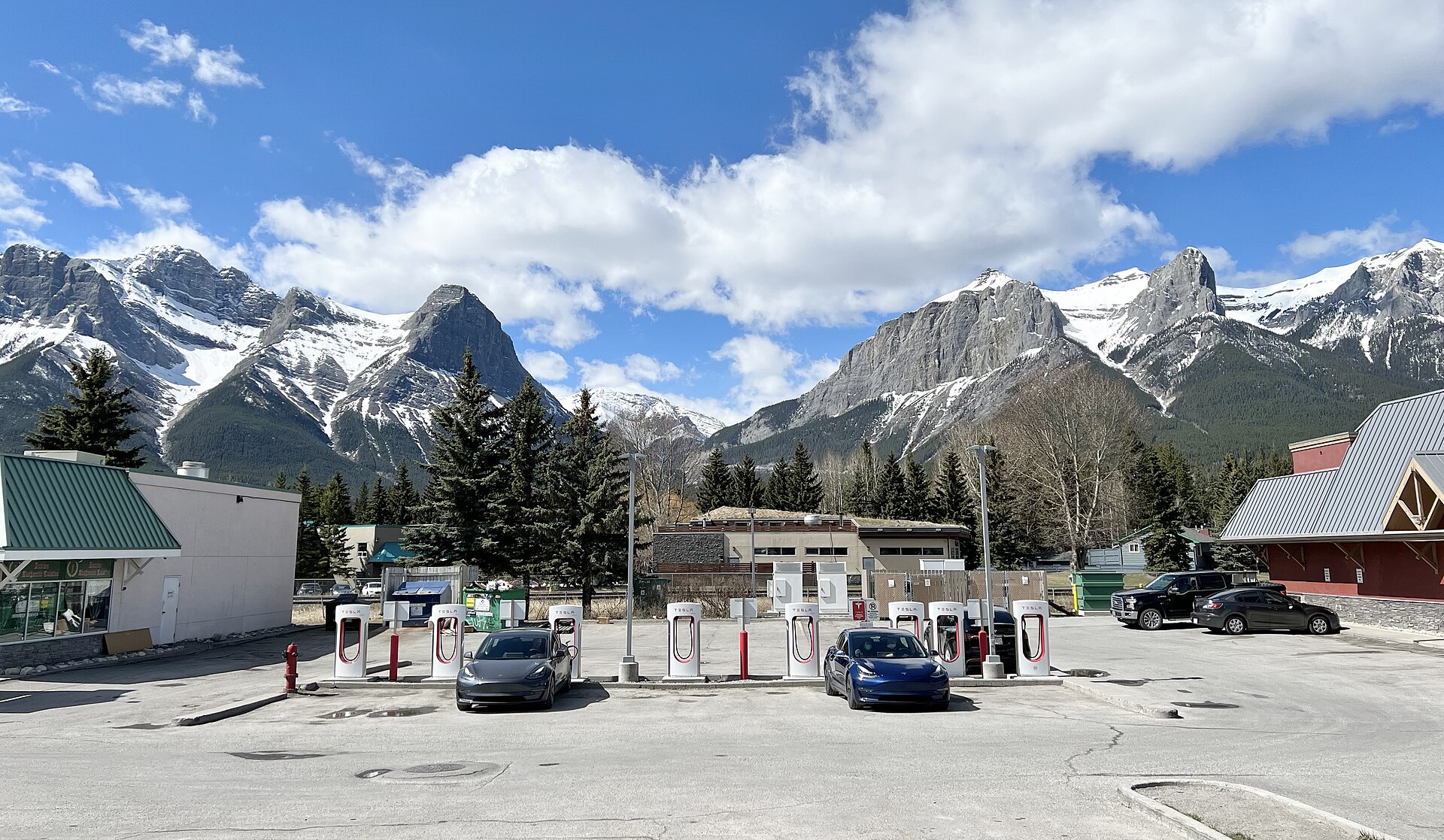
Information current as of September 2026. Supercharger prices, connectivity fees, customs exemptions, insurance terms and U.S./Canadian entry rules change frequently — confirm with Tesla, CBSA, CBP, USCIS and your insurer before you travel. This article is general information, not legal, tax, immigration or financial advice. Some links are affiliate or referral links; see our disclosure page. Image credit: Sharon Hahn Darlin, CC BY 2.0, via Wikimedia Commons.
About the author: Lifei Zhou
Model Y owner since 2022Ontario STO registered apprentice · 310SWorks on Porsche, Mercedes, BMW, Audi weeklyHundreds of readers referred (est.)
Lifei is a Tesla owner based in Canada, writing practical, fact-checked Tesla guides for US and Canadian drivers — buying, ownership, insurance, charging, and TSLA investing, all from first-hand experience.