
Tesla Tire Pressure: Recommended PSI for Model 3, Y, S, X & Cybertruck (2026)
Tesla Tire Pressure: Recommended PSI for Model 3, Y, S, X & Cybertruck (2026)

Most Teslas run 42 psi (290 kPa) cold, front and rear: that is Tesla’s factory figure for the Model 3 on 18- and 19-inch wheels and the Model Y on 19- and 20-inch wheels. The Cybertruck runs 50 psi, and the number on your own door-pillar label always beats any chart, including this one.
Tire pressure is the single cheapest thing you can control on your Tesla, and it quietly affects almost everything you care about: range, ride comfort, tire life, and how often that yellow warning pops up on the touchscreen. Yet most new owners never think about it until the low-pressure light appears on a cold morning. Because Teslas are heavy, run stiff low-rolling-resistance tires, and show you live pressures on the screen, they punish under-inflation more visibly than a typical gas car does — a few missing PSI can cost you real miles of range.
This guide covers exactly what pressure your Model 3, Model Y, Cybertruck, or the older Model S/X should run, where to find the number that actually applies to your car, how to check and correct it the right way, and how Tesla’s tire-pressure monitoring system (TPMS) behaves in North American winters. Pressures below come from the factory tables in Tesla’s owner’s manuals, re-checked on October 14, 2026.
Disclosure: some links are affiliate/referral links. If you buy or order through them we may earn a commission or credit at no extra cost to you. See our disclosure page.
Tesla tire pressure at a glance (checked October 14, 2026)
- Model 3 (18″ and 19″) and Model Y (19″ and 20″): 42 psi cold, front and rear.
- Model S: 42 psi on 19″ wheels, 40 psi on 21″. Model X: 42 psi on 20″ and 22″.
- Cybertruck: 50 psi; All-Terrain tires go to 65 psi when loaded to GVWR.
- Measure cold: parked at least three hours. About 1.6 km of driving is enough to warm the tires.
- Expect about 1 psi lost for every 6 °C (10 °F) the temperature drops.
- After a wheel swap, TPMS relearns within about two minutes of driving above 25 km/h (15 mph).
📋 Contents
- What Tire Pressure Should a Tesla Run?
- Where to Find Your Tesla’s Exact Recommended PSI
- How to Check and Set Tesla Tire Pressure the Right Way
- How Tesla’s TPMS Works — and How to Reset It
- Cold Weather: Why the Light Loves November
- What Wrong Pressure Actually Costs You
- Handling a Flat: There’s No Spare
- Thinking About Ordering a New Tesla?
- Frequently Asked Questions
- The Bottom Line
What Tire Pressure Should a Tesla Run?
For almost every recent Model 3 and Model Y sold in the U.S. and Canada, the recommended cold tire pressure is 42 psi (290 kPa) front and rear. That is the figure in the factory tables of the Model 3 and Model Y owner’s manuals. Performance trims and aftermarket wheels are not in those tables, and the Cybertruck runs higher. The placard on your own car (see the next section) always wins over any chart online, including this one.
| Model and wheel | Factory tire size | Cold pressure (front / rear) |
|---|---|---|
| Model 3, 18″ | 235/45R18 | 42 / 42 psi (290 kPa) |
| Model 3, 19″ | 235/40R19 | 42 / 42 psi (290 kPa) |
| Model 3 Performance, 20″ | 235/35R20 front, 275/30R20 rear | Not in the manual table: use the door label |
| Model Y, 19″ | 255/45R19 | 42 / 42 psi (290 kPa) |
| Model Y, 20″ | 255/40R20 | 42 / 42 psi (290 kPa) |
| Model Y Standard 18″ or Performance 21″ | 235/55R18 / 255/35R21 + 275/35R21 | Not in the manual table: use the door label |
| Model S, 19″ | 255/45R19 front, 285/40R19 rear | 42 / 42 psi (290 kPa) |
| Model S, 21″ | 265/35R21 front, 295/30R21 rear | 40 / 40 psi (276 kPa) |
| Model X, 20″ or 22″ | 265/45R20 + 275/45R20 / 265/35R22 + 285/35R22 | 42 / 42 psi (290 kPa) |
| Cybertruck, 20″ or 18″ All-Season | 285/65R20 on 20″ | 50 / 50 psi |
| Cybertruck, 20″ All-Terrain | 285/65R20 | 50 psi normal load, 65 psi at GVWR |
Pressures are from the factory tables in Tesla’s owner’s manuals. Model S and Model X are out of production but still serviced. Older cars and different wheel packages can differ, so check your label.
Two things trip people up. First, these are cold numbers, meaning the car has sat for at least three hours or has been driven less than about a mile. Second, the pressure printed on the tire sidewall (often 50 psi or higher) is the tire’s maximum, not the recommended pressure — never inflate to the sidewall figure.
Where to Find Your Tesla’s Exact Recommended PSI
The authoritative number for your specific car lives on the Tire and Loading Information label, a sticker on the center door pillar that’s visible when the driver’s door is open. It lists the cold pressure Tesla engineered for your exact wheel and tire combination, plus the maximum passenger and cargo load. Tesla also publishes the figures in the owner’s manual and in the touchscreen tire-pressure screen.
Trust the placard over forum posts and generic charts, because pressures can differ between wheel sizes, a Standard versus Performance trim, and a passenger car versus the Cybertruck. If you’ve fitted aftermarket wheels or a different tire size, ask the installer what cold pressure they set and why. For a deeper look at sizes, load ratings, and when tread is worn out, see our Tesla tire replacement guide.
How to Check and Set Tesla Tire Pressure the Right Way
Your Tesla shows live pressures on the touchscreen (tap the tire/car icon, or open Controls). That readout is great for spotting a slow leak, but it isn’t the tool you use to set pressure — the sensors update slowly and read warm after driving. To do it properly:
- Check cold. Measure first thing in the morning or after the car has sat 3+ hours. Driving heats the tires and can add 3–5 psi, which will fool you into under-inflating.
- Use a real gauge. Gas-station gauges are notoriously inaccurate. A dedicated digital gauge such as the AstroAI digital tire pressure gauge reads to 0.5 psi and costs about the price of two coffees — the best value tool in this whole article.
- Top up at home. A compact 12V pump like the AstroAI portable air compressor plugs into the 12V socket and lets you add a couple of PSI in the driveway instead of hunting for a working station. Set your target, let it auto-stop, then re-check with your gauge. On my own Model Y I use a cordless JOWUA 100W inflator (more on it in the flat-tire section).
- Do all four. Match every tire to the placard value. A left-to-right imbalance of even 3–4 psi can make the car track oddly and wear tires unevenly.
Aim to check monthly and before any road trip. Pressure naturally drifts down about 1–2 psi a month even with no leak, and faster as the seasons turn.
How Tesla’s TPMS Works — and How to Reset It
Every Tesla uses a direct TPMS: a battery-powered sensor inside each wheel transmits the actual pressure by radio to the car, which is why you see a live per-wheel PSI number rather than just a warning light. The system flags a tire once it drops roughly 20–25% below the recommended cold pressure, or if it detects a rapid loss.
TPMS re-learns automatically. After wheels are replaced or swapped, Tesla’s owner’s manual says the sensors reset within about two minutes of driving above 25 km/h (15 mph). After you adjust pressure, the warning light also needs a short drive above that speed before it turns off. If you fitted winter tires or a different tire, update Controls > Service > Wheel & Tire > Tires so the car resets its learned tire settings. Only Tesla-compatible sensors work reliably: Tesla notes that if a non-Tesla shop replaces a tire sensor, it may not work until Tesla performs the setup. A light that flashes for a minute every time you start the car means a TPMS fault, not low pressure.
Normal cold-weather drop
- All four tires fell by a similar amount
- It appeared on the first cold morning
- The tires hold the new pressure after you top them up
Probably a leak
- One tire is several psi lower than the others
- It keeps dropping after you top it up
- You can see a nail, screw or sidewall damage
One key point: the warning light means “act now,” not “the sky is falling.” Slow to a safe speed, get to air, and inflate to the placard value. If the tire won’t hold pressure, you likely have a puncture — see the flat-tire section below.
Cold Weather: Why the Light Loves November
Air contracts as it cools, so tire pressure falls with the temperature: roughly 1 psi for every 10°F (about 6°C) drop, the figure in Tesla’s owner’s manual. That’s why so many owners get a low-pressure warning on the first genuinely cold morning of the season — a tire set to 42 psi in a 75°F garage can read about 37 psi after a night at 25°F outside, enough to trip the alert even though nothing is leaking.
Estimate using Tesla’s figure of about 1 psi lost per 6 °C. Nothing is leaking; the air is just colder. Top up to the label value at the outdoor temperature.
The fix is simple: re-inflate to the placard pressure when the tires are cold, using the winter temperatures you’re actually driving in. Don’t chase the number by adding air to a warm tire in a heated garage — it’ll be over-inflated once it cools. Some owners set pressure 1–2 psi above the placard in deep winter to reduce nuisance warnings, which is fine within reason, but never exceed the tire’s max sidewall pressure. If you run a dedicated cold-weather setup, our Tesla winter tires guide covers when and why to switch.
What Wrong Pressure Actually Costs You
Under-inflation is the expensive mistake. Soft tires flex more, generate heat, and create extra rolling resistance the motor has to overcome — and because an EV can’t be “topped off” in three minutes at a pump, that wasted energy comes straight out of your range. The U.S. Department of Energy’s fueleconomy.gov puts the loss at about 0.2% for every 1 psi drop in average tire pressure. A set running 5–6 psi low costs roughly 1% of efficiency, on top of the range winter already takes. Chronic under-inflation also wears the tire shoulders faster and raises the risk of a heat-related blowout.
Over-inflation has its own downsides: a harsher ride, less grip in the wet, and accelerated wear down the center of the tread. The sweet spot is simply the placard number, kept consistent. If squeezing maximum miles out of a charge is your goal, correct pressure is step one — our guide to maximizing Tesla range and efficiency covers the rest.
| Condition | What you’ll notice | Main risk |
|---|---|---|
| Under-inflated (low) | Lower range, vague steering, warmer tires | Shoulder wear, heat build-up, blowout |
| At placard (correct) | Best balance of range, grip, comfort | — |
| Over-inflated (high) | Harsher ride, more road noise | Center wear, reduced wet grip |
Handling a Flat: There’s No Spare
Teslas ship without a spare tire, so a slow leak or a nail is where tire-pressure awareness really pays off. If the touchscreen shows one tire dropping, don’t ignore it — a tire caught early can often be plugged, while one run flat is usually scrap. For small tread punctures away from the sidewall, topping the tire up with a portable inflator such as the JOWUA 100W air compressor (code TSLNA for 5% off) can often get you to a shop for a proper plug. It is the inflator I use on my own Model Y: cordless, built-in battery, no 12V cable, easy controls and well made. JOWUA is a partner brand: orders with code TSLNA earn this site a commission. Most punctures are slow leaks: top the tire up and you can usually reach home or a tire shop; skip liquid sealant, which can ruin the foam liner and TPMS sensor inside Tesla tires. Sidewall damage, a large gash, or a tire that won’t hold air is a job for Tesla Roadside or a tow, not a patch.
For the full rundown of your options — sealant, plug kits, mobile service, and what Tesla Roadside covers — see does a Tesla have a spare tire? You can browse more protective gear and driveway tools in our Tesla accessories section.
Thinking About Ordering a New Tesla?
If a new Model 3, Model Y, or Cybertruck is on your shortlist, ordering through a referral link is the easiest money you’ll save at delivery: as of 2026, placing your order through a referral link gets you 3 months of free Full Self-Driving (Supervised) — worth roughly $300. You can use our Tesla referral link when you configure. It costs you nothing extra and simply attaches the current owner-referral perk to your order. New cars also come with a 30-day FSD trial, but the two generally can’t be combined, and Tesla confirms the final perk on your order; either way you get a good look at the software before deciding whether to subscribe. When you’re ready, start your build here and the current three-months-free FSD (Supervised) perk is applied automatically at checkout.
Frequently Asked Questions
What is the correct tire pressure for a Tesla Model Y and Model 3?
Tesla’s factory table lists 42 psi (290 kPa) cold, front and rear, for the Model 3 on 18- and 19-inch wheels and the Model Y on 19- and 20-inch wheels. Performance trims are not in that table. Always confirm against the Tire and Loading Information label on your driver’s-side door pillar, which lists the exact figure for your car.
What tire pressure should a Tesla Model S or Model X run?
The Model S factory table lists 42 psi on 19-inch wheels and 40 psi on 21-inch wheels. The Model X lists 42 psi on both 20-inch and 22-inch wheels. Both cars use different front and rear tire sizes, so check the door label for your exact setup.
What tire pressure does the Cybertruck need?
50 psi front and rear for normal loads on the 20-inch All-Season, 20-inch All-Terrain and 18-inch tires, per the Cybertruck owner’s manual. With All-Terrain tires and a load up to GVWR, raise them to 65 psi. Towing has its own pressure table.
Should I check tire pressure when the tires are cold or warm?
Always cold — after the car has sat at least three hours or been driven less than about a mile. Driving heats the air inside and can add 3–5 psi, so setting pressure on warm tires leaves you under-inflated once they cool.
Why does my Tesla’s low tire pressure warning come on in winter?
Tires lose roughly 1 psi for every 10°F (about 6°C) drop in temperature. If you are switching to a winter set, our Tesla winter tires guide covers sizes and timing. A set filled in a warm garage can fall several PSI overnight in the cold and trip the alert without any actual leak. Re-inflate to the placard value on cold tires at outdoor temperatures and the warning should clear.
How do I reset the TPMS on a Tesla?
You usually do not need to. Inflate to the label value, then drive above 25 km/h (15 mph): the light clears after a short drive, and after a wheel swap the sensors relearn within about two minutes. If you changed tire type, also update Controls > Service > Wheel & Tire > Tires. A light that flashes at every start, or won’t clear, points to a failing or non-Tesla sensor.
Does low tire pressure really reduce Tesla range?
Yes. Under-inflated tires add rolling resistance the motor must overcome. fueleconomy.gov estimates about 0.2% lost for every 1 psi drop in average pressure, so running 5–6 psi low costs around 1% all the time, which adds up over a winter of commuting.
Can I inflate my Tesla tires to the pressure on the sidewall?
No. The sidewall number is the tire’s maximum safe pressure, not the recommended one. Inflate to the door-placard figure (typically 42 psi on Model 3/Y). The sidewall max only matters as a ceiling you should never exceed.
The Bottom Line
- Target: 42 psi cold for most Model 3/Y and Model X; 40–42 psi for Model S; 50 psi for Cybertruck; always defer to your door-pillar placard.
- Check cold, with a real gauge — the touchscreen readout is for monitoring, not for setting pressure.
- Expect winter warnings: ~1 psi lost per 10°F drop; re-inflate on cold tires and the light clears.
- Correct pressure protects range, tread, and safety; under-inflation is the costly mistake for a heavy EV.
- No spare means keeping a gauge, a 12V inflator, and a plug kit in the frunk is cheap peace of mind.
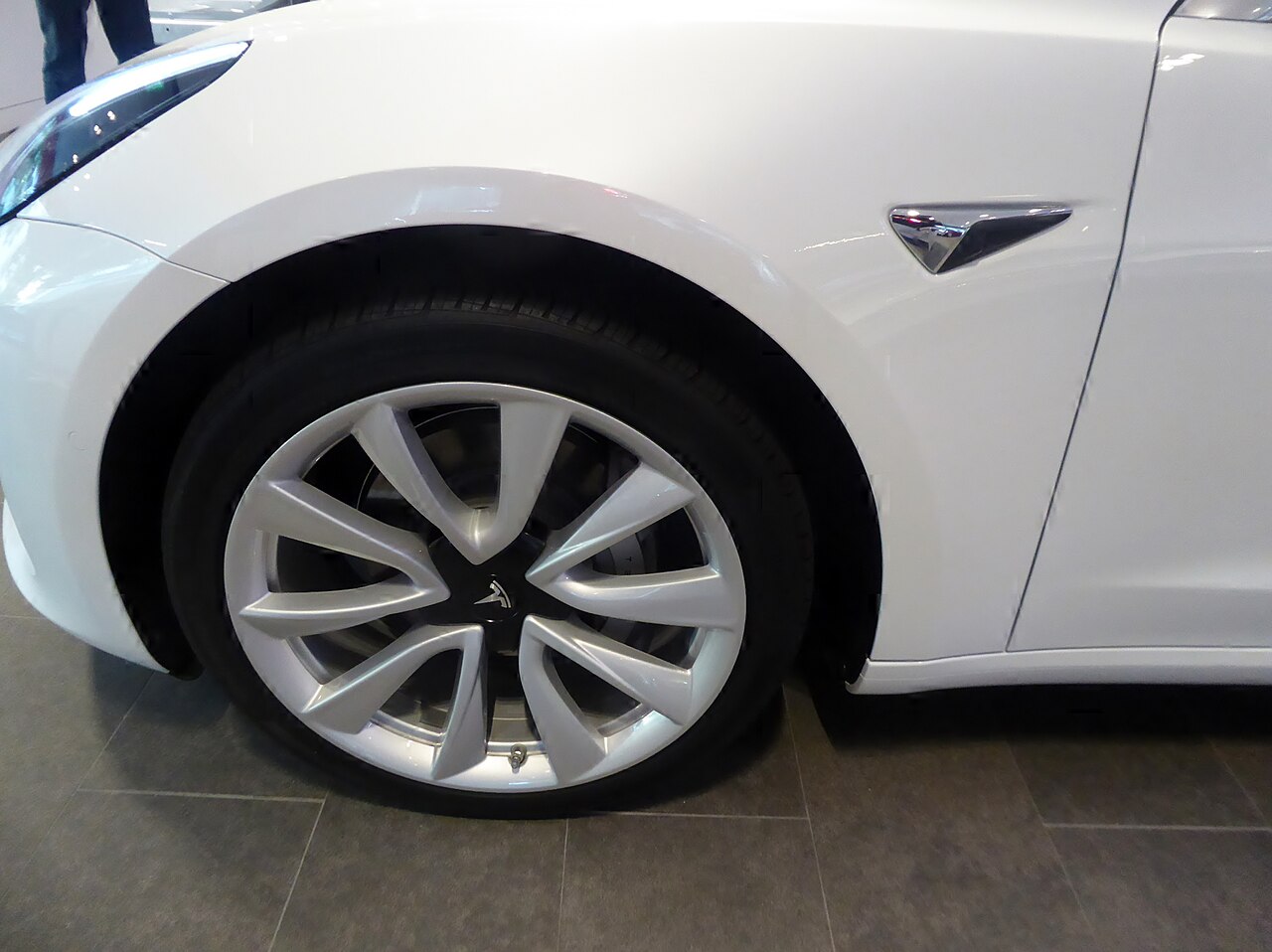
Tire pressures were re-checked against Tesla’s owner’s manuals on October 14, 2026; pricing, promotions, and specs change — always confirm your exact recommended pressure on your vehicle’s door-pillar placard and current details on Tesla’s official site before acting. This article is general information, not professional automotive advice, and contains affiliate/referral links (see our disclosure page). Image credit: “The tire wheel of TESLA MODEL 3” by Tokumeigakarinoaoshima, licensed under CC BY-SA 4.0, via Wikimedia Commons.
Authoritative sources: Tesla Owner’s Manual – Tire Care & Maintenance; NHTSA – Tires & TPMS; fueleconomy.gov – Keeping Your Vehicle in Shape.

About the author: Lifei Zhou
Model Y owner since 2022Ontario STO registered apprentice · 310SWorks on Porsche, Mercedes, BMW, Audi weeklyHundreds of readers referred (est.)
Lifei is a Tesla owner based in Canada, writing practical, fact-checked Tesla guides for US and Canadian drivers — buying, ownership, insurance, charging, and TSLA investing, all from first-hand experience.