
Private Tesla Sale in Ontario (2026): UVIP, Safety Certificate, 13% Tax and the Tesla App Transfer
Private Tesla Sale in Ontario (2026): UVIP, Safety Certificate, 13% Tax and the Tesla App Transfer

Buying a Tesla privately in Ontario means the seller gives you a $20 Used Vehicle Information Package (UVIP) and a signed bill of sale. You then have 6 days to register the car at ServiceOntario. When you register, you pay 13% retail sales tax on the price or the UVIP’s wholesale value, whichever is higher, plus a $32 permit fee, and you need a Safety Standards Certificate that’s less than 36 days old. After that, the Tesla side is a separate step: the seller removes the car from their Tesla account and you claim it in the app with proof of ownership.
Disclosure: some links are affiliate/referral links, and we may earn a commission or referral credit at no extra cost to you. See our disclosure page.
Key facts (checked November 14, 2026)
- The seller must give you a UVIP. It costs $20 from ServiceOntario and shows liens, past owners, odometer history and the average wholesale value.
- Tax: 13% RST, paid by the buyer at ServiceOntario, on the purchase price or the wholesale value, whichever is greater.
- You must register within 6 days of the sale. A new permit is $32, and plates are $59 if you don’t already have a set to move over.
- A Safety Standards Certificate is required unless the buyer is the seller’s spouse. It’s valid for 36 days, and each inspection centre sets its own price.
- Private sales have no OMVIC protection and no access to the dealer compensation fund.
- The Tesla account transfer is separate from the provincial paperwork. Do it only after the sale is final.
I ordered my own Model Y new, straight from tesla.com in January 2022, so I haven’t bought a Tesla privately myself. I do work on European cars at a shop in Markham as a registered 310S apprentice (not a licensed technician), and I’ve seen a lot of Ontario sale paperwork come through. This guide covers the official rules first, then the Tesla-specific checks a generic used-car checklist leaves out. For the bigger picture on prices, mileage and what to inspect, see our used Tesla guide.
📋 Contents
- The paperwork Ontario requires in a private sale
- The UVIP: what to read before you hand over any money
- How the 13% tax actually works (and the wholesale value trap)
- Safety Standards Certificate: who pays, and what “as-is” really means
- Tesla-specific checks a generic used-car inspection misses
- Private seller vs registered dealer: what you give up for a lower price
- Moving the car into your Tesla account
- Frequently Asked Questions
- Summary
The paperwork Ontario requires in a private sale
Ontario’s buy or sell a used vehicle page lists what the seller has to hand over. The list is short, but every item matters at the ServiceOntario counter.
| Document | Who provides it | What to check |
|---|---|---|
| Used Vehicle Information Package (UVIP) | Seller (required under the Highway Traffic Act) | VIN matches the car, liens, odometer history, wholesale value, “wrecked” or “unfit” status |
| Signed bill of sale | Seller and buyer | Both names and addresses, date, actual price paid |
| Application for Transfer (back of the ownership permit) | Seller signs, buyer completes | Seller’s name matches their ID and the UVIP |
| Safety Standards Certificate (SSC) | Usually the seller, or the buyer on an “as-is” sale | Issued by a DriveON inspection centre within the last 36 days |
| Proof of insurance | Buyer | Policy covers this VIN from the day you register |
The plates stay with the seller. Ontario says plates “travel with a driver, not a vehicle,” so the seller takes them off and can apply for a refund on any full months left on their sticker. If you already own plates from a car you sold, you can move them over. Otherwise you’ll buy a new set.
The UVIP: what to read before you hand over any money
The UVIP costs $20. The seller can order it online (it’s mailed within 5 business days) or buy it the same day at any ServiceOntario centre. It isn’t a formality. Five lines in it deserve a careful read:
- Lien information. If someone has a security interest in the car, such as a bank or Tesla’s own financing, the lien can follow the vehicle to you. Don’t pay until the seller shows you a discharge or you pay the lender directly and get written confirmation.
- Registration history. Past owners, their cities and odometer readings. A Tesla that jumped from Quebec or out of province recently should come with matching paperwork.
- Average wholesale value. This is the minimum amount Ontario will tax, no matter what you paid.
- Condition status. Watch for “unfit,” “rebuilt” or a “wrecked” report. A rebuilt Tesla is legal to drive, but resale value and insurance are a different story.
- Vehicle details. The VIN, year and model on the UVIP must match the car in front of you and the VIN shown on the touchscreen under Controls > Software.
If the seller won’t provide a UVIP, walk away. It’s their legal obligation, and refusing is a common sign of a curbsider, someone illegally selling cars for profit while posing as a private owner.
How the 13% tax actually works (and the wholesale value trap)
You pay 13% retail sales tax (RST) at ServiceOntario when you register. A dealer charges 13% HST on its invoice instead. Ontario taxes the purchase price or the UVIP’s average wholesale value, whichever is greater. So a “great deal” below wholesale doesn’t lower your tax bill.
Here’s a simple example. You agree on $30,000 for a used Model 3, but the UVIP lists a wholesale value of $33,000. You pay tax on $33,000, not $30,000.
Hypothetical prices for illustration. Rule: Ontario charges RST on the greater of the purchase price or the UVIP average wholesale value. Scale: $5,000.
There are a few exemptions. RST isn’t charged when a vehicle is gifted to a close family member, which needs a sworn family gift statement at ServiceOntario, or for qualifying diplomats or Status Indians. Writing a lower price on the bill of sale doesn’t help, because the wholesale value sets the floor anyway. Misstating the price on a government form is also a bad idea.
Here’s what the full drive-away cost looks like on a $40,000 private sale where the price is above wholesale and you need new plates:
- Price paid$40,000
- 13% RST$5,200
- Permit $32 + plates $59$91
- Total$45,291
Fees from ontario.ca (checked November 14, 2026). The SSC isn’t included because each inspection centre sets its own price.
Fees come from Ontario’s vehicle registration page: a new permit is $32, and a licence plate with permit is $59. Budget for insurance too. A Tesla often costs more to insure than a comparable gas car, so get a quote on the exact VIN before you agree on a price.
Safety Standards Certificate: who pays, and what “as-is” really means
You can’t put plates on a used car in Ontario without a Safety Standards Certificate, unless the transfer is to the seller’s spouse. Since the old paper system ended in March 2025, certificates come from DriveON Vehicle Inspection Centres licensed by the Ministry of Transportation. You get the certificate by email, and you can look up a car’s inspection history by VIN on the DriveON portal.
Two details catch private buyers:
- The certificate is valid for 36 calendar days after the inspection. A seller’s SSC from two months ago is useless, and you’d pay for a new inspection.
- An “as-is” sale is legal, but it means you buy the car without a certificate and then have to get one yourself before you can plate it. Whatever repairs it needs to pass are your cost. Price that risk in.
As an apprentice I can’t sign safety certificates; only licensed technicians at licensed centres can. What I can tell you is that an SSC is a minimum safety check on the day of inspection. It isn’t a pre-purchase inspection and says nothing about battery health or software. Treat it as a box you need to tick, not as reassurance.
Tesla-specific checks a generic used-car inspection misses
Most Ontario mechanics will check brakes, tires, suspension and lights. Those matter, and Ontario salt is hard on Tesla brake calipers and suspension bolts that rarely get exercised thanks to regenerative braking. But a few checks are unique to Tesla, and you can do most of them yourself in 20 minutes:
- Service history and recalls. Ask the seller to show their Tesla app’s service history. Then enter the VIN in Transport Canada’s recall database. Most Tesla recalls are fixed over the air, but some need a service visit.
- Warranty status. Tesla’s warranty follows the vehicle, not the owner. Check the in-service date and odometer against the basic and battery warranty limits in our Tesla warranty guide.
- Software and hardware. Under Controls > Software you’ll see the software version and, on most cars, the Autopilot computer. Whether a car has HW3 or HW4 matters for future FSD features.
- FSD and other software upgrades. A purchased FSD package generally stays with the car in a private sale. A subscription belongs to the seller’s account and doesn’t transfer. Ask for a screenshot, then confirm it still shows after your app transfer.
- Charging gear. Tesla stopped including the Mobile Connector with new cars in 2024, so many used Teslas come without one. Ask what’s included before you agree on a price.
- Tires and alignment. Uneven inner-edge wear is common on heavy EVs. Factor in a new set if the tread is low; our alignment warning signs guide explains what to look for.
If you’re in the Greater Toronto Area and the car shows uneven tire wear, come to the shop where I work for Tesla alignment and tires: XIUCHE in Markham works by appointment only (437-214-5267), and for Teslas it does alignment and tires only, not battery, motor, high-voltage or software work. XIUCHE is the shop where I work, so I can stand behind the quality.
If the car comes without home charging gear, the full-power option is the Tesla Wall Connector. It’s hardwired by an electrician, delivers up to 48A on the right circuit, and works with every Tesla model year. It’s worth it if you’ll own the car for years and park in a garage or driveway. If you already have a NEMA 14-50 outlet and want something cheaper that you can take with you, the Lectron 40A portable Level 2 charger plugs straight in and fits all Tesla models.
Private seller vs registered dealer: what you give up for a lower price
The biggest difference isn’t the tax, since 13% applies either way. It’s protection. Ontario’s consumer rights page is clear: if you buy privately or out of province, you can’t claim from the Motor Vehicle Dealers Compensation Fund, and OMVIC can’t step in if something goes wrong.
Private seller
- Often the lowest price
- You can meet the owner and see how the car was kept
- Tesla warranty still follows the car
- No OMVIC help or compensation fund
- You handle the UVIP check, lien payoff and registration yourself
- “As-is” sales put the SSC repairs on you
Registered dealer
- Covered by the Motor Vehicle Dealers Act
- Compensation fund access if the dealer fails to deliver
- Dealer handles the paperwork and lien payoff
- 13% HST on the dealer invoice
- Usually a higher price than a private sale
- Check for the OMVIC decal or search the dealer’s registration
A private sale still makes sense when the seller is clearly the person on the ownership permit, the UVIP is clean, and you can verify the car’s history in the Tesla app. Be wary if any of those is missing.
Moving the car into your Tesla account
Provincial registration makes you the legal owner. Tesla’s app transfer gives you the phone key, remote climate, Sentry Mode clips, service scheduling and any software upgrades tied to the car. Tesla’s add or remove a vehicle support page outlines the steps:
- The seller removes the vehicle from their Tesla account in the app, and ideally resets the car to factory settings and deletes their phone keys and key cards.
- You open the Tesla app, choose to add a vehicle, and enter the VIN.
- You upload one piece of personal ID and one proof of ownership, such as your new Ontario registration or the bill of sale.
- Tesla verifies the documents and moves the car to your account. Third-party guides report this often takes a few business days.
Don’t let the seller start the transfer before you’ve paid and signed. Once it’s in your account, pair your own phone key, add the key cards, and check that the warranty and any FSD purchase appear under your profile. Our Tesla app guide covers the settings worth changing on day one.
If you compare the numbers and a new car comes out ahead once tax and reconditioning are added, ordering through a Tesla referral link gives new owners 3 months of FSD (Supervised). It generally can’t be combined with the new-car FSD trial or other offers, and Tesla confirms the final perk on your order. For Ontario-specific new-car pricing, see our Toronto and Ontario Tesla buying guide, and browse more Canada Tesla guides.
Frequently Asked Questions
Does the seller have to provide a safety certificate in Ontario?
The buyer needs a valid Safety Standards Certificate to register and plate the car, unless they’re the seller’s spouse. Many sellers include one. A seller can sell “as-is” without one, but then you must get the car certified yourself, and pay for any repairs it needs, before you can put plates on it.
How much tax do I pay on a used Tesla bought privately in Ontario?
You pay 13% retail sales tax at ServiceOntario, calculated on the purchase price or the UVIP’s average wholesale value, whichever is higher. Gifts to close family members are exempt with a sworn statement.
How long do I have to register a used car in Ontario after buying it?
Six days from the date of purchase. Bring the UVIP, signed bill of sale, completed Application for Transfer, Safety Standards Certificate and proof of insurance to a ServiceOntario centre.
Can I drive a privately bought Tesla home on the seller’s plates?
No. The plates stay with the seller. Plan to register the car and put your own plates on it, with insurance in place, before you drive it on public roads.
Does the Tesla warranty transfer to a private buyer?
Yes. Tesla’s warranty follows the vehicle, so the remaining basic and battery coverage transfers with the car. Check the original in-service date and odometer to see how much is left.
Does Full Self-Driving transfer when I buy a used Tesla privately?
A purchased FSD package is tied to the car and generally stays with it. A subscription is tied to the seller’s account and ends when they cancel it. Confirm FSD is listed under your account after the app transfer.
How do I check if a used Tesla has a lien in Ontario?
The UVIP includes lien information. If it shows money owing, have the seller pay off the lender and get a discharge, or pay the lender directly from the sale funds with written confirmation, before the car changes hands.
Summary
- Insist on the $20 UVIP and read the lien, history and wholesale value lines before paying.
- Budget 13% RST on the higher of price or wholesale value, plus $32 for the permit and $59 for plates if you need them.
- Register within 6 days, with an SSC that’s less than 36 days old and proof of insurance.
- Run Tesla-specific checks: service history, recalls, warranty dates, FSD status and charging gear.
- Private sales have no OMVIC protection, so verify the seller is the registered owner.
- Do the Tesla app transfer only after the sale is final.
Compare with a new Tesla (3 months of FSD Supervised for new owners) →
This article is general information about Ontario rules as of November 2026, not legal or tax advice. Check ServiceOntario for your specific situation.
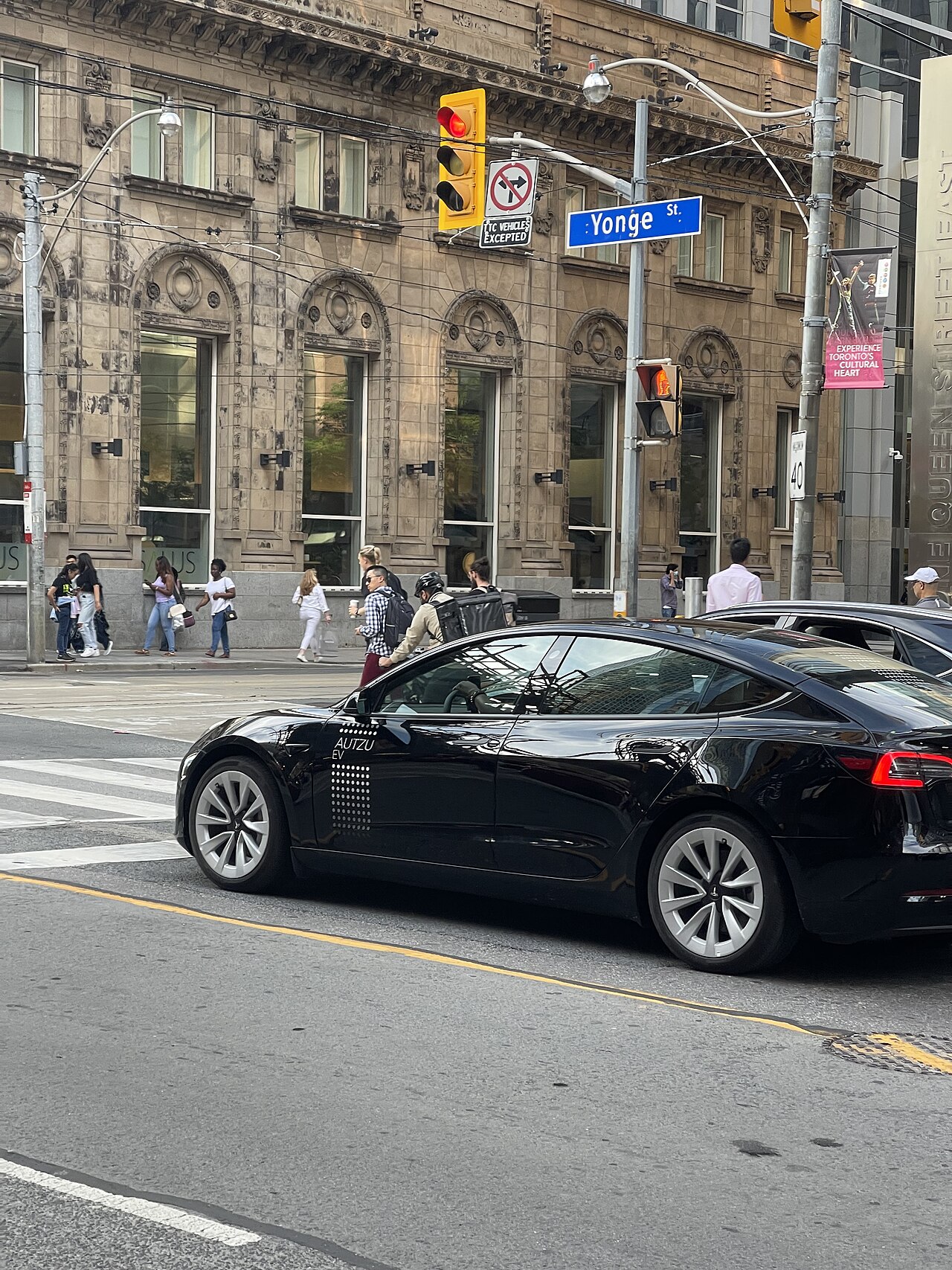
Image credit: “Autzu EV in Toronto” by Autzu-media, licensed CC BY-SA 4.0, via Wikimedia Commons.
About the author: Lifei Zhou
Model Y owner since 2022Ontario STO registered apprentice · 310SWorks on Porsche, Mercedes, BMW, Audi weeklyHundreds of readers referred (est.)
Lifei is a Tesla owner based in Canada, writing practical, fact-checked Tesla guides for US and Canadian drivers — buying, ownership, insurance, charging, and TSLA investing, all from first-hand experience.