
Does a Tesla Need a Wheel Alignment? Cost, Warning Signs and Inner Tire Wear (2026)
Does a Tesla Need a Wheel Alignment? Cost, Warning Signs and Inner Tire Wear (2026)

Yes, a Tesla needs a wheel alignment, but not on a fixed schedule. Get one when you put on a new set of tires, after a hard pothole or curb hit, or when you see uneven wear or an off-center steering wheel. Expect roughly US$100 to $200 at a good independent shop and noticeably more at a Tesla service center, and insist on the 150 lb seat ballast that Tesla’s own procedure calls for.
Disclosure: some links are affiliate/referral links (Tesla referral and Amazon). If you buy through them, we may earn a reward or commission at no extra cost to you. See our disclosure page.
Key facts (checked October 15, 2026)
- Tesla gives no fixed alignment interval. Its tire guidance recommends an alignment after a new set of tires, and rotation every 10,000 km (6,250 miles) or when tread depths differ by 2/32 in (1.5 mm).
- Tesla’s Model Y service manual calls for 68 kg (150 lb) of ballast in each front seat during the alignment. Many shops skip this step.
- Model 3 and Model Y have no dedicated camber or caster adjusters. On Structural Pack Model Y, front camber and caster are not adjustable at all.
- Factory rear camber on a non-Performance Model Y is -1.00° ± 1.0°, so a reading of -2.0° is still “in spec” and can still chew the inner shoulder.
- Independent four-wheel alignments are commonly quoted at about US$100 to $200. Owner-reported Tesla service center quotes run higher, often around US$270 to $340.
Alignment is one of those jobs that sounds optional until you flip a rear tire over and see the inner edge worn to the cords while the outer tread still looks new. That pattern is common enough on Model 3 and Model Y that it has its own forum threads. This guide covers when an alignment is worth paying for, what Tesla’s own spec sheet says, where to get it done in the US and Canada, and what to tell the technician so you don’t pay for an alignment that changes nothing.
📋 Contents
- When a Tesla Actually Needs an Alignment
- Warning Signs: Read Your Tires Before You Pay
- What Tesla’s Service Manual Says About Alignment
- Where to Get It Done and What It Costs
- Six Things to Tell the Shop Before They Start
- Inner Tire Wear and Adjustable Camber Arms
- Who Pays: Warranty, Insurance and Pothole Claims
- Frequently Asked Questions
- Summary
When a Tesla Actually Needs an Alignment
Tesla doesn’t publish a mileage interval for alignments. Its Tire Care and Maintenance guidance focuses on rotation: every 10,000 km (6,250 miles), or sooner if the tread depth difference between tires reaches 2/32 in (1.5 mm). The owner’s manual also recommends a wheel alignment after you install a new set of tires. Beyond that, alignment is condition-based. These are the situations where it pays off:
- New tires. A set of Tesla-size tires costs far more than an alignment. Aligning at install protects the investment from day one.
- A hard hit. A deep pothole, a curb strike while parking, or a chunk of debris on the highway can bend a link even if the car feels fine afterward.
- Suspension or steering parts replaced. Control arms, tie rods, toe links or bushings change the geometry. A proper shop includes the alignment on the work order.
- Lowering springs or aftermarket arms. Any ride-height change moves camber and toe.
- Visible symptoms. An off-center steering wheel, a pull to one side, or uneven wear, covered in the next section.
Seasonal wheel swaps are a different story. If your winter tires are mounted on their own wheels, swapping sets in October and April doesn’t change the alignment. It’s still a good moment to check tread depth on all three zones of each tire, and our Tesla winter tires guide covers sizes and dedicated wheel sets.
Book one
- You just bought a full set of new tires
- You hit a pothole or curb hard enough to flinch
- The steering wheel is off-center on a straight, flat road
- One shoulder of a tire is visibly lower than the other
- Suspension or steering parts were just replaced
Usually not needed
- Swapping winter and summer sets that are already on their own wheels
- A routine tire rotation with even wear
- A slight drift that disappears after setting tire pressures to the door placard
- Only because the app or a shop suggests it, with no symptoms and even wear
Based on Tesla’s tire care guidance and the condition-based approach described in this article.
Warning Signs: Read Your Tires Before You Pay
Before you book anything, set cold tire pressures to the placard in the driver’s door jamb. Low pressure can mimic a pull, and our Tesla tire pressure guide lists the right PSI by model. Then look at the tires themselves. Turn the steering wheel to full lock to see the fronts, and use your phone camera to look at the inside edge of the rears.
| What you see | Most likely cause | What to do |
|---|---|---|
| Inner edge feathered: smooth one way, sharp the other when you run your palm across it | Toe out of spec | Alignment, with toe set accurately under ballast |
| Smooth, even wear across just the inner shoulder | Negative camber | Check camber readings; rotate on schedule; consider adjustable arms if it keeps happening |
| Both shoulders worn, center fine | Underinflation | Fix pressures first, then re-check |
| Center worn faster than shoulders | Overinflation | Lower to placard pressure |
| Patchy, cupped or scalloped wear | Worn dampers, bushings or wheel balance | Inspect suspension and balance before aligning |
Whiteline, which sells suspension parts for Tesla, sums up the toe-versus-camber split well in its Model Y inner-edge wear article: feathered inner edges usually mean toe, while smooth wear across only the inner shoulder usually means camber. Toe is the more destructive of the two, because the tire is scrubbed sideways on every revolution.
For measuring, a cheap tread depth gauge beats the penny test because it reads in 32nds and lets you compare the inner, center and outer grooves. This GODESON two-pack of color-coded tread depth gauges is a simple option that fits in the glovebox, and it works on any car. Pair it with a reliable pressure gauge such as the AstroAI digital tire pressure gauge so you aren’t relying only on the TPMS reading. If the inner groove is 2/32 in or more below the outer groove on the same tire, you have uneven wear worth investigating.
What Tesla’s Service Manual Says About Alignment
Tesla publishes its service procedures, and the Model Y wheel alignment specifications answer a lot of forum arguments. Three details matter most for owners.
First, ballast. The procedure calls for 68 kg (150 lb) ballast bags on each front seat to simulate a driver and front passenger, and Tesla states that skipping them compromises the real-world accuracy of the adjustments. The spec sheet even lists separate “with ballast” and “without ballast” numbers, because the geometry changes as the body settles.
Second, adjustability. Model 3 and Model Y don’t have dedicated camber or caster adjustment points. Technicians set them by working within the play in the suspension mounts. On Structural Pack versions of Model Y, Tesla says front camber and caster are not adjustable at all. Toe, front and rear, is the main thing any shop can really dial in.
Third, the tolerance window is wide. Here are the factory camber targets for a coil-spring Model Y with ballast:
Scale 0 to -1.5°. Source: Tesla Model Y service manual, coil suspension, with 150 lb ballast per front seat. Front tolerance ±0.45°, rear ±1.0°.
Rear camber tolerance is ±1.0°. On a non-Performance Model Y, that means anything from 0° to -2.0° passes. A car at the edge of that range prints a green report and can still wear the inner shoulder faster than you’d like. Performance models start with more negative camber, which is one reason they go through rear tires sooner. Rear toe targets are IN 0.20° ± 0.15° with ballast, and front toe is OUT 0.05° ± 0.15°.
The procedure also tells you what a complete Tesla alignment looks like, step by step:
Summarized from Tesla’s published Model Y four-wheel alignment check and adjust procedure.
Step 6 is easy to miss at a general tire shop. After an alignment, if Autopilot or FSD (Supervised) seems to hold slightly off-center in the lane, many owners clear the camera calibration under Controls > Service > Camera Calibration and let the car recalibrate over the next stretch of driving. Some driver assistance features are limited until it finishes.
Where to Get It Done and What It Costs
Alignment pricing isn’t posted consistently, so treat these as ballpark figures and get a quote before you book. Tesla service center prices also vary by location.
| Option | Typical quote (US) | Pros | Watch out for |
|---|---|---|---|
| Tesla service center | Owner reports cluster around $270 to $340 | Follows Tesla’s procedure, ballast and Service Mode steps; knows the lift points | Highest price; appointments can be a week or two out |
| Independent alignment or tire shop | About $100 to $200 for four wheels | Best value when the tech has done plenty of Teslas | Quality varies; ask about ballast and Tesla specs |
| National chain lifetime alignment | One-time fee; check current coupons | Pays off if you keep the car and hit a lot of potholes | Add-on fees for ADAS-equipped cars; tech experience with Teslas varies |
Firestone is the best-known lifetime alignment in the US. Its October 2026 offer page advertises $40 off a lifetime alignment when you buy two or more Bridgestone or Firestone tires, and the fine print notes an additional $20 charge may apply to ADAS-equipped vehicles. Ask for an itemized quote so you know what the alignment itself costs.
In Canada, posted alignment prices are rare. Tire chains and independent shops typically quote in a similar numeric range in Canadian dollars, and Tesla service centers again sit at the top of the range. Call two shops and ask the questions in the next section before you choose.
My own route into all this is a bit unusual. I ordered my Model Y straight from tesla.com in January 2022 without a test drive, took delivery that November, and have driven it through four Toronto-area winters. In my spare time I work as a registered 310S apprentice (not yet licensed) at XIUCHE in Markham, a shop that mainly services Porsche, Mercedes, BMW and Audi. Tesla work there is limited to alignments and tires: no battery, motor, high-voltage or software work. If you’re in the GTA, come to the shop where I work for Tesla alignment and tires. It’s appointment only, call 437-214-5267. XIUCHE is the shop where I work, so I can stand behind the quality.
Six Things to Tell the Shop Before They Start
Most “I got an alignment and nothing changed” stories come down to communication. Bring this list:
- Confirm the exact model and year in the alignment database. Performance and non-Performance specs differ, and the refreshed Model Y should be selected correctly.
- Ask for ballast. 150 lb in each front seat, per Tesla’s procedure. If the shop has no ballast bags, ask how they account for it.
- Use the correct lift points. The battery pack runs under the floor, so the car must be lifted only at the designated points, ideally with jack pads. Our Tesla jack points guide shows where they are. If your shop doesn’t have pads, keep a set like these Chirano lifting jack pads in the trunk. The listing says they fit Model 3, S, X, Y and the refreshed Model Y; check your model year against the listing.
- Ask for the before-and-after printout. Green and red readings for every angle. Without it, you can’t tell what was actually adjusted.
- Don’t force camber. If rear camber is far outside spec, it points to a bent part or worn bushing. That needs a part, not a crowbar.
- Test drive before you pay. Make sure the steering wheel is level on a straight road. A toe adjustment made without the wheel locked level is a common reason for a return visit.
For owners fighting inner rear wear on a stock-height car, a common request is to set rear toe toward the low end of the factory range while staying in spec. Discuss it with the technician and keep the printout so you can compare wear at the next rotation.
Inner Tire Wear and Adjustable Camber Arms
Aftermarket adjustable rear camber and toe arms from brands like Whiteline, N2itive and Unplugged Performance replace fixed factory links so a shop can pull camber back toward zero. Whether you need them depends on how you use the car.
- Stock height, daily driving. Start with a ballasted alignment, accurate rear toe, correct pressures and rotation every 10,000 km. That’s enough for most owners.
- Lowered car, Performance model or larger wheels. Negative camber is higher and the factory range can’t compensate. Adjustable arms often pay for themselves over a set or two of tires.
- Stock height but rear tires still wear out early. Rule out worn bushings and bent links first. Then consider arms.
Keep the original parts if you modify the suspension, and use a shop that documents the work. Aftermarket parts don’t automatically void a warranty, but if a failure is traced to a modified part, coverage for the affected components can be refused. This is general information, not legal advice. Our Tesla tire replacement guide covers tire choices and costs if you’re replacing a worn set at the same time.
Who Pays: Warranty, Insurance and Pothole Claims
Plan on paying for alignments yourself. Routine alignment is normally treated as maintenance rather than a warranty repair. If the steering wheel is crooked or the car pulls from delivery day, report it in the Tesla app right away with the delivery date and mileage, and let the service center assess it. Tires themselves are generally covered by the tire maker’s warranty, not Tesla’s.
Pothole damage beyond a simple alignment, such as a cracked wheel or bent control arm, can go through collision coverage, minus your deductible. If the bill is smaller than the deductible, claiming makes little sense.
Some cities accept claims for pothole damage. In Toronto, the city’s pothole claims page says you must file within 10 days of the incident using the Claim Submission Web Form. Reporting the pothole to 311 is not a claim. Adjusters check whether the city met the provincial Minimum Maintenance Standards, and you need to show the damage was caused by the city’s negligence, so many claims are denied. Even so, CTV reported in April 2026 that Toronto paid out more than $500,000 for pothole vehicle repairs in 2025. Take photos of the pothole and damage and keep every receipt and estimate. The city’s claims inquiry line is 416-397-4212. For general tire safety information in the US, NHTSA’s tire safety page covers pressure, tread and inspection basics.
If you’re still shopping, remember that trim and wheel size drive long-term tire and alignment costs. Performance models and bigger wheels go through tires faster. When you’re ready to order, using a Tesla referral link gives new buyers 3 months of FSD (Supervised). It generally can’t be combined with the new-car FSD trial or other offers; Tesla confirms the final perk on your order.
Frequently Asked Questions
How often should a Tesla get a wheel alignment?
Tesla doesn’t set a fixed interval. Align after installing a new set of tires, after a hard pothole or curb hit, after suspension work, and whenever you see uneven wear or an off-center steering wheel. Checking once a year, ideally after pothole season, is a sensible habit.
How much does a Tesla alignment cost?
Independent shops commonly quote about US$100 to $200 for a four-wheel alignment. Owner-reported Tesla service center quotes are higher, often around US$270 to $340. Prices vary by city, so get a quote first.
Why are my Model Y rear tires wearing on the inside?
Usually a combination of negative rear camber and rear toe. Feathered wear points to toe, smooth shoulder wear to camber. Start with a ballasted alignment, correct pressures and regular rotation. If the car is lowered or the wear continues, look at adjustable arms or worn parts.
Can any tire shop align a Tesla?
Yes, if the shop has current Tesla specs in its alignment software, lifts the car only at the designated points, uses ballast, and gives you a before-and-after printout. Ask whether they align Teslas regularly before booking.
Do I need an alignment after swapping to winter tires?
Not if the winter tires are already mounted on their own wheels. Swapping complete wheel sets doesn’t change alignment. If new tires are being mounted on your wheels, that’s a good time to align.
Is a Tesla alignment covered under warranty?
Routine alignments are normally owner-paid maintenance. If the car pulls or the steering wheel is off-center right after delivery, report it through the Tesla app and let the service center decide.
Summary
- Align after new tires, hard impacts, suspension work, or visible uneven wear. There’s no fixed Tesla interval.
- Check pressures and read the wear pattern first: feathered edges point to toe, smooth shoulder wear to camber.
- Insist on 150 lb ballast per front seat, correct lift points and a before-and-after printout.
- Model 3 and Model Y have limited camber adjustment, and “in spec” rear camber can still wear inner shoulders.
- Independent shops are usually the best value. Tesla service centers cost more but follow the factory procedure.
- In Toronto, pothole claims must be filed within 10 days through the city’s web form.
Order with a referral link for 3 months of FSD (Supervised) →
More guides: Canada Tesla and US Tesla.
Pothole claim and warranty information is general and not legal advice. Check your own warranty terms and your city’s current rules.
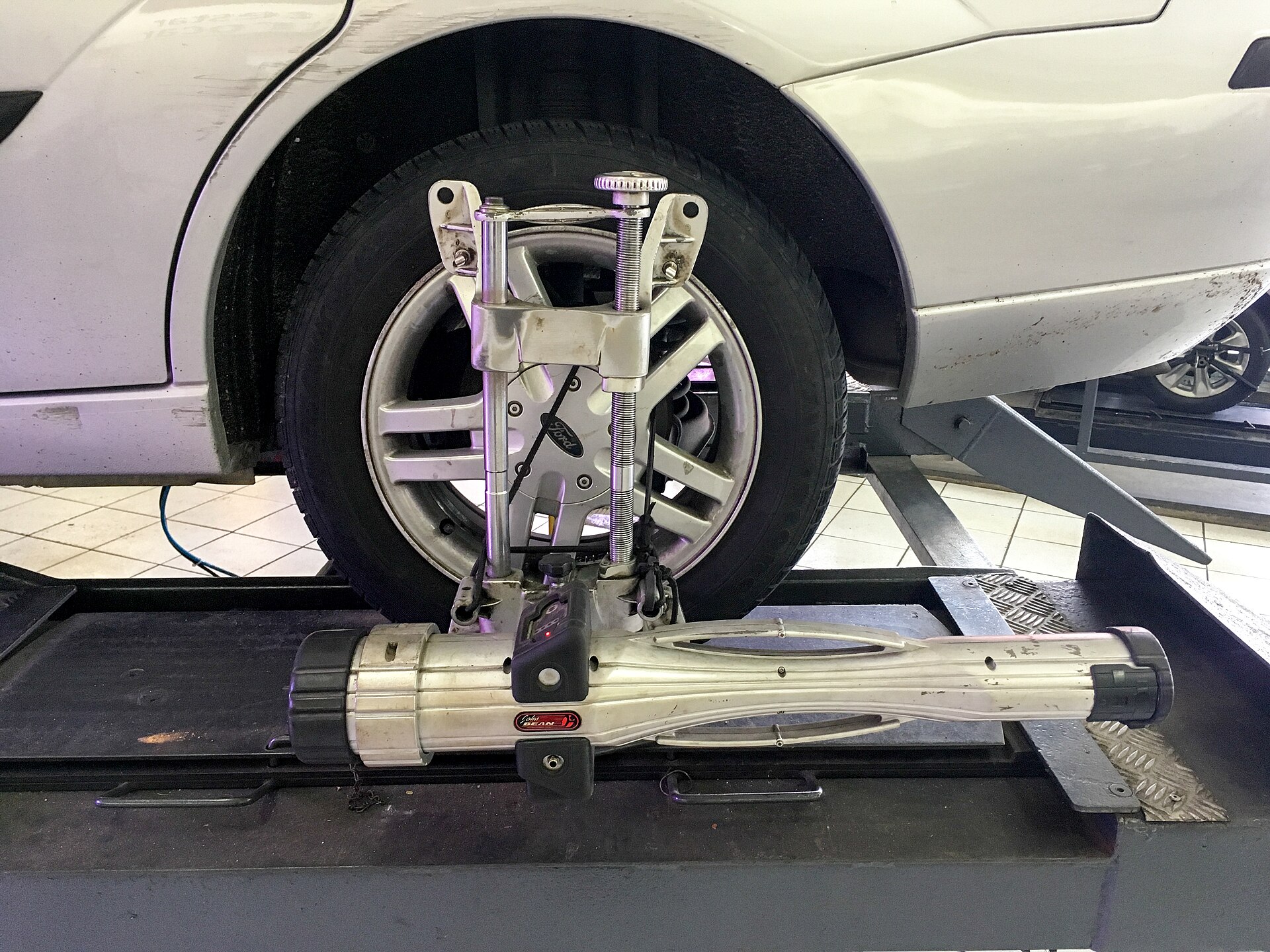
Image credit: “Wheel alignment on a Ford Focus 1” by Mike Peel (www.mikepeel.net), CC BY-SA 4.0, via Wikimedia Commons.
About the author: Lifei Zhou
Model Y owner since 2022Ontario STO registered apprentice · 310SWorks on Porsche, Mercedes, BMW, Audi weeklyHundreds of readers referred (est.)
Lifei is a Tesla owner based in Canada, writing practical, fact-checked Tesla guides for US and Canadian drivers — buying, ownership, insurance, charging, and TSLA investing, all from first-hand experience.