
How to Get a Tesla Unstuck From Snow (2026): Slip Start, Off-Road Assist and Who to Call
How to Get a Tesla Unstuck From Snow (2026): Slip Start, Off-Road Assist and Who to Call

To get a Tesla unstuck from snow, stop spinning the wheels, clear the snow from around all four tires and under the car, then turn on the wheel-slip setting under Controls > Dynamics and rock the car gently between Drive and Reverse. The setting is called Off-Road Assist on the current Model Y, Stuck Assist on the current Model 3, and Slip Start on older cars. If that doesn’t work after a few minutes, put something grippy under the drive wheels or call a tow truck, because Tesla Roadside Assistance does not cover pulling a car out of snow.
Disclosure: some links are affiliate/referral links, and we may earn a commission or referral credit at no extra cost to you. See our disclosure page.
Key facts (checked November 20, 2026)
- The wheel-slip setting lives under Controls > Dynamics: Off-Road Assist (current Model Y), Stuck Assist (current Model 3) or Slip Start (2020 to 2024 Model Y and other older cars).
- These settings stop traction control from cutting power when the wheels slip. Traction control comes back on by itself on your next drive.
- Tesla’s Roadside Assistance policy lists “extraction due to being stuck in mud, snow, sand or other soft surfaces” as not covered.
- CAA and AAA memberships generally do include winching if a truck can reach the car from the road.
- Only pull a Tesla by its screw-in tow eye, which is stored in the front trunk. Never by the suspension or the frame.
- A Tesla must never be towed with its wheels on the ground. Flatbed only.
I’ve driven my Model Y Long Range through four Toronto winters, and the car is good in snow on proper tires. I haven’t needed a tow out of a snowbank myself, so the steps below are built from Tesla’s owner’s manuals, Tesla’s roadside policy and Transport Canada’s winter guidance rather than from a rescue story of my own. For the wider cold-weather picture, see our Tesla winter driving guide.
📋 Contents
- Why a Tesla gets stuck in the first place
- Step 1: turn on the right setting (it has three different names)
- Step 2: the unstuck routine, in order
- Step 3: add traction under the drive wheels
- Who to call: Tesla Roadside doesn’t cover snow extraction
- If someone pulls you out: tow eye, Tow Mode and what can break
- Waiting for help in an EV
- How to not get stuck next time
- Frequently Asked Questions
- Summary
Why a Tesla gets stuck in the first place
A Tesla usually gets stuck for one of three reasons, and each one has a different fix.
- Traction control is doing its job too well. By default the car cuts motor power the instant a wheel slips. On a snowy driveway that can feel like the car refuses to move at all. The fix is a setting, covered in the next section.
- The tires have polished the snow into ice. Spinning wheels melt the snow under them, and it refreezes as a slick dish. More throttle makes the dish deeper. The fix is to stop, dig and add grip.
- The car is sitting on its belly. Tesla’s owner’s manual lists Model Y ground clearance at roughly 6 to 6.6 inches (151 to 167 mm) unladen depending on the version and market, and less with passengers and cargo. A Model 3 sits lower. When the snow under the flat battery floor is packed higher than that, the wheels carry less weight and can’t bite. The fix is a shovel, not a setting.
Step 1: turn on the right setting (it has three different names)
Tesla has renamed this feature several times, which is why forum advice is confusing. I read the current manuals for both cars on November 20, 2026. Here is what each one calls it.
Current Model Y
- Wheel spin
- Allowed
- Extra
- Balances front and rear motor torque
Current Model 3
- Wheel spin
- Allowed, at limited speed
- Extra
- Overridden by Track Mode
2020 to 2024 Model Y and older cars
- Wheel spin
- Allowed
- Extra
- Dual-motor cars also list Off-Road Assist
Names as shown in Tesla’s owner’s manuals on November 20, 2026. Software updates can move or rename them, so check your own Dynamics menu.
The current Model Y traction control page describes Off-Road Assist as allowing the wheels to spin while balancing torque between the front and rear motors, and says it helps on soft surfaces where one side of the car has grip and the other doesn’t. It also makes the accelerator more gradual, which is exactly what you want when easing out of a rut. The current Model 3 page says Stuck Assist is “designed to make it easier to dislodge Model 3 when stuck in mud, snow, ice”, and lists three uses: starting on a loose surface, driving in deep snow, sand or mud, and rocking out of a hole or deep rut. The 2020 to 2024 Model Y manual uses the older name, Slip Start, for the same job.
What about Slippery Surface?
Slippery Surface is a different tool. Tesla says it “distributes traction evenly across all tires” for rain, snow or ice. It is for driving on a slick road, not for getting out of a hole. If you are already stuck, pick the setting that lets the wheels spin.
Three things to know before you tap it
- The car shows an alert saying traction control is no longer preventing wheel slip. That is expected.
- On the Model Y, Automatic Emergency Braking and Lane Departure Avoidance do not operate while Off-Road Assist is on.
- These settings aren’t available while assisted driving features are active. Tesla strongly recommends turning the setting off once you’re free. If you forget, traction control re-enables on your next drive.
Step 2: the unstuck routine, in order
Work through these in order. Most stuck cars come out at step three or four.
How to rock an electric car
Rocking is easier in a Tesla than in a gas car because there is no transmission to hurt and the switch between Drive and Reverse is instant. Press the accelerator lightly until the car climbs a few inches, lift off before the wheels spin fast, let it roll back, select the other direction and repeat. You are packing a small runway and building momentum. If the car stops gaining ground after five or six swings, stop and go back to the shovel.
Keep steering inputs small while you do it. A straight track is the easiest one to climb.
What not to do
Do
- Clear snow from under the battery floor, not just around the tires
- Use light, steady throttle
- Put traction aids tight against the tread of the driven wheels
- Keep bystanders to the side, never behind or in front of a spinning wheel
- Turn the wheel-slip setting off once you’re out
Don’t
- Floor it. You’ll dig four holes and glaze them
- Let anyone hook a strap to a suspension arm, wheel or the rear bumper beam
- Let anyone tow the car down the road on its wheels
- Shovel hard in extreme cold if you have a heart condition
- Leave the car in a live lane to walk for help in a storm
The last two points come from Transport Canada’s winter trip planning page, which says to stay calm, stay inside the vehicle if it isn’t at risk of being hit, and avoid heavy lifting, shovelling or pushing in bitter cold. Its safe winter driving page also gives the generic version of step four: “If you get stuck, turn off your ESC.”
Step 3: add traction under the drive wheels
If rocking alone doesn’t work, the tires need something to bite. Transport Canada’s winter kit list includes a small shovel with a long handle, sand or kitty litter, and traction mats. Those three items solve most driveway and parking-lot situations.
Know which wheels to feed. A rear-wheel-drive Model 3 or Model Y drives the rear wheels only, so that is where the boards or sand go. On a dual-motor car, put them at whichever axle is spinning, usually the end sitting in the deeper snow.
Traction boards: the one tool that works alone
If you park on an unplowed street, have a steep driveway or drive to ski hills and cottages, a pair of real recovery boards is worth the money. The MAXTRAX MKII recovery boards are the well-known choice: fibre-reinforced nylon, 115 cm long and 33 cm wide per the listing, with moulded teeth that grip the tread. They cost roughly US$200 to $300 a pair. They are for the driver who gets stuck more than once a winter or who is often far from a tow truck. Measure your trunk before ordering, since 115 cm is long for a sedan.
For a car that mostly lives in the city, the budget alternative is a pair of X-BULL traction tracks at well under US$100. They do the same job for occasional use. Wedge either type hard against the front of the tire, teeth up, and drive onto them slowly. Spinning on a plastic board melts the teeth.
Pair the boards with a shovel that actually fits in the car. A collapsible aluminum one like the Overmont folding snow shovel (about US$20 to $30) breaks into three pieces, so it stows in a corner of the trunk. The rest of what I’d carry year-round is in our Tesla emergency kit guide.
Airing down: a last resort
Lowering tire pressure makes the contact patch longer and is a standard off-road trick. Tesla’s Cybertruck lead engineer included airing down in a list of stuck-in-snow tips he shared with owners, as Torque News reported. The Model 3 and Model Y manuals don’t suggest it, and you’ll get a tire pressure warning. Only do it if you can pump the tires back up on the spot before driving at speed. The inflator I use is the JOWUA 100W rechargeable one: it’s cordless, has a built-in battery, needs no 12V cable, has easy controls and is well made. It’s available from JOWUA here, and code TSLNA takes 5% off. JOWUA is a partner brand: orders with code TSLNA earn this site a commission.
Who to call: Tesla Roadside doesn’t cover snow extraction
This surprises a lot of owners. Tesla’s Roadside Assistance policy covers towing for warranty-related breakdowns, and its “What is not covered” list includes “extraction due to being stuck in mud, snow, sand or other soft surfaces”. It also excludes installing and removing snow chains. The policy says some services may be available for a fee with advance notice, so you can still ask through the Tesla app, but don’t expect it to be free. The policy also says Tesla won’t reimburse roadside help you arrange without its involvement.
An auto club membership is the cheaper safety net for this specific problem.
| Provider | Stuck in snow covered? | The fine print |
|---|---|---|
| Tesla Roadside Assistance | No | Extraction from mud, snow or sand is listed as not covered. Help may be offered at your cost. |
| CAA-Quebec | Yes, on Classic and above | Car must be safely reachable from a normally travelled road. Classic includes one service vehicle; Plus and Premier add a second for up to an hour. The entry CAA Go card doesn’t include it. |
| AAA (Mountain West club) | Yes, all plans | Car must be within 25 feet of a passable paved road. |
| Independent tow company | Pay per call | Ask for the winch-out price before the truck rolls, and say it’s an EV that needs a flatbed if it has to be moved. |
The auto club details come from CAA-Quebec’s roadside handbook and AAA’s winching page, both read on November 20, 2026. CAA and AAA are federations of regional clubs, and each club writes its own terms, so check yours before winter rather than from the snowbank.
If someone pulls you out: tow eye, Tow Mode and what can break
The Instructions for Transporters section of the Model Y manual is short and strict. Show it to whoever is hooking up. The manual is also on the car’s touchscreen under Controls > Service > Owner’s Manual.
- Use the tow eye only. Tesla says to pull the car only by a properly installed tow eye, and that using the chassis, frame or suspension components can cause damage. The tow eye is stored in the front trunk.
- Front socket: press firmly on the top right edge of the small cover in the front bumper until it pivots, then pull it out. Thread the tow eye in counter-clockwise until it’s tight.
- Rear socket: the cover releases from its bottom edge. Cars with a factory hitch receiver can’t use the rear tow eye. Tesla allows the hitch receiver to be used only to pull the car to a safe spot, such as onto a flatbed.
- Tow Mode: hold the brake and tap Controls > Service > Towing, then Enter Tow Mode. The car then rolls freely. It’s meant for winching onto a flatbed or repositioning at walking speed over a very short distance, about 10 metres in the manual I read.
- Never wheels-down. The motors generate power whenever the wheels turn. Tesla’s warning is in capitals: never transport the vehicle with the tires in a position where they can spin.
Tesla describes the tow eye for winching onto a truck, not for hard snatch recoveries. If a neighbour with a pickup offers a strap, keep it to a slow, steady, straight pull with the Tesla helping gently under its own power. No running starts. If the car is nose-down in a ditch or the pull would be at an angle, wait for a tow operator with a winch.
Waiting for help in an EV
This is the one part of being stuck where an electric car is easier. There is no engine running and no tailpipe to bury, so you can keep the heat on without worrying about exhaust. The cabin heat runs off the main battery, so a car with a decent charge can keep you warm while you wait. If the battery is low, turn the cabin temperature down and lean on the seat heaters to stretch it.
Turn on the hazard lights, keep your phone charging from the car, and follow Transport Canada’s advice to stay with the vehicle unless it’s at risk of being hit. If you’re in danger or blocking a live lane, call 911.
How to not get stuck next time
- Winter tires first. Transport Canada notes that all-season and summer tires begin to lose traction below 7°C (45°F). Tires matter more than drivetrain. Our winter tires guide covers sizes for Model 3 and Model Y.
- Back into snowy driveways and spots. Driving out forward along your own tracks is easier than reversing uphill through fresh snow.
- Don’t stop on the hill. Momentum is free traction. Pick a line and keep a steady, slow speed.
- Respect the belly. If the snow ridge left by the plow is taller than the gap under your car, shovel a path before you try to drive through it.
- Know where chains fit. For mountain passes, see our Tesla snow chains guide.
Drivetrain does matter at the margin. A dual-motor car has four driven wheels to find grip and gets Off-Road Assist’s torque balancing, and our Model Y RWD vs AWD winter comparison goes through when it’s worth paying for. I ordered my own Long Range straight from tesla.com without a test drive, and for a snowy Toronto driveway I’d pick dual motor again. If you’re ordering, new owners who use our Tesla referral link get 3 months of FSD (Supervised). It generally can’t be combined with the new-car FSD trial or other offers, and Tesla confirms the final perk on your order.
More cold-weather guides are in our Canada Tesla section.
Frequently Asked Questions
Does a Tesla have a snow mode?
Not by that name. Under Controls > Dynamics, current cars have Slippery Surface for driving on slick roads, plus a wheel-slip setting for getting unstuck: Off-Road Assist on the Model Y and Stuck Assist on the Model 3. Older cars call the wheel-slip setting Slip Start.
Where is Slip Start on a Tesla?
On older software it’s under Controls > Pedals & Steering or Controls > Dynamics. On current cars the name has changed. Look in Controls > Dynamics for Stuck Assist (Model 3) or Off-Road Assist (Model Y).
Will Tesla Roadside Assistance pull my car out of snow?
Not as a covered service. Tesla’s policy lists extraction from mud, snow, sand or other soft surfaces as not covered. Tesla may be able to arrange help at your cost. CAA, AAA and many insurer roadside plans do include winching when the car can be reached from the road.
Can another car tow a Tesla out with a strap?
A short, slow, straight pull using the screw-in tow eye is the limit. Don’t attach to the suspension, wheels or frame, don’t allow running-start yanks, and never let the car be towed down the road on its wheels. After it’s free, a Tesla drives away under its own power or goes on a flatbed.
Can I stay warm in a stuck Tesla?
Yes. There’s no exhaust, and the heat runs off the main battery, so watch your charge level and use the seat heaters if it’s low. Stay with the car unless it’s at risk of being hit, and call 911 if you’re in danger.
Summary
- Stop spinning, dig out all four tires and the snow under the floor, and straighten the wheels.
- Turn on Off-Road Assist (Model Y), Stuck Assist (Model 3) or Slip Start (older cars) under Controls > Dynamics, then rock gently.
- Add grip at the driven wheels with traction boards, sand or kitty litter.
- Tesla Roadside doesn’t cover snow extraction. A CAA or AAA membership usually does.
- Pull only by the tow eye, slowly and straight. Flatbed only if the car has to be moved.
- Winter tires and a small shovel prevent most of this.
Order a Tesla with 3 months of FSD (Supervised) for new owners →
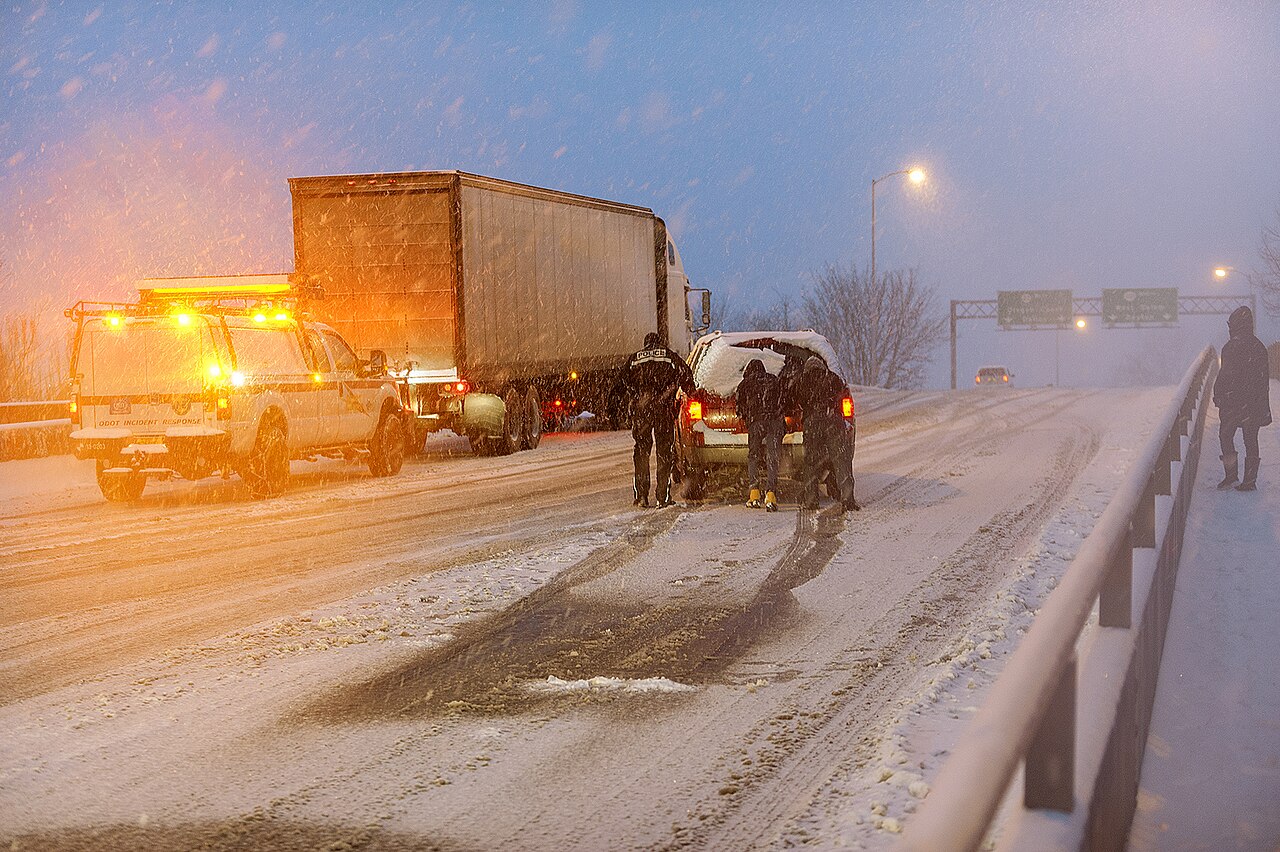
Image credit: “Lending a hand to a stuck car” by Oregon Department of Transportation, licensed CC BY 2.0, via Wikimedia Commons.
About the author: Lifei Zhou
Model Y owner since 2022Ontario STO registered apprentice · 310SWorks on Porsche, Mercedes, BMW, Audi weeklyHundreds of readers referred (est.)
Lifei is a Tesla owner based in Canada, writing practical, fact-checked Tesla guides for US and Canadian drivers — buying, ownership, insurance, charging, and TSLA investing, all from first-hand experience.