
Tesla Safety Ratings 2026: IIHS & NHTSA Crash Test Results for Model Y, Model 3 and Cybertruck
Tesla Safety Ratings 2026: IIHS & NHTSA Crash Test Results for Model Y, Model 3 and Cybertruck

In one sentence
2026 Tesla crash-test results: Model Y and Cybertruck earn IIHS Top Safety Pick+, Model 3 gets 5 NHTSA stars but no IIHS award. What it means in the US and Canada.
Tesla has a reputation for building very safe cars, and the 2026 crash-test results mostly back that up. Mostly. The Model Y and Cybertruck earned the top award from the Insurance Institute for Highway Safety (IIHS). The refreshed Model 3 picked up a five-star overall rating from NHTSA this month, but it did not get an IIHS award under the tougher 2026 rules. That gap matters if you regularly carry adults in the back seat.
This guide collects the current IIHS and NHTSA results for every Tesla you can buy new in the US and Canada. It explains what each test measures and why the Model 3 missed out. It also covers the safety details the star ratings leave out: seat-belt reminders, child-seat anchors, door releases and window glass. Everything below was checked against the official rating pages in late September 2026.
Disclosure: some links are affiliate/referral links. If you buy through them, we may earn a commission or referral credit at no extra cost to you. See our disclosure page.
📋 Contents
Tesla Safety Ratings at a Glance (September 2026)
The short version: all three current Teslas score five stars overall from NHTSA. The Model Y and Cybertruck are 2026 IIHS Top Safety Pick+ winners. The Model 3 has good results but no 2026 IIHS award.
| Model (years rated) | IIHS 2026 award | NHTSA overall | Weak spots |
|---|---|---|---|
| Model Y (2026–27) | Top Safety Pick+ | 5 stars; first vehicle to pass NHTSA’s four new driver-assist tests | Seat-belt reminders Marginal; LATCH Acceptable |
| Model 3 (2025–27) | No award | 5 stars (frontal, side, rollover) | Updated moderate overlap Acceptable; headlights Acceptable; belt reminders Marginal |
| Cybertruck (2026–27) | Top Safety Pick+ | 5 stars | Seat-belt reminders Marginal; LATCH Acceptable |
| Model S / Model X | Discontinued in 2026 | Check the rating for the specific model year | Used only. Results vary by year and test protocol |
Two quick notes on the table. IIHS ratings are published by model year, so an award for the 2026–27 Model Y says nothing about a 2022 Model Y on a used lot. And NHTSA and IIHS run different tests, so a car can ace one and fall short in the other, as the Model 3 shows.
IIHS vs NHTSA: What Each Rating Actually Measures
People often treat “5-star” and “Top Safety Pick” as the same thing. They aren’t, and knowing the difference helps you read the results.
NHTSA 5-Star Safety Ratings (government)
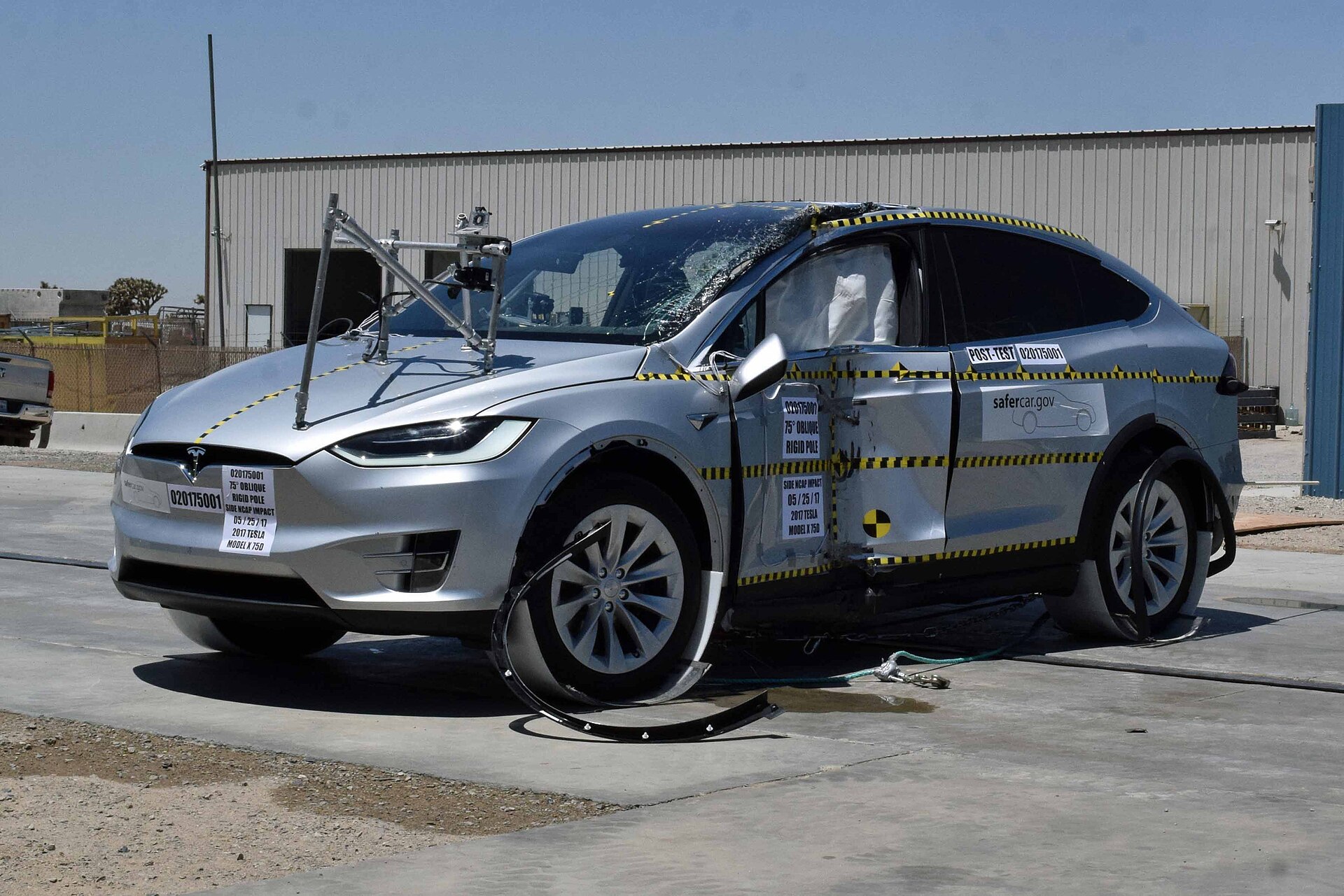
NHTSA’s New Car Assessment Program is run by the US government. It crashes cars in a full-width frontal test, a side barrier test and a side pole test, and it estimates rollover risk from how the vehicle is built. The results roll up into a single overall score from one to five stars. Since the 2026 model year, NHTSA also checks four driver-assist systems on a pass/fail basis: pedestrian automatic emergency braking, lane keeping assistance, blind spot warning and blind spot intervention. Those checks don’t change the star count, but they show up on the NHTSA ratings page for each vehicle.
IIHS Top Safety Pick and Top Safety Pick+ (insurance industry)
IIHS is funded by auto insurers, and its tests are usually tougher and change more often. For 2026, both awards require a Good rating in three crash tests: the small overlap front test (which hits just the corner of the car), the updated moderate overlap front test, and the updated side test. The updated side test uses a heavier barrier moving at higher speed, roughly like being hit by a modern midsize SUV. The updated moderate overlap test places a small dummy in the rear seat, and that dummy is where many popular cars lose points.
To get the “+”, a vehicle also needs acceptable or good standard headlights, strong pedestrian crash prevention, and an Acceptable or Good score in the newer vehicle-to-vehicle front crash prevention test. The full criteria are on the IIHS Top Safety Picks page.
In practice, NHTSA stars tell you whether the car protects people in standard crashes. The IIHS award tells you whether it also protects rear passengers, handles corner impacts and comes standard with good crash-avoidance tech.
Model-by-Model Breakdown
Model Y (2026–27): the one to beat
The redesigned Model Y (the “Juniper” refresh) is rated Good in every IIHS crash test: small overlap, updated moderate overlap and updated side. Both headlight versions rated Good, the one on Premium/Performance trims and the simpler one on the Standard trim. Both front crash prevention tests (vehicle-to-vehicle and pedestrian) also came back Good, which earned it Top Safety Pick+. The IIHS Model Y rating page lists the 2026–27 model years. Model Y has now held the TSP+ award across several consecutive model years.
On the NHTSA side, the 2026 Model Y scored five stars overall and five in every category. In May 2026 it became the first vehicle to pass all four of NHTSA’s new driver-assist tests (for vehicles built after November 12, 2025). If crash safety is your top priority for a family vehicle, this is the strongest Tesla on paper.
If a Model Y is on your list, ordering through a Tesla referral link adds three months of FSD (Supervised), which generally doesn’t stack with the new-car trial (Tesla confirms the final perk on your order). The car and the price are the same either way.
Model 3 (2025–27): five stars, but no 2026 IIHS award
The Model 3 is a good example of why you should look at the individual test scores, not just the headline. NHTSA gives the 2026 Model 3 five stars in frontal, side and rollover, on both RWD and AWD. It also has all ten driver-assist technologies NHTSA currently recommends. Euro NCAP gave the same generation five stars in 2025 and named it Best in Class for large family cars.
IIHS scored it lower. On the 2026 Model 3 page, the updated moderate overlap test is Acceptable, not Good, and that alone rules out both 2026 awards. The headlights are also Acceptable. Small overlap, the updated side test and both front crash prevention tests are Good.
What this means for you: the Model 3 protects front-seat occupants very well. The Acceptable score comes from the rear-seat dummy in the moderate overlap test. That’s a problem many sedans have and IIHS only started testing for recently. If you drive alone or with one passenger, it barely matters. If you’ll often have adults or teens in the back, the Model Y’s all-Good result is a real advantage. In Canada, the Model 3 also starts well below the Model Y (Premium RWD at C$39,490 vs. Model Y RWD at C$49,990 before incentives), so you’re trading some rear-seat protection for a lower price.
Cybertruck (2026–27): TSP+ despite the unusual design
People doubted the Cybertruck’s stainless exoskeleton and unusual shape, but the crash tests turned out well. IIHS rates the 2026–27 Cybertruck Good in all three crash tests, Good for headlights and Good in both front crash prevention tests, which earns Top Safety Pick+. IIHS notes that Tesla changed the front underbody and footwell structure starting with April 2025 production, so a 2024 build may not match these results. NHTSA gave the truck five stars overall, with five-star driver and passenger scores.
One caveat: crash tests measure what happens to the people inside the vehicle. They don’t measure how a 6,600-plus-lb truck with a sharp front end affects pedestrians or smaller cars. The Cybertruck has passed the required regulations, but think about that if you drive mostly in dense urban areas.
Model S and Model X: used buyers only
Tesla ended production of the S and X in 2026, and new inventory is essentially gone. If you’re shopping for one used, look up the exact model year on both IIHS and NHTSA. Older results were earned under easier test protocols, so a 2019 score doesn’t compare directly with a 2026 one. Our used Tesla buying guide covers the other checks worth doing, including battery health, open recalls and the warranty that transfers.
What Canadian Buyers Should Know
Canada doesn’t publish its own star ratings. Transport Canada enforces the Canada Motor Vehicle Safety Standards (CMVSS), and every Tesla sold here must certify compliance. For comparative ratings, Canadian buyers use the same IIHS and NHTSA results Americans do.
There’s one detail worth knowing. Canadian Model Y inventory comes from Giga Berlin, and the current Canadian Model 3 comes from Shanghai. The US tests were done on American-built cars. The body structure, airbags and software are the same design, so the results carry over in practice. If you want a second opinion on the exact factory output, Euro NCAP tests cars built in Berlin and Shanghai, and both the current Model 3 and Model Y received five stars there in 2025.
Safety ratings also feed into insurance in a roundabout way. Insurers look at claims history and repair costs more than crash-test stars, which is why Teslas can still be expensive to insure in Ontario even with top ratings. Our Tesla insurance guide for Canada breaks down typical premiums by province.
Safety Details the Star Ratings Don’t Show
These are the smaller results that don’t make headlines, plus a few things every owner should know about their car.
Seat-belt reminders are rated Marginal on all three models
IIHS rates the belt reminders on the Model Y, Model 3 and Cybertruck as Marginal. The front-row chime doesn’t last long enough (IIHS wants at least 90 seconds), and on the Model 3 and Model Y the rear reminder doesn’t meet IIHS timing requirements. The fix costs nothing: make buckling up a habit for everyone, and glance at the seat-occupancy icons on the touchscreen before you pull out.
Child-seat anchors: two full LATCH positions, not three
The Model 3 and Model Y have full LATCH hardware in the two outboard rear seats. The center seat has only a top tether, so for a center installation you’d use the seat belt plus the tether. The Cybertruck has LATCH anchors in all three rear positions, though IIHS notes some are harder to reach. All three get an overall Acceptable. If you’re installing a convertible seat, one that installs easily with either LATCH or the belt, like the Graco 4Ever DLX SnugLock (typically in the $250–$350 range), is simpler to get right in a Tesla’s firm rear bench. Our Tesla car seat guide goes seat by seat.
Know your manual door releases before you need them
Tesla doors open electronically. If the 12V system loses power after a crash, the button on the door won’t work. Every Tesla has a mechanical release inside the cabin. On the front doors of the Model 3 and Model Y it’s a lever just ahead of the window switches. Rear-door releases vary by model and year, and some are hidden under the door-pocket mat. Find yours in the owner’s manual under “Opening doors without power,” then show everyone who regularly rides with you, kids included.
This is an active regulatory issue. On July 23, 2026, NHTSA started a rulemaking process for federal standards requiring “reliable and readily apparent” door escape systems. In the same decision it declined a separate petition seeking a defect investigation into the 2022 Model 3 releases, saying the issue belongs in the rulemaking. Tesla design chief Franz von Holzhausen has confirmed a redesigned door handle, which reports expect in production around late 2026 or early 2027. Treat that timing as reported, not official.
Laminated glass changes the escape-tool advice
Recent Model 3 and Model Y builds use laminated acoustic glass in at least the front side windows. It’s quieter and harder to break into, but a spring-loaded window punch won’t shatter it the way it shatters tempered glass. Look for the small label in the corner of each window. Knowing which ones say “tempered” tells you which window to use as an exit. A keychain tool like the resqme (usually under $20) is still worth having for the seatbelt cutter alone. Just don’t count on it to break every window.
Loose objects and phones
Crash tests use empty cabins. Real cabins have water bottles, sunglasses and phones that fly forward in a hard stop. Put small items in closed storage and keep the phone in a mount instead of your hand or lap. JOWUA’s center console set for the 2025+ Model Y (Premium, Performance and Model Y L; not the Standard trim) and its MagSafe vent mount for the Highland/Juniper cars are two tidy options. Use code TSLNA for 5% off at checkout.
Driver assistance is not part of the crash score
FSD (Supervised) and Autopilot don’t change any IIHS or NHTSA crash rating, and neither makes the car drive itself. The standard safety features that do count, such as automatic emergency braking, lane departure avoidance and blind spot warning, work whether or not you subscribe to FSD. For what the different hardware generations can do, see our HW3 vs HW4 guide.
A 10-Minute Safety Setup for New Tesla Owners
Crash ratings describe the car as it left the factory. These steps help it perform that way in real driving:
- Check tire pressure against the door-jamb placard monthly. Grip and braking depend on it, and Teslas are heavy. Keep a Slime tire repair kit in the trunk, since no current Tesla comes with a spare.
- Leave Automatic Emergency Braking and Forward Collision Warning on (Controls → Autopilot). Set the warning to “Early” or “Medium,” not “Off.”
- Set up driver profiles so seat, mirror and steering positions are right for each driver. A poorly adjusted seat reduces how well the airbags and belts protect you.
- Show every regular passenger the manual door release.
- Run your VIN through NHTSA’s recall lookup once a year. Most Tesla recalls are fixed over the air, but some need a service visit.
- Put together a small emergency kit for winter or long highway drives. Our Tesla emergency roadside kit guide lists what’s actually useful.
If you drive rural Canadian highways, the Trans-Canada north of Superior or long stretches of BC and Northern Ontario, keep in mind that Tesla’s built-in LTE and your phone may both lose signal for hours. Some owners carry a Starlink Mini for those stretches so they can still call for help or check road conditions. If that sounds like your driving, this Starlink referral link works for Canadian orders (it isn’t valid in the US). Our other Starlink articles cover powering it from the car.
Frequently Asked Questions
Is the Tesla Model Y a Top Safety Pick+ in 2026?
Yes. The 2026–27 Model Y earned IIHS Top Safety Pick+, with Good ratings in all three crash tests, both headlight versions and both front crash prevention tests. It also has a five-star overall rating from NHTSA.
Why didn’t the 2026 Model 3 get an IIHS award?
It scored Acceptable instead of Good in IIHS’s updated moderate overlap front test, which includes a rear-seat dummy. Both 2026 awards require Good in that test. The Model 3’s other crash results are Good, and it has a five-star overall NHTSA rating.
Is the Cybertruck safe in a crash?
For the people inside, yes. The 2026–27 Cybertruck is an IIHS Top Safety Pick+ and has a five-star NHTSA overall rating. Structural updates began with April 2025 production, so early 2024 builds may not match the current results.
Do Canadian Teslas have the same safety ratings as US models?
Canada has no separate star-rating program, so the IIHS and NHTSA results are the reference. Canadian Model Y (Berlin) and Model 3 (Shanghai) share the same design as the US-tested cars, and both also earned five stars from Euro NCAP.
How do I open a Tesla door if the power is out?
Use the mechanical release inside the cabin. On the Model 3 and Model Y front doors, it’s a lever in front of the window switches. Rear releases vary by model and year. Check the owner’s manual section on opening doors without power.
Do good crash-test ratings lower my insurance?
Only a little, if at all. Insurers weigh repair costs, claim frequency and theft rates more heavily. That’s why Teslas can still cost more to insure than their safety ratings would suggest. Getting quotes before you order is the only reliable way to know.
Does FSD (Supervised) affect the safety rating?
No. IIHS and NHTSA crash and crash-avoidance ratings are based on standard equipment. FSD is an optional subscription and requires an attentive driver at all times.
Summary
- Model Y (2026–27): IIHS Top Safety Pick+ and NHTSA five stars. The strongest overall safety record in Tesla’s lineup, and the first vehicle to pass NHTSA’s four new driver-assist tests.
- Model 3 (2025–27): NHTSA five stars and Euro NCAP Best in Class, but no 2026 IIHS award because of an Acceptable score in the rear-seat-focused moderate overlap test.
- Cybertruck (2026–27): IIHS Top Safety Pick+ and NHTSA five stars. Prefer builds from April 2025 onward.
- All three models: seat-belt reminders rated Marginal, and learn the manual door release on day one.
- Canadian buyers rely on the same IIHS/NHTSA data, and Euro NCAP confirms the Berlin- and Shanghai-built cars.
- Ready to order? A Tesla referral link gets you three months of FSD (Supervised) on a new Model 3, Model Y or Cybertruck.
Ratings reflect the IIHS and NHTSA websites and published coverage as of September 26, 2026. IIHS updates its criteria every year and ratings apply only to the model years listed, so check the official pages before you buy. This article is general information, not professional safety or legal advice. Some links are affiliate or referral links. See our disclosure page. More US buying advice in our US Tesla section. Image credit: 2017 Tesla Model X side pole test by Karco Engineering / NHTSA, public domain (US government work), via Wikimedia Commons.
About the author: Lifei Zhou
Model Y owner since 2022Ontario STO registered apprentice · 310SWorks on Porsche, Mercedes, BMW, Audi weeklyHundreds of readers referred (est.)
Lifei is a Tesla owner based in Canada, writing practical, fact-checked Tesla guides for US and Canadian drivers — buying, ownership, insurance, charging, and TSLA investing, all from first-hand experience.