
Tesla Family Car Guide 2026: Car Seats, LATCH & Road-Tripping With Kids (US & Canada)
Tesla Family Car Guide 2026: Car Seats, LATCH & Road-Tripping With Kids (US & Canada)

In one sentence
How many car seats fit in a Model 3, Model Y, Model Y L and Model X, where the LATCH anchors are, 2026 US/Canada car-seat stages, and the family gear worth buying.
If you are shopping for a family car in 2026, a Tesla probably keeps showing up on your list — and the questions that follow are always the same. Will two or three car seats actually fit? Are the LATCH anchors easy to reach? Is the glass roof going to cook the kids in the back on a July afternoon? And is the whole thing worth the money once you factor in charging on a road trip? This guide answers all of that for North American parents, with real numbers for the Model 3, Model Y, the new six-seat Model Y L, and the Model X.
We will cover where the anchors live, how many seats fit across each model, the 2026 car-seat stages under NHTSA in the U.S. and Transport Canada up north, the accessories that genuinely earn their place, and the family-friendly software tricks most owners never turn on. Let’s get the interior sorted.
Disclosure: some links are affiliate/referral links, meaning we may earn a commission at no extra cost to you if you buy through them. See our disclosure page.
📋 Contents
- Is a Tesla a Good Family Car? The Honest Answer
- Where the Car Seat Anchors Are: LATCH, ISOFIX and Top Tethers
- How Many Car Seats Fit — Model 3, Model Y, Model Y L and Model X
- Car Seat Stages for 2026: US (NHTSA) vs Canada (Transport Canada)
- Choosing a Car Seat That Actually Works in a Tesla
- Kid-Proofing the Interior: Kick Mats, Sunshades and Cleanup
- Road-Tripping With Kids in a Tesla: Charging, Camp Mode and Screen Time
- Family-Friendly Tesla Features Worth Knowing
- Buying a Tesla for Your Family? A Note on the Referral Perk
- Frequently Asked Questions
- The Bottom Line
Is a Tesla a Good Family Car? The Honest Answer
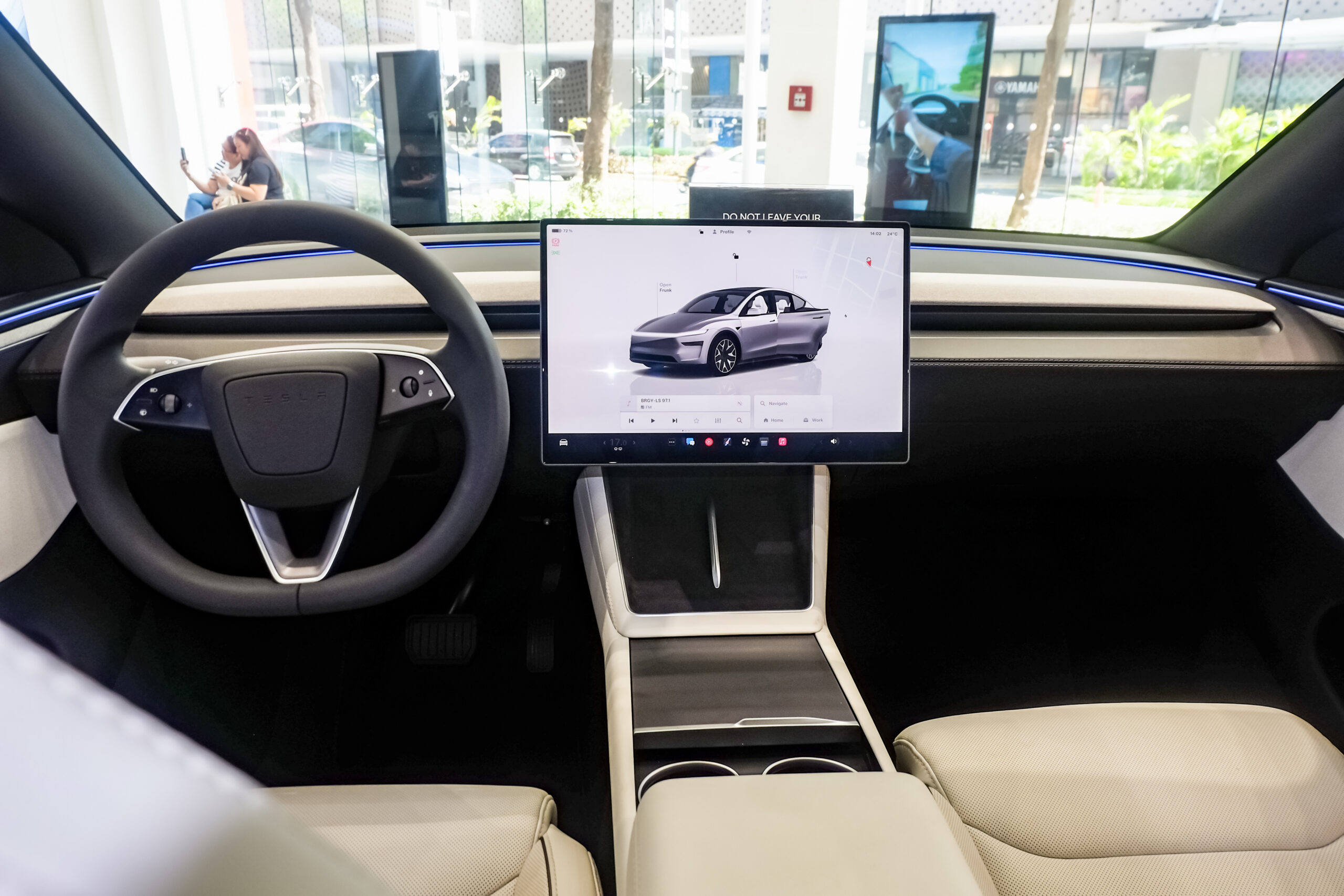
For most families, yes — with a couple of caveats worth knowing before you sign. The strengths are real. The rear floor in the Model 3 and Model Y is completely flat, with no transmission hump, so a center passenger or a third seat has somewhere to put their feet. The seats are upright and the door openings are wide, which makes wrestling a rear-facing infant seat in and out far less of a back workout than in a low sedan. There is a huge frunk plus a deep underfloor trunk for the stroller, and the ride is quiet enough that a napping toddler tends to stay asleep.
The caveats: the Model 3’s sloping roofline eats a little headroom for tall forward-facing seats, and its lower trunk opening is a hatch-less sedan lip, so a bulky stroller can be awkward. The Model Y is the sweet spot for most families — SUV height, a big liftgate, and enough width to make three-across a genuine possibility. And if you have three or more kids in seats, the new Model Y L (six seats, 2+2+2) and the Model X (up to seven) open up captain’s-chair layouts that make daily buckling dramatically easier.
One thing to set expectations on: Tesla does not sell a built-in booster or an integrated child seat in North America, so everything below assumes you are bringing your own seats.
Where the Car Seat Anchors Are: LATCH, ISOFIX and Top Tethers
Every Tesla sold in the U.S. and Canada uses the LATCH system (Lower Anchors and Tethers for Children — the same hardware Europe calls ISOFIX for the lower bars). Knowing exactly where they sit saves a lot of fumbling on install day.
- Lower anchors: Model 3 and Model Y provide lower LATCH anchors in the two outboard rear seats. They are the gap-style type — you reach into the crease between the seat cushion and seatback to clip on. The center rear position does not have its own lower anchors, so a seat there must be installed with the seat belt.
- Top tethers: all three rear seats have top-tether anchor points on the back of the seatbacks (accessed from the trunk area). Use the top tether for every forward-facing install — LATCH or belt.
- Model Y L and Model X: the second-row captain’s chairs carry lower anchors and tethers; check the owner’s manual for the exact third-row provisions on your build.
A couple of rules that trip parents up. Do not use LATCH lower anchors and the seat belt at the same time in one position — pick one. And per Tesla’s own guidance, disconnect the LATCH connectors before installing a backless or high-back booster; boosters are designed to be held by the vehicle belt, not the lower anchors. When in doubt, the definitive source is the Model Y owner’s manual child-restraint section and your seat manufacturer’s manual — read both.
How Many Car Seats Fit — Model 3, Model Y, Model Y L and Model X
The honest answer is “it depends on the seats,” because car-seat width varies wildly. But here is a realistic 2026 guide based on typical mainstream seats and real-world owner reports.
| Model | Seats / rows | Two seats? | Three across? |
|---|---|---|---|
| Model 3 | 5 (2 rows) | Easy on the outboard anchors | Only with narrow seats; tight |
| Model Y (5-seat) | 5 (2 rows) | Easy, roomy | Possible with slim seats — the flat floor helps |
| Model Y L | 6 (3 rows, 2+2+2) | Very easy — captain’s chairs | Spread across rows 2 and 3 |
| Model X | 6 or 7 (3 rows) | Very easy | Yes, across rows 2 and 3 |
Two big-picture takeaways. First, a five-seat Model Y can do three-across, but only if you choose deliberately narrow seats — measure before you buy, and expect the front passenger to give up some legroom for a rear-facing seat behind them. Second, if three-across is a hard requirement for your family, the six-seat Model Y L or a Model X removes the puzzle entirely by giving each kid their own captain’s chair, with a walk-through aisle that makes buckling a squirming toddler far less of a fight. For a deeper look at the L’s dimensions and pricing, see our Model Y L guide, and our full Model Y buying guide for the standard five-seat trims.
Car Seat Stages for 2026: US (NHTSA) vs Canada (Transport Canada)
The guidance on both sides of the border lands in the same place: keep your child in each stage as long as they fit the seat’s height and weight limits, not until they age out. The framing differs slightly, so here is a clean comparison for 2026.
| Stage | United States (NHTSA) | Canada (Transport Canada) |
|---|---|---|
| Rear-facing | Birth until the seat’s rear-facing limits — often age 3–4+ | Keep rear-facing to at least age 2; longer if they still fit |
| Forward-facing harness | Roughly ages 4–7, to the harness height/weight max | After rear-facing and at least 10 kg (22 lb), to the seat’s max |
| Booster | Roughly ages 8–12, until the belt fits correctly | From at least 18 kg (40 lb) until the belt fits |
| Seat belt only | When belt sits low on the hips and mid-shoulder — often 4’9″ | Usually ~9 years or 145 cm, per your province’s law |
Because Canadian rules are set province by province, the exact booster age and height cutoffs vary — Ontario, Quebec and B.C. each phrase Stage 4 a little differently. Always confirm against the official pages: the NHTSA car seats hub for the U.S. and Transport Canada’s child car seat safety pages for Canada. For independent crash-test ratings on which boosters provide good belt fit, the IIHS booster ratings are the gold standard.
Choosing a Car Seat That Actually Works in a Tesla
Tesla’s flat rear floor and upright bench are forgiving, but two things still matter: the seat’s footprint (narrow is your friend if you want three-across) and how long it stays useful before you are shopping again. For a lot of families, an all-in-one convertible that spans rear-facing through booster is the least-hassle answer — you install it once and it grows with the child instead of forcing two or three separate purchases.
A dependable pick in that category is the Graco 4Ever DLX 4-in-1 (expect a mid-hundreds price range in the U.S.). It converts from rear-facing harness to forward-facing harness to high-back booster to backless booster, so a single seat can cover roughly ages zero through ten. It clicks onto the Model 3 and Model Y outboard LATCH anchors without drama, and its moderate width leaves a fighting chance at fitting a second seat beside it. Whatever seat you choose, do a real installation test in your own car before the return window closes — fit is specific to both the seat and your trim.
Two practical notes for Tesla owners specifically. First, if you go rear-facing behind the front passenger, that passenger seat usually has to slide forward — fine for shorter adults, tight for tall ones. Second, the front passenger seat is the only place in a Tesla with a passenger airbag, so no rear-facing seat goes up front, ever.
Kid-Proofing the Interior: Kick Mats, Sunshades and Cleanup
Tesla’s light-colored vegan-leather interiors look fantastic and show every muddy shoe print, juice spill and cracker crumb within a week of family life. A little prep keeps resale value intact and your weekends free of scrubbing.
- Seatback protectors. Kids kick — it’s physics. A pair of Lusso Gear kick mats (budget price range) covers the back of the front seats and, on white interiors, prevents scuff marks you can’t fully clean off. Many include a tablet holder that doubles as screen-time real estate on long drives.
- Roof and window shade. The glass roof is beautiful and, on a sunny day, warm — babies and toddlers feel it most. A BASENOR foldable sunshade (low price range) knocks down glare and heat before the A/C catches up, which also means less battery spent on cooling.
- Floor and trunk protection. Stock carpet mats are the first casualty of family duty. A set of 3W all-weather floor mats (moderate price range) with raised lips catches slush, sand and spilled snacks, and hoses clean in the driveway. Pair them with a matching cargo liner for stroller-and-diaper-bag duty. Our Tesla floor mats and interior protection guide breaks down fitment across Highland, Juniper and the older trims.
None of this is mandatory, but together it costs less than one detailing appointment and saves you many. Keep a small microfiber cloth in the door pocket for touchscreen fingerprints — kids leave a lot of those too.
Road-Tripping With Kids in a Tesla: Charging, Camp Mode and Screen Time
Road trips are where an EV changes the rhythm of family travel — and mostly for the better. You will stop every couple of hours to charge for 15–25 minutes, which happens to line up almost perfectly with bathroom breaks, diaper changes and letting toddlers burn off energy. The Trip Planner builds Supercharger stops into your route automatically, so you are never guessing.
Three features are worth setting up before you leave:
- Camp Mode keeps climate control, the screen and USB power running while parked, at a slow, quiet battery drain — ideal for a roadside nap or waiting out a downpour without idling an engine. Our Camp Mode guide walks through the settings.
- Rear entertainment. On a charging stop, the main screen streams Netflix, Disney+ and YouTube (parked only), and Model Y L and refreshed cars offer a rear screen. A tablet on a kick-mat holder is the low-tech backup that never buffers on a dead-zone highway.
- Charging pace. Plan for real-world range that runs 15–25% below the EPA number in winter or at highway speeds with a full load. Build in a buffer, and read our Tesla summer road trip guide for a full packing-and-charging checklist.
One underrated perk: preconditioning. From the app, you can warm or cool the cabin before you carry a sleeping kid out to the car, so nobody gets buckled into a freezing or blazing seat.
Family-Friendly Tesla Features Worth Knowing
Beyond car seats, a few built-in features make daily parenting life easier once you know they exist:
- Child locks. Enable rear door and window child locks from the touchscreen (Controls → Locks) so little hands can’t pop a door at a red light.
- Dog Mode / Cabin overheat protection. Cabin Overheat Protection keeps the interior from becoming dangerous on hot days — useful peace of mind, though a child should never be left unattended regardless.
- Sentry Mode records around the car in parking lots — handy documentation if someone dings your door while you’re wrangling kids and groceries.
- Driver profiles. Save seat, mirror and climate presets per parent so the car snaps to your setup the moment you sit down — one less thing to fiddle with while a toddler melts down in the back.
- PIN to Drive. A four-digit code stops an older kid (or anyone) from moving the car unexpectedly.
Buying a Tesla for Your Family? A Note on the Referral Perk
If this guide has you ready to order, there’s an easy way to start ownership with a bonus. When you place a new Model 3, Model Y (including the Model Y L) or Cybertruck order through a Tesla referral link, you currently get three months of free Full Self-Driving (Supervised) — worth roughly $297 — though it generally can’t be combined with the standard 30-day trial. For a family test-driving FSD on daycare runs and road trips, that’s a genuinely useful window at no cost.
It costs you nothing extra and takes one tap before you configure. If you’d like to understand how Tesla’s referral program works in more detail, we break it down in our Tesla referral code guide, and you can browse more setup tips in our US Tesla section. When you’re ready, order through the referral link to lock in the free FSD (Supervised) months.
Frequently Asked Questions
Can you fit three car seats across in a Tesla Model Y?
Yes, but only with deliberately narrow seats. The Model Y’s flat rear floor and reasonable width make three-across possible where many sedans can’t, but standard-width convertible seats will be a very tight squeeze or won’t work. Measure your seats’ widths, aim for slim models, and if three-across is non-negotiable, the six-seat Model Y L or a Model X removes the problem by spreading kids across two rows.
Where are the LATCH anchors in a Tesla Model 3 and Model Y?
Both have lower LATCH anchors in the two outboard rear seats, accessed through the gap between the seat cushion and seatback. All three rear positions have top-tether anchors on the seatbacks, reached from the trunk. The center rear seat has no lower anchors, so a seat there installs with the seat belt.
Can I put a rear-facing car seat in the front of a Tesla?
No. The front passenger seat has an active airbag, and a rear-facing seat should never be placed in front of an airbag. All child seats belong in the rear. If a rear-facing seat behind the front passenger crowds their legroom, slide that seat forward for shorter adults only.
Is the Model Y or Model 3 better for a family?
The Model Y for most families — its SUV height, taller doors and big liftgate make loading kids and gear easier, and its width gives three-across a real chance. The Model 3 works well for one or two seats but its lower roofline and sedan trunk are less forgiving with bulky gear.
Does a Tesla have a child lock?
Yes. You can enable rear door and window child locks from the touchscreen under Controls → Locks, plus PIN to Drive to prevent the car from being driven without a code. Cabin Overheat Protection and Driver Profiles add further convenience for families.
Do I still get the federal EV tax credit on a family Tesla?
No. The U.S. federal $7,500 new-EV and $4,000 used-EV credits ended on September 30, 2025 under the OBBBA and have not been revived. In Canada, the federal iZEV incentive is paused, though Quebec still offers its provincial rebate through 2026 — check current programs before ordering, as they change often.
The Bottom Line
- Teslas make strong family cars: flat rear floors, wide doors, quiet cabins and huge cargo space — the Model Y is the sweet spot, the Model Y L and Model X solve three-across.
- Lower LATCH anchors sit in the two outboard rear seats of the Model 3 and Model Y; all three positions have top tethers. Never mix LATCH and belt in one seat, and disconnect LATCH for boosters.
- Follow the seat’s height/weight limits, not your child’s age — U.S. (NHTSA) and Canadian (Transport Canada) guidance both say keep them in each stage as long as they fit.
- An all-in-one convertible like the Graco 4Ever plus kick mats, a sunshade and all-weather mats covers most family needs affordably.
- Ordering through a Tesla referral link adds three months of free FSD (Supervised) — a nice head start for a new family car.
Information is current as of August 2026 and reflects U.S. NHTSA and Transport Canada guidance, Tesla pricing and program details that can change — always confirm car-seat fit and installation against your seat manufacturer’s manual and the Tesla owner’s manual before driving. This article is general information, not safety or legal advice. Some links are affiliate or referral links; see our disclosure page. Image credit: Ethan Llamas, CC BY-SA 4.0, via Wikimedia Commons.
About the author: Lifei Zhou
Model Y owner since 2022Ontario STO registered apprentice · 310SWorks on Porsche, Mercedes, BMW, Audi weeklyHundreds of readers referred (est.)
Lifei is a Tesla owner based in Canada, writing practical, fact-checked Tesla guides for US and Canadian drivers — buying, ownership, insurance, charging, and TSLA investing, all from first-hand experience.