
Driving a Tesla in the Mountains: Altitude, Range & Charging (2026)
Driving a Tesla in the Mountains: Altitude, Range & Charging (2026)

In one sentence
How elevation, regenerative braking, cold, and remote charging affect a Tesla in the mountains, plus a US and Canada route and gear guide for EV mountain road trips.
Few things test an electric car quite like a mountain. Long climbs drain the battery faster than any highway, Superchargers thin out the moment you leave the interstate, and the temperature can drop 20 degrees between the valley floor and the pass. Yet a Tesla is arguably better suited to mountain roads than a gas car—every foot you climb is partly refunded on the way down through regenerative braking, and one-pedal driving means you almost never touch the brakes on a long descent. This guide explains what actually happens to your range at altitude, how to plan charging on a mountain route, and the gear worth packing before you point a Model 3, Model Y, or Cybertruck toward the Rockies, the Sierra, or the Canadian Rockies.
Disclosure: some links are affiliate/referral links, and we may earn a commission at no extra cost to you. See our disclosure page.
📋 Contents
- How Elevation Actually Affects Your Tesla’s Range
- Regenerative Braking: Your Mountain Superpower (and Its Limits)
- Planning Range and Charging on a Mountain Route
- Cold, Altitude, and Weather: The Combined Range Hit
- Traction, Tires, and Steep Grades
- Gear and Emergencies for Remote Mountain Drives
- Top Mountain Destinations for Tesla Owners (US & Canada)
- Frequently Asked Questions
- The Bottom Line
How Elevation Actually Affects Your Tesla’s Range
Climbing a mountain means lifting roughly two tons of car against gravity, and that energy has to come from the battery. As a rough rule of thumb, expect to spend an extra 8–10 miles of rated range for every 1,000 feet of elevation you gain, on top of whatever the horizontal distance costs. A drive from Denver (about 5,280 ft) up to the Eisenhower Tunnel on I-70 (about 11,000 ft) climbs nearly 6,000 feet—so you might watch 50 miles of indicated range evaporate over a stretch that’s only about 60 actual miles. New owners often panic at this point. Don’t.
Here’s the part gas drivers never get: on the way back down, regenerative braking pours much of that energy back into the pack. You’ll typically recover 5–7 miles of range for every 1,000 feet you descend. Because the recovery isn’t 100% efficient (some energy is always lost to heat, tires, and drivetrain friction), a round trip nets out modestly below your flat-ground range—but far, far better than the scary uphill number suggests. Many owners report that a full up-and-back mountain loop lands remarkably close to what the same mileage would cost on level ground.
| Scenario | Rough range effect | What to do about it |
|---|---|---|
| Sustained climb | −8 to −10 mi per 1,000 ft gained | Leave the base charged high; don’t judge arrival range by the halfway point |
| Sustained descent | +5 to +7 mi per 1,000 ft dropped (regen) | Keep enough headroom in the pack to absorb it (see below) |
| Round-trip loop | Nets close to flat-ground range | Plan on the whole loop, not the worst leg |
| Cold + climbing together | Compounds—can exceed 30–40% loss | Precondition, use seat heaters, precondition the battery for charging |
The single biggest mistake is treating the climb as one-way math. Your car’s Trip Planner already accounts for elevation in its arrival-battery estimate—if you set your mountain destination as the navigation target, the percentage it predicts at arrival is far more trustworthy than the raw range number ticking down on the climb.
Regenerative Braking: Your Mountain Superpower (and Its Limits)
On a long, steep descent, a gas car rides its brakes (or downshifts) and risks overheating them—the dreaded brake fade. A Tesla instead uses its motors as generators, slowing the car while sending current back to the battery. With regenerative braking doing the work, you can descend a 6% grade for miles with your foot off both pedals, brakes stone cold, and range climbing. If you’ve adjusted to one-pedal driving, mountain descents become the most relaxing part of the trip.
There’s one catch worth understanding. Regen needs somewhere to put the energy, and it needs a warm-ish battery to accept it quickly. Two situations reduce it:
- A nearly full battery. If you start a big descent at 100%, there’s little room to store the recovered energy, so the car limits regen and you’ll see a dashed line or a “Regenerative braking limited” note. This is exactly why you don’t want to charge to 100% at the top of a mountain.
- A cold battery. First thing on a frosty morning, regen is temporarily reduced until the pack warms. Driving gently for the first few minutes—or preconditioning while plugged in—restores full regen quickly.
The practical takeaway: arrive at the base of a big climb with a high charge, and arrive at a summit with room to spare, not a brimming pack. Your brakes will thank you, and so will your range on the way down.
Planning Range and Charging on a Mountain Route
Mountains are where charging deserts are real. Interstate corridors like I-70 in Colorado, I-80 across the Sierra, and the Coquihalla (Highway 5) in British Columbia have well-placed Superchargers, but the moment you turn onto a state or provincial highway toward a trailhead or a remote lodge, stalls get sparse. Plan the trip around known charging, not hope.
A few field-tested rules:
- Charge high at the base. Top up to 90–100% at the last Supercharger before a major climb. Range you “waste” charging near full is often exactly what the mountain will demand.
- Don’t try to fill up at the summit. If there’s a charger at the top, treat it as a top-off, not a full charge—leave headroom so regen works on the descent. Charging past ~60% at altitude before a long downhill is usually wasted time.
- Always navigate to the charger. When you set a Supercharger as your destination, the car preconditions the battery on the way so it charges at near-summer speeds even when it’s freezing out. Tesla’s system typically starts warming the pack 15–45 minutes before arrival and shows “Preconditioning battery for fast charging” on screen. A cold pack that you roll up to unwarmed can charge painfully slowly—more on the mechanics in our charging speed and preconditioning guide.
- Know your off-network options. With a NACS car (or an adapter), many CCS fast chargers and destination Level 2 units at mountain hotels and ski resorts are fair game. A Level 2 overnight charge at your lodging is often the smartest “charging” of the whole trip—you wake up full and skip a stop.
| Where you are | Target charge | Why |
|---|---|---|
| Last Supercharger before the climb | 90–100% | Cover the uphill energy cost with margin |
| At altitude / summit town | Top-off only (~50–60%) | Leave regen headroom for the descent |
| Overnight at lodge / resort | Level 2 to 80–90% | Free-ish, and you skip a morning stop |
| Back down in the valley | Charge as normal | Fast, warm battery, cheap electricity |
Cold, Altitude, and Weather: The Combined Range Hit
Elevation rarely travels alone. Gain a few thousand feet and the temperature falls, and cold is what really eats EV range—mostly because heating the cabin draws real power. U.S. Department of Energy testing summarized by FuelEconomy.gov found EV driving range can fall by roughly 40% in mixed driving at about 20°F when the cabin heater is running, but only around 10–12% when it isn’t. That gap is the whole game.
So the winning cold-mountain strategy is to heat the people, not the air:
- Lean on seat and steering-wheel heaters. They warm you directly for a tiny fraction of the energy the cabin heater uses. Modern Teslas also use an efficient heat pump, but seat heat is still the cheapest warmth per watt. If your climate spends most of the year cold, a plug-in 12V heated seat cushion (roughly $30–$50) is a cheap way to stay warm on longer or older-model trips without leaning on the HVAC.
- Precondition while plugged in. Warm the cabin (and battery) from the charger before you unplug, so that energy comes from the grid rather than your pack.
- Precondition the battery for charging by navigating to the Supercharger, as covered above.
For the full cold-weather playbook, see our winter range guide and the broader winter driving guide. As for thin mountain air itself: high altitude has a mild positive effect on an EV, since less dense air means slightly less aerodynamic drag at speed. It’s a small factor compared with grade and cold, but it’s a rare case where the mountain gives something back.
Traction, Tires, and Steep Grades
Range is only half the mountain equation; grip is the other half. Mountain roads mean switchbacks, sudden weather, and—for much of the year—snow and ice above a certain elevation. A dual-motor AWD Tesla handles winter roads confidently, but AWD does nothing for stopping distance. Tires do.
- Run proper winter tires in snow country. All-season tires harden and lose grip below about 45°F; dedicated winter tires transform how a Tesla behaves on a snowy pass. Some Canadian mountain highways legally require winter tires or chains in season—check local rules before you go.
- Watch your tire pressure. Pressure drops with both temperature and, to a lesser degree, altitude—roughly 1 psi per 10°F. A low-pressure warning halfway up a cold mountain is common. Keep a compact 12V tire inflator in the frunk so you can top off at a viewpoint instead of limping to the next town.
- Clear snow before you drive. Cameras and sensors need clean sightlines, and a snow-covered roof slides forward onto your windshield under regen braking. A telescoping snow brush and ice scraper lives in the trunk of every sensible mountain-country Tesla.
- Use one-pedal driving to control speed downhill. Let regen hold your speed on the descent rather than riding the friction brakes, which can overheat on very long grades in any car.
Gear and Emergencies for Remote Mountain Drives
Cell coverage disappears in the backcountry, temperatures swing, and help can be hours away. A little preparation turns a scary situation into an inconvenience.
The one item I’d never drive a remote mountain road without is a portable jump pack. Teslas run a low-voltage battery (12V or newer 16V lithium) that powers the door handles, screens, and computers; if it dies in a dead zone—which cold weather makes more likely—you can be locked out and unable to wake the car. A pocket-sized NOCO Boost jump starter (around $70–$100) can revive the 12V system and get you back online. It doubles as a phone/USB power bank and flashlight. Round out a simple kit with water, layers, a blanket, and a headlamp.
If you’re overnighting at a trailhead or turning your Tesla into a base camp, Camp Mode keeps the climate and power on all night while you sleep, and a rear-seat inflatable mattress makes the Model Y a genuinely comfortable one-night shelter. Just start the night with plenty of charge—Camp Mode in the cold can use 10–20% overnight.
Staying connected off the grid
Remote mountain lodges, ski cabins, and campgrounds are notorious for dead cell service and slow, flaky Wi-Fi—which matters if you’re working remotely, planning the next day’s charging, or just want to stream while the car charges. In Canada, where a lot of the best mountain terrain sits well outside cellular coverage, portable Starlink has become the go-to fix for cabins and off-grid stays (this referral is for Canadian customers; U.S. availability and plans differ). Since Starlink and Tesla are both Musk companies, a lot of Tesla road-trippers already run one to keep the cabin—and the car’s own trip planning—online where the map goes blank. It’s overkill for a weekend on the interstate, but for a week in the mountains it can be the difference between working from a lake and driving back into town for a signal.
Top Mountain Destinations for Tesla Owners (US & Canada)
The good news for 2026 is that the Supercharger network now reaches most marquee mountain regions on both sides of the border. A few favorites and what to know:
| Destination | Country | Charging notes |
|---|---|---|
| Colorado Rockies / I-70 (Denver–Vail–Aspen) | USA | Superchargers in Silverthorne, Frisco, Glenwood Springs; charge high in Denver before the climb |
| Lake Tahoe / Sierra Nevada | USA | Well covered from Sacramento and Reno; Truckee and South Lake have stalls |
| Utah’s “Mighty 5” national parks | USA | Superchargers near Moab, Hurricane, and Richfield; plan carefully between parks |
| Sea-to-Sky & Whistler (Hwy 99) | Canada | Superchargers in Squamish and Whistler; scenic but winding—budget extra energy |
| Banff, Lake Louise & Icefields Parkway | Canada | Charge full in Canmore/Banff; the Icefields Parkway is remote—top off before it |
| Coquihalla Highway (Hwy 5, BC) | Canada | Big climbs, well-spaced Superchargers; winter tires often legally required |
If a mountain road trip is what finally sells you on going electric, ordering a new Model 3, Model Y, or Cybertruck through a Tesla referral link currently adds 3 months of free Full Self-Driving (Supervised)—handy for the long, monotonous interstate legs that bookend most mountain trips. New to the brand? Our Canada Tesla and US Tesla sections walk through buying, financing, and delivery on each side of the border.
Frequently Asked Questions
Do you lose more range going up a mountain than you get back coming down?
Yes, but less than the uphill numbers suggest. You’ll spend roughly 8–10 miles of range per 1,000 feet climbed and recover about 5–7 miles per 1,000 feet descended through regen. A full round trip typically lands modestly below your flat-ground range—not the catastrophic loss the climb alone implies.
Should I charge to 100% before a mountain descent?
No. Starting a long descent at a full battery leaves no room for regen to store recovered energy, so the car limits regen and you fall back on the friction brakes. Charge high at the base of a climb, but leave a summit charge partial so regen has headroom on the way down.
Why is my regenerative braking weaker in the morning?
A cold battery can’t accept charge quickly, so regen is temporarily limited until the pack warms. Drive gently for the first few minutes, or precondition the car while it’s still plugged in, and full regen returns.
Are there enough Superchargers in the mountains?
Major mountain corridors—Colorado’s I-70, the Sierra, BC’s Coquihalla, the Banff area—are well covered in 2026. Trouble starts on remote spur roads to trailheads and small lodges. Always set the charger as your navigation destination and top up before leaving the main highway.
Do I need winter tires for a Tesla in the mountains?
In snow country, absolutely—AWD helps you go but does nothing to help you stop. Winter tires dramatically improve grip below about 45°F, and some Canadian mountain highways legally require them (or chains) seasonally.
Does high altitude hurt the battery or motor?
No. Unlike a gas engine, an electric motor doesn’t need oxygen, so it makes full power at altitude—and thinner air actually reduces drag slightly at speed. Grade and cold affect your range far more than elevation itself.
The Bottom Line
- Budget roughly 8–10 miles of range per 1,000 ft climbed; expect to recover 5–7 per 1,000 ft on the way down.
- Charge high at the base of a climb; leave headroom at the summit so regen works on the descent.
- Always navigate to the Supercharger so the battery preconditions for fast, warm-weather charging speeds.
- Cold, not altitude, is the real range thief—heat the seats, not the air, and precondition while plugged in.
- Run winter tires in snow country, carry an inflator and a jump pack, and plan for dead cell zones on remote roads.
- The Supercharger network now reaches most marquee mountain regions in the U.S. and Canada—plan around it and mountain travel is a Tesla’s happy place.
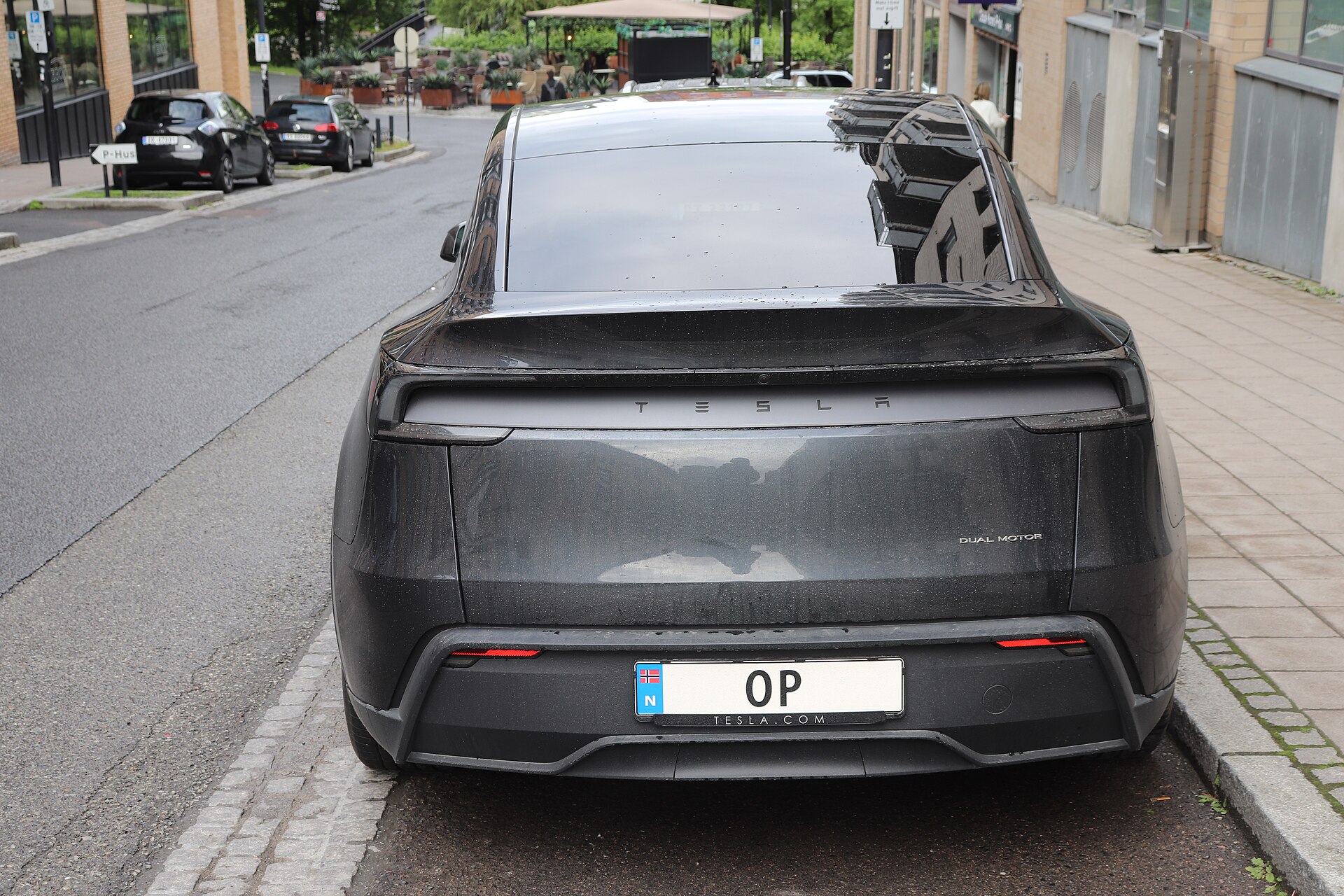
Information is current as of September 2026 and reflects our best understanding of pricing, charging, and program details at publication; specifications, incentives, and charger locations change—verify current details with Tesla and local authorities before you travel. Range figures are rules of thumb, not guarantees, and vary with speed, weather, load, and driving style. This article is general information, not professional or safety advice. Some links are affiliate or referral links; see our disclosure page. Additional reading: U.S. DOE Alternative Fuels Data Center, Natural Resources Canada fuel consumption ratings, and Tesla’s official winter driving tips. Image credit: Andrzej Otrębski, CC BY-SA 4.0, via Wikimedia Commons.
About the author: Lifei Zhou
Model Y owner since 2022Ontario STO registered apprentice · 310SWorks on Porsche, Mercedes, BMW, Audi weeklyHundreds of readers referred (est.)
Lifei is a Tesla owner based in Canada, writing practical, fact-checked Tesla guides for US and Canadian drivers — buying, ownership, insurance, charging, and TSLA investing, all from first-hand experience.