
Can You Put Snow Chains on a Tesla? Approved Chains, Rear-Only Rule and Where They’re Required (2026)
Can You Put Snow Chains on a Tesla? Approved Chains, Rear-Only Rule and Where They’re Required (2026)

Yes, you can put snow chains on a Tesla, but only Tesla-approved, low-profile chains, only on the rear tires, and only at low speed (Tesla says no faster than about 48 to 50 km/h, or 30 mph). Most Model 3 and Model Y owners will rarely need to fit them. Good winter tires plus dual-motor AWD get through most conditions, but you may still be legally required to carry chains on mountain passes in BC, California and Washington.
Disclosure: some links are affiliate/referral links (Tesla referral and Amazon). If you buy through them, we may earn a reward or commission at no extra cost to you. See our disclosure page.
Key facts (checked October 17, 2026)
- Tesla’s owner’s manuals say tire chains go on the rear tires only. Never fit them to the front.
- Tesla-approved chains: König CG-9 102 (Model 3, 18″) and CG-9 103 (Model 3, 19″). For 2020 to 2024 Model Y on 19″ or 20″ wheels, it’s the König XG-12 Pro 252.
- Keep speed under roughly 48 to 50 km/h (30 mph). Remove aero or wheel covers first, and don’t fit chains on summer tires.
- BC requires winter tires (M+S or mountain/snowflake, at least 3.5 mm of tread) on signed highways from October 1. Chains on summer tires don’t count.
- Under California’s R2 and Washington’s “chains required except AWD” levels, an AWD Tesla can skip chains if it has proper traction tires, but it must still carry chains.
Tesla is a bit of a special case here. The cars sit low, the wheels are large, and clearance between the tire and the suspension is tight, so a regular hardware-store chain can rub on suspension parts or brake lines. Tesla has tested specific chains for specific tire sizes, and the manual says other chains can cause damage the warranty won’t cover. This guide covers which chains fit your car, when you’re legally required to have them, how to put them on, and when a good set of winter tires makes the whole question moot.
📋 Contents
Which Snow Chains Fit a Tesla Model 3 or Model Y?
Tesla lists approved chains by tire size in the Model 3 owner’s manual and the Model Y owner’s manual (both under Tire Care and Maintenance). It also sells the same sets in the Tesla Shop. Stock comes and goes, especially in the fall, so check early.
Model 3, 18″ wheels
- Position
- Rear only
Model 3, 19″ wheels
- Position
- Rear only
Model Y, 19″ or 20″ (2020 to 2024)
- Position
- Rear only
Source: Tesla owner’s manuals and Tesla Shop listings. Model 3 Performance on 20″ wheels has its own Tesla-sold set. For the 2025 and later Model Y, check the manual in your car’s touchscreen for its approved chain.
A few details trip people up:
- Match the tire size, not just the wheel diameter. Read the sidewall (for example 255/45R19) and compare it with the chain’s fit list.
- Model 3 Performance and some Model Y trims use larger wheels or wider rear tires. Those need the Performance-specific set or nothing at all.
- If your car has aero covers or wheel covers, they have to come off first. The manual is clear that damage from leaving them on isn’t covered.
- Don’t fit chains over summer tires. Tesla’s manual warns that this can cause damage, and in BC it isn’t legal winter equipment anyway.
Textile “snow socks” are popular in Europe and light to carry, but they aren’t on Tesla’s approved list. They also wear out fast on bare pavement. BC’s own winter driving page notes that textile covers work on snow and ice but degrade quickly on asphalt. If a jurisdiction accepts them as a traction device and you choose them, treat them as a get-out-of-trouble tool, not something to drive on for kilometres.
Do You Legally Need Chains? BC, Quebec, California and Washington
For most Tesla owners in Ontario, the Prairies and the eastern US, chains are never required. The places where they come up are mountain passes and provinces or states with signed winter rules.
| Where | What’s required | What it means for an AWD Tesla |
|---|---|---|
| British Columbia | Winter tires (M+S or mountain/snowflake, 3.5 mm tread) on signed highways, Oct 1 to Mar 31 or Apr 30 depending on route | Winter tires are the requirement. Chains on summer tires aren’t a substitute. Carrying chains is advised for extreme conditions. |
| Quebec | Winter tires with the mountain/snowflake symbol, Dec 1 to Mar 15, on Quebec-registered vehicles | No chain rule. Winter tires are mandatory and all-seasons don’t qualify. |
| California (R1 / R2 / R3) | Chain controls posted by Caltrans in mountain areas | R1 and R2: exempt with snow-tread tires on all four wheels, but must carry chains. R3: chains on every vehicle. |
| Washington | WSDOT pass restrictions, from “traction tires advised” up to “chains required on all vehicles” | At “chains required except AWD,” fit approved traction tires and carry chains. At the top level, chain up. |
British Columbia
BC’s rules start October 1. On signed routes, passenger vehicles need at least two matching winter tires on the drive axle, marked M+S or with the three-peak mountain/snowflake symbol, with at least 3.5 mm of tread. The requirement runs to April 30 on mountain passes and high-snowfall routes, and to March 31 on some others. The province’s winter tire page is direct about it: “Chains on summer tires are not an acceptable substitute for legal winter tires on signed B.C. highways.” Police and CVSE can turn you around at the signs. If you live in Vancouver and drive the Sea-to-Sky, the Coquihalla or Highway 3, winter tires are the answer and chains are the backup. Our Vancouver and BC Tesla guide covers the rest of owning one there.
Quebec
Quebec doesn’t regulate chains for passenger cars, but its winter tire law requires tires with the mountain/snowflake symbol on Quebec-registered vehicles from December 1 to March 15. Studded tires are allowed from October 15 to May 1. All-season tires don’t qualify, even if they’re marked M+S.
California and Washington
Caltrans posts three chain control levels. Under R2, four-wheel and all-wheel drive vehicles with snow-tread tires on all four wheels are exempt, but Caltrans says AWD vehicles “must carry traction devices in chain control areas.” Under R3, everyone chains up. The posted speed limit with chains is 25 or 30 mph. Washington works the same way. When WSDOT posts “chains required on all vehicles except all-wheel drive” on Snoqualmie or Stevens Pass, AWD vehicles need approved traction tires and must carry chains. At the top level, chains go on every vehicle. Check WSDOT’s mountain pass reports before you leave.
- October 1, 2026BC winter tire and chain signs take effect on designated highways.
- October 15, 2026Studded tires allowed in Quebec (through May 1).
- December 1, 2026Quebec winter tires mandatory on Quebec-registered vehicles.
- March 15, 2027Quebec winter tire requirement ends.
- March 31, 2027BC requirement ends on select routes outside mountain passes and high-snowfall areas.
- April 30, 2027BC requirement ends on mountain passes and high-snowfall routes.
Sources: Government of British Columbia and Gouvernement du Québec winter tire pages. California and Washington chain controls are posted storm by storm, not by date.
Winter Tires First, Chains Second
Here’s the honest take: if you own a dual-motor Model 3 or Model Y, a set of proper winter tires does far more for you than chains ever will. Chains are for the worst hour of the worst storm on a closed-in mountain pass. Winter tires are for every cold morning from November to April. Teslas are heavy and deliver torque instantly, and all-season rubber hardens as the temperature drops. The traction control does a good job, but it can’t add grip that the tires don’t have.
I’ve driven my Model Y through four winters in the Toronto area, and that’s the pattern most GTA owners land on: winter tires on a second set of wheels, swapped each fall and spring. Our Tesla winter tires guide has sizes and models for Model 3 and Model Y. If you’re in the GTA and need the swap, come to the shop where I work for Tesla alignment and tires: XIUCHE in Markham is by appointment only (437-214-5267), and for Teslas it does alignment and tires only. XIUCHE is the shop where I work, so I can stand behind the quality.
Rear-wheel drive Teslas, like the Model Y Rear-Wheel Drive and Model 3 Premium RWD, are where chains earn their place. The drive wheels are the rear wheels, which is also where Tesla says chains go, so one set of rear chains turns an RWD car into a much more capable climber on packed snow. Dual-motor cars benefit too, but less dramatically.
If you’re still choosing a trim and you live somewhere snowy, it’s worth weighing AWD. I ordered mine straight from tesla.com without a test drive, and ordering through a Tesla referral link gives new owners 3 months of FSD (Supervised). It generally can’t be combined with the new-car FSD trial or other offers; Tesla confirms the final perk on your order. Current Canadian and US prices are in the configurator.
How to Put Snow Chains on a Tesla
Practise once in your driveway before you need to do it on a dark, icy shoulder. It takes 10 to 20 minutes the first time and much less after that.
Based on Tesla’s owner’s manuals and the chain maker’s instructions. Always follow the instructions in the box for your specific set.
Some practical tips:
- Keep the chains, a pair of waterproof gloves, a kneeling mat and a headlamp in one bag in the trunk. The frunk is handy too, but in a pile-up the trunk is easier to reach from the shoulder.
- Steel link chains grip better than cable chains on banked curves, according to BC’s winter driving guidance.
- Take them off as soon as you reach bare, wet pavement. Driving chained on asphalt chews up the chain and can damage the wheel or tire.
- Recheck tension after the first kilometre. Self-tensioning chains help, but they still settle.
What to Pack for a Winter Mountain Trip
Chain-up areas are also where passes close for hours. A Tesla handles a long wait well, since the heater runs on the battery and Camp Mode keeps the cabin warm, but plan for it. Arrive at the pass with a healthy state of charge and precondition the battery before you leave. Our mountain driving guide covers range on long climbs and regen on the way down.
Three things worth adding to the chain bag, all chosen for this exact situation:
- A long-handled snow brush so you can clear the roof and the camera lenses before you set off. The AstroAI extendable snow brush (usually around US$20 to $35) reaches across a Model Y roof without scratching the glass if you brush, not scrape.
- A digital tire gauge. Pressure drops as temperatures fall, and correct pressure matters for chain fit. The AstroAI digital tire pressure gauge (about US$10 to $15) is simple and reads in psi or kPa.
- A 12V heated blanket for long closures, so you can turn the cabin heat down and save range. The Sealy 12V heated blanket (roughly US$30 to $50) plugs into the car’s 12V socket.
Frequently Asked Questions
Can you put snow chains on the front of a Tesla?
No. Tesla’s manuals say chains should only be installed on the rear tires. That applies to dual-motor AWD cars as well as RWD.
Does a Tesla with AWD need chains?
Usually not fitted, but often carried. In California’s R2 and Washington’s “except AWD” levels, an AWD Tesla with proper snow or traction tires on all four wheels can drive without chains, but it must carry them. At the top level in both states, every vehicle has to chain up.
Will chains void my Tesla warranty?
Using Tesla-approved chains correctly won’t. Damage caused by non-recommended chains, chains on unapproved tire sizes, or incorrect installation isn’t covered by the warranty.
How fast can you drive with chains on a Tesla?
Tesla’s guidance is no more than about 48 to 50 km/h (30 mph). In California, the posted speed limit in chain control areas is 25 or 30 mph.
Are chains a legal substitute for winter tires in BC?
No. BC says chains on summer tires are not an acceptable substitute for legal winter tires on signed highways. You need M+S or mountain/snowflake tires with at least 3.5 mm of tread.
Can I use snow socks on a Tesla?
They aren’t on Tesla’s approved list. Some drivers carry them as an emergency backup, but they wear out quickly on pavement, and you should check whether the road authority on your route accepts them.
Summary
- Tesla allows snow chains, but only approved low-profile sets, only on the rear tires, and only at low speed.
- Approved sets: König CG-9 102 and CG-9 103 for Model 3 on 18″ and 19″ wheels, and König XG-12 Pro 252 for 2020 to 2024 Model Y on 19″ or 20″ wheels.
- Remove wheel covers first, and never fit chains on summer tires.
- BC and Quebec require winter tires, not chains. California and Washington can require AWD cars to carry chains.
- For most owners, winter tires do far more than chains. Carry chains for mountain passes, and practise fitting them at home.
Order with a referral link for 3 months of FSD (Supervised) →
More guides: Canada Tesla and US Tesla.
Winter tire and chain rules are summarized for general information and are not legal advice. Check the current rules and posted signs for your route before you travel.
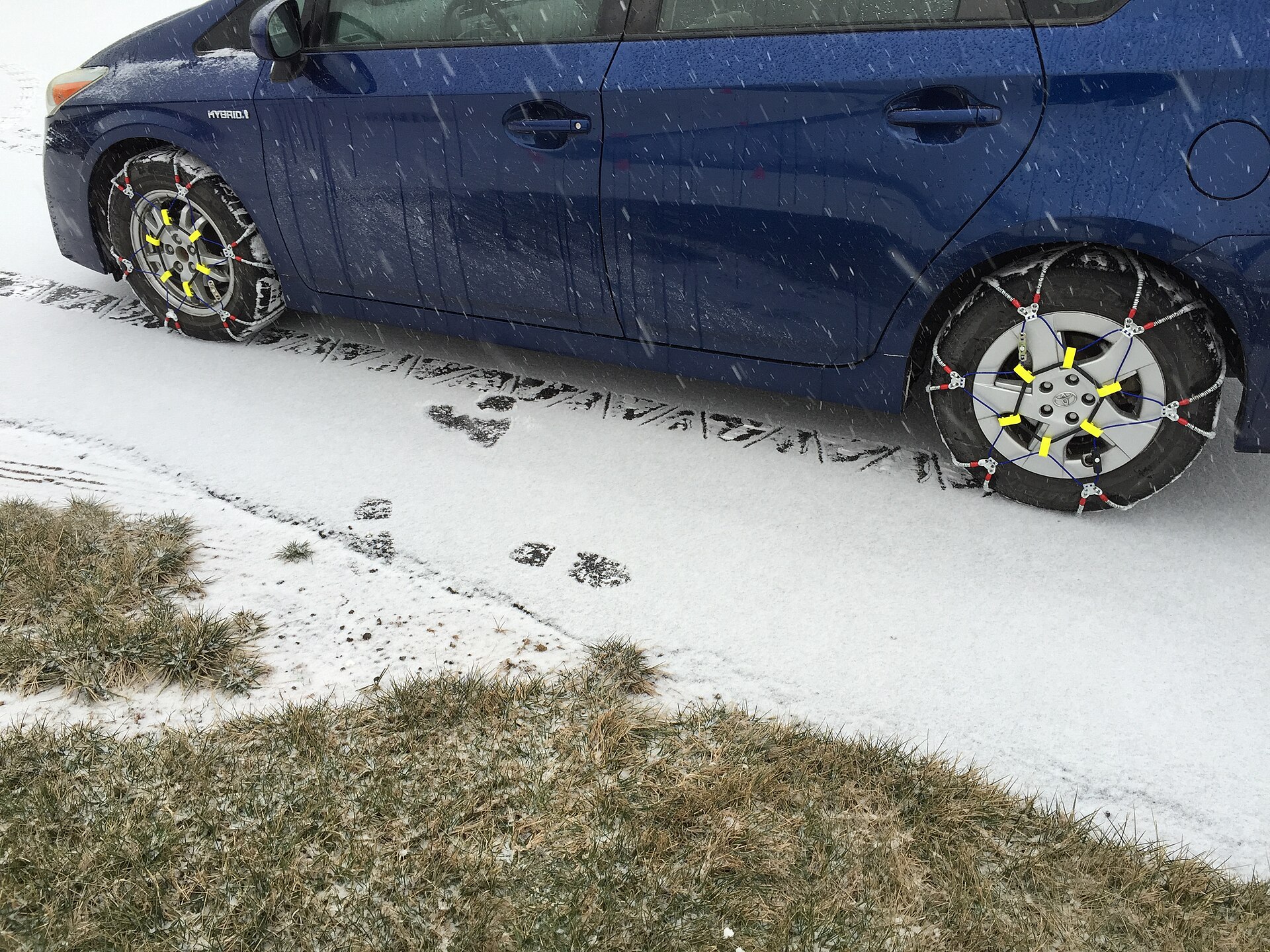
Image credit: “Tire chains for snow installed on a Toyota Prius at the beginning of the Blizzard of 2016 in Sterling, Loudoun County, Virginia” by Famartin, CC BY-SA 4.0, via Wikimedia Commons.

About the author: Lifei Zhou
Model Y owner since 2022Ontario STO registered apprentice · 310SWorks on Porsche, Mercedes, BMW, Audi weeklyHundreds of readers referred (est.)
Lifei is a Tesla owner based in Canada, writing practical, fact-checked Tesla guides for US and Canadian drivers — buying, ownership, insurance, charging, and TSLA investing, all from first-hand experience.