
Tesla Cybercab (October 2026): 300+ in Austin, Dallas Next, NHTSA Deadline & Can You Buy One?
Tesla Cybercab (October 2026): 300+ in Austin, Dallas Next, NHTSA Deadline & Can You Buy One?

As of October 14, 2026, the Tesla Cybercab is carrying paying riders only in Austin, where Tesla says more than 300 are now in service, and Dallas is next. You still cannot buy one: there is no price, no order page and no Canadian launch, and NHTSA is waiting for Tesla’s sworn answers on how a car with no steering wheel was certified, now due October 30.
On September 3, 2026, Tesla put a car with no steering wheel, no pedals, and no mirrors into paid service on public roads in Austin, Texas. The Cybercab has been a slide-deck promise since the “We, Robot” event in October 2024; now it is a real two-seater you can hail with the Robotaxi app, at least in parts of one city. The same day, the National Highway Traffic Safety Administration (NHTSA) opened an audit into how Tesla decided the car was legal to sell at all. Both of those things are true at once, and that tension is the whole Cybercab story right now.
This guide is for US and Canadian readers who want the facts without the hype in either direction: what the Cybercab actually is, the specs Tesla filed with regulators, what happened at the launch, what the NHTSA audit means, whether you’ll ever be able to buy one for your driveway, and what it does and doesn’t mean if you already own a Tesla or a few shares of TSLA. First published September 4, 2026 and updated October 14, 2026. This story moves fast, so check the dates.
Latest Cybercab update (October 14, 2026)
- Fleet: on October 10, Tesla’s Robotaxi account said “300+ Cybercabs” were serving Austin, an 8x jump in 30 days. Independent counts from Texas registration data were lower, around 169 earlier in October.
- Next city: Tesla AI chief Ashok Elluswamy says Dallas is “soon.” No date has been given.
- Regulators: the deadline for Tesla’s sworn answers to NHTSA’s Special Order moved from September 30 to October 30. Tesla asked for November 20 and got 30 days.
- Earnings: Tesla reports Q3 2026 results after the close on Wednesday, October 21, with the webcast at 5:30 p.m. Eastern. Cybercab ramp and new cities are the questions to watch.
- Selling to fleets: Tesla has put up an interest form for fleet operators, mobility hubs and infrastructure partners, a sign it may not own every Cybercab on its network.
- Still not for sale to consumers: no price, no order page, and no Canadian launch.
Disclosure: some links are affiliate/referral links, which means we may earn a commission at no extra cost to you if you buy through them. Nothing here is investment advice. See our disclosure page.
📋 Contents
- What the Cybercab Is (and Isn’t)
- Timeline: From “We, Robot” to Paid Rides
- Specs: What Tesla Told the EPA
- The Launch: What Actually Happened in Austin
- October 2026 Update: 300+ Cybercabs, Dallas Next, and Two Dates to Watch
- The NHTSA Audit: Why a Car With No Steering Wheel Is a Legal Question
- Can You Buy a Cybercab? Price and Consumer Sales
- What It Means If You Already Own a Tesla
- What It Means for TSLA Investors
- Will the Cybercab Come to Canada?
- Frequently Asked Questions
- The Bottom Line
What the Cybercab Is (and Isn’t)
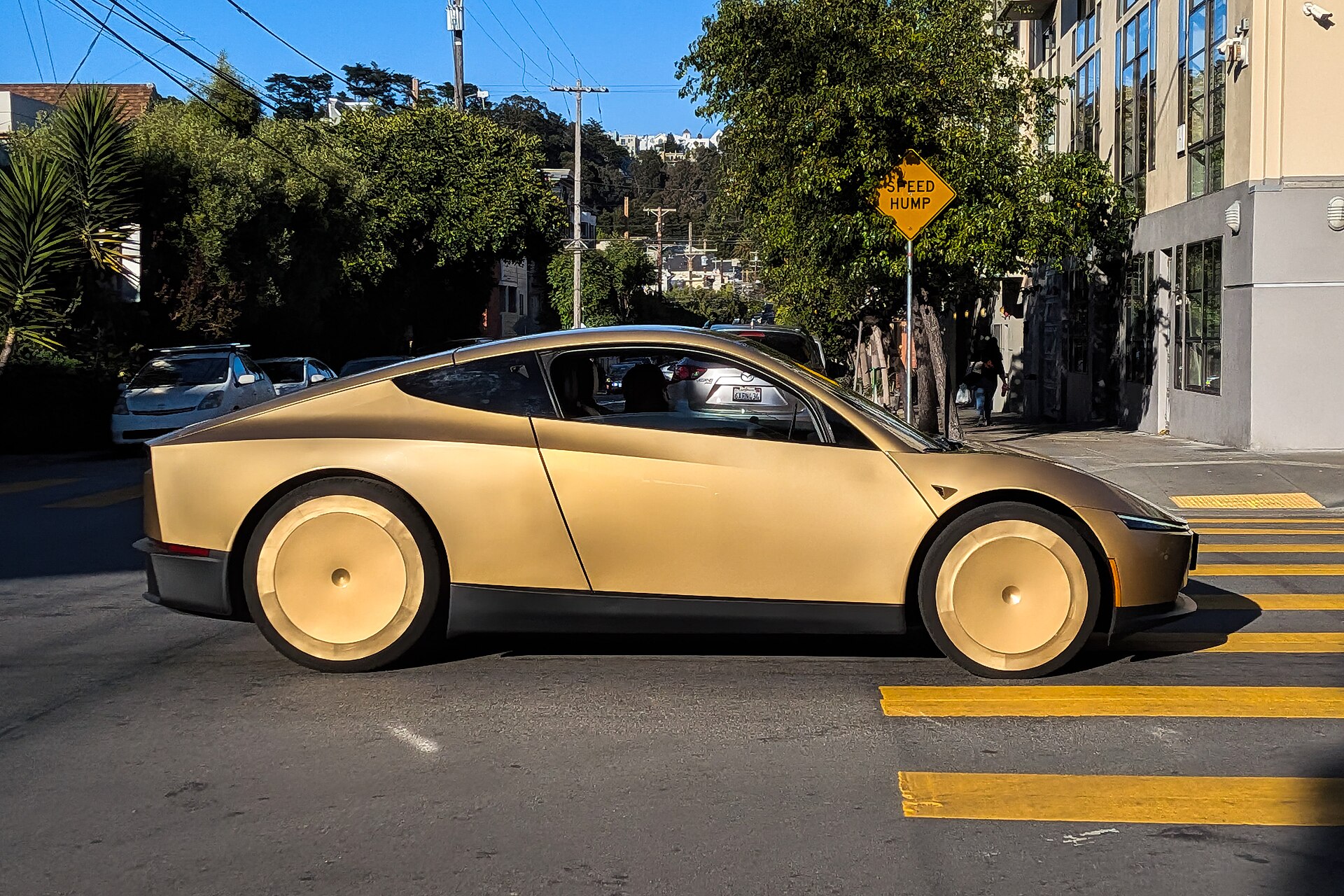
The Cybercab is a purpose-built robotaxi: a compact two-door, two-seat electric car designed from the start to be driven only by Tesla’s Full Self-Driving software. There is no steering wheel, no accelerator or brake pedal, and no side mirrors. The doors open upward in a butterfly arrangement, the paint is a metallic gold, and the cabin is essentially a bench, a center screen, and a wireless phone charger. It runs Tesla’s AI4 computer, the same generation as the hardware in current Model 3 and Model Y production.
What it is not: it is not the FSD (Supervised) you can subscribe to on your own car. Your Model Y still requires you to watch the road and be ready to take over. The Cybercab has no way for a human inside to take over at all, which is why its legal status, not its technology, is the most interesting question in 2026. Our Tesla FSD guide explains the difference between the consumer product and the robotaxi stack in more detail, and the Robotaxi in Austin guide covers the Model Y-based service the Cybercab is now joining.
Timeline: From “We, Robot” to Paid Rides
| Date | Milestone |
|---|---|
| Oct 10, 2024 | Cybercab unveiled at the “We, Robot” event in Los Angeles; Musk floats a price “below $30,000” and production “before 2027.” |
| June 2025 | Tesla’s Robotaxi pilot starts in Austin using Model Y vehicles with safety monitors. |
| Feb 17, 2026 | First Cybercab rolls off the line at Gigafactory Texas. Same day, Musk answers “Yes” on X to selling Cybercabs to consumers before 2027 at $30,000 or less. |
| April 2026 | Volume production begins; on the Q1 earnings call Musk says initial output will be “very slow” before ramping “exponentially” late in the year. |
| May 26–29, 2026 | EPA certification issued; Cybercab formally “introduced into commerce,” which makes the specs below public record. |
| June 2026 | Steering-wheel-free Cybercabs begin on-road testing (San Francisco sightings, pictured above). Federal regulators move to drop the manual brake-pedal requirement for vehicles driven only by automated systems. |
| July 9, 2026 | NHTSA Administrator Jonathan Morrison says the agency would “absolutely” consider ending the steering-wheel requirement for driverless vehicles. |
| Sept 3, 2026 | Invite-only launch in Austin; first Cybercab rides. NHTSA opens an audit query into Tesla’s certification the same day. |
| Sept 4, 2026 | Cybercab rides open to the public through the Robotaxi app in limited areas of Austin. |
| Sept 9, 2026 | Cybercab Asia exhibition opens in Hong Kong, with Japan and China showings planned. No sales or rides. |
| Sept 10, 2026 | NHTSA issues a Special Order under the audit: sworn answers from a Tesla officer due September 30. |
| Early Oct 2026 | NHTSA grants a 30-day extension; Tesla’s answers are now due October 30 (Tesla had asked for November 20). |
| Oct 10, 2026 | Tesla says 300+ Cybercabs are serving Austin; Elluswamy says Dallas is next, “soon.” |
| Oct 21, 2026 | Q3 2026 earnings call (scheduled). |
Specs: What Tesla Told the EPA
Tesla hasn’t published a consumer spec sheet, but the EPA certification filed in late May 2026 fills in most of the picture (Electrek’s breakdown of the filing is the best public summary). A few of these numbers surprised people.
| Spec | Cybercab (EPA filing, May 2026) | Why it matters |
|---|---|---|
| Seats / doors | 2 seats, 2 butterfly doors | Most ride-hail trips carry one or two people; Tesla sized for the average, not the maximum. |
| Motor | Single permanent-magnet motor, 163 kW (219 hp), front-wheel drive | Tesla’s first front-drive car; cheap to build, plenty for city speeds. |
| Battery | About 47.6 kWh (326 V) | Smaller than any current Model 3. The car’s efficiency, not a big pack, does the work. |
| Curb weight | 3,113 lb (GVWR 3,730 lb) | Roughly 800 lb lighter than a Model 3 RWD. |
| Range | 418 mi combined / 375 mi highway, unadjusted; roughly 290 mi on the usual EPA-adjusted basis | The 418 figure circulating online is the raw test number. Think “about 290 real miles.” |
| Charging | Wireless inductive charging only; no NACS port. Observed rate around 19 kW. | A robotaxi parks itself over a pad; no human plugs it in. It also means you cannot use a Supercharger. |
| Controls | None. No steering wheel, pedals, or mirrors. | The reason for the NHTSA audit (next section). |
Two takeaways. First, the Cybercab is an efficiency car: a small pack, low weight, and front-wheel drive add up to a very low cost per mile, which is the entire business case. Second, the wireless-only charging is a bigger deal than it sounds. Tesla’s current robotaxi fleet of Model Ys can be plugged into any Supercharger by a staffer; a Cybercab fleet needs dedicated inductive pads at a depot. That is infrastructure Tesla has to build city by city before it can scale, and it is one reason the rollout starts small.
The Launch: What Actually Happened in Austin
The September 3 event was invite-only, held for winners of a Robotaxi rider sweepstakes, shareholders, and a handful of influencers, all 21 and over. There was no livestream and no stage presentation, which caught some fans off guard after Tesla had suggested one. Musk appeared in a video calling the Cybercab “the first car that is specifically built for unsupervised full self-driving,” and Tesla’s head of AI, Ashok Elluswamy, told reporters the service is “open to the entire public.”
The public part came the next morning. Since September 4, anyone with the Robotaxi app in Austin can be matched with a Cybercab, but only in limited areas of the city rather than across the full greater-Austin geofence the Model Y robotaxis cover. According to Texas registration records reported by Reuters, Tesla had 45 Cybercabs registered as part of a total autonomous fleet of about 420 vehicles at launch. Executives described demand-responsive pricing (fares rise when it’s busy) and promised “a first-class experience at coach price,” but as of this writing Tesla hasn’t said when Cybercab rides will start being charged at a different rate than the existing Model Y robotaxis. For reference, Austin Model Y robotaxi fares run a little over $2 for a sub-mile hop and roughly $8 to $13 for a 5-to-8-mile trip, which is in the same range as Uber or Lyft, not dramatically cheaper. Early riders praised the ride as smooth; none of them had a steering wheel to grab if it hadn’t been.
October 2026 Update: 300+ Cybercabs, Dallas Next, and Two Dates to Watch
The fleet grew much faster in the first month than the launch numbers suggested. Texas records showed 45 Cybercabs at launch; on October 10, Tesla’s Robotaxi account said more than 300 were serving Austin, an eightfold increase in 30 days. Fleet trackers working from Texas registration data counted fewer, about 169 earlier in October, so treat 300 as Tesla’s own upper figure until registrations catch up. Riding one still works the same way: open the Robotaxi app in Austin and you may be matched with a Cybercab or a Model Y. Our step-by-step Austin Robotaxi guide covers the app, fares and the airport.
Dallas is the next named city. Ashok Elluswamy, Tesla’s head of AI, posted that Cybercabs are “everywhere in Austin” and that Dallas is coming “soon,” without a date. Dallas already has driverless Model Y robotaxis, so adding Cybercabs there is mostly a question of depots, inductive charging pads and regulators.
- Sept 3–4Paid rides start in Austin, invite-only on day one, then open to the public in limited areas.
- Sept 3 and Sept 10NHTSA opens an audit query, then issues a Special Order requiring sworn answers.
- Early OctoberDeadline for those answers extended to October 30.
- Oct 10Tesla says 300+ Cybercabs serve Austin; Dallas named as the next city.
- Oct 21Q3 earnings call, the next chance for official numbers and timelines.
- Oct 30Tesla’s sworn answers due to NHTSA.
Green dots are expansion milestones, red dots are regulatory pressure points.
Two dates matter more than any launch video. On October 21, Tesla reports third-quarter results after the market closes, with the webcast at 4:30 p.m. Central (5:30 p.m. Eastern), according to the notice Tesla filed with the SEC. That filing also put Q3 deliveries at 486,532 vehicles. Expect questions about the Cybercab production ramp, the next cities and when consumers can buy one. Then on October 30, Tesla’s sworn answers to NHTSA are due.
The NHTSA Audit: Why a Car With No Steering Wheel Is a Legal Question
Here’s the part most launch coverage glossed over. Every car sold in the US has to comply with the Federal Motor Vehicle Safety Standards (FMVSS), and several of those standards assume a human driver: a steering wheel with an airbag in it, a brake pedal, mirrors, a “driver’s seat.” Amazon’s Zoox, which also builds a car with no controls, spent years seeking a formal exemption from those standards and finally got one in July 2026, capped at 2,500 vehicles per year for two years.
Tesla took a different route. It self-certified the Cybercab as compliant, on the reasoning that standards written around a human driver simply don’t apply to a vehicle that has no driver position. Self-certification is the normal process for every car (there’s no federal pre-approval), but applying it to a car with no controls is new. On launch day, NHTSA’s Office of Defects Investigation opened an Audit Query covering roughly 1,000 Cybercabs to examine, in its words, “the process and technical data on which Tesla relied when certifying the Cybercab and related issues.” NHTSA Administrator Morrison had already said in July that the agency would “absolutely” consider dropping the steering-wheel rule, and the Department of Transportation moved in June to remove the brake-pedal requirement for vehicles driven only by automated systems. So the regulatory direction favors Tesla; the audit is about whether Tesla got ahead of the rules rather than waiting for them.
The audit escalated a week later. On September 10, NHTSA issued a Special Order tied to the audit, which is a legally binding demand for information: a responsible Tesla officer has to answer under oath. The original deadline was September 30, 2026; NHTSA later extended it by 30 days to October 30 after Tesla asked for more time. According to reporting on the order, the questions cover which federal safety standards Tesla treated as applicable and which it treated as not applicable, whether Cybercabs can run with temporarily attached human controls and whether those were part of the certification, and how the car complies without a Part 555 exemption like the one Zoox received. Failing to respond can bring civil penalties. The order is not a finding that the Cybercab is unsafe or illegally sold, but it is the step to watch: what NHTSA does after Tesla answers on October 30 will shape how fast the Cybercab can expand.
Steps 1 to 3 have happened or are scheduled; step 4 has not been decided.
What an audit query can and can’t do: it is a formal information-gathering step, not a recall and not a finding of wrongdoing. It can escalate to an investigation, which can lead to a recall or a stop-sale, or it can close quietly. Tesla’s larger FSD investigation, covering a few million vehicles, is still open with no conclusion, so “NHTSA is looking at it” is a status Tesla has lived with for years. But a stop-sale on the Cybercab specifically would be a real blow to the 2026 timeline, so this is the item to watch. NHTSA’s automated vehicles page is the official source for the framework as it evolves.
Can You Buy a Cybercab? Price and Consumer Sales
Short answer: not yet, and there’s no order button. Here’s what has been said on the record:
- At the 2024 unveiling, Musk targeted a price “below $30,000” and said the car would enter production “before 2027.”
- On February 17, 2026, asked directly on X whether Tesla would sell the Cybercab to regular consumers before 2027 for $30,000 or less, Musk replied “Yes.”
- As of October 14, 2026, there is no public MSRP, no destination charge, no financing terms, no delivery estimate, and no configurator. Cybercabs exist only inside Tesla’s own robotaxi service.
- Tesla has started collecting interest from fleet operators, mobility hubs and infrastructure partners. If businesses get Cybercabs first, that would come before any individual sales.
You can
- Ride one in Austin through the Robotaxi app
- Try FSD (Supervised) in a Model 3 or Model Y you own
- Follow the October 21 earnings call for timing
You can’t (yet)
- See a price or place an order
- Ride one outside Austin
- Buy or ride one in Canada
- Charge one at a Supercharger (wireless only)
Status checked October 14, 2026.
Two things stand between Musk’s “Yes” and a car in your driveway. The first is regulatory: selling a no-controls vehicle to an individual raises questions a fleet deployment doesn’t (who is responsible when it’s parked in your garage, what happens outside a geofence, how it’s insured). The second is priority. Musk said on the Q1 call that material Cybercab revenue is unlikely before 2027, and every unit Tesla builds this year goes into its own fleet, where it earns fares rather than a one-time margin. If a consumer version does arrive, expect it to be tied to FSD being unsupervised in your area, not just wherever Tesla operates robotaxis.
Practical advice for anyone thinking “I’ll wait for the $30K Cybercab instead of buying a Model 3 or Y”: a two-seater with no wheel and wireless-only charging is a second car for a specific kind of person, not a replacement for a family EV. If you need a car in the next year, the 2026 Model Y guide is where to start. And if you do order a new Model 3, Model Y, or Cybertruck, using a Tesla referral link gets you 3 months of free FSD (Supervised), which is the closest thing to a Cybercab experience you can have in a car you own.
What It Means If You Already Own a Tesla
Less than the headlines suggest, at least this year. The Cybercab runs on the AI4 computer (HW4), and Tesla has been clear that HW3 cars will not get unsupervised capability; the “v14 Lite” build that shipped to HW3 owners in July 2026 is a distilled version of the HW4 stack. If you’re on HW4, the software in your car and the software in the Cybercab share a lineage, and improvements to one tend to reach the other over time. But there is no announced path from “my Model Y” to “my Model Y earns money as a robotaxi while I’m at work.” Musk has floated that idea since 2019, and the Cybercab’s launch doesn’t change its status: an aspiration, not a product. Our HW3 vs HW4 guide covers where each generation stands.
What does affect you: the regulatory outcome. If NHTSA blesses Tesla’s self-certification approach, the path to unsupervised FSD for consumer cars gets shorter. If it forces Tesla into a Zoox-style exemption with a vehicle cap, expect Tesla to keep leaning on its own fleet and the subscription in your car to keep its supervised label longer. Either way, the cheapest way to judge the software lineage for yourself is the trial: new orders placed through an owner referral link come with 3 months of FSD (Supervised), which generally doesn’t stack with the standard 30-day trial.
What It Means for TSLA Investors
The Cybercab is the physical embodiment of the reason Tesla trades at a multiple no other automaker gets. It’s worth being clear-eyed about where the numbers are. Tesla’s Q2 2026 report showed record deliveries and strong revenue, but operating margin in the low single digits, negative free cash flow for the first time in over two years, and capital spending guidance around $25 billion for the year, much of it aimed at AI, robotics, and autonomy. The stock spent late summer near its 52-week low around the $300 mark. Bulls read the Cybercab launch, and the jump to 300+ cars in Austin within a month, as the start of the payoff on that spending; bears note that independent counts are well below Tesla’s figure, that rides are still limited to one city, and that the NHTSA review is unresolved, against Waymo’s roughly 3,000 driverless vehicles and more than half a million paid trips a week. Q3 deliveries came in at 486,532, and the October 21 call is the next checkpoint.
Both readings can be right at different time horizons. What’s checkable: fleet size (Texas registrations are public), whether Dallas gets Cybercab rides before year-end, service-area maps in the app, whether Cybercab fares actually diverge from Uber’s, and the status of the NHTSA audit. Those are better signals than launch-event vibes. Canadian readers who want to own the stock can see our guide to buying TSLA from Canada; brokers such as Interactive Brokers offer US-listed shares in both countries. None of this is investment advice; TSLA is volatile and you can lose money.
Will the Cybercab Come to Canada?
Nothing has been announced, and the honest expectation is: not soon. Three things have to happen first. Tesla would need to certify the vehicle under Canada’s own motor vehicle safety standards, which mirror the US rules on driver controls and would face the same no-steering-wheel question. A province would need to permit commercial driverless operation; Ontario runs an automated-vehicle pilot, but it’s built around testing with a human present. And Tesla would need the depot and inductive-charging infrastructure in a Canadian city, plus winter validation for a car whose sensors are cameras only. Given that the US rollout is currently one city, Canadian Tesla owners should treat Cybercab as a 2027-or-later question. FSD (Supervised) itself is available in Canada at the same $99 per month as the US, and that is the product to evaluate today.
Frequently Asked Questions
Can I ride in a Tesla Cybercab right now?
Only in Austin, Texas. Since September 4, 2026, the Robotaxi app can match public riders with a Cybercab, and that was still the case on October 14, with Tesla reporting 300+ Cybercabs in the city. Elsewhere, Tesla’s robotaxi service (Houston, Dallas, Miami, Orlando, Tampa, and the Bay Area with a safety monitor) uses Model Y vehicles.
How much does a Cybercab ride cost?
Tesla hasn’t published Cybercab-specific fares. Existing Austin robotaxi rides use dynamic per-mile pricing, roughly $2 for a short hop and $8 to $13 for a 5-to-8-mile trip, similar to Uber or Lyft. Executives have said pricing will rise with demand and have promised “coach price,” but no timeline for changes has been given.
Can I buy a Cybercab, and how much will it cost?
Not yet. Musk has said Tesla will sell the Cybercab to consumers before 2027 for $30,000 or less, most recently in a February 17, 2026 post on X. There is no MSRP, order page, or delivery estimate, and every Cybercab built so far has gone into Tesla’s own fleet.
Is the Cybercab legal without a steering wheel?
Tesla says yes: it self-certified the car as compliant with federal standards on the grounds that rules written for human drivers don’t apply. NHTSA opened an audit query on September 3, 2026 to review that reasoning and on September 10 ordered Tesla to answer 21 questions under oath; after an extension, the answers are due October 30. Federal regulators have separately moved to relax the brake-pedal and steering-wheel rules for automated vehicles, so the direction is favorable, but the audit is unresolved.
When is the Cybercab coming to Dallas?
Tesla says Dallas is next, but no date has been given. Ashok Elluswamy wrote “Dallas soon” on October 10. Dallas already has driverless Model Y robotaxis, so Cybercabs would join an existing service.
When is Tesla’s Q3 2026 earnings call?
Wednesday, October 21, 2026, after the market closes. The live Q&A webcast starts at 4:30 p.m. Central, 5:30 p.m. Eastern, per Tesla’s SEC filing.
What is the Cybercab’s real range?
The EPA filing lists 418 miles unadjusted, which is a raw test figure. On the adjusted basis used for window stickers, expect something around 290 miles from the roughly 48 kWh battery. It charges only by wireless induction, so it can’t use a Supercharger.
Is the Cybercab coming to Canada?
Nothing has been announced. Tesla would need to certify the car under Canada’s motor vehicle safety standards, a province would need to allow commercial driverless rides, and Tesla would need inductive-charging depots in a Canadian city. Treat it as 2027 or later. FSD (Supervised) is available in Canada today at C$99 per month.
Does my Tesla become a robotaxi now?
No. The Cybercab shares its AI4 hardware and software lineage with HW4 consumer cars, but Tesla has not launched any program that lets owners add their cars to the robotaxi network. FSD in your car remains “Supervised,” and HW3 cars are not on the path to unsupervised driving.
The Bottom Line
- The Cybercab is real and in paid public service in parts of Austin as of September 4, 2026: two seats, no controls, about 48 kWh, roughly 290 real-world miles, wireless charging only.
- Tesla self-certified it under federal safety standards; NHTSA opened an audit the day it launched and escalated it with a Special Order on September 10, with answers now due October 30. That review, not the technology, is the biggest near-term risk.
- You can’t buy one. Musk’s “under $30,000, before 2027” promise stands, but there is no price, order page, or delivery date.
- Scale is growing fast but is still one city: Tesla says 300+ Cybercabs in Austin, independent counts are lower, and Dallas is next. Waymo runs roughly 3,000 driverless vehicles. Watch registrations, service maps, fares and the October 21 earnings call, not launch vibes.
- Owners: nothing changes in your car this year. Canada: no announcement, likely 2027 or later. Investors: the launch is a milestone, not a revenue event; material Cybercab revenue is not expected before 2027.
Information current as of October 14, 2026. The Cybercab launch, NHTSA’s audit, Tesla’s pricing statements, and service areas are all changing quickly; verify with Tesla, NHTSA, and current reporting before making decisions. This article is general information, not purchasing, legal, or investment advice. Some links are affiliate or referral links; see our disclosure page. Image credit: “Tesla Cybercab – San Francisco – June 2026” by 9yz, licensed CC BY 4.0, via Wikimedia Commons.
About the author: Lifei Zhou
Model Y owner since 2022Ontario STO registered apprentice · 310SWorks on Porsche, Mercedes, BMW, Audi weeklyHundreds of readers referred (est.)
Lifei is a Tesla owner based in Canada, writing practical, fact-checked Tesla guides for US and Canadian drivers — buying, ownership, insurance, charging, and TSLA investing, all from first-hand experience.