
Tesla Driving in the Rain: Auto Wipers, Wiper Blades & Wet-Road Safety (2026)
Tesla Driving in the Rain: Auto Wipers, Wiper Blades & Wet-Road Safety (2026)

In one sentence
How Tesla's no-rain-sensor auto wipers work in 2026, fast manual overrides, the wiper blades and repellents that actually help, and NHTSA wet-road safety tips.
Every Tesla owner remembers the first hard rainstorm. You reach instinctively for the wiper stalk that isn’t there, the glass blurs over, and the automatic wipers either sit frozen or suddenly slap into overdrive on a dry pane. Tesla’s decision to run everything through cameras instead of a dedicated rain sensor makes wet-weather driving one of the most talked-about quirks of the ownership experience — and one of the easiest to master once you understand what’s actually happening behind the windshield.
This guide walks through how Tesla’s vision-based “auto wipers” work in 2026, the fastest ways to take manual control when they misbehave, the single accessory upgrade that helps most, and the wet-road safety habits the NHTSA wants every driver to follow. It applies to Model 3, Model Y, Cybertruck and the remaining Model S/X fleet across the United States and Canada.
Disclosure: some links are affiliate/referral links. If you buy through them we may earn a commission at no extra cost to you, and Tesla referral links may earn rewards. See our disclosure page.
📋 Contents
- How Tesla’s Auto Wipers Actually Work (There Is No Rain Sensor)
- Take Control Fast: Manual Wiper Tricks Every Driver Should Know
- The Upgrade That Helps Most: Better Wiper Blades
- Do Rain Repellents Like Rain-X Help a Tesla? (Read This First)
- Driving Safely in Heavy Rain: Hydroplaning, Speed and Headlights
- Keeping the Inside Clear: Fog, Condensation and Wet Floors
- Your Rainy-Day Tesla Toolkit at a Glance
- Frequently Asked Questions
- The Bottom Line
How Tesla’s Auto Wipers Actually Work (There Is No Rain Sensor)
Almost every other car on the road uses a small infrared rain sensor tucked behind the mirror. It shines light at the glass and measures how much bounces back; more water, more wiping. Tesla deleted that part years ago as part of its “Tesla Vision” push to replace discrete sensors with cameras and AI. Instead, the forward-facing cameras feed a neural network — internally nicknamed Deep Rain — that looks at the windshield and estimates how wet it is.
The upside is that it’s a pure software system that can improve with over-the-air updates. The downside is the one owners feel: a camera looking through glass is worse at judging a thin film of drizzle than a sensor pressed against it. That’s why the classic complaints are light rain (wipers won’t start until visibility is already poor) and false triggers (wipers sweeping a bone-dry windshield in bright sun), documented at length by outlets like InsideEVs.
Tesla has kept iterating. In April 2026 the company published a patent titled “Wiper Friction Estimation for Autowiper Performance Improvement,” and a fleet-wide update began blending a new signal into Deep Rain: instead of relying on cameras alone, the system now watches the electrical load and blade position of the wiper motor to estimate how much friction — and therefore how much water — is actually on the glass. In practice, moderate-to-heavy rain performance has improved noticeably; it’s still the light, misty stuff that trips the system up.
Take Control Fast: Manual Wiper Tricks Every Driver Should Know
You are never actually stuck with whatever the auto system decides. The trick is knowing the shortcuts before you need them, because fumbling through menus at highway speed in a downpour is exactly when you don’t want to be looking away from the road.
- Left scroll wheel: Press the button on the end of the left steering-wheel stalk (Model 3/Y) once for a single wipe and the on-screen wiper card; the left scroll wheel then bumps speed up or down instantly. This is your fastest override.
- Voice command: Tap the voice button and say “Wipe faster,” “Wipe slower,” or “Set wipers to two.” No menu diving required.
- Single-wipe washer: Pull the stalk toward you for a spray-and-wipe to clear road grime — do this the moment a truck throws spray on you.
- Manual speeds I–IV: Open the wiper card and pick a fixed speed. In steady rain a fixed setting is far less nerve-wracking than watching the AI hesitate.
One important catch: when Autosteer (part of Autopilot or Full Self-Driving) is engaged, Tesla forces the wipers back to Auto and won’t let you lock in a manual speed. If the auto wipers are lagging in heavy rain, that’s a strong signal to take over driving yourself rather than fight the software — which is the safe move in poor visibility anyway. (Shopping for a car and want to test these systems firsthand? Ordering a new Tesla through a Tesla referral link includes three months of Full Self-Driving (Supervised) so you can try rain-mode Autopilot yourself.) Tesla’s own Autopilot support page notes these systems can be degraded by rain, spray and dirty cameras.
The Upgrade That Helps Most: Better Wiper Blades
Before you blame the software for every smear, look at the rubber. Tesla’s factory blades are unremarkable, and the enormous single driver-side blade sweeps a big, curved windshield — so a worn or cheap blade streaks badly and makes even “correct” wiper timing feel useless. Fresh, well-made blades are the highest-impact, lowest-cost fix for rainy-day visibility.
Both Model 3 and Model Y (2017–2026, including Highland and Juniper) use a 26-inch driver blade and a 19-inch passenger blade with a tool-free push-button clip. A quality beam-style set such as the Bosch ICON 26″/19″ wiper blades (you need both sizes) wipes cleaner and lasts longer than the factory rubber, typically in the $30–$45 range for the pair. Swapping them takes about five minutes with no tools; if you want the step-by-step, see our DIY cabin filter and wiper blade replacement guide.
Replace blades roughly once a year, or the moment you hear chatter or see streaks. In hot-sun states the rubber hardens faster — a good excuse to check them when you rotate tires.
Do Rain Repellents Like Rain-X Help a Tesla? (Read This First)
On a normal car, wiping a hydrophobic coating onto the windshield is a slam-dunk — water beads and rolls away above about 40 mph. On a Tesla it’s more complicated, and getting this wrong can make your wipers worse.
Because Deep Rain judges rain by looking at the glass through the cameras, the exaggerated beading from a repellent can fool it into thinking it’s pouring when it’s barely misting — so the wipers surge to full speed and chatter across glass that’s mostly dry. Tesla’s own owner’s manual even warns against washer fluids containing water repellent for exactly this reason. The community consensus, echoed across the Tesla Owners Online forums, is to keep repellents off the main windshield camera zone.
Where repellents genuinely shine on a Tesla is the glass the cameras don’t watch:
- Rear glass and side windows: There’s no wiper back there and no rain-detection camera, so a coating dramatically improves your rear-view visibility in traffic.
- Side mirrors: A quick wipe keeps them clear so you can actually use them when it’s dark and wet.
A classic bottle of Rain-X original glass treatment (about $6–$12) lasts months on those surfaces. If you insist on treating the front windshield, keep it well clear of the camera housing behind the mirror and expect some auto-wiper weirdness — or just switch to manual speeds when it rains.
Driving Safely in Heavy Rain: Hydroplaning, Speed and Headlights
Wipers are only half the equation. The first 10–15 minutes of rain are the most dangerous, when oil lifts off the pavement before it washes away. The NHTSA’s severe-weather guidance is simple and worth committing to memory:
- Slow down and double your following distance. An instant-torque EV can break traction on a wet surface faster than you’d expect — ease onto the accelerator.
- Turn your headlights on. In most U.S. states and all of Canada, headlights are legally required whenever wipers are running. Tesla’s auto headlights usually catch this, but confirm they’re on — the IIHS stresses how much conspicuity matters in low visibility.
- Never cruise-control through standing water. If you start to hydroplane, ease off the accelerator and steer straight — don’t brake hard.
- Turn around for flooded roads. The NHTSA reminds drivers that just 12 inches of moving water can carry away most cars; an EV’s low battery pack does not make it a boat.
Your tires matter as much as anything. Worn tread can’t channel water out from under the contact patch, which is what causes hydroplaning in the first place. Check tread and keep pressures at the door-jamb spec — see the NHTSA TireWise program for how to read tread depth. Range takes a hit in the rain too (wet roads and headlights add drag and draw), so pad your charging stops on wet road trips. The same slow-down, boost-following-distance discipline carries straight over to snow and ice — our Tesla winter driving guide goes deeper on cold-weather traction and preconditioning.
Keeping the Inside Clear: Fog, Condensation and Wet Floors
Rainy-day visibility problems are often inside the glass. When warm, humid bodies climb into a cool cabin, the windshield fogs instantly. The fastest fix in a Tesla: swipe up the climate menu and tap the front defrost/defog icons, or just say “Defog windshield.” The heat pump clears the glass in seconds — the same system covered in our cabin climate and cooling guide. Auto climate with a fresh cabin air filter keeps it from coming back — another reason that filter change in our DIY maintenance guide pays off.
A clean interior windshield also fogs less and glares less at night. Keep a plush large microfiber drying towel (roughly $15–$25) in the frunk to wipe condensation and dry off the glass without leaving lint — far better than the sleeve of your jacket.
Then there’s the mess wet shoes and dripping umbrellas make of Tesla’s light-colored carpet. A set of laser-fit all-weather rubber floor mats (typically $70–$130 for the set) traps water and grit in raised channels and hoses clean in the driveway. It’s the single accessory that keeps a rainy commute from slowly ruining your interior. For more first-week essentials, our new-owner accessories guide covers the rest.
Your Rainy-Day Tesla Toolkit at a Glance
| Item | What it fixes | Use it on | Price range (USD) |
|---|---|---|---|
| Beam wiper blades (26″ + 19″) | Streaks, chatter, poor clearing | Windshield | $30–$45 / pair |
| Glass rain repellent | Poor rear/side visibility | Rear glass & mirrors only | $6–$12 |
| Microfiber drying towel | Interior fog & condensation | Inside glass, keep in frunk | $15–$25 |
| All-weather floor mats | Wet shoes, dripping umbrellas | Cabin floor | $70–$130 / set |
None of these are exotic — they’re the four things that turn a stressful rainy commute into a non-event. If you’re still shopping for the car itself and vision-based wipers are on your mind, know that you can order any new Model 3, Model Y or Cybertruck through a Tesla referral link and get three months of Full Self-Driving (Supervised) included — handy for trying the rain-detection and Autopilot features yourself before committing. For more real-world ownership tips, browse our full library of US Tesla guides.
Frequently Asked Questions
Why do my Tesla wipers run when it isn’t raining?
The camera-based Deep Rain system occasionally misreads glare, shadows from overpasses, or bugs and dust on the glass as water. Clean the windshield, and if it keeps happening, take manual control with the left scroll wheel or a fixed speed. A software update often improves false triggers over time.
Can I add a rain sensor to my Tesla?
No — there’s no factory rain sensor and no supported retrofit. Rain detection is entirely software (Tesla Vision), so the only “upgrade” is the over-the-air improvements Tesla ships and your own manual overrides.
Is it safe to use Autopilot in heavy rain?
Autopilot and Full Self-Driving can be degraded by heavy rain, road spray and dirty cameras, and Tesla says as much. If you see a “poor weather” alert or the system hesitates, take over and drive manually. In a downpour, human eyes and slower speeds beat the cameras.
Should I put Rain-X on my Tesla windshield?
Be cautious. The extra beading can confuse the camera-based auto wipers into over-wiping. Repellents are best used on the rear window and side mirrors, where there’s no wiper and no rain-detection camera. If you treat the front glass, keep it away from the camera area behind the mirror and switch wipers to manual.
What wiper blade size does a Tesla Model 3 or Model Y use?
Both use a 26-inch driver-side blade and a 19-inch passenger-side blade (2017–2026 model years, including Highland and Juniper). They clip on tool-free with a push button.
Does rain reduce my Tesla’s range?
Yes, modestly. Wet roads add rolling resistance and you’ll be running wipers, headlights and often climate — expect a noticeable but not dramatic drop. Plan a little extra buffer on rainy road trips.
The Bottom Line
- Tesla has no rain sensor; the camera-based “Deep Rain” system runs the auto wipers and improved again with a 2026 friction-estimation update — but light drizzle still trips it up.
- Learn the manual overrides (left scroll wheel, voice, fixed speeds I–IV) before you need them; Autosteer forces wipers back to Auto, so take over driving in heavy rain.
- Fresh 26″/19″ beam blades are the highest-impact, lowest-cost visibility upgrade.
- Use rain repellents on rear glass and mirrors, not the camera-watched windshield.
- Follow NHTSA wet-road basics — slow down, headlights on, double your following distance, avoid standing water — and keep tires and floor mats rain-ready.
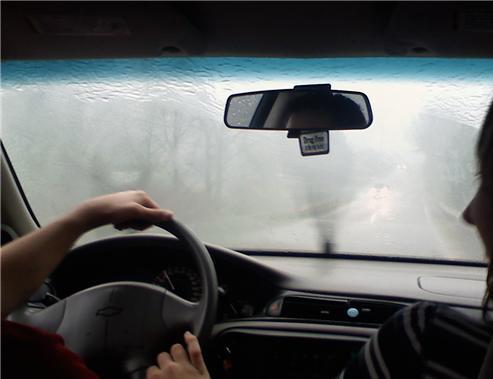
Information is current as of August 2026 and reflects Tesla software and pricing that change frequently; always confirm current details with Tesla and follow official safety guidance. This article is general ownership information, not driving or legal advice. Some links are affiliate or referral links — see our disclosure page. Image credit: “Rain on windscreen” by Malinaccier, licensed under CC BY 3.0, via Wikimedia Commons.
About the author: Lifei Zhou
Model Y owner since 2022Ontario STO registered apprentice · 310SWorks on Porsche, Mercedes, BMW, Audi weeklyHundreds of readers referred (est.)
Lifei is a Tesla owner based in Canada, writing practical, fact-checked Tesla guides for US and Canadian drivers — buying, ownership, insurance, charging, and TSLA investing, all from first-hand experience.