
Alberta Electricity Rates for Tesla Charging (2026): RoLR vs Fixed Contracts, Real Cost per 100 km
Alberta Electricity Rates for Tesla Charging (2026): RoLR vs Fixed Contracts, Real Cost per 100 km

Charging a Tesla at home in Calgary on Alberta’s default Rate of Last Resort works out to about 17.5 cents per kWh once you add the per-kWh delivery charges, or roughly $3 per 100 km for a Model Y. Move to a competitive fixed-rate contract around 8 cents and that drops to about $2.30 per 100 km. Alberta has no overnight EV discount like Ontario or BC, so the retailer you pick matters more than the time you plug in.
Disclosure: some links are affiliate/referral links. If you buy through them, this site may earn a commission at no extra cost to you. See our disclosure page.
Key facts (checked November 8, 2026)
- The Rate of Last Resort (RoLR) energy price is fixed at 12.01 to 12.06 cents per kWh, depending on your provider, until December 31, 2026.
- New RoLR prices for 2027 and 2028 must be set by December 2, 2026. They can normally move by no more than 10% either way.
- In Calgary, ENMAX’s 2026 residential delivery tariff adds 5.45 cents per kWh (1.55 cents distribution plus 3.90 cents transmission) on top of the energy price.
- Alberta has no province-wide overnight or EV rate, so a cheaper energy contract is the main way to cut home charging costs.
- On RoLR, a Model Y driven 1,500 km a month costs roughly $47 a month to charge in Calgary, GST included (our estimate).
I live in the Toronto area, not Alberta. But the math behind Alberta charging is very different from what I’m used to, and readers in Calgary and Edmonton keep asking. In Ontario the big lever is the time of day. In Alberta the time of day barely matters, and the contract on your bill does. This guide shows what a Tesla actually costs to charge on each option and when switching is worth it.
📋 Contents
- How Alberta’s electricity bill works for EV owners
- Alberta electricity rates in 2026 by area
- What it costs to charge a Tesla at home in Alberta
- RoLR vs a fixed-rate contract: which should a Tesla owner pick?
- The 2027 RoLR reset: what to watch in December
- Smart charging habits that still matter in Alberta
- Home charging hardware for Alberta winters
- Alberta vs Ontario, BC and Québec: how home charging compares
- Frequently Asked Questions
- Summary
How Alberta’s electricity bill works for EV owners
Alberta’s electricity market is deregulated, so your bill has two separate parts that come from different companies:
- Energy charge. This is the price of the electricity itself, set by your retailer. You either stay on the regulated default (the Rate of Last Resort) or sign with a competitive retailer on a fixed or variable plan.
- Delivery charges. These are transmission and distribution, set by the Alberta Utilities Commission (AUC) for the company that owns the wires in your area. You pay them no matter which retailer you choose.
On top of that come a daily administration charge, a municipal local access fee in cities like Calgary and Edmonton, and 5% GST. Alberta has no provincial sales tax.
For a Tesla owner, the key point is that most of these charges are billed per kWh. When you add 250 to 350 kWh a month of charging, the energy price and the per-kWh delivery charges both rise with it. The fixed daily fees don’t change, so you can leave them out when you work out what the car costs.
The Rate of Last Resort replaced the old Regulated Rate Option on January 1, 2025. Unlike the old RRO, which changed every month, the RoLR price is fixed for a two-year term. The Utilities Consumer Advocate explains that it is approved by the AUC and that any change at a reset normally can’t exceed 10% of the existing rate.
Alberta electricity rates in 2026 by area
Which RoLR provider you get depends on who owns the wires at your address. Here is the 2025 to 2026 energy price for each area, fixed until December 31, 2026. EPCOR posts its own November 2026 residential RoLR rate as 12.01 cents per kWh.
| Area | Wires owner | RoLR provider | RoLR energy price (2025 to 2026) |
|---|---|---|---|
| Calgary | ENMAX Power | ENMAX Energy | 12.06¢/kWh |
| Edmonton | EPCOR Distribution & Transmission | EPCOR Energy Alberta | 12.01¢/kWh |
| Most of southern and central Alberta (Red Deer region, many towns and acreages) | FortisAlberta | EPCOR Energy Alberta | 12.01¢/kWh |
| Northern and east-central Alberta | ATCO Electric | Direct Energy Regulated Services | 12.02¢/kWh |
Some municipalities run their own utilities with their own rates. Medicine Hat, Red Deer, Lethbridge and Ponoka are examples. If your bill comes from the city, use its posted rate instead.
Delivery charges: the part people forget
The energy price is only part of what you pay per kWh. In Calgary, the AUC-approved ENMAX Power residential tariff (rate D100), effective January 1, 2026, charges a distribution system usage charge of $0.015477 per kWh and a transmission charge of $0.038996 per kWh. There is also a fixed $0.77 per day. Together the per-kWh delivery charges add about 5.45 cents to every kWh your Tesla draws.
In Edmonton, the 2026 EPCOR residential transmission charge alone is $0.04050 per kWh. EPCOR also bills distribution, so the per-kWh delivery total is in the same range as Calgary’s. Rural FortisAlberta and especially ATCO Electric areas have noticeably higher delivery charges, because there are more kilometres of line for each customer. Look up your own numbers on a recent bill before you do the math.
- Energy (ENMAX RoLR)12.06¢
- Transmission3.90¢
- Distribution1.55¢
- Total per kWh17.51¢
Sources: ENMAX Energy RoLR rate; ENMAX Power 2026 D100 tariff. Excludes daily fixed charges, quarterly riders, Calgary’s local access fee and 5% GST.
What it costs to charge a Tesla at home in Alberta
To keep the numbers honest, here are the assumptions. A Model Y or Model 3 typically uses around 17 kWh per 100 km measured at the wall in mild weather. That figure is our estimate, and it includes charging losses. In a real Alberta cold snap, expect it to climb by a quarter or more, especially on short trips with cabin heat. The examples use Calgary’s delivery charges and 1,500 km a month, about 18,000 km a year.
That works out to about 255 kWh a month from the wall.
| Option (Calgary) | Energy + delivery per kWh | Per 100 km | Per month (255 kWh, incl. GST) |
|---|---|---|---|
| Rate of Last Resort (12.06¢) | 17.51¢ | $2.98 | $46.88 |
| Fixed contract at 8.0¢ (example) | 13.45¢ | $2.29 | $36.00 |
| Supercharging only, $0.25 to $0.60/kWh | 25¢ to 60¢ | $4.25 to $10.20 | Depends on the site and time |
The Supercharger range is the 2026 national price band. Tesla adjusted prices across Canada twice in September 2026, so check the price in the app before you rely on it. The per-100-km figure for Supercharging uses the same 17 kWh for simplicity. It is slightly generous, because DC charging skips some of the home charging losses.
Estimates. Energy use of 17 kWh/100 km is an assumption; winter use is higher. Home figures include ENMAX 2026 per-kWh delivery charges but not fixed daily fees or Calgary’s local access fee.
Over a year, moving that 3,060 kWh of car charging from the RoLR to an 8-cent fixed contract saves about $124 before GST. That covers the car only. The same price gap applies to the rest of your household use, which is usually larger than the car’s share.
If you’re still shopping for the car itself, our Calgary and Alberta Tesla buying guide covers prices, GST and delivery fees. I ordered my own Model Y straight from tesla.com without a test drive. If you order the same way, using a Tesla referral link gives new owners 3 months of FSD (Supervised). It generally can’t be combined with the new-car FSD trial or other offers, and Tesla confirms the final perk on your order.
RoLR vs a fixed-rate contract: which should a Tesla owner pick?
Fixed retail offers have been well below the RoLR for most of 2026. Get Energy, one Alberta retailer, posted a two-year fixed rate of 7.27 cents per kWh as of October 30, 2026, with longer terms costing more. A summary of the Market Surveillance Administrator’s findings put the average home’s savings from leaving the RoLR at $20 to $28 a month as of March 2026. Retailers also charge their own monthly admin fee, so compare the full offer and not just the cents per kWh.
The Utilities Consumer Advocate runs a free cost comparison tool that lists current offers for your postal code. It is the quickest way to see real numbers instead of advertised headlines.
A fixed contract makes sense if
- You drive 1,000 km or more a month and charge mostly at home.
- You want a known price for two or more years.
- Your household already uses a lot of power (electric heat, hot tub, shop tools).
- You’re comfortable reading cancellation terms before signing.
Staying on RoLR is reasonable if
- You may move within a year and don’t want exit fees.
- You drive little and mostly Supercharge or charge at work.
- You want to see the 2027 to 2028 RoLR price before you commit.
- You’d rather not deal with retailer deposits or credit checks.
What about variable (floating) rates?
Variable plans follow Alberta’s wholesale pool price. They can look very cheap during calm months and then spike during cold snaps, when demand is highest and you’re also charging more. If you go variable, set a reminder to check your bill every month. A Tesla that adds 300 kWh in January shows a price spike faster than most homes do.
The 2027 RoLR reset: what to watch in December
The current RoLR term ends on December 31, 2026. Under the AUC’s decision, providers must set prices for January 2027 to December 2028 by December 2, 2026. Each reset is normally capped at 10% up or down, which means a 12.01-cent rate could land anywhere from about 10.81 to 13.21 cents.
- January 1, 2025RoLR replaces the monthly Regulated Rate Option, fixed at 12.01 to 12.06¢/kWh for two years.
- March 2026The MSA estimates an average home saves $20 to $28 a month by switching to a competitive retailer.
- April 2026A summary of the MSA report projects the RoLR rising to about 12.82¢/kWh in 2027.
- December 2, 2026Deadline to set the 2027 to 2028 RoLR prices, normally within 10% of today’s rate.
- January 1, 2027New two-year RoLR term starts.
The MSA projection is a forecast, not an approved price. My practical advice: if you’re on the RoLR now, wait for the December announcement, then compare it with fixed offers using the UCA tool. If the new RoLR comes in high, most fixed offers will look even better. If it comes in low, you’ve lost nothing by waiting a few weeks.
Smart charging habits that still matter in Alberta
Without a time-of-use rate, scheduling your charge doesn’t save money directly. Some habits still cut what you pay:
- Set Scheduled Departure in winter. Having the car finish charging just before you leave keeps the battery warm. Preconditioning while plugged in uses wall power instead of battery energy. Our guide to preconditioning a Tesla in winter walks through the settings.
- Charge on Level 2, not a 120V outlet. A standard household outlet is slow, and in cold weather a bigger share of the energy goes to keeping the battery warm instead of filling it. A 240V circuit wastes less.
- Keep your daily limit around 80% on nickel-based batteries. This is about battery care, not price. If your car has an LFP battery, follow the charge-limit recommendation shown on your car’s charging screen.
- Park in a garage if you have one. A warmer battery accepts charge more efficiently and needs less heating before a drive.
Home charging hardware for Alberta winters
The cost savings above assume Level 2 charging at home. If you don’t have it yet, this is the one purchase that matters. For installation steps, permits and electrician quotes, see our Tesla home charger installation guide.
- Main pick: Tesla Wall Connector. This is a hardwired unit for a dedicated circuit. It works with every current Tesla, has Wi-Fi for firmware updates, and is rated for outdoor use, which helps on an Alberta driveway at minus 30. It’s the more expensive route once you add an electrician, but it’s the cleanest long-term setup. It suits owners who expect to keep a Tesla for years.
- Budget alternative: Lectron 40A portable Level 2 charger. This plugs into a NEMA 14-50 outlet. It suits renters, or anyone who already has a 240V outlet in the garage and wants to avoid a hardwired install. Check that the connector matches your car’s port before ordering.
- Also worth a look: Tesla Mobile Connector. This is Tesla’s own portable cable. It’s handy as a backup in the trunk for cabin weekends in the Rockies, where a 120V or 240V outlet may be all you get.
If your weekends take you well outside Calgary or Edmonton, internet coverage gets as patchy as charging. I bought a Starlink Mini myself and measured 131 Mbps on my Toronto balcony. It also works sitting on the Model Y dashboard, through the windshield. Canadian readers can order through this Starlink referral link. The link is for Canada only and doesn’t work for US addresses.
Alberta vs Ontario, BC and Québec: how home charging compares
The three other big provinces each give EV owners a time-based or tiered lever. Alberta doesn’t.
- Ontario has an Ultra-Low Overnight plan with a deep 11 p.m. to 7 a.m. discount, so the clock is the main lever there.
- BC Hydro offers an optional time-of-day rate with an overnight discount.
- Québec uses tiered pricing with no overnight discount, and its base rate is among the cheapest in North America.
- Alberta has no standard residential time-of-use rate, so your contract choice does the work.
Our cost to charge a Tesla guide compares home and Supercharger costs more broadly. More province guides are in the Canada Tesla section.
Order a Tesla with 3 months of FSD (Supervised) →
Frequently Asked Questions
How much does it cost to charge a Tesla at home in Alberta?
On the 2026 Rate of Last Resort in Calgary, energy plus per-kWh delivery comes to about 17.5 cents per kWh before GST. That’s roughly $3 per 100 km for a Model Y, or about $47 a month for 1,500 km including GST. On a fixed contract near 8 cents, it falls to about $36 a month. These are estimates, and winter driving costs more.
Does Alberta have a time-of-use or overnight EV rate?
Not a standard one. Unlike Ontario’s Ultra-Low Overnight plan or BC Hydro’s time-of-day rate, Alberta residential customers generally pay the same per-kWh price at any hour. The main way to save is choosing a cheaper energy contract.
What is the Rate of Last Resort in Alberta?
It’s the regulated default electricity price for customers who haven’t signed with a competitive retailer. For 2025 and 2026 it is fixed at 12.01 to 12.06 cents per kWh depending on the provider. New prices for 2027 and 2028 must be set by December 2, 2026, normally within 10% of the current rate.
Should I switch retailers before or after the December 2026 RoLR announcement?
If you’re on the RoLR now, waiting a few weeks for the new price costs little and gives you a real comparison point. If you’re already on a fixed contract that’s ending, compare renewal offers using the Utilities Consumer Advocate’s tool before you auto-renew.
Do delivery charges change if I switch retailers?
No. Transmission and distribution charges are set by the AUC for the company that owns the lines in your area. They are the same whichever retailer sells you the energy. Switching changes only the energy charge and the retailer’s own fees.
Is Supercharging cheaper than charging at home in Alberta?
Almost never. With 2026 Supercharger prices in Canada roughly $0.25 to $0.60 per kWh, even the cheapest Supercharger session costs more per kWh than home charging on the RoLR, delivery charges included.
Summary
- Alberta home charging costs about 17.5 cents per kWh on Calgary’s RoLR with delivery, or about 13.5 cents on an 8-cent fixed contract (before GST).
- That’s roughly $2.30 to $3 per 100 km for a Model Y, far below Supercharging.
- There’s no overnight EV discount, so your retailer and contract matter more than charging times.
- The 2027 to 2028 RoLR price must be set by December 2, 2026. Compare it with fixed offers using the UCA tool before you decide.
- Level 2 charging and winter preconditioning while plugged in cut waste, whatever you pay per kWh.
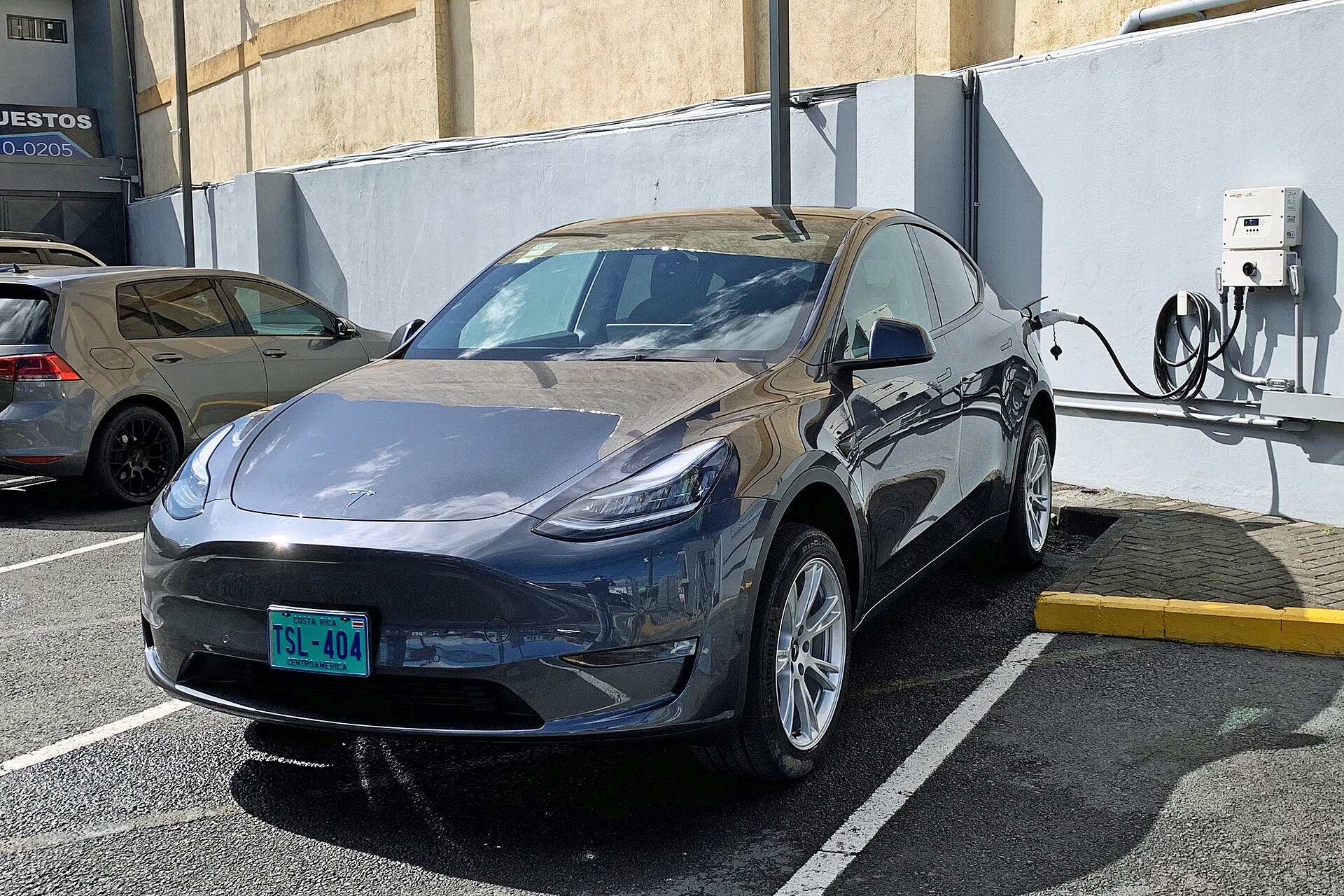
Image credit: Mariordo (Mario Roberto Durán Ortiz), CC BY-SA 4.0, via Wikimedia Commons.

About the author: Lifei Zhou
Model Y owner since 2022Ontario STO registered apprentice · 310SWorks on Porsche, Mercedes, BMW, Audi weeklyHundreds of readers referred (est.)
Lifei is a Tesla owner based in Canada, writing practical, fact-checked Tesla guides for US and Canadian drivers — buying, ownership, insurance, charging, and TSLA investing, all from first-hand experience.