
Can a Tesla Tow? Tesla Towing Capacity Guide 2026 (Model Y, X & Cybertruck)
Can a Tesla Tow? Tesla Towing Capacity Guide 2026 (Model Y, X & Cybertruck)

In one sentence
Can a Tesla tow? 2026 towing capacity for Model Y, X and Cybertruck, real-world range loss, the tow package, Trailer Mode, Supercharging with a trailer and the best accessories.
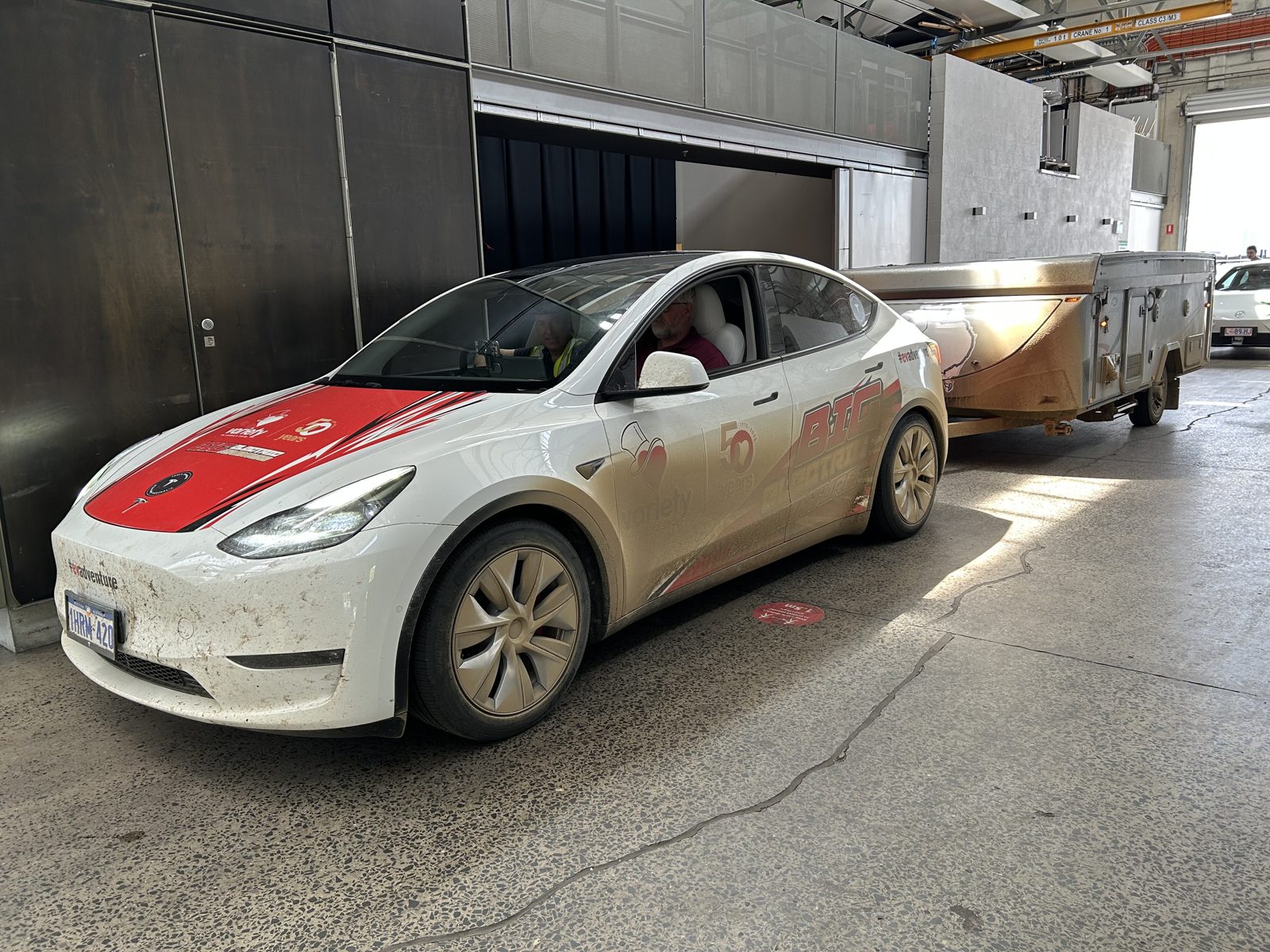
One of the most common questions new EV shoppers ask is a simple one: can a Tesla actually tow anything? The short answer is yes — a factory-equipped Model Y can pull a small camper, a Model X can haul a boat, and the Cybertruck out-tows most half-ton pickups on paper. The longer answer, the one that decides whether towing with a Tesla works for you, comes down to range. Hitching a trailer to an electric car can cut its driving range roughly in half, which changes how you plan every trip.
This guide breaks down 2026 towing capacity for every Tesla model sold in the United States and Canada, how much range you should really expect to lose, what the factory tow package includes, and the accessories and habits that make electric towing painless instead of stressful.
Disclosure: some links are affiliate/referral links. If you buy or order through them we may earn a commission at no extra cost to you. See our disclosure page.
📋 Contents
- Tesla Towing Capacity by Model (2026)
- How Much Range Do You Lose When Towing a Tesla?
- The Tesla Tow Package: What You Get and What It Costs
- Trailer Mode: How Towing Changes Your Tesla’s Software
- Supercharging With a Trailer: The Pull-Through Problem
- Towing Tips to Maximize Range and Stay Safe
- Accessories Worth Buying for Towing and Hauling
- Is Towing With a Tesla Actually Worth It?
- Frequently Asked Questions
- The Bottom Line
Tesla Towing Capacity by Model (2026)
Not every Tesla is built to tow, and even among the ones that are, the rated capacity depends on the tow package, wheel size and market. Here is where each model stands for the 2026 model year in North America.
| Model | Max Towing Capacity | Tow Package | Notes |
|---|---|---|---|
| Model Y | 3,500 lb (1,588 kg) | Factory, ~$1,300 US | Most popular Tesla for towing; 2″ receiver, 7-pin connector |
| Model X | 5,000 lb (2,268 kg) | Factory | Drops to 3,500 lb on 22″ wheels; the strongest tow car in the lineup |
| Cybertruck | 11,000 lb (4,990 kg) | Factory (built in) | Base Dual Motor rated 7,500 lb; 11,000 lb on AWD/Cyberbeast with tow gear |
| Model 3 | Not officially rated (US/CA) | Aftermarket only | Rated ~1,000 kg in Europe; North American manuals do not approve towing |
| Model S | Not officially rated (US/CA) | Aftermarket only | Aftermarket hitches list ~4,000 lb; use at your own risk, no factory support |
The practical takeaway: if towing matters to you, buy a Model Y, Model X or Cybertruck. The Model 3 and Model S can physically accept an aftermarket hitch for a bike rack or a tiny utility trailer, but Tesla does not sanction real towing on them in North America, and doing so can affect your warranty. If you’re deciding which model to order, our Model Y USA guide and Model S and X guide break down the trims in detail. Serious haulers should read the Cybertruck buying guide.
How Much Range Do You Lose When Towing a Tesla?
This is the number that surprises people. Aerodynamic drag and extra weight mean an EV towing a trailer typically uses 1.5 to 2 times the energy per mile. Independent tests from InsideEVs and MotorTrend, plus thousands of owner reports, converge on the same rough picture: expect to lose 40–50% of your range with an average trailer, and up to 55–65% with a big, boxy camper at highway speed.
| What you’re towing | Typical range loss | Real range on a ~330-mile Model Y |
|---|---|---|
| Small aero trailer / teardrop | 25–35% | ~215–250 miles |
| Open utility / U-Haul trailer | 40–50% | ~165–200 miles |
| Boxy travel trailer / large camper | 50–65% | ~115–165 miles |
| Enclosed car hauler / wake boat | 55–70% | ~100–150 miles |
Two variables dominate: speed and shape. Dropping from 70 mph to 60 mph can claw back a surprising amount of range, and a low, aerodynamic trailer punishes you far less than a tall, flat-fronted box. Cold winter temperatures stack on top of the towing penalty, so a January boat trip is the worst-case scenario. For long-haul planning strategy, our Tesla road trip guide covers charging cadence in detail.
The Tesla Tow Package: What You Get and What It Costs
On the Model Y, the factory tow package is a roughly $1,300 option (it must be selected at order or added by a Tesla Service Center). According to Tesla’s official support page, it includes:
- A high-strength steel tow bar with a 2-inch hitch receiver
- A 7-pin standard trailer connector wired to the car’s lighting
- A trailer wiring harness and control module
- The Trailer Mode software package, unlocked automatically
On the Model X and Cybertruck, the towing hardware is either standard or bundled with the trim, so there’s no separate box to check. If you already own a Model Y without the package, retrofitting it through Tesla Service is possible but pricey — many owners instead fit an aftermarket EcoHitch-style receiver for a bike or cargo rack (not for towing a braked trailer). Ordering a new Tesla anyway? Using a Tesla referral link when you order currently gets you 3 months of free Full Self-Driving (Supervised) — worth doing while you configure your tow-package Model Y.
Trailer Mode: How Towing Changes Your Tesla’s Software
When a trailer is connected and detected, your Tesla automatically enters Trailer Mode, which quietly changes several behaviors:
- Autopilot lane changes and steering assists are limited — the car knows it’s longer and heavier.
- Parking sensors behind the car are disabled so the trailer doesn’t trigger constant chimes.
- Range and energy estimates recalibrate as the car learns your real consumption, though the trip planner is still conservative about trailer aerodynamics.
- The touchscreen shows a trailer icon confirming the connection and lighting status.
One genuine limitation worth knowing: Tesla’s in-car trip planner does not reliably account for your trailer’s drag. It may route you to a Supercharger you can’t actually reach at your true towing efficiency. Always pad your buffer and watch the live Wh/mi figure rather than trusting the projected arrival percentage blindly.
Supercharging With a Trailer: The Pull-Through Problem
Here’s the practical headache nobody warns you about. The vast majority of Superchargers are back-in stalls in tight rows designed for a single car — not a 25-foot rig. Unhitching at every charging stop gets old fast. Strategies that work:
- Favor newer V4 Supercharger sites and “pull-through” locations; the Tesla app and community maps like A Better Route Planner flag trailer-friendly stops.
- Charge at the end of a row or an unoccupied edge stall where the trailer can hang off the back.
- Plan slightly shorter legs (120–150 miles) so you’re never desperate and can pick the roomiest site rather than the closest one.
- Keep a CCS or J1772 adapter handy — big pull-through DC fast chargers at truck stops are often easier to enter with a trailer than a cramped Supercharger.
- If you know you’ll be unhitching often, a swivel trailer jack with a caster wheel turns a ten-minute wrestling match into a two-minute roll-aside.
Because towing shrinks your usable range, the density of Superchargers on your route matters more than usual — build the map before you leave.
Towing Tips to Maximize Range and Stay Safe
- Slow down. 55–60 mph instead of 70 can recover 15–25% of your towing range. Drag rises with the square of speed.
- Respect tongue weight. Aim for 10–15% of trailer weight on the hitch for stability, and never exceed your Tesla’s rated tongue-weight limit.
- Charge to 100% before a towing leg. This is the one time the usual “80% is healthier” advice bends — you need every mile, and you’ll burn it off quickly.
- Precondition the battery in cold weather so regen and charging work at full strength.
- Distribute cargo low and forward in the trailer to avoid sway; a sway-control hitch helps with taller trailers.
- Check trailer brakes. Anything approaching the max rating should have its own electric brakes; the U.S. NHTSA towing guidance and provincial rules in Canada spell out when they’re mandatory. One catch Tesla doesn’t advertise: the Model Y and Model X have no built-in trailer brake controller, so an electric-braked trailer needs a plug-and-play wireless brake controller (Curt Echo-style units pair with your phone and need no dash wiring).
For efficiency baselines on your specific model, the U.S. Department of Energy’s fueleconomy.gov EV ratings are the neutral reference point before you apply the towing penalty.
Accessories Worth Buying for Towing and Hauling
A little gear goes a long way. These are the items that come up again and again in owner forums — each solves a specific, predictable problem rather than being a nice-to-have:
- Hitch-mounted bike or cargo rack. The single most popular use of a Tesla hitch isn’t towing at all. A 2-inch receiver bike rack costs a fraction of the range penalty a roof rack imposes — hitch-mounted carriers sit in the car’s wake and barely dent efficiency.
- 7-pin to 4-pin adapter. Tesla wires the full 7-pin RV connector, but most small utility and boat trailers use a flat 4-pin plug. A simple 7-to-4 adapter lives in the trunk and saves you at the U-Haul counter.
- Weight-distribution / anti-sway hitch. If your trailer is tall or within 500 lb of the limit, a sway-control hitch is the difference between a relaxed drive and white knuckles in crosswinds.
- Portable 12V tire inflator. Trailer tires are the most common roadside failure on any towing trip, and Teslas carry no spare. A compact inflator handles slow leaks on both the car and the trailer.
- Hitch lock. Sentry Mode watches your car — it doesn’t stop someone lifting your $600 bike rack out of the receiver in a parking lot. A locking hitch pin is cheap insurance.
- A quality NACS-to-CCS adapter for the wider, easier-to-enter fast chargers on long trips (covered above).
Canadian owners will find the same gear — usually the identical brands — on Amazon.ca, which matters in winter when cross-border shipping slows down. And if you’re ordering a new tow-capable Tesla anyway, use a Tesla referral link to pick up the current 3-months-free FSD (Supervised) perk on top of the tow package. Browse the rest of our coverage on the US Tesla guides hub.
Is Towing With a Tesla Actually Worth It?
For light-duty, local hauling — a couple of mountain bikes, a small utility trailer, a teardrop camper for weekend trips within a couple hundred miles — a tow-equipped Model Y is genuinely excellent. It’s quiet, torquey, and the instant power makes merging with a load effortless. Many owners never look back.
Where an EV struggles today is the long-distance, heavy tow: a big travel trailer across several states, or a boat to a lake 300 miles away in winter. The range penalty and the trailer-unfriendly charging network mean a trip that takes a gas truck one fuel stop might take a Tesla three or four charging stops, some of which require unhitching. If that’s your primary use case every weekend, be honest about the added time before you rely on it.
A useful rule of thumb: take your normal EPA range, cut it roughly in half, then subtract a safety buffer. If the resulting number comfortably covers the gaps between Superchargers on your regular routes, towing with a Tesla will feel easy. If it doesn’t, a plug-in hybrid or a second gas vehicle for tow days may still make sense — for now.
A note for Canadian owners
Winter compounds everything. Cold-soaked batteries, heater draw and denser cold air all cut range on top of the towing penalty, so a trailer trip in a Prairie or Ontario January can see 60%+ losses. Precondition before you set off, charge to 100%, and plan shorter legs. Provincial rules also dictate when trailer brakes and breakaway systems are mandatory — check your province’s requirements before hauling anything heavy.
Frequently Asked Questions
Can a Tesla Model 3 tow a trailer?
Not officially in North America. Tesla’s US and Canadian owner’s manuals do not approve the Model 3 for towing, and there’s no factory tow package here. In Europe the Model 3 is rated for about 1,000 kg with a braked trailer. Owners in North America sometimes fit an aftermarket hitch for a bike rack, but towing a real trailer is unsupported and can affect your warranty.
How much range does a Tesla lose while towing?
Plan on losing 40–50% of your range with an average trailer, and up to 55–65% with a large, boxy camper at highway speed. A 330-mile Model Y can drop to roughly 150–200 real miles between charges. Slower speeds and aerodynamic trailers reduce the hit significantly.
How much does the Tesla tow package cost?
On the Model Y it’s about $1,300 in the US and includes the steel tow bar, 2-inch receiver, 7-pin wiring and Trailer Mode software. On the Model X and Cybertruck the towing hardware is bundled with the vehicle, so there’s no separate charge.
Which Tesla can tow the most?
The Cybertruck, by a wide margin — up to 11,000 lb on AWD and Cyberbeast trims with the right tires and tow setup (7,500 lb on the base Dual Motor). Among the cars, the Model X leads at 5,000 lb, followed by the Model Y at 3,500 lb.
Can I Supercharge with a trailer attached?
Sometimes, but most Superchargers are back-in stalls that don’t fit a trailer. Look for pull-through or end-of-row stalls, favor newer V4 sites, and keep a CCS/J1772 adapter so you can use roomier third-party fast chargers when needed.
Does towing hurt my Tesla’s battery?
Towing within the rated limits doesn’t damage the battery, but it does draw high, sustained power, so charge to 100% before a towing leg and precondition in the cold. The heavier load simply means more energy per mile, not accelerated degradation.
Does a hitch bike rack reduce Tesla range?
Barely — typically 2–5% with bikes loaded, because a hitch rack rides in the car’s aerodynamic wake. That’s far better than a roof-mounted rack, which can cost 15–25% at highway speed. If you carry bikes regularly, the hitch is the efficient way to do it, and it’s another reason the tow package pays for itself even if you never pull a trailer.
The Bottom Line
- Model Y (3,500 lb), Model X (5,000 lb) and Cybertruck (up to 11,000 lb) are the tow-capable Teslas; Model 3 and Model S are not factory-rated for towing in North America.
- Expect to lose 40–65% of your range while towing — plan charging stops around your true towing efficiency, not the EPA number.
- The Model Y tow package (~$1,300) adds the hitch, wiring and Trailer Mode; slow down to 55–60 mph and charge to 100% before each leg.
- The real friction point is Supercharging with a trailer attached — scout pull-through stalls in advance.
Information current as of 2026 and based on Tesla’s published specifications and independent range testing; capacities, prices and options can change by model year, trim and market — always confirm current figures with Tesla before ordering, and follow local trailer-brake and licensing laws. This article is general information, not professional or safety advice. Some links are affiliate/referral links; see our disclosure page. Image credit: Tesla Model 3 with pop-up camper by Chuq, licensed under CC BY-SA 4.0, via Wikimedia Commons.

About the author: Lifei Zhou
Model Y owner since 2022Ontario STO registered apprentice · 310SWorks on Porsche, Mercedes, BMW, Audi weeklyHundreds of readers referred (est.)
Lifei is a Tesla owner based in Canada, writing practical, fact-checked Tesla guides for US and Canadian drivers — buying, ownership, insurance, charging, and TSLA investing, all from first-hand experience.