
Is Tesla FSD Legal in Canada? The Rules Province by Province (2026)
Is Tesla FSD Legal in Canada? The Rules Province by Province (2026)

Yes. Tesla FSD (Supervised) is legal to use in every Canadian province, because it is a Level 2 driver assistance system and you remain the driver at all times. What provinces restrict is Level 3 and higher “self-driving” operation: British Columbia bans it outright, Ontario allows it only inside a government pilot, and Quebec allows Level 3 only for vehicles Transport Canada has authorized for sale. No such vehicle is on sale in Canada today.
Disclosure: some links are affiliate/referral links (Tesla referral and Amazon). If you buy through them, we may earn a reward or commission at no extra cost to you. See our disclosure page.
Key facts (checked October 6, 2026)
- FSD (Supervised) is Level 2: the person in the driver’s seat is legally the driver in every province.
- British Columbia has prohibited driving Level 3, 4 and 5 vehicles since April 5, 2024, with penalties from $368 and 3 points up to $2,000 and 6 months in jail.
- Ontario limits Level 3+ vehicles to its automated vehicle pilot (O. Reg. 306/15); the province proposed extending it to October 13, 2027.
- Quebec allows Level 3 only if Transport Canada has authorized the vehicle for sale in Canada.
- Transport Canada says self-driving vehicles aren’t commercially available in Canada.
- In Canada FSD is subscription-only at $99/month; outright purchase has been discontinued.
This guide goes province by province, links each rule to the government page it comes from, and ends with practical habits that keep you on the right side of the law when FSD is engaged. Where we could not find a clear official statement for a province, we say so instead of guessing.
📋 Contents
- What “legal” actually means for FSD in Canada
- FSD rules province by province (October 2026)
- What the law expects from you while FSD is engaged
- Penalties: what you actually risk
- Getting FSD in Canada: price, hardware and the referral perk
- Will unsupervised FSD be legal in Canada?
- Frequently Asked Questions
- Summary
What “legal” actually means for FSD in Canada
Canada splits the job. The federal government, through Transport Canada, sets safety standards for vehicles that can be sold or imported. The provinces and territories regulate how vehicles are driven: licensing, traffic laws, distracted driving and insurance. So the question “is FSD legal?” really has two parts. Can Tesla sell it here? Yes, FSD (Supervised) is offered to Canadian owners as a $99/month subscription. And can you use it on a provincial road? Yes, as long as you keep driving the car.
The key is the SAE automation level. Most Canadian laws that mention self-driving cars use the SAE scale:
- Level 2: the car can steer, brake and accelerate, but a human must supervise constantly and is responsible. Tesla Autopilot and FSD (Supervised) sit here.
- Level 3: the system drives in limited conditions and the human only needs to take over when asked.
- Levels 4 and 5: no human driver needed in some or all conditions.
Transport Canada’s own guidance is blunt: “Self-driving vehicles aren’t commercially available in Canada”, and driver assistance systems “can’t replace you.” Tesla says the same thing in its product name. FSD is “Supervised,” the car watches you through the cabin camera, and it disengages if you stop paying attention.
Level 2 (FSD Supervised, Autopilot)
- Legal to use on public roads in every province
- You are the driver and carry full responsibility
- Normal traffic, careless driving and distracted driving laws apply
- Hands ready, eyes on the road
Level 3, 4 and 5
- B.C.: prohibited since April 5, 2024 unless allowed by regulation
- Ontario: only under the provincial pilot (O. Reg. 306/15)
- Quebec: Level 3 only if Transport Canada authorized the vehicle for sale
- No consumer Level 3 car is sold in Canada today
FSD rules province by province (October 2026)
Here is what each province has on the books, based on official government pages. “No specific rule” does not mean anything goes. It means the province has no separate law for driver assistance, so the general rules apply: you must be in control, drive with due care, and obey the distracted driving law.
| Province | Rule on self-driving vehicles | FSD (Supervised)? |
|---|---|---|
| British Columbia | Level 3–5 prohibited since April 5, 2024 (gov.bc.ca) | Allowed. Level 1–2 is explicitly permitted |
| Alberta | No specific rule found; distracted driving law applies (alberta.ca) | Allowed as Level 2, driver responsible |
| Saskatchewan | No official, specific statement found (SGI) | Allowed as Level 2, driver responsible |
| Manitoba | Testing permits for automated vehicles under the Vehicle Technology Testing Act, 2021 (gov.mb.ca) | Allowed as Level 2, driver responsible |
| Ontario | Level 3–5 only within the pilot under O. Reg. 306/15 (ontario.ca) | Allowed. The pilot covers Level 3+ only |
| Quebec | Level 3 allowed if Transport Canada authorized its sale; Level 3+ also in ministry pilots (quebec.ca) | Allowed as Level 2, driver responsible |
| New Brunswick | No official, specific statement found (gnb.ca) | Allowed as Level 2, driver responsible |
| Nova Scotia | New Traffic Safety Act passed October 2025, coming into effect in 2026; no AV detail on the official page (novascotia.ca) | Allowed as Level 2, driver responsible |
| Prince Edward Island | No official, specific statement found (princeedwardisland.ca) | Allowed as Level 2, driver responsible |
| Newfoundland and Labrador | No official, specific statement found (gov.nl.ca) | Allowed as Level 2, driver responsible |
British Columbia: the strictest wording, but FSD is still fine
B.C. is the province people worry about, because headlines in 2024 called it a “self-driving ban.” The B.C. government page is clear on the scope. Since April 5, 2024, the Motor Vehicle Act prohibits operating Level 3, 4 and 5 vehicles unless a regulation allows it. Level 1 and Level 2 driver assistance, the category FSD (Supervised) falls into, remains permitted. Penalties for breaking the Level 3+ rule run from $368 and 3 penalty points up to a $2,000 maximum and 6 months in jail.
In practice, the risk for a B.C. Tesla owner is not the ban itself. It is behaving as if the car were Level 3: looking at a phone, reading, or treating FSD as a chauffeur. Doing that takes you out of the supervised role the law expects, and B.C.’s ordinary careless and distracted driving rules still apply.
Ontario: a pilot for Level 3+, nothing special for Level 2
Ontario has run an automated vehicle pilot since January 1, 2016 under O. Reg. 306/15. The regulation defines an automated vehicle as one with a Level 3, 4 or 5 system and says no one may drive one on a highway except as the pilot allows. The pilot’s original end date was December 31, 2025. A City of Toronto report dated November 19, 2025 notes that the Ministry of Transportation proposed extending it to October 13, 2027. Check e-Laws for the version in force when you read this.
FSD (Supervised) is Level 2, so the pilot doesn’t apply to it. What does apply is Ontario’s distracted driving law. A first conviction for a fully licensed driver means a $615 fine if settled out of court (up to $1,000 if you go to court), 3 demerit points and a 3-day licence suspension. The same page also bans having a display visible to the driver that is unrelated to driving. So don’t take the “the car is driving” mindset into Ontario traffic.
Quebec: the only province that already allows consumer Level 3
Quebec took a different route. Its official page says a Level 3 vehicle is allowed on Quebec roads provided Transport Canada has authorized its sale in Canada, and that the driver “has to be alert and ready to take over driving.” Level 3 and higher is also allowed inside pilot projects run by the Ministère des Transports et de la Mobilité durable. The page doesn’t mention Level 1 or 2 at all, because ordinary driver assistance isn’t treated as an autonomous vehicle. FSD (Supervised) runs in Quebec the same way it does in Ontario.
Manitoba, Alberta and the rest
Manitoba’s Vehicle Technology Testing Act (royal assent May 20, 2021) lets the province issue testing permits for automated driving systems. It’s aimed at companies running trials, not at owners using a Level 2 feature. Alberta has no dedicated self-driving rule we could find. Its distracted driving page sets a $390 fine and 3 demerit points, and lets a GPS be used only if it is mounted and programmed before you drive or voice-activated. For Saskatchewan, New Brunswick, Nova Scotia, PEI and Newfoundland and Labrador, we found no official statement that deals with Level 2 or self-driving features specifically. The general rules apply there too: you drive the car.
- January 1, 2016Ontario’s automated vehicle pilot (O. Reg. 306/15) takes effect for Level 3+ testing.
- May 20, 2021Manitoba’s Vehicle Technology Testing Act receives royal assent.
- April 5, 2024B.C. prohibits operating Level 3, 4 and 5 vehicles; Level 1–2 stays legal.
- October 2025Nova Scotia passes its new Traffic Safety Act; Ontario proposes extending its pilot to October 13, 2027.
- September 19, 2026Software 2026.27.10: HW4 cars get FSD v14.3.10, HW3 cars get v14.2 Lite.
What the law expects from you while FSD is engaged
Across every province, the legal picture comes down to one sentence: if FSD makes a mistake, the driver made it. Tickets, demerit points, careless driving charges and insurance claims all go to the person in the driver’s seat. A Level 2 system doesn’t move that responsibility to Tesla.
That shapes a few everyday habits:
- Keep your phone down. Every province has a hand-held device law, and FSD being on is not an exception. The cabin camera will also nag you and can strike you out of FSD for the drive.
- Watch speed offsets. FSD lets you choose a driving profile and speed behaviour. If the car speeds, you get the ticket.
- Take over early in construction zones, school zones, around police or emergency scenes, and on snow-covered roads where lane lines vanish.
- Don’t use defeat devices. Steering wheel weights and camera covers are designed to fool the attention monitoring. They take you out of the supervised role your provincial law assumes.
When I used FSD in summer 2024 to drive my Model Y about 1,400 km round trip from Oakville to Ottawa and Montreal, it crossed from Ontario into Quebec without any change in how it behaved or what it asked of me. The rules for the person behind the wheel didn’t change at the border either. I wrote up that drive in our Toronto to Ottawa and Montreal FSD road trip.
Penalties: what you actually risk
Since FSD itself is legal, the penalties that matter are the ordinary ones a distracted or careless driver faces. Here are the first-offence numbers from the official pages we checked.
Sources: ontario.ca (plus 3 demerit points and a 3-day suspension) and alberta.ca (plus 3 demerit points). Other provinces set their own amounts.
On top of fines, a careless driving or distracted driving conviction usually shows up on your driving record and can raise your insurance premium at renewal. In B.C., using a feature in a way that makes the car operate as Level 3 or higher falls under the prohibition itself, with the $368 to $2,000 range above.
If you’re ever in a collision with FSD engaged, footage matters. Tesla’s built-in Dashcam and Sentry Mode can save clips to a USB drive in the glovebox. A fast, rugged drive such as the Samsung T7 Shield 1TB SSD (typically around $100–$150) is a common choice for Model 3 and Model Y owners who want reliable recording. Format it from the car’s USB settings before the first drive.
Getting FSD in Canada: price, hardware and the referral perk
As of our October 5, 2026 check of Tesla’s Canadian site, FSD (Supervised) is sold only as a $99/month subscription. The one-time purchase option has been discontinued. What you get depends on your car’s computer. With software 2026.27.10 (September 19, 2026), HW4 cars run FSD v14.3.10 while HW3 cars get v14.2 Lite, and HW3 won’t receive unsupervised FSD. If you aren’t sure which you have, our HW3 vs HW4 guide shows how to check.
HW4 (AI4)
- Price
- $99/month
- Unsupervised
- Not offered
HW3
- Price
- $99/month
- Unsupervised
- Will not come to HW3
If you are still shopping, you can try FSD before committing to a subscription. New buyers who order through a Tesla referral link get 3 months of FSD (Supervised). It generally can’t be combined with the new-car FSD trial or other offers, and Tesla confirms the final perk on your order. Current or past Tesla owners get a credit on the vehicle price instead (C$650 in Canada, US$500 in the US), not FSD. I ordered my own Model Y straight from tesla.com without a test drive, and the online order is where the referral is applied.
Order with our referral link for 3 months of FSD (Supervised) →
Full details on how the perk works are in our Tesla referral code guide, and the broader feature rundown is in our FSD guide for US and Canada owners. More Canada-specific coverage is in the Canada Tesla section.
Will unsupervised FSD be legal in Canada?
Not soon, and not everywhere at once. Even if Tesla released an unsupervised mode for HW4 cars, it would be a Level 3 or higher system. Under today’s rules it would be prohibited in B.C. unless the province makes a regulation, limited to the pilot in Ontario, and allowed in Quebec only once Transport Canada has authorized the vehicle for sale. The other provinces would need to decide how their traffic laws treat a car with no human driver. Transport Canada’s position today is that self-driving vehicles aren’t commercially available in Canada.
The practical takeaway: treat any news about robotaxis or unsupervised FSD in US cities as US news until a Canadian province changes its rules. For owners here, FSD stays a supervised system, and that’s how the law will treat it.
Frequently Asked Questions
Is Tesla FSD legal in Ontario?
Yes. FSD (Supervised) is Level 2 driver assistance, and Ontario’s automated vehicle pilot under O. Reg. 306/15 applies only to Level 3, 4 and 5 systems. You remain the driver, and Ontario’s distracted driving and careless driving laws apply as usual.
Did British Columbia ban Tesla FSD?
No. Since April 5, 2024, B.C. prohibits operating Level 3, 4 and 5 vehicles. The government page says Level 1 and 2 driver assistance remains permitted. FSD (Supervised) is Level 2, so it is legal as long as you supervise it.
Can I take my hands off the wheel with FSD in Canada?
No province gives you a legal right to stop supervising. Tesla’s attention monitoring relies mainly on the cabin camera, but the law still expects you to be in control and ready to take over immediately. If the car does something wrong, you are responsible.
Who gets the ticket if FSD speeds or runs a light?
The driver. With a Level 2 system, tickets, demerit points and insurance consequences go to the person in the driver’s seat, not to Tesla.
Can I use my phone while FSD is driving?
No. Hand-held device laws apply whether or not FSD is engaged. In Ontario a first conviction is $615 out of court, 3 demerit points and a 3-day suspension; in Alberta it is $390 and 3 demerit points.
Does FSD work the same when I drive from Ontario into Quebec?
Yes. FSD (Supervised) is Level 2 in both provinces, and Quebec’s Level 3 rules don’t change how it works. You remain the supervising driver on both sides of the border.
Summary
- FSD (Supervised) is legal in every Canadian province because it is Level 2 and you stay the driver.
- B.C. bans Level 3–5 operation (since April 5, 2024), Ontario limits it to a pilot, and Quebec allows Level 3 only for vehicles Transport Canada has authorized for sale.
- Saskatchewan, New Brunswick, Nova Scotia, PEI and Newfoundland and Labrador have no specific official statement on driver assistance we could find; general traffic law applies.
- The real risks are distracted and careless driving penalties, which apply in full with FSD engaged.
- In Canada FSD is $99/month; new buyers can get 3 months through a Tesla referral link.
This article is general information about provincial rules as of October 6, 2026 and is not legal advice. Laws and regulations change; check the linked government pages or speak with a lawyer about your situation.
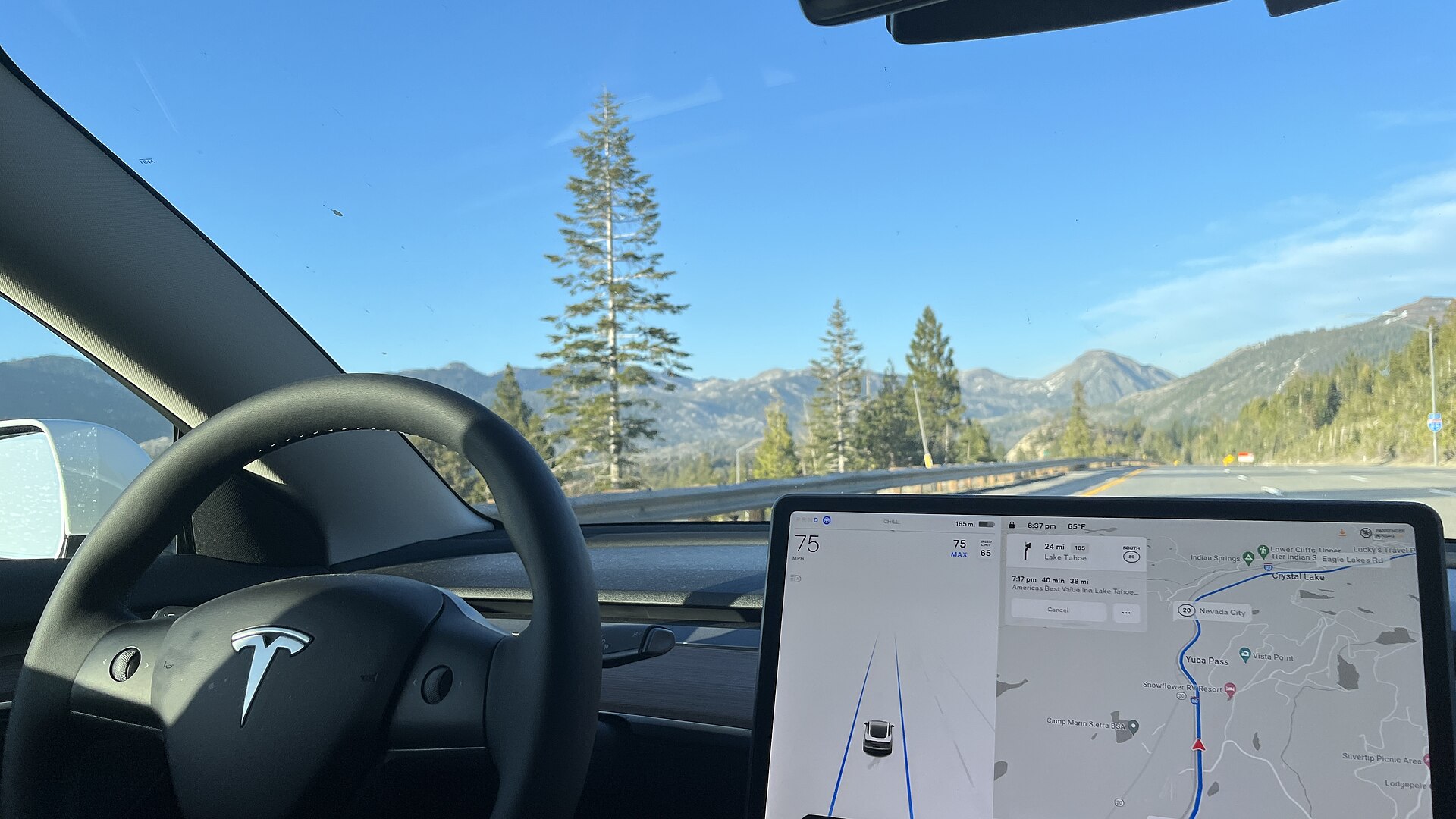
Image credit: “Tesla Autopilot engaged on I-80 near Lake Tahoe” by Natecation, licensed under CC BY-SA 4.0, via Wikimedia Commons.
About the author: Lifei Zhou
Model Y owner since 2022Ontario STO registered apprentice · 310SWorks on Porsche, Mercedes, BMW, Audi weeklyHundreds of readers referred (est.)
Lifei is a Tesla owner based in Canada, writing practical, fact-checked Tesla guides for US and Canadian drivers — buying, ownership, insurance, charging, and TSLA investing, all from first-hand experience.